Tracksuit Manufacturing
FashionMe manufactures custom and private label tracksuits in two ways: your branding on a tracksuit that is already in production (Stock Match), or a jacket and pants developed from your own design (Made to Order).
Stock Match
10 pieces minimum
7–10 days lead time
Made to Order
50 pieces minimum
7–12 days sampling
15–20 days production
Request a quote with a photo, a sketch or a tech pack.
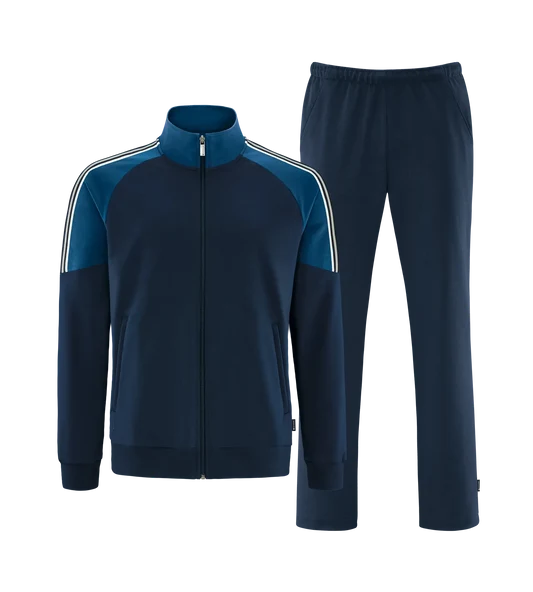
Stock Match or Made to Order
Stock Match
With Stock Match the patterns, fabric, colors, size range and construction stay as the factory makes them. Before packing, your woven or printed labels replace the factory labels ($0.35 a unit, with a minimum of 50 a style), and your hang tags ($0.25) and branded polybags, mailers or boxes ($0.45) are added.
Stock Match orders are inspected by pulling samples from the lot, and inspecting every unit instead is an add-on at $0.18 a unit.
Made to Order
Made to Order develops the jacket and pants from whatever you have, whether that’s a tech pack, a sketch, photos, a sample or a set of measurements. Pattern development and size grading are part of the service, and so are relabeling, branded packaging and 100% final inspection.
We can source the fabric and trims as a full package, or cut and sew fabric you supply (full package versus CMT).
The 10-piece and 50-piece minimums count complete sets, a jacket and a pair of pants, and sizes can be mixed within them. On Made to Order the minimum applies to each style in each color.
What a Custom Tracksuit Costs
Stock Match is priced as the factory’s invoice for the goods plus a sourcing fee on that invoice. The fee is 12% under $5,000, 9% from $5,000 to $20,000, 7% from $20,000 to $50,000 and 5% above that. Made to Order is quoted in two parts, pattern and sample development and then a per-unit price for production. Freight and duties are charged at cost on top of either (pricing page).
For a first Made to Order budget, the ranges below are what Chinese factories were asking for custom tracksuit sets, jacket and pants together, on B2B sourcing platforms in October 2026.
$10–28 a set, from plain styles at 300 sets or more up to custom color combinations at 50–100 sets.
$13–26 a set.
$12–25 a set.
$19–36 a set, with soft-shell styles at the top.
Listings that priced by quantity charged 8–17% less a set at 300 sets than at their minimum order, usually 50 sets, and 15–18% less at 600 or 1,000 sets.
Sample sets on the same platforms cost $30–150, with styles developed from scratch at the top of that range. Many factories credit the fee against a bulk order that reaches their minimum, sometimes only in part, and sending the sample by express courier adds $15–60.
Screen-print setup is paid once per design rather than per set, typically $15–45 per screen with one screen for each color. A four-color chest print at $25 a screen therefore carries $100 of setup, which comes to $2 a set on 50 sets and $0.20 on 500. Digitizing a logo for embroidery is a similar one-off charge of $10–75, and DTF transfers need no screens.
The largest part of the unit price is material: fabric for two garments, rib, a full-length zipper and any pocket zippers, elastic, drawcord, stripe tape or panel fabric, labels and packaging. Wide legs and long jackets take more fabric than slim cuts, and each pieced stripe, contrast panel or zip pocket adds cutting and sewing time.
A color dyed to your swatch weighs most on a small order, because knit mills commonly dye in lots of around 500 kg per color, about ten times the fabric in 50 tricot sets. Below the mill’s minimum, a custom color carries a small-lot surcharge, or the order moves to one of the mill’s stock colors. Printed stripe tape and molded zipper pullers can have supplier minimums of their own.
Main Fabric
Whether the shell is knit or woven decides how much ease the pattern needs, how the seams are sewn and whether the jacket needs a lining.
The classic track jacket fabric: a warp knit with a smooth, slightly shiny face that keeps its shape well through washing and wear.
A double knit with both faces smooth, widely used for teamwear and uniforms.
Sweatsuit-style sets use the same cloth as hoodies, with French terry zip styles at around 220–280 gsm and everyday sweatshirt fleece at around 280–350 gsm (fabric weights for hoodies).
Its cut pile lies in one direction, and every piece has to be cut facing the same way or one leg will look darker than the other.
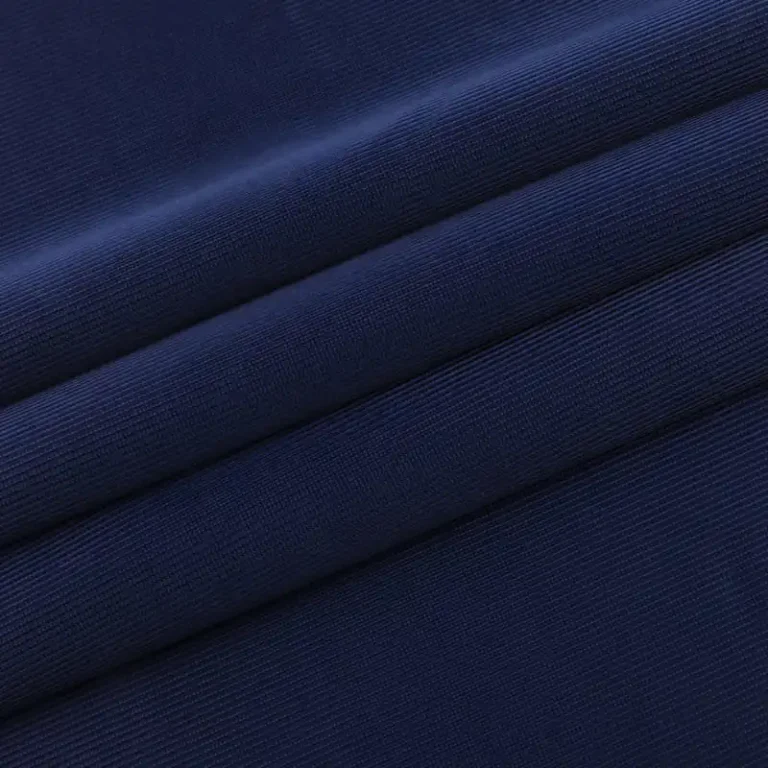
Each fabric is specified by fiber content, gsm, construction, stretch direction, color and finish. Mesh, lining, pocket bags, rib and contrast fabrics get their own lines on the bill of materials (BOM). Final approval is given on the bulk fabric itself, even if an early sample was made in something close.
Sampling
Made to Order sampling takes 7–12 days, with one or two rounds of revisions included. Nothing is cut in bulk until you’ve approved the sample, either from photos or from a garment shipped to you.
Fit comments are most useful when they come back as numbers. With a 54 cm half chest against a 56 cm target, the pattern room has a 2 cm gap to trace through the pattern and the sewing and correct in the next round.
Try the jacket and pants on together, since most tracksuit fit questions are about where the two meet. The usual ones are the jacket length against the waistband and the cuffs and hem band against the width of the leg.
The last sample before production is made in the bulk fabric, rib, zipper and trims, with the labels and artwork in place. That jacket and pair of pants become the reference for cutting, sewing and the final inspection.
Jacket Pattern
A full-zip track jacket is cut as two fronts, a back, two sleeves, a collar or hood, the pocket pieces and any contrast panels. Anything with rib or elastic is measured twice, relaxed and extended.
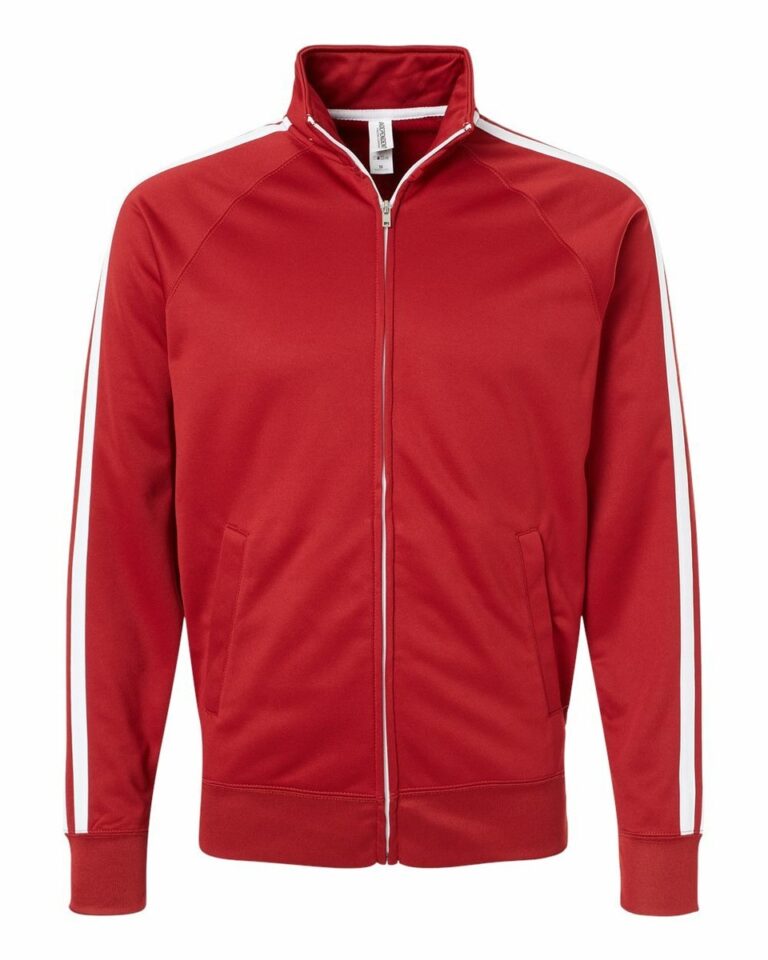
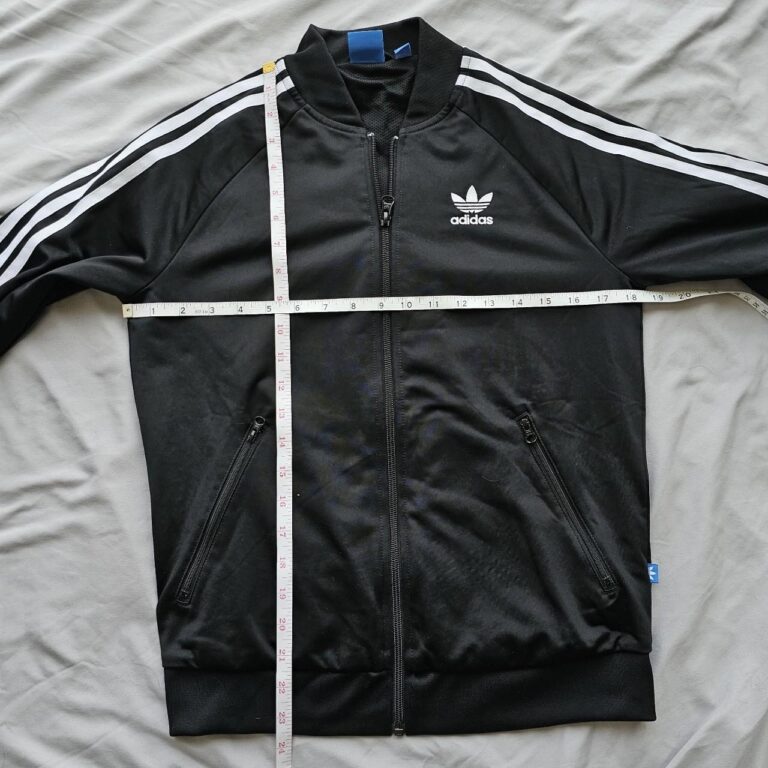
From the high point shoulder (HPS) to the finished hem. Some brands measure from the center back neck instead, and the spec says which.
Straight across, 2.5 cm below the armhole.
Seam to seam across the back on set-in and dropped shoulders. A raglan jacket has no shoulder seam, so this line is left off.
Set-in sleeves from the shoulder seam to the cuff edge. Raglan sleeves from the center back neck, over the shoulder to the cuff edge.
Relaxed, and extended where the cuff is rib or elastic, so a hand still passes through.
Measured once the hem, band or elastic is finished, and extended as well on a banded hem.
Center-Front Zipper
A full-zip jacket takes an open-end, or separating, zipper, usually a #3 or #5 nylon coil or a molded plastic zipper, cut to the length of the finished front opening. Its supplier article, tape color, slider and puller go on the BOM, and the tape is matched to the shell along with the rib and drawcord.
On a knit jacket the front can ripple along the zipper. The knit stretches slightly as it feeds through the machine and the zipper tape doesn’t, so the front comes out a little longer than the zipper. Fusible stay tape along the front edges and setting the zipper without pulling the fabric keep it flat.
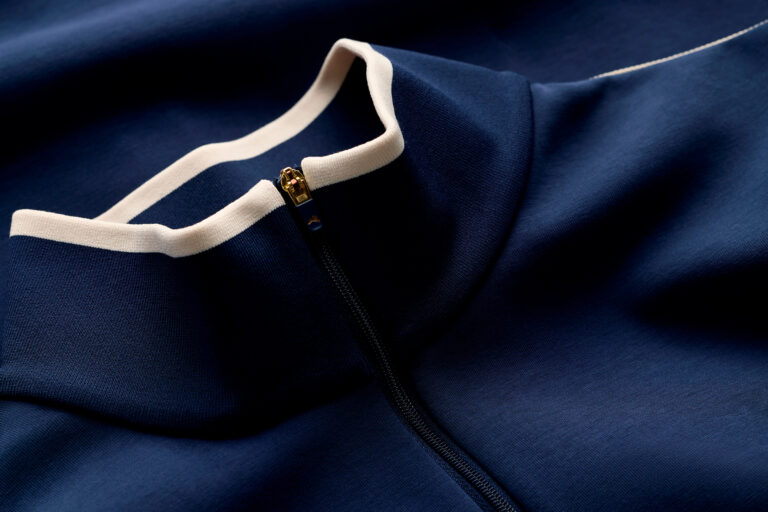
Cuffs, Hem and Collar
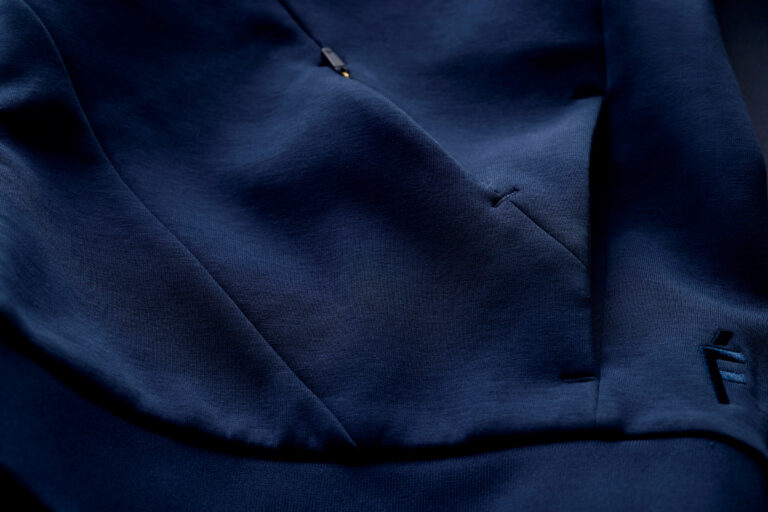
Rib cuffs and a rib hem band finish most track jackets, and the rib is its own article on the BOM, dyed to match the shell. Because it stretches and recovers differently from the shell, the cuff and band openings are taken from the approved sample.
Without a rib band, the bottom is finished as a plain turned hem, an elasticated hem or a drawcord channel, and the bottom opening is measured on whichever one the spec calls for.
The collar is either a stand collar, in the shell fabric or in rib, or a hood. A stand collar in the shell is often interfaced so it stands up. When the zipper runs to the top, a small fold of fabric called a zipper garage keeps the pull off the chin.
Track Pants Pattern
Relaxed and fully extended. The extended figure confirms the waistband stretches far enough to pass over the hips.
From the crotch seam intersection to the top of the waistband, at center front and center back (how rise is measured).
Measured straight across, commonly 18–20 cm below the top of the waistband.
One leg, straight across, 2.5 cm below the crotch.
At a set drop below the crotch, for example 33 cm on the base size, with the drop changing along with the inseam from size to size.
From the crotch point to the finished hem, along the inside leg seam.
Across the finished hem, and extended too when the ankle is rib or elastic.
Leg shape
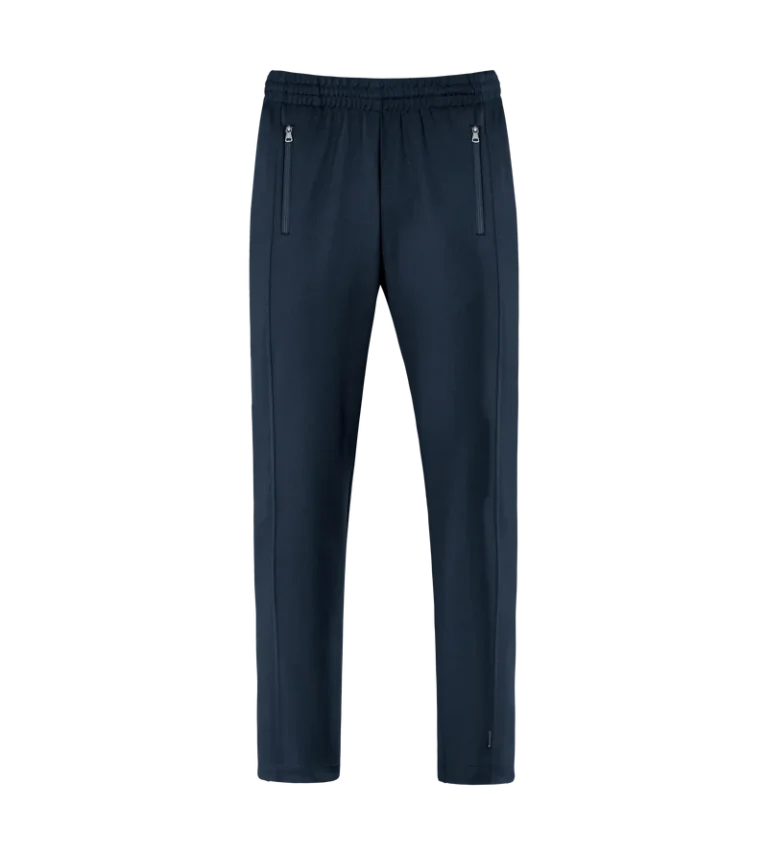
Tapered track pants finish in a rib cuff, an elastic hem or an ankle zip to get the foot through the narrow ankle, and the choice goes on the spec next to the leg opening.
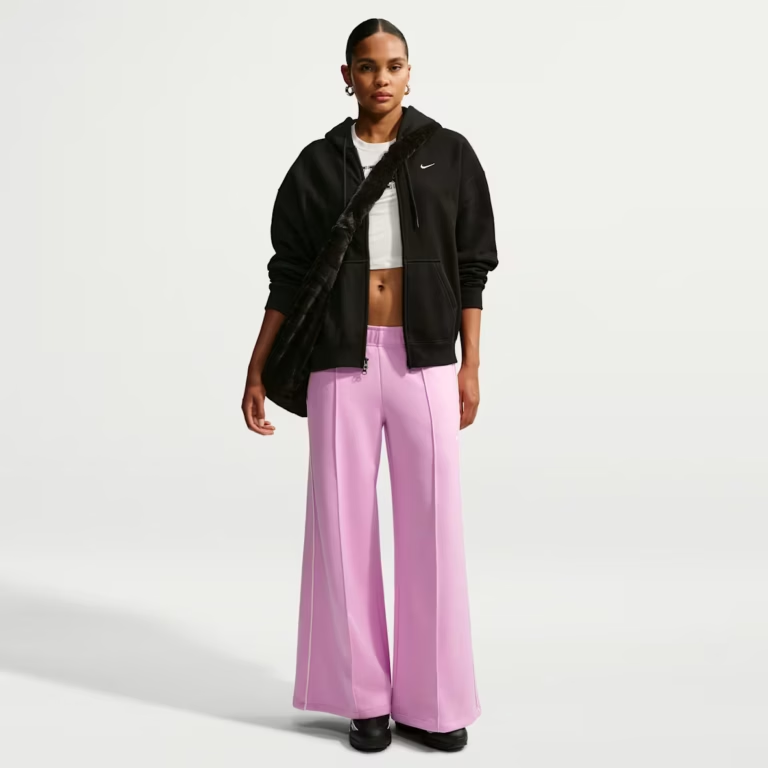
Wide and flared legs take more fabric below the knee, and a flare is shaped from a set knee point down to the hem. Each size gets its own thigh, knee and leg-opening targets to keep the leg the same shape across the size range.
Elastic Waistband and Drawcord
For an elastic waist, the BOM gives the elastic article, its width and its cut length, and the spec gives the waistband height and the relaxed and extended waist. Elastic cut too short gathers the waistband hard and may stop it reaching the extended measurement. The opposite mistake shows later, when an over-long elastic relaxes in the wash and the waist sits loose.
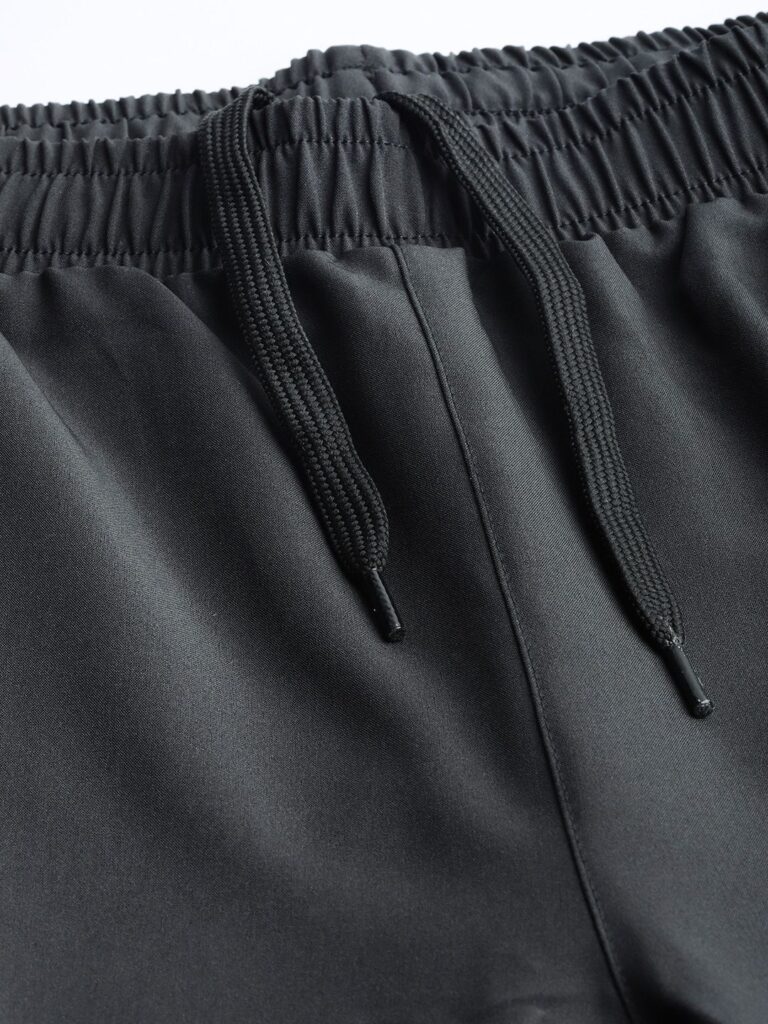
Inside the waistband the elastic is either enclosed in a channel or stitched through with several rows so it can’t roll or twist. The drawcord exits at center front through eyelets or buttonholes, its ends knotted, tipped or capped.
Side Stripes and Contrast Panels
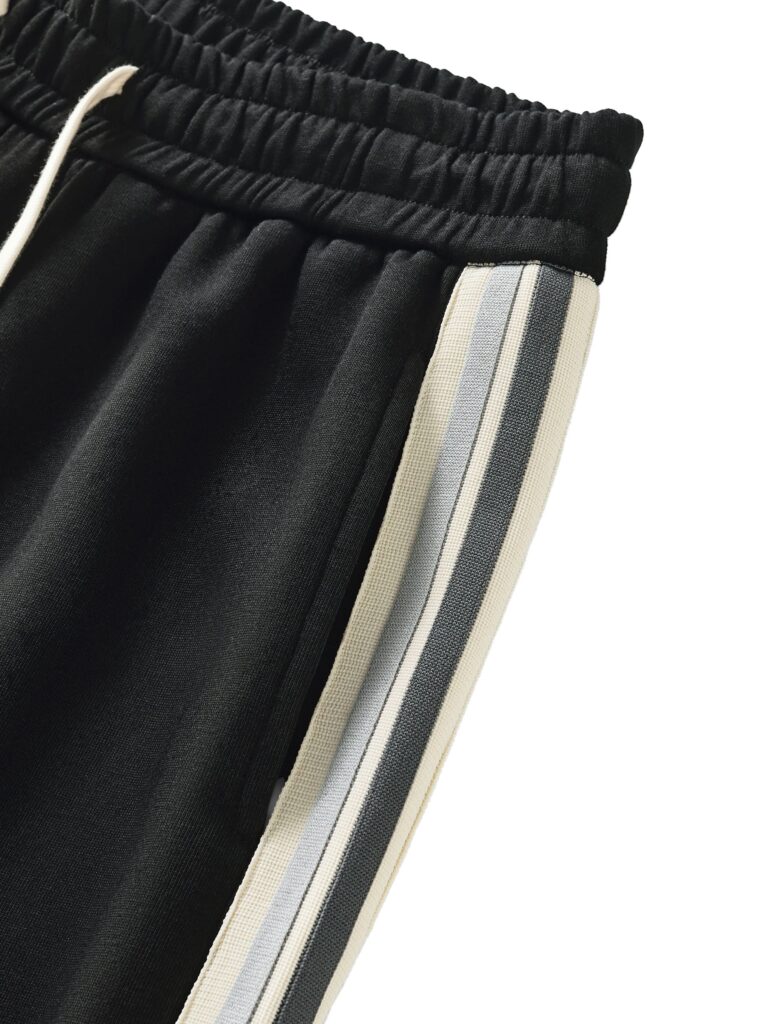
Pieced stripe
The stripe is a pattern piece of its own, sewn into the side seam. Its finished width, seam allowance, start and end points and any taper are on the pattern, and it’s graded with the leg.
Applied tape
An applied tape is stitched on top of the shell, and the file gives its article, width and color, its distance from the side seam and both end points. On a multi-stripe tape it also gives the spacing between stripes, and the left and right legs are set from the same references.
Tape and shell rarely shrink by the same amount, and after a wash the difference shows up as puckering or rippling along the stripe. Washing a taped sample leg before bulk finds it early, and pre-shrunk tape, or a knit tape that stretches with the shell, prevents it.
Stripe layouts and logos on the order need to be your own or licensed. Three parallel stripes down the sleeve and leg are an adidas trademark in many countries, and goods that copy another brand’s stripes can be held at customs.
Contrast panels
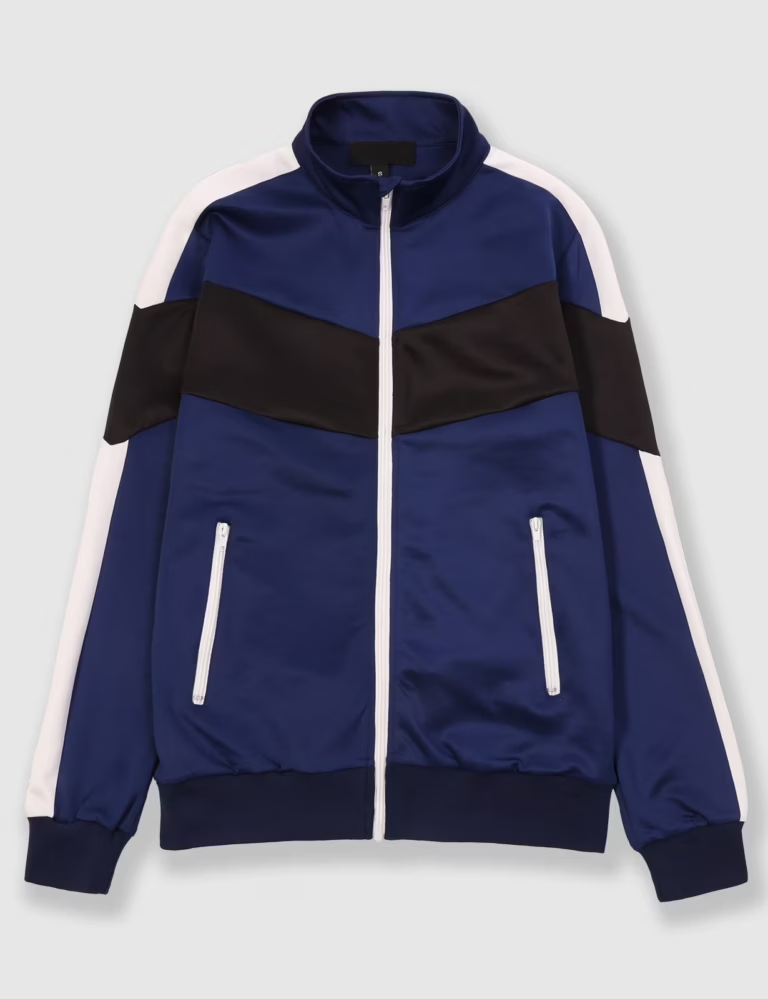
Contrast shoulder, sleeve and side panels are separate pattern pieces, and a panel in a different fabric gets its own line on the BOM. When a panel has to keep its proportion across the sizes, its width and shape are graded with the garment.
Color-blocked sets are most likely to go wrong where a dark panel meets a light one, because a navy or red panel can bleed into the white next to it in the wash. Colorfastness-to-washing results for the panel fabrics (ISO 105-C06 or AATCC 61) and a washed sample with the panels sewn in will show it before bulk.
Pockets
Jacket pockets
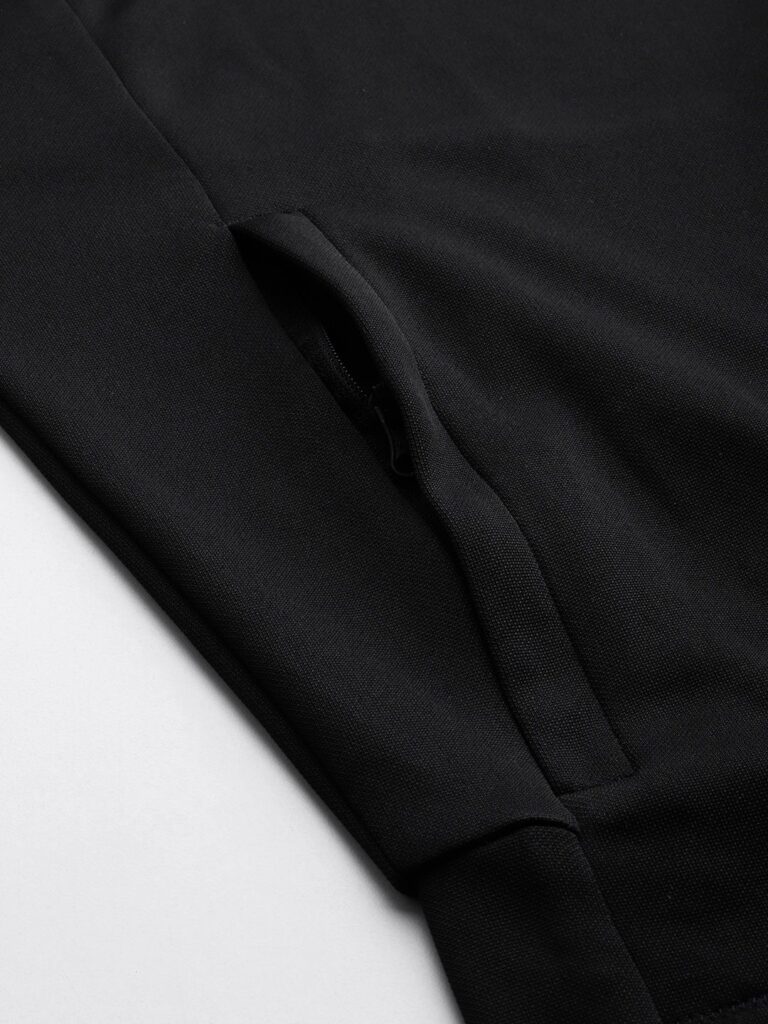
Track jacket pockets are usually welt or zip pockets set into the side front or into a panel seam. The spec records the finished opening and its position from center front, the side seam and the hem, plus the zipper article and length on a zip pocket.
The pocket bag is cut separately, often from mesh or a lighter knit so it doesn’t add weight or show through the front.
Pants pockets
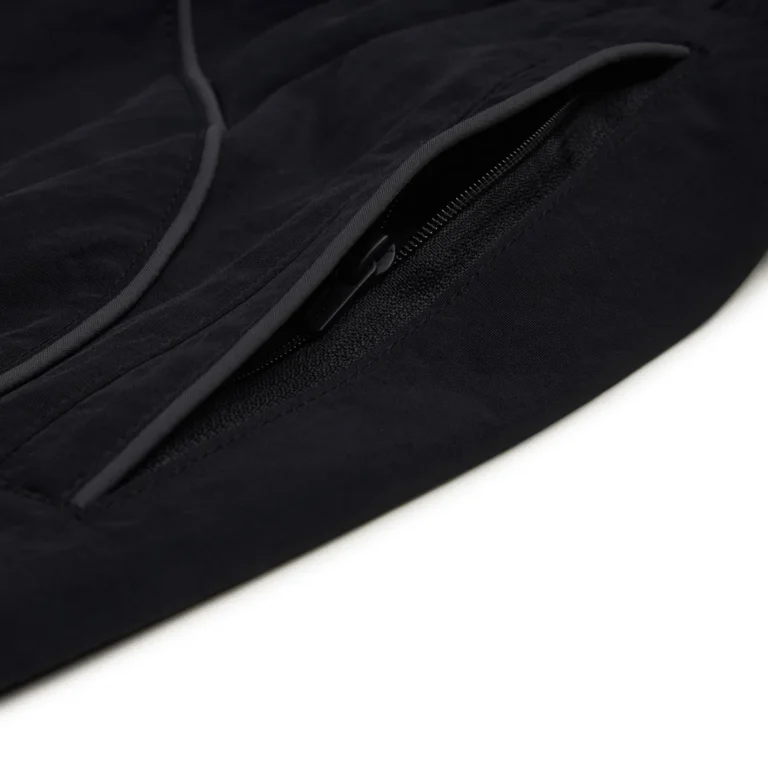
Pants pockets are placed from the waistband and the side seam, and the spec gives the opening length and position, the shape and depth of the bag and any zipper or snap. A bag around 18–20 cm deep holds a phone without letting it slide out when the wearer sits down. Back and cargo pockets are cut as separate pieces with measurements of their own.
Logo, Print and Embroidery
A chest logo is positioned on the finished garment from center front and the high point shoulder, and a thigh logo from the waistband and the side seam. Back prints work from center back and the neck seam. The artwork file gives the version, finished width and height, colors and method, which can be screen printing, DTF, flat embroidery or 3D puff embroidery.
The disperse dyes in dark polyester can migrate into a light print during curing and turn white ink pink or grey. Prints on dark polyester therefore use a low-bleed ink or a blocker base, cured at a lower temperature. On thin tricot or interlock, embroidery needs a cut-away backing, or the fabric puckers around the logo.
Grading and the Size Set
Once the base size is approved, both patterns are graded across your size range, most often XS or S to 3XL, with 4XL to 6XL or XXS added on request. Grading moves chest, length, shoulder, sleeve, cuff and bottom opening on the jacket and waist, hip, both rises, thigh, knee, inseam and leg opening on the pants. Pocket, stripe and panel positions move with the grade, the artwork placement is checked on the graded sizes, and the zipper lengthens with each size’s front opening.
Each size has its own target measurements and tolerances, since approving the size M doesn’t prove the XS or the 3XL. A size set, one sample in each size, shows before cutting whether a wide shoulder or a stripe position still works at the ends of the range.
Cutting
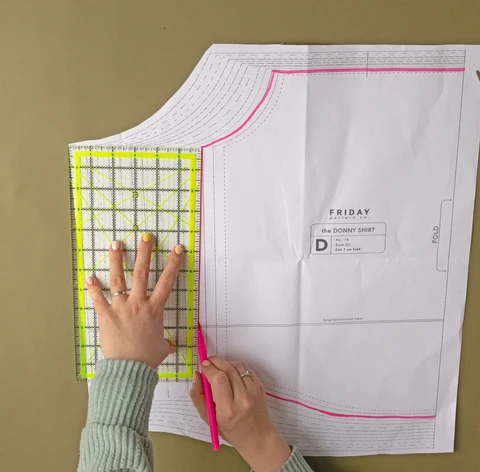
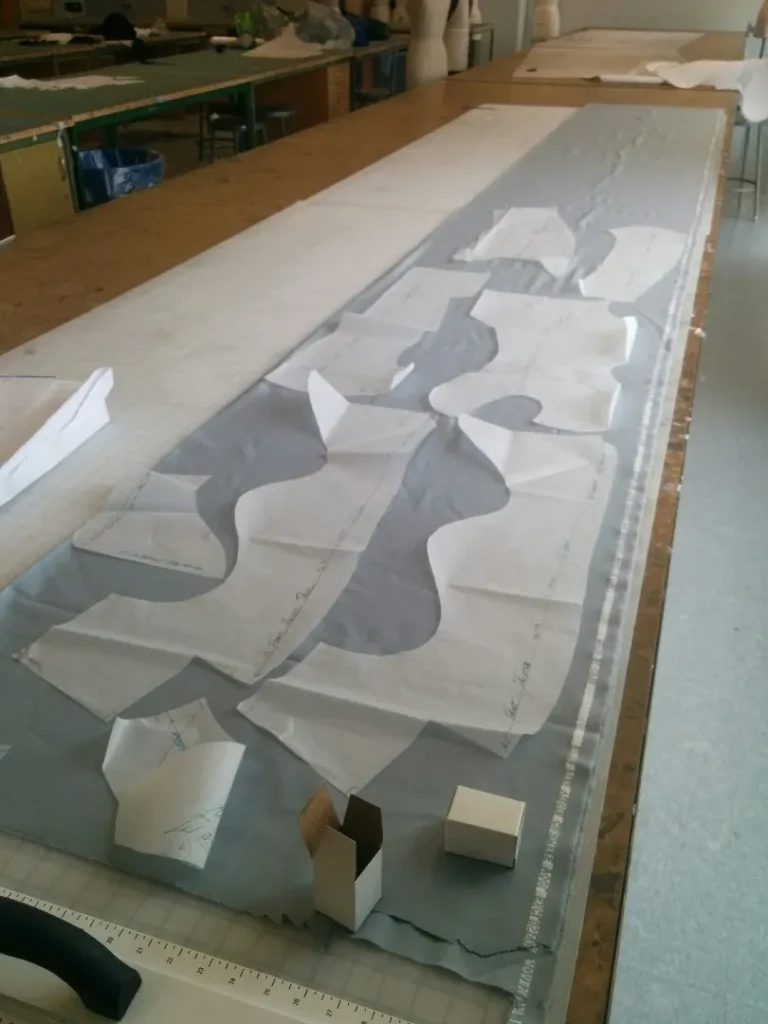
The cutting ticket lists the jacket and pants pattern revisions, the quantity per size, the shell article, contrast fabrics, rib, stripe pieces and pocket parts. A revised pattern replaces the old one before the cutting layout, the marker, is released.
Each set’s jacket and pants are cut from the same roll, because rolls from different dye lots can differ slightly in shade and the difference is easiest to see on two garments worn together. Pile fabrics such as velour need a one-way layout, which takes more fabric than a knit without a direction.
Sewing
Knit tracksuits
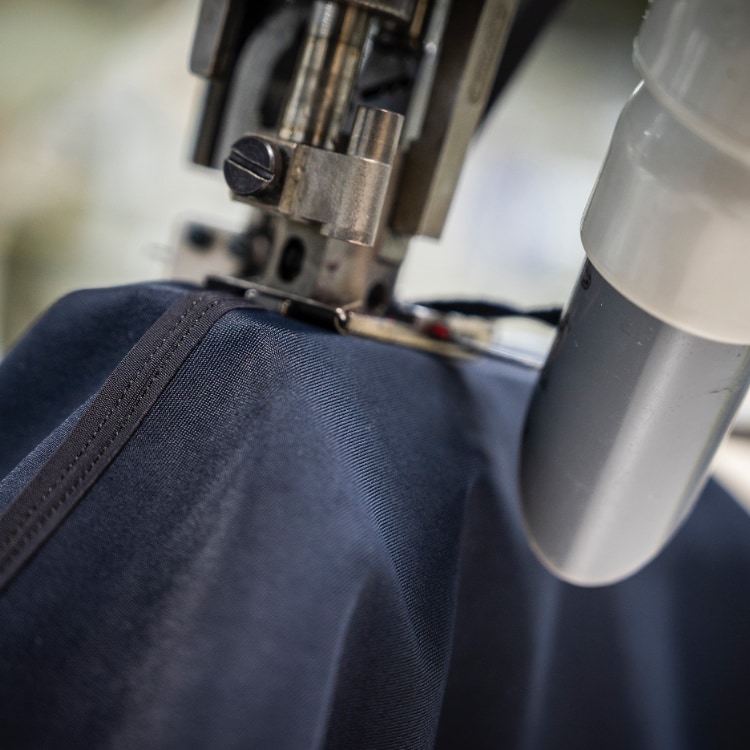
On a knit tracksuit the seams are sewn on a four-thread overlock (stitch type 514), which stretches with the fabric. Hems and topstitching use a two-needle coverstitch (406), and the zipper and pocket openings are set with a lockstitch (301).
Woven tracksuits
A woven shell is lockstitched (301), with the allowances overlocked or enclosed by a mesh lining. Woven nylon has no give, so seams that take strain, such as the crotch and underarm, are often double-stitched or taped.
Washing and Finished Measurements
A tracksuit that’s washed, garment-dyed or given any other size-changing finish is measured after that process, and its stripe tape, rib and panel fabrics go through the same wash test as the shell.
If the shell shrinks 3% in length, a 68 cm jacket body loses about 2 cm and an 80 cm inseam about 2.4 cm, while rib cuffs and waistband elastic shrink at rates of their own. Each garment is measured after washing and corrected in its own pattern, with a waist change going into the waistband or the top of the pants block.
Final Inspection
Every Made to Order jacket is measured against its spec and has its zipper run from end to end. It fails on fronts that don’t meet level at the collar and hem, stripes or panels that don’t line up across the opening, a sticking zipper, a damaged slider or the wrong zipper length.
The pants are measured at the waist, relaxed and extended, and at both rises, hip, thigh, knee, inseam and leg opening. Twisted elastic, broken channel stitching, a drawcord that exits off center or damaged eyelets fail them. On both garments, pockets are checked as separate parts, and prints and embroidery for position, size and color against the approved sample.
Then the jacket and pants are laid side by side and checked as a set:
- style and size pairing
- shell shade
- rib and zipper tape
- drawcord and side tape
- contrast panels
- artwork and labels
A pair that visibly differs in shade isn’t packed as a set, and you review the finished goods before they ship. For one streetwear label, moving to factory-side 100% inspection took the defect rate on delivered goods from more than 4% to 0.4% over three production runs (case study).
Shipping
We arrange delivery from China, and the door-to-door transit times below are typical for 2026.
To the US
3–6 days by express courier
5–8 days by air freight
18–30 days by full container to the West Coast
30–45 days by full container to the East Coast
22–45 days by shared container
To Germany
2–5 days by express courier
8–12 days by air freight
16–24 days by rail
33–45 days by full container
38–50 days by shared container
Freight rates to the US in 2026 ran $5–10 a kg by express, $3.50–7 a kg by air freight and $40–80 per cubic meter by shared container. Express is the usual choice for samples and small Stock Match orders. A few hundred tracksuits fill only a small part of a container, so most orders that go by sea travel in a shared container (LCL).
Counting 7–12 days of sampling and 15–20 days of production, a Made to Order tracksuit reaches the US 4–6 weeks after sampling starts when it goes by air, or 6–11 weeks by shared container. Neither figure includes the days the sample spends reaching you or the time you take to approve it. A Stock Match order sent to the US by express arrives 10–16 days after it’s confirmed.
Request a Tracksuit Quote
A quote starts with one to six files, which can be photos, videos, sketches or a tech pack, and a tiered quote comes back within 24 hours. One reference photo is enough for Stock Match.
Made to Order quotes get more precise with the size range, the quantity per size and color, the fabric if you have one in mind, and any stripes, panels, prints or embroidery.