Double Needle Stitching Versus Single Needle
Two parallel stitch rows on a garment can come from several sewing operations. A two-needle lockstitch machine can produce the pair during one pass. The same appearance can also be made by sewing the area twice on a single-needle machine. On jersey T-shirts, two straight rows across the hem often belong to a coverseam, with looper thread running across the reverse.
Those differences matter once the style enters production. The machine setup controls how the row spacing is held, how the sewing behaves through a corner, what happens when one needle reaches a thicker fabric stack, how much stretch remains in a knit hem, and how much work is involved when a visible topstitch row has to be repaired.
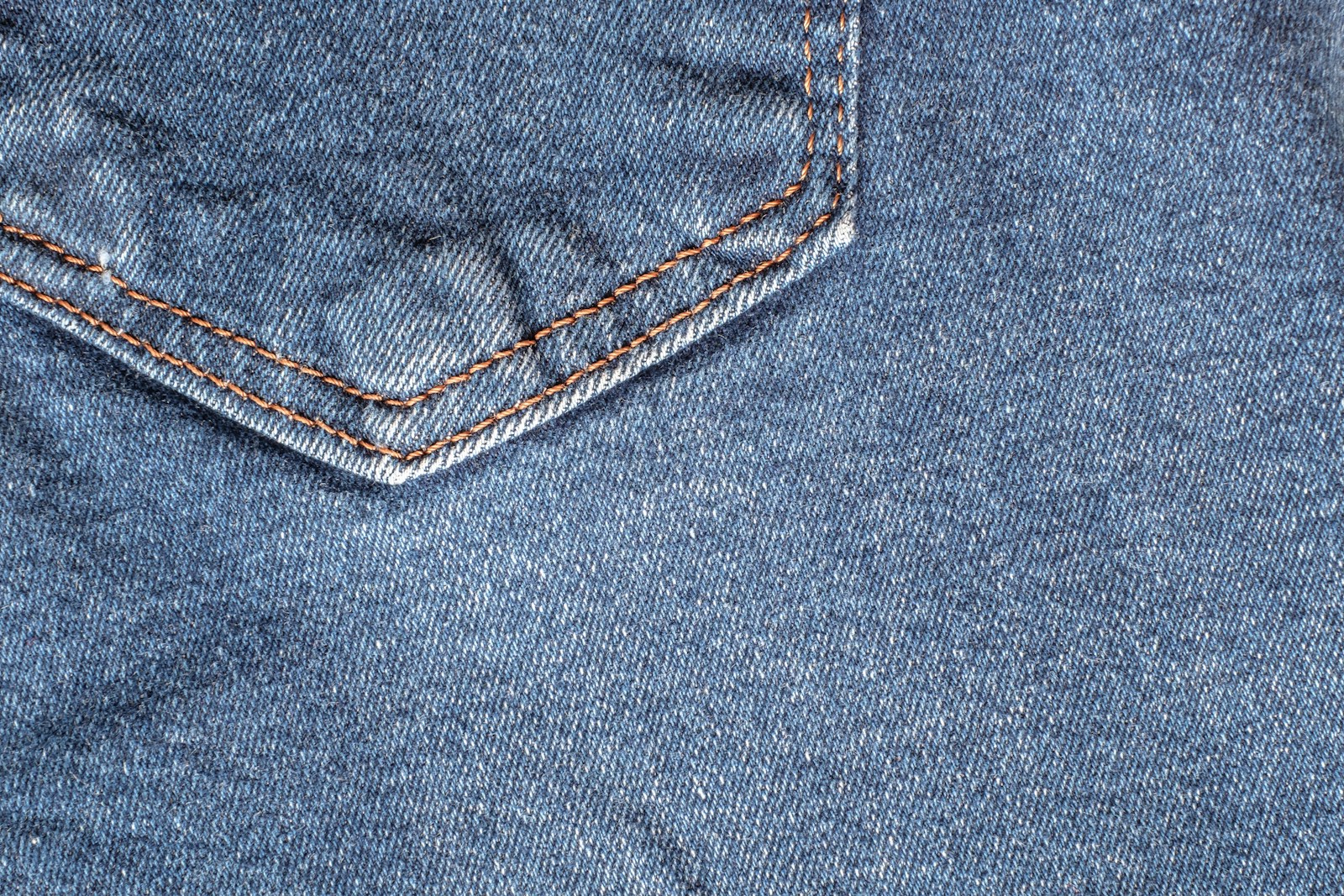
What the Two Rows Actually Tell You
The common industrial single-needle lockstitch is stitch type 301. One needle carries the upper thread through the material and interlocks it with bobbin thread below. One trip through the machine produces one stitch row.
A second 301 row can be added in another operation. The operator finishes the first line, positions the garment again and sews the next path. The two finished rows may look very regular, especially when an edge guide or dedicated presser foot controls the second pass.
Two-needle lockstitch equipment forms the pair differently. Two needle positions are installed at a defined gauge, and both stitch rows are created during the same feed movement.
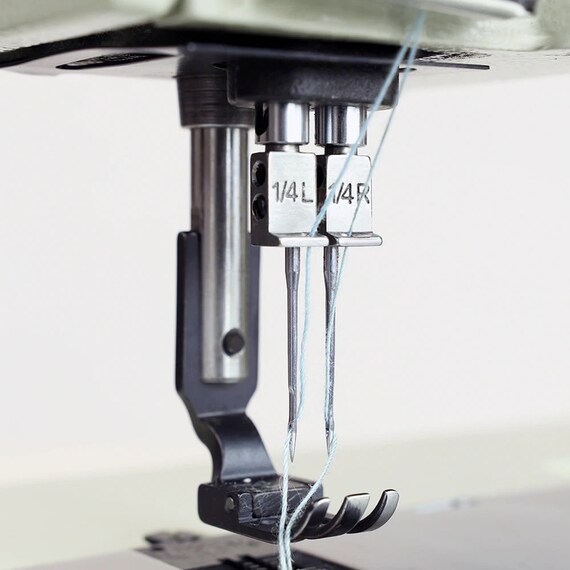
A&E’s denim stitch matrix gives 8 stitches per inch as a typical reference for several denim operations and lists 1/4-inch needle spacing for twin-needle lockstitch. One quarter inch is 6.35 mm measured from needle centre to needle centre.
The visible pair therefore tells you very little about how many times the component went through a sewing machine.
A Jeans Back Pocket Is More Useful Than a Flat Test Strip
A back pocket has long edges, lower corners and folded areas near the opening. Those changes make the sewing method easier to understand.
With separate passes, the first row can follow the pocket edge on its own path. The operator can stop at a corner, reposition the component and continue through the new direction. The second row is added afterward, so its route can change slightly where the design requires it. Some styles narrow the space between the rows through a corner; others end one decorative line before a bartack or pocket opening.
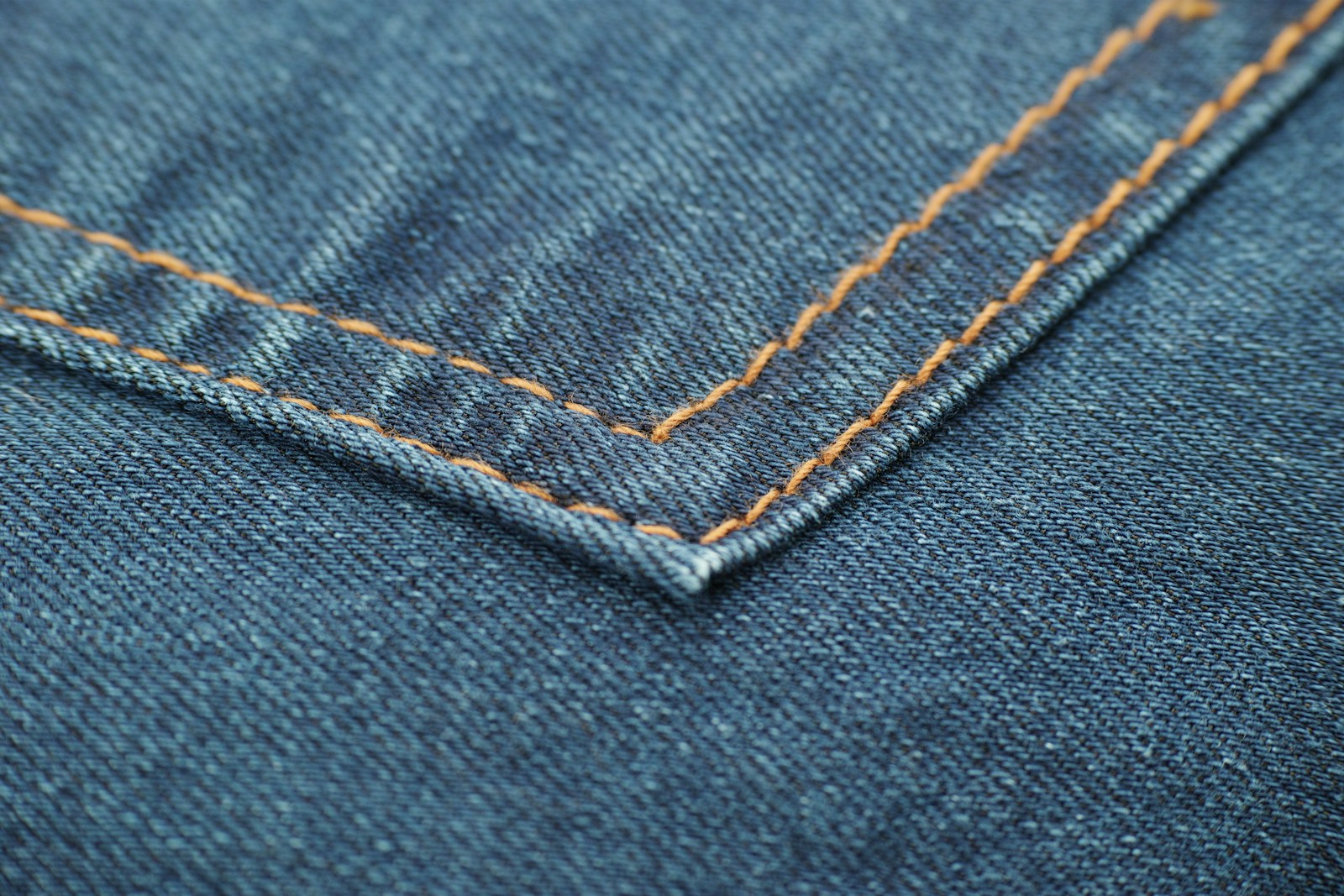
The long sections demand more control. A second row intended to remain 6 mm from the first has to hold that distance over the entire edge. Small changes in hand pressure, fabric rotation or the position of a guide can show up immediately when tan or cream thread is sewn over dark indigo denim.
Fixed-gauge two-needle equipment removes most of that row-to-row positioning work on stable sections. Both needles travel together. The operator still has to place the pair correctly on the pocket.
That last point matters during inspection. Two stitch rows can remain perfectly parallel and still sit too far from the finished edge.
What 6.35 mm Actually Controls
Consider a pocket callout with these dimensions:
Outer stitch row: 3 mm from finished edge
Row spacing: 6.35 mm centre to centre
The 3 mm measurement establishes where the stitching sits on the pocket. The 6.35 mm measurement controls the space between the two lines.
A machine can maintain an exact 6.35 mm gauge while the complete pair travels 2 mm too far inward. With two separately sewn rows, the outer line may remain at the correct 3 mm position and the inner row can gradually drift.
A tech sketch showing two parallel lines does not supply either dimension.
A Real Watch-Pocket Operation Uses More Than a Needle Count
Coats publishes a denim application example for attaching a watch pocket with 301 × 2 stitching. The setup includes:
Stitch density: 10–12 stitches per 3 cm
Approximate equivalent: 8.5–10.2 SPI
Needle thread: Tex 105
Lower thread: Tex 40
Needles: Nm 125–140
That is a much more useful production description than “double needle topstitch.”
Tex 105 is a substantial upper thread. The lower thread in this example is finer at Tex 40. The needles are also considerably larger than those used for lightweight jersey sewing.
The figures describe a published denim application rather than a universal setting. A lighter denim, finer decorative thread or different pocket construction can require another combination.
Stitch Density Changes the Surface Quickly
At 8 SPI, the feed distance per stitch is approximately 3.18 mm.
At 10 SPI, it is 2.54 mm.
At 12 SPI, each stitch covers roughly 2.12 mm.
Those differences are easy to see on heavy contrast topstitching. Eight SPI exposes longer sections of thread across the denim surface. Increasing the stitch density produces a tighter-looking row and puts more needle penetrations into the same seam length.
A&E’s 8 SPI denim reference and the Coats watch-pocket range of 10–12 stitches per 3 cm sit close enough to show how real factory settings can vary without one of them being “wrong.” The final value belongs to the style, thread, material and approved sample.
Long Seams Explain Why Factories Use Two-Needle Machines
Take a straight 500 mm panel seam that needs two parallel rows.
Two separate single-needle passes involve approximately 1,000 mm of sewing travel. The garment also has to be picked up, aligned and placed for the second operation.
Two needles producing both lines together travel the 500 mm seam once.
That does not mean production time is automatically reduced by 50 percent. A real sewing cycle includes acceleration, deceleration, trimming, handling, alignment, corners, bobbin changes and delays at bulky intersections. The 500 mm example only shows the difference in sewing travel.
The handling saved on one garment may be small. Repeating the same operation through several thousand workwear jackets changes its importance.
Maximum Machine Speed Is a Different Number
JUKI’s LH-3588A two-needle lockstitch machine for jeans and heavyweight materials has a published maximum sewing speed of 3,000 stitches per minute and a maximum stitch length of 5 mm.
A heavy-material version of JUKI’s DDL-9000C single-needle line can run at a higher maximum machine speed under appropriate settings.
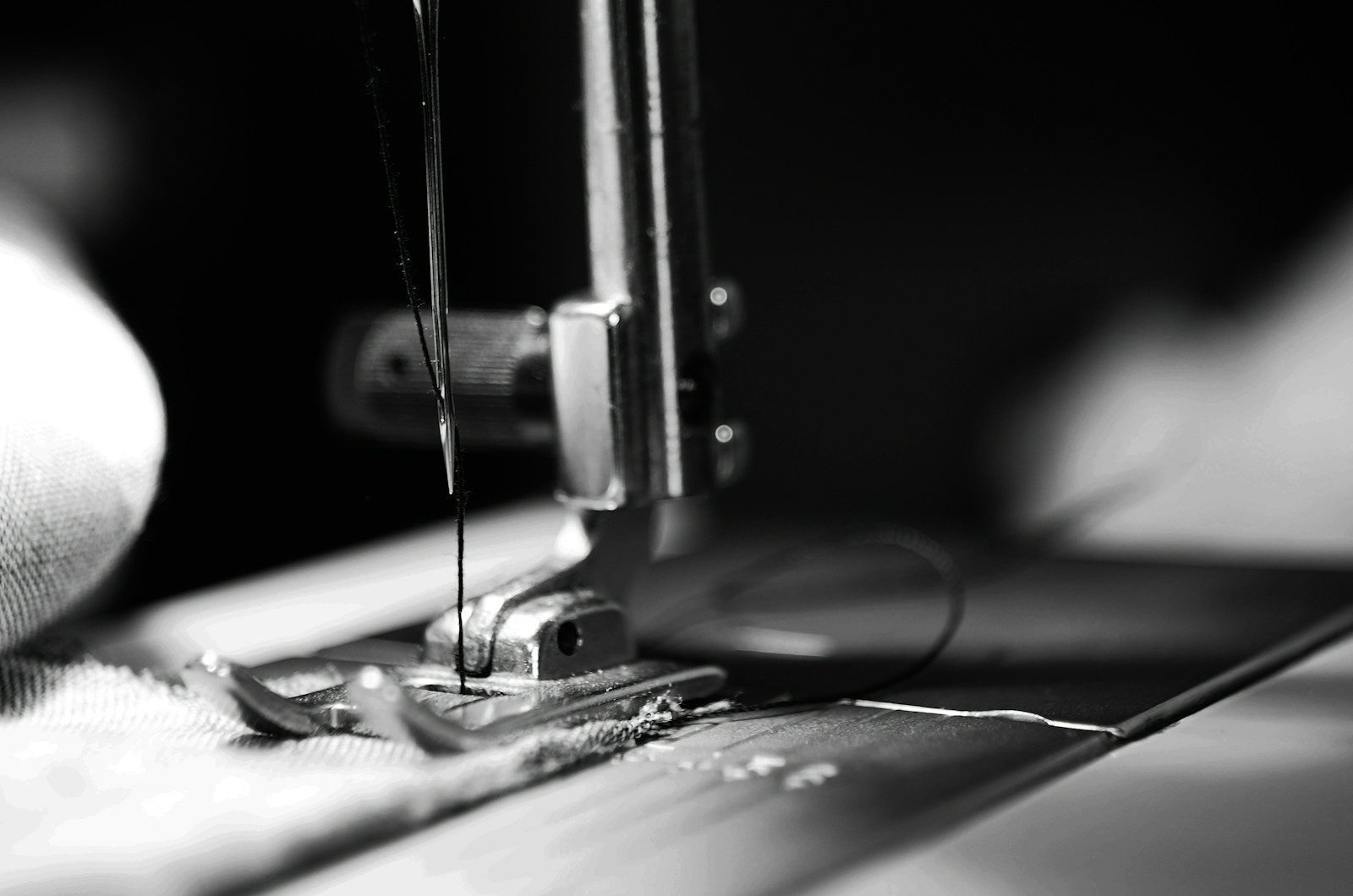
Machine speed alone does not establish which operation finishes a pair of stitch rows faster. A single-needle station producing two rows has another sewing path to complete. Actual garment output depends on the complete operation around the machine.
This distinction is useful when comparing factory quotations. A faster motor specification does not remove a second pass through the sewing station.
Tight Curves Change What the Needles Have to Do
Two fixed stitch rows travelling around a curve do not cover the same distance. The line farther from the centre follows the larger arc.
A broad curve generally gives the fabric enough room to move through the operation cleanly. Tight pocket corners make the geometry more noticeable, especially with firm denim and wider gauges.
Separate passes give the operator control over each route. Industrial two-needle machinery can also be configured for more complicated work. JUKI offers organised split-needle-bar versions within its heavy two-needle range, allowing the machine arrangement to deal with corner-stitching operations differently from a basic fixed-pair setup.
The exact machine on the factory floor therefore matters when a style contains difficult corners.
The Two Rows on a T-Shirt Hem Belong to Another Stitch Family
A jersey T-shirt hem often shows two straight rows on the outside. Turn the garment inside out and the sewing structure usually changes completely.
A common construction is 406 two-needle coverseam. Two needle threads create the visible rows, and a looper thread spreads underneath the folded hem.
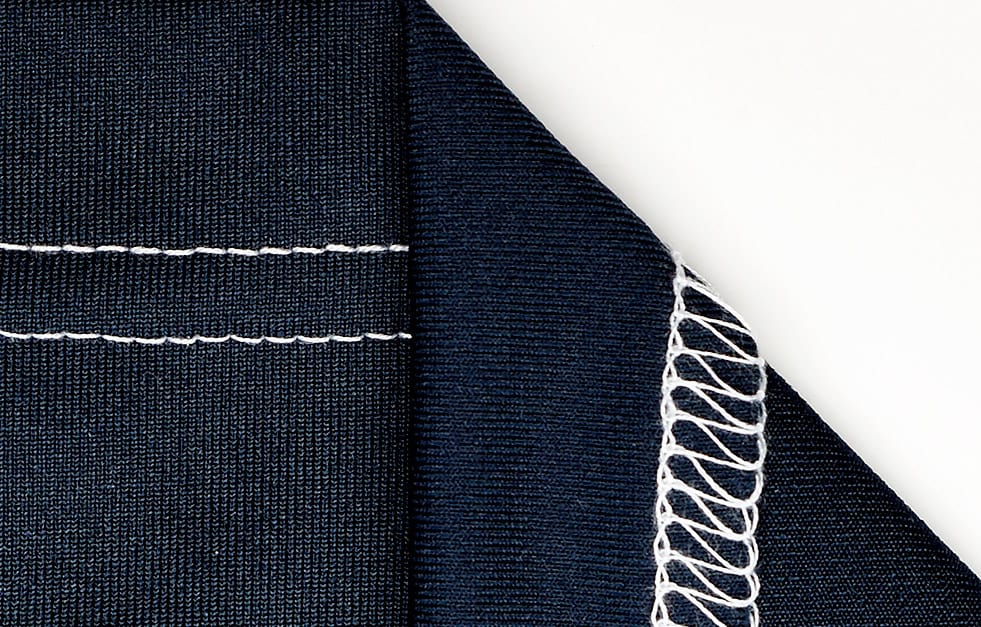
The extra thread path underneath is important because a knit opening has to extend. A fitted T-shirt can stretch considerably when it moves over the shoulders, chest or hips. The seam has to tolerate enough of that movement for the garment to be worn repeatedly without popped stitches.
Coats’ T-shirt application data gives a 406 example using:
Stitch density: 14–18 stitches per 3 cm
Approximate equivalent: 11.9–15.2 SPI
Needle thread: Tex 27
Looper thread: Tex 18
Needles: Nm 75–90
These numbers are far lighter than the denim watch-pocket setup described earlier because the operation is being performed on a different material for a different purpose.
A production callout for an actual T-shirt might specify:
Stitch: 406 two-needle coverseam
Needle gauge: 6 mm
Finished hem depth: 20 mm
The 6 mm gauge and 20 mm hem depth are style dimensions. Another T-shirt can legitimately use different values.
“Double Needle Hem” Leaves Too Much Unsaid
The words describe the front appearance but omit the stitch type, gauge and fold depth.
That can create problems when a style moves from one supplier to another. A factory holding an approved sample can turn the garment over and identify the construction. A supplier working from a sketch alone has to make assumptions.
The problem becomes more serious on stretch fabric. Two rows of 301 lockstitch can look clean while the garment is lying flat, yet the threads may reach their extension limit before the jersey reaches its normal stretch.
The sample needs to be checked under the extension expected at that opening.
One Needle Can Also Produce Chainstitch
Stitch type 401 uses one needle and a looper system. Its reverse side has the characteristic chain formation rather than the lower-thread appearance of 301 lockstitch.
The seam also has different elongation characteristics.
For this reason, a production sheet that requires a particular construction should say 301 lockstitch or 401 chainstitch instead of relying on the words “single needle.”
Thick Denim Changes the Operation at the Exact Point Most Visible to the Buyer
A flat two-ply denim test is easy sewing. A waistband intersection is not.
At a bulky junction, one needle in a two-needle machine may pass through more material than the other. Folded seam allowances, pocket edges and intersecting construction seams can create a thick stack under only part of the presser foot.
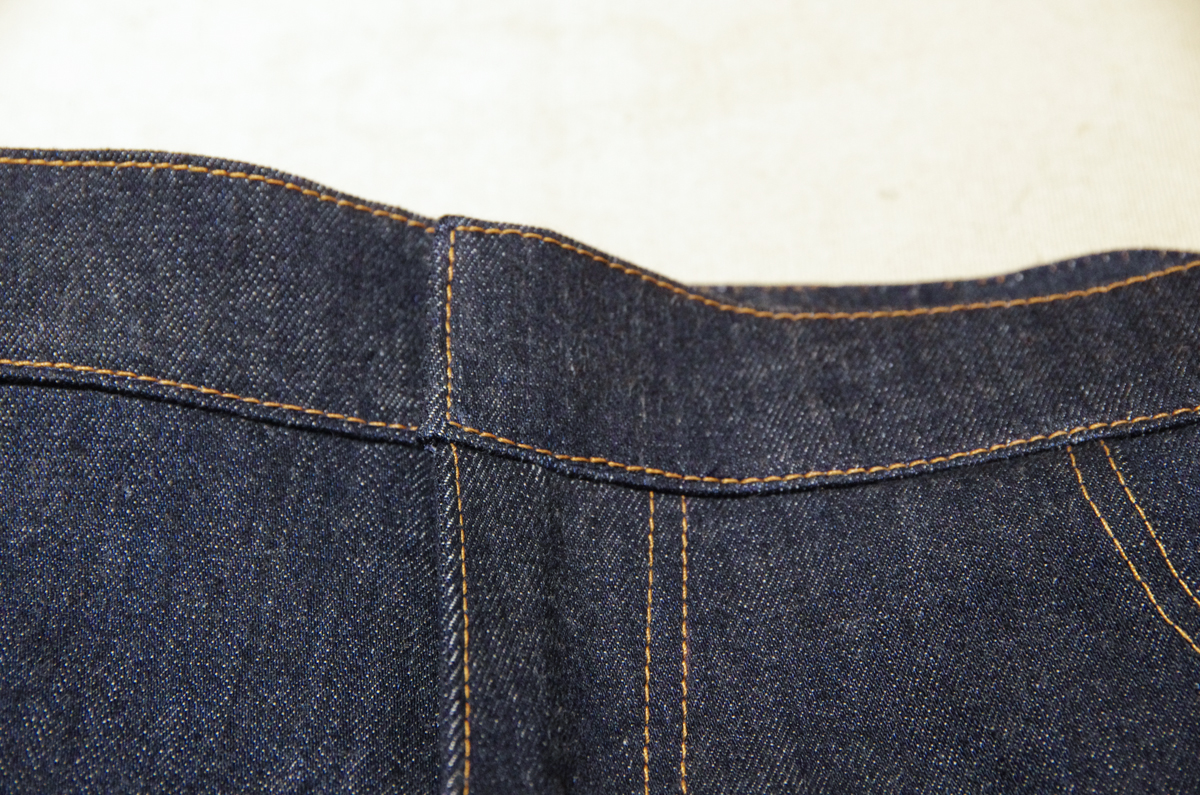
The foot rises as it reaches the junction. Effective feeding may shorten over several stitches. The needle entering the thicker side can deflect from its normal path, increasing the chance of an incomplete stitch or skipped penetration. Thread tension can also shift as the thread is pulled through a greater amount of material.
Contrast topstitching makes those changes visible. A short stitch at a waistband join stands out against a regular row that has run cleanly for several hundred millimetres.
The JUKI LH-3588A gives a useful sense of scale for heavyweight machinery. Its specifications include 7 mm presser-foot lift by hand, 13 mm by knee, and a DP×5 #16–#23 needle range.
The 13 mm lift is clearance. It does not guarantee that every compressed 13 mm seam stack will feed and sew correctly.
A production sample should include the actual thickest junction made from the intended fabric, seam allowances and thread.
Thread Size Changes the Needle Requirement
The Coats watch-pocket example uses Tex 105 upper thread with Nm 125–140 needles.
The T-shirt coverseam reference uses Tex 27 needle thread with Nm 75–90 needles.
A heavier thread needs enough room to pass through the needle eye and through the hole created in the fabric. Insufficient clearance increases friction and can damage the thread during sewing.
Moving to a larger needle creates more space and a larger penetration hole. Dense twill, coated fabrics and compact synthetic materials can retain those holes clearly after a seam has been removed.
That becomes important during visible repairs.
Two Rows Do Not Give a Fixed Strength Percentage
A second stitch row does not automatically double seam strength.
Some topstitching sits beside the construction that carries most of the load. Elsewhere, both rows pass through the joined garment plies and contribute directly when the seam is stressed.
Fabric failure also has to be considered. Higher stitch density places more holes along the same path, and heavy decorative thread often requires a larger needle. A material that is sensitive to perforation can begin tearing through the line of needle holes.
A meaningful seam-strength test therefore has to use the production fabric, actual seam construction, selected thread, needle size, stitch type and stitch density.
Bobbin Changes Become a Production Issue at Scale
A 301 lockstitch receives its lower thread from a bobbin with limited capacity. Thick thread occupies more volume, so less total thread length fits onto the bobbin.
This may barely register during a sample run. Repeated long topstitch seams across a large denim order make the stops much more noticeable.
JUKI addresses the same issue in some heavy two-needle equipment with large-hook arrangements. Its LH-3500A-series documentation describes a hook with roughly 1.8 times the standard capacity, reducing the frequency of bobbin-thread changes.
There is no useful universal figure for metres of thread per bobbin because bobbin dimensions and thread diameter change the result.
Repairing Topstitching Leaves Evidence in the Cloth
Imagine that 70 mm of the outside topstitch row on a jacket has been damaged.
A separately sewn row can sometimes be opened without removing the neighbouring line. The replacement has to meet the original stitching cleanly and preserve the established stitch density.
The old needle holes remain after the thread comes out. Washed denim can hide some of them in its surface texture. Dense twill and coated cloth often show the abandoned perforations more clearly if the replacement row shifts away from the original path.
A paired operation can require more stitching to be removed when the restart has to blend back into two aligned rows. The amount depends on where the defect occurred and how visible the seam is.
Real Jeans Move Through Several Different Sewing Operations
A&E’s denim stitch matrix includes 301 single-needle lockstitch for several pocket, fly, side-seam and bottom-hemming operations. The same matrix also includes 301 twin-needle lockstitch for selected pocket and topstitching work.
Double-needle 401 chainstitch appears in other denim operations, with published gauges including 1/4 inch and 9/16 inch depending on the construction.
A pair of jeans is assembled by moving through the machines needed for each part of the garment. The stitch method changes as the seam function changes.
The Tech Pack Needs Numbers That Can Be Measured on the Garment
A woven pocket using two parallel lockstitch rows could be written like this:
Stitch type: 301 lockstitch
Rows: 2
Outer row: 3 mm from finished edge
Row spacing: 6.35 mm centre to centre
Stitch density: 8 SPI
Needle thread: specified Tex or ticket size and colour
Lower thread: specified size and colour
If simultaneous two-needle production is required, that instruction can be added separately.
For a heavier watch-pocket construction, the confirmed sample may use something closer to the published Coats example: 301 × 2, 10–12 stitches per 3 cm, Tex 105 needle thread, Tex 40 lower thread and Nm 125–140 needles.
A knit hem needs its own callout because 406 coverseam is a different stitch construction.
Reading the Finished Sample
Turn the garment over and identify the stitch formation before judging the two lines on the face. Two 301 rows show their corresponding lockstitch formations underneath. A 406 coverseam has looper thread spanning the folded hem. A 401 seam shows its chain.
On a woven two-row detail, measure the centre-to-centre spacing at several points. Record the outer-row distance from the finished edge separately, since one measurement can be correct while the other is outside tolerance.
Stitch density is better counted over a known length than estimated visually. When the specification is written in stitches per 3 cm, count directly over 30 mm rather than converting first.
The clean straight section is rarely where the useful evidence is found. Corners reveal spacing changes, thick junctions show feeding and needle-deflection problems, and repaired areas can leave an unused line of needle holes beside the active stitching.