Skirts Manufacturing
You need about 4.5 m of 140 cm-wide fabric for a full circle skirt 100 cm long on an 80 cm waist. A half circle that long takes 2.5 m.
FashionMe makes skirts for clothing labels through 120+ audited factories. Stock Match is for a skirt one of those factories already produces. Orders start at 10 pieces in the colors the factory has and take 7–10 days. You pay the supplier’s invoice and a sourcing fee worked out as a percentage of it; freight and duties come on top at cost.
| Stock Match invoice | Sourcing fee |
|---|---|
| Under $5,000 | 12% |
| $5,000–20,000 | 9% |
| $20,000–50,000 | 7% |
| Over $50,000 | 5%, custom quote |
Anything you add to a Stock Match order goes on after the stock is matched and leaves the skirt itself as the factory makes it.
| Stock Match add-on | Price |
|---|---|
| Your own brand label (50-piece minimum for a style) | $0.35 a piece |
| Hang tag | $0.25 a piece |
| Branded packaging | $0.45 a piece |
| Full (100%) inspection | $0.18 a piece |
Made to Order takes your own pattern or fabric from 50 pieces a color. Five colors means at least 250 pieces. Sampling takes 7–12 days and covers one or two rounds of changes; production follows in 15–20 days. Relabeling and branded packaging are included.
The pattern and sample cost $90–160. Production runs $5.50–10.00 a skirt at 300–500 pieces and drops further from 1,000 up. Where your skirt lands in that range depends on how much fabric the shape uses and how long it takes to cut and sew. Between the 50-piece minimum and 300 there’s no published price; you get the figure for your quantity on the quote.
Dyeing a shade just for your order means meeting the mill’s minimum for a new dye lot, unless the mill already stocks that color in your quantity. Prints and embroidery are quoted from the artwork and its placement. The shop that does them works to a minimum apart from the sewing. You see that figure before you order.
Getting the Waist to Fit
Darts and the curve of the side seams take a fitted woven skirt in from hip to waist. The darts on a basic skirt block are 3/4 inch (19 mm) wide at the back and 1/2 inch (13 mm) at the front.
A hip measurement on your size chart means little without the depth it was taken at, measured down from the waist. Skirt blocks commonly use 20 cm (8 inches), occasionally 23 cm (9 inches). Patterns for straight skirts add 2 to 2½ inches (5–6 cm) of ease at the fullest hip and about 1 inch (2.5 cm) at the waist beyond the finished waistband.
Look at where the first sample pulls on your fit model. If the model has a full tummy, the pattern maker lengthens the front panel and lifts the waist slightly at center front. The front darts then move out toward the side seams until they line up with the hipbones. Seat problems go to the back panel. Once the waist seam has moved, a shaped waistband has to be redrawn to the new line before grading starts.
Waistbands
The fabric gathered onto the elastic of a pull-on skirt runs from 1.2 times the hip measurement for a semi-fitted look up to twice the hip for an extra-loose one. The elastic is either stitched straight to the top edge or run through a casing at least 1/8 inch (3 mm) wider than itself. Three channels in the casing take three elastics. The waist stretches only as far as the fabric the elastic gathers, which has to be enough to clear the hips.
Contoured waistbands are cut as two curved layers with interfacing between them, and the inner layer folds down to cover the waist seam allowance. Since nothing in them stretches, getting the skirt over the hips takes an opening below the band. The waistband length you send should leave out the seam allowances and the fastening extension.
Choosing a Zipper
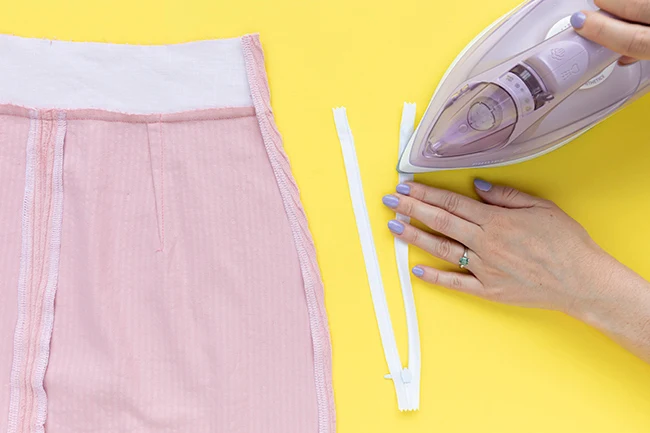
The zipper in most fitted skirts is an invisible one, set into the center back seam or the left side seam. It vanishes into the seam from outside. Lapped zippers, the classic kind, cover their teeth with a fold of fabric topstitched in place.
Most skirt zippers are the lightweight #2 and #3 sizes, numbered by the width of their teeth in millimeters, in lengths of 7 to 9 inches (18–23 cm). Heavy denim skirts take the same #4.5 or #5 zipper as jeans. A few casual styles borrow the jeans fly front. Custom zippers and buttons are bought at their supplier’s minimum; the extra pieces and any setup charge go on the quote.
The waistband extension above the zipper takes a hook-and-bar or a button, whichever goes in your tech pack. The two halves of the waistband seam meet level once the zipper is closed. The zipper pulls easily as long as the stitching stays clear of the coil and the lining is turned back out of the slider’s path.
Pleats
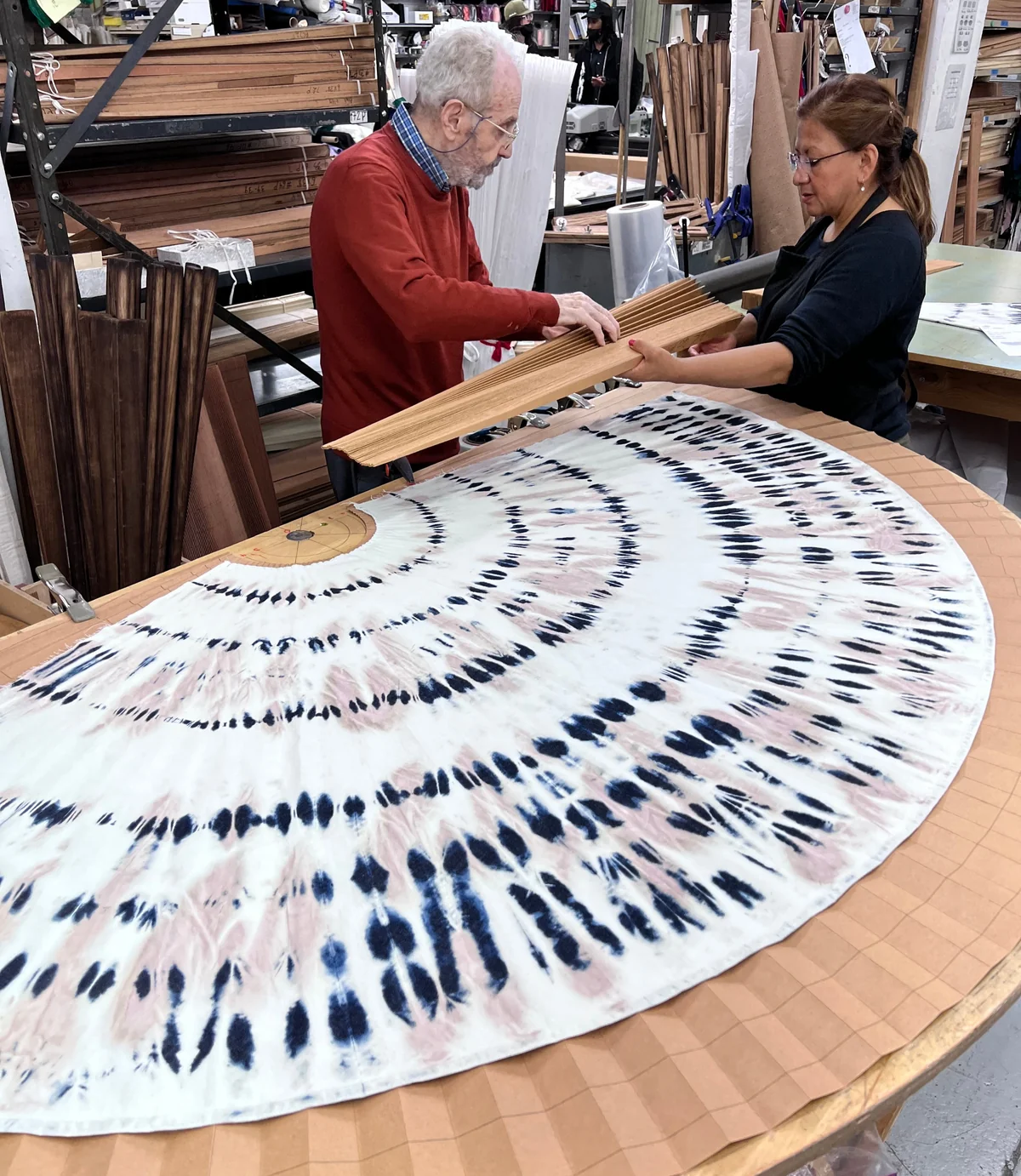
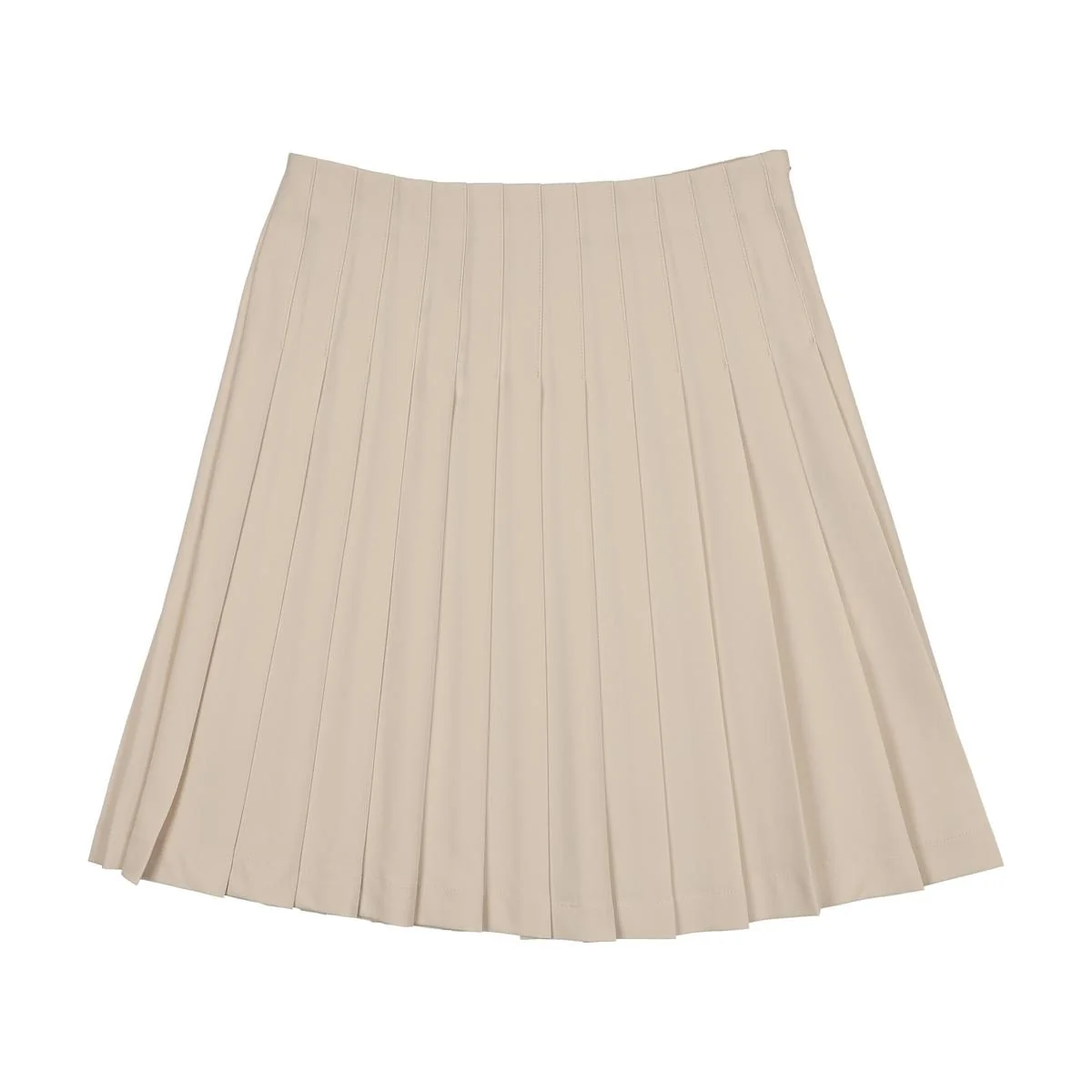
Box and crystal pleats can go through a pleating machine a whole roll at a time, which keeps them the least expensive to make. Sunburst pleats, narrow at the waist and wide at the hem, are steamed into cut panels inside a cardboard mold instead.
Pleat depth on a tech pack = how far the fabric folds under, half of what the pleat uses.
Flat panel width = finished width + number of pleats × 2 × pleat depth
Example, before seam and closure allowances: 40 cm + 8 × 2 × 2.5 cm = 80 cm
The same panel with 5 cm entered as depth by mistake: 40 cm + 8 × 2 × 5 cm = 120 cm
Polyester is the fabric for pleats that have to survive the washing machine, and a heat-set pleat lasts as long as the fabric does. Getting cotton and silk to hold a pleat takes a chemical treatment. The bulk fabric should get a retention test after it’s washed the way your care label says.
Which way the pleats face and how far down from the waist they’re stitched go on the tech pack. The seam that closes the panel into a loop can sit inside a fold, where it disappears once the pleats lie closed.
Full Circles and Bias Cuts
Whether a full circle fits across 140 cm-wide fabric in one piece comes down to its length. The limit for an 80 cm waist falls between 40 and 60 cm. Fabric use jumps past it.
Longer circles are mostly cut as two halves joined at side seams, which then hold the zipper and pockets. Splitting the circle into narrow gores instead frees up the layout on the fabric and gives more room to adjust fit and flare.
Fabric cut at 45 degrees to the straight grain drapes softly and keeps stretching under its own weight, which pulls the hem of a circle skirt down wherever it runs on the bias. The finished skirt therefore hangs at least 24 hours, or more in heavy, drapey fabric, before the hem is leveled and trimmed. The narrow double-turned hem, 1/4 inch (6 mm) folded twice, is usually the easiest finish to get right on a full circle.
Where the Skirt Opens
The seam of a slit stops at a reinforced point, and the raw edges below are turned under and stitched down. Vents add an extension on one panel that laps behind the other and parts only when you walk. Lined pencil skirts have the lining vented separately and sewn in loosely enough that the outer vent can still open.
How much a wrap skirt overlaps depends on where it sits on the body. It’s measured fastened at the height it’s meant to be worn. That height goes on the size chart next to the overlap and the fastening positions.
The Lining
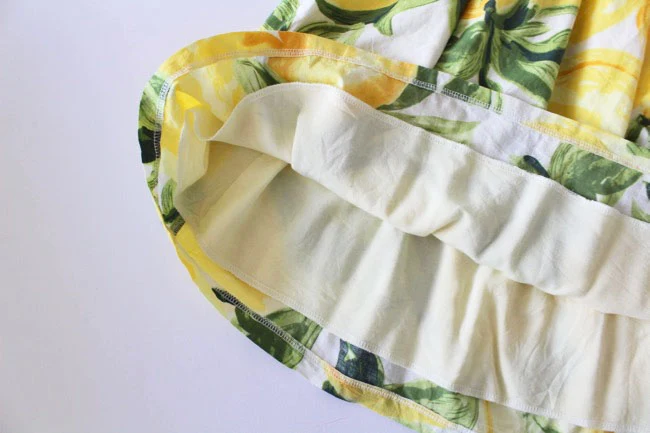
The lining can hang free with its own hem 1 to 2 cm above the shell’s, or it can be sewn to the skirt at the bottom, which means cutting it longer to allow for that seam. Measure its length after the same finishing as the bulk and list it separately on your size chart.
The lining gets preshrunk before cutting and needs to take the same care as the skirt; otherwise any extra shrinkage pulls the outer hem up from inside. Acetate linings have to be dry-cleaned, which makes them a poor match for a skirt you want people to wash at home.
Pocket Placement
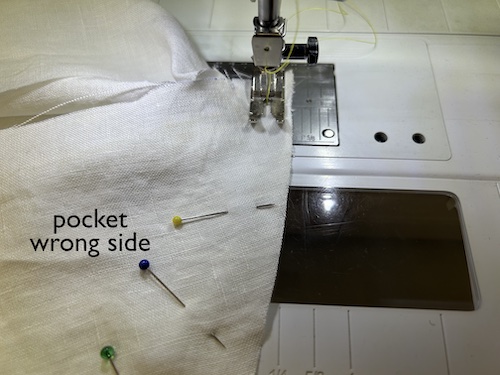
You place an in-seam pocket by giving the top and bottom of its opening in centimeters down from the waist, and the bar tacks go across those two ends. Understitching along the front edge keeps the pocket bag from rolling into view. If the skirt zips at the side, the bag of the pocket on that side stays clear of the zipper.
Patch pockets are stitched on the outside, where the slightest tilt between the pair catches the eye. Once a welt pocket’s slit has been cut through the panel, there’s no moving it.
Gathered Tiers
Top tier = hip + 5 in (13 cm). Next tier down = tier above × 1.5.
Example, 40 in (102 cm) hip: 45 in → 68 in → 102 in → 153 in
The 5 inches added to the hip cover ease and a seam allowance. Fuller skirts use 2 instead of 1.5. The bottom tier of a five-tier skirt on a 40-inch hip comes to about 230 inches (5.8 m) around even at 1.5, which is more than four widths of 140 cm fabric sewn end to end.
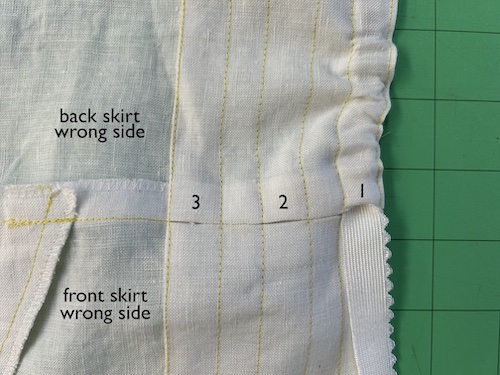
Gathers come out even all the way around when matching marks split the two seam lines into equal sections before the wider tier goes onto the narrower one. Ruffles sewn on separately are measured twice, at their cut length and at their depth once the edge is finished.
Seam allowances between tiers stay out of the finished length, which is just the waistband depth plus the tier heights you can see. Border prints get their edge marked on the tier pattern before cutting.
Cutting and Stitching
Matching a check at the seams takes at least one extra repeat of the plaid, more for a large one. Unbalanced checks need more still, and they’re cut one layer at a time instead of from a folded stack. Flag one-way prints before the marker is drawn.
The sewing then runs mostly on the four ISO stitch types in this table. You order a stitch by its number.
| Stitch | What it is |
|---|---|
| 301 | Lockstitch, for assembly seams and topstitching |
| 504 | Three-thread overedge, for finishing raw edges and light seams |
| 516 | Five-thread safety stitch, a 401 chain stitch and a 504 overedge combined in one seam |
| 103 | Single-thread blindstitch, invisible from one side, for hems |
Your Size Chart
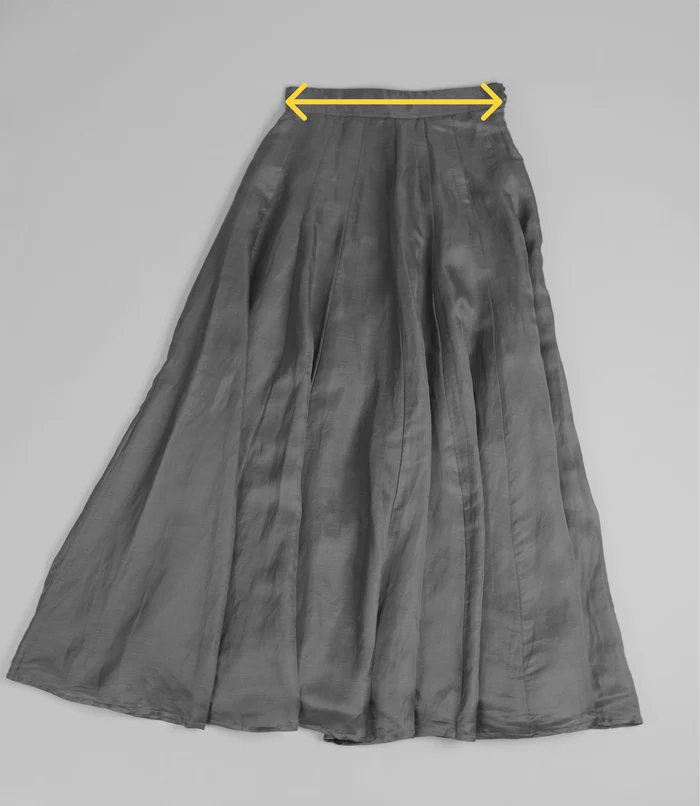
The tolerances here come from a published example tech pack and work as a starting point until you set your own for bulk; washed skirts get them about 50% wider. Widths are half measurements, taken flat.
| Measurement | How it’s taken | Tolerance |
|---|---|---|
| Waist | Waistband closed, along the measuring line you name | ±0.5 cm |
| Hip | Fullest point, at the hip depth on your chart | ±1 cm |
| Length | Waist edge to finished hem at the front, back and sides, turn-up excluded | ±1 cm |
| Sweep | Along the hem, in the pleat position you choose | ±1 cm |
| Pleat depth | How far one pleat folds under | ±0.3 cm |
| Slit or vent | Reinforced stop to hem; for a vent, extension width and which side laps over | Set your own |
| Elastic waist | Relaxed, and fully stretched | Set your own |
Grading is included in Made to Order and starts once the sample fits. You only send finished measurements. The pattern maker grades the waistband and lining with the panels and moves the darts as they widen. Pleated styles leave one choice to you, whether bigger sizes get more pleats or wider ones.
Before It Ships
Made to Order skirts are 100% inspected at no extra charge. Stock Match orders get a sample pull unless you pay for full inspection. Inspectors measure the fastened skirts against your tolerances and look closely at the points particular to a skirt.
- Waistband alignment
- Zipper travel
- Pocket access
- Hem balance
- Pleat direction
- Stitched-down pleat length
- Lining clearance
- Slit or vent movement
Skirts sent back for repair, whether for an open seam or a measurement outside tolerance, only ship after passing a second check. You approve photos of the actual goods in your order before anything leaves the factory.
You decide in the packing instruction how the skirts are folded and how sizes are marked. Tissue paper between the folds keeps a pleated skirt from creasing in the carton. Structured skirts travel better flat in a box than folded into a poly mailer.
Send the Skirt You Want to Make
Up to six files can go with the request, from a phone photo to a full tech pack. Add the number of skirts you want in which colors, and finished measurements if you have them.
You’ll get a tiered quote within 24 hours. When a factory already makes something close to your skirt, you can compare Stock Match and Made to Order on price and lead time.
FashionMe turns the QC photos of your batch into a free Launch Kit of six images and a video of about 10 seconds. You can list the skirts and start ads with it before they arrive.
Request a skirt quote