Types of Skirts: 22 Cuts and Designs Explained
Skirts are part of everyday dressing as well as evening and occasionwear. Familiar styles include the A-line skirt, pencil skirt, pleated skirt and wrap skirt, with cuts that change the fit through the hips and the width around the legs.
A pleated denim midi belongs to several categories at once: it has folded construction, denim fabric and a hem below the knee.
1. A-Line Skirt
An A-line skirt widens gradually from the waist to the hem. The sides slope outward, forming the outline of a capital A. Extending these sloping seams below the knees continues to add width around the legs, giving an A-line maxi its broad hem.
The navy floral skirt’s fairly firm cloth holds its modest flare open around the thighs. Its smooth upper section sits close enough to the body for a fine-knit sweater to tuck into the waist. Knee-high leather boots fit beneath the short hem, leaving the skirt’s angled sides visible above them.

2. Pencil Skirt
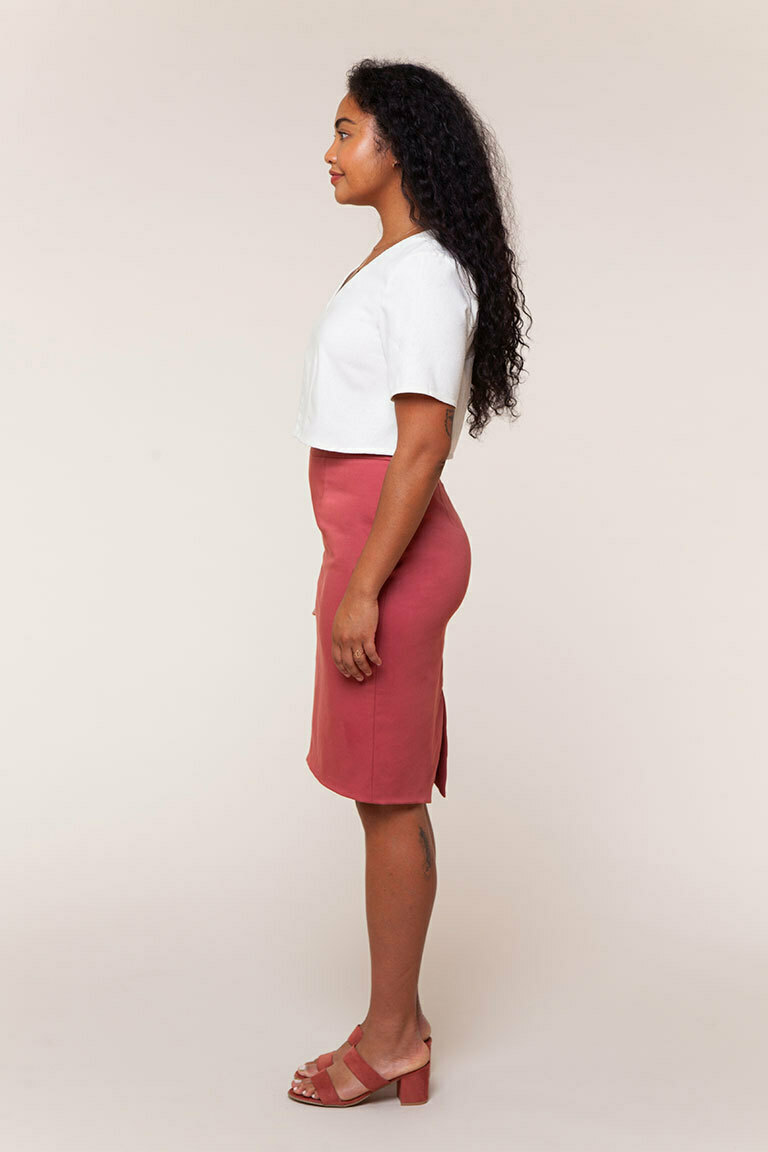
At the back of the rose Christina pencil skirt, a split opens as the legs separate during a step. Above it, the skirt follows the hips and narrows toward the knees.
The split’s edges are finished with a facing, a shaped piece of fabric sewn inside the opening.
Sitting draws the cloth across the hips and upper thighs, where movement comes from room in the cut and the fabric’s stretch. Darts above the hips take the upper skirt into the waist.
3. Straight Skirt
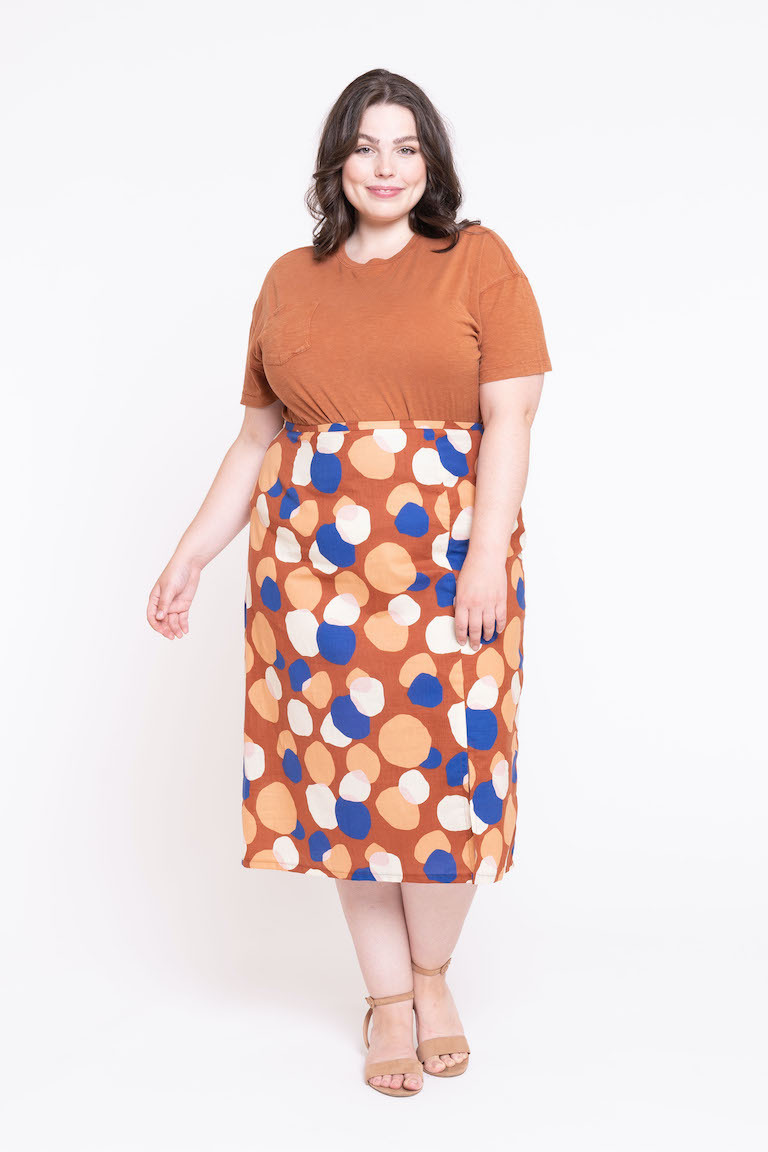
The orange, blue and cream spots cover a broad front panel on the Pauline skirt. Within that print, a long seam curves over the hips and continues down the leg. The shaping happens along the panel joins, leaving the sides to descend almost vertically into a straight, column-shaped skirt. Near the bottom, the front seam opens into a vent, giving the calf-length hem room to part during a step.
4. Circle Skirt
The flare of a short skater skirt can come from a circular pattern. A full circle uses 360 degrees of fabric around a central waist opening.
The waist measurement sets the size of the inner opening. A longer skirt reaches farther out from that opening to a larger circle at the hem, which falls into folds when the garment hangs from the waist.
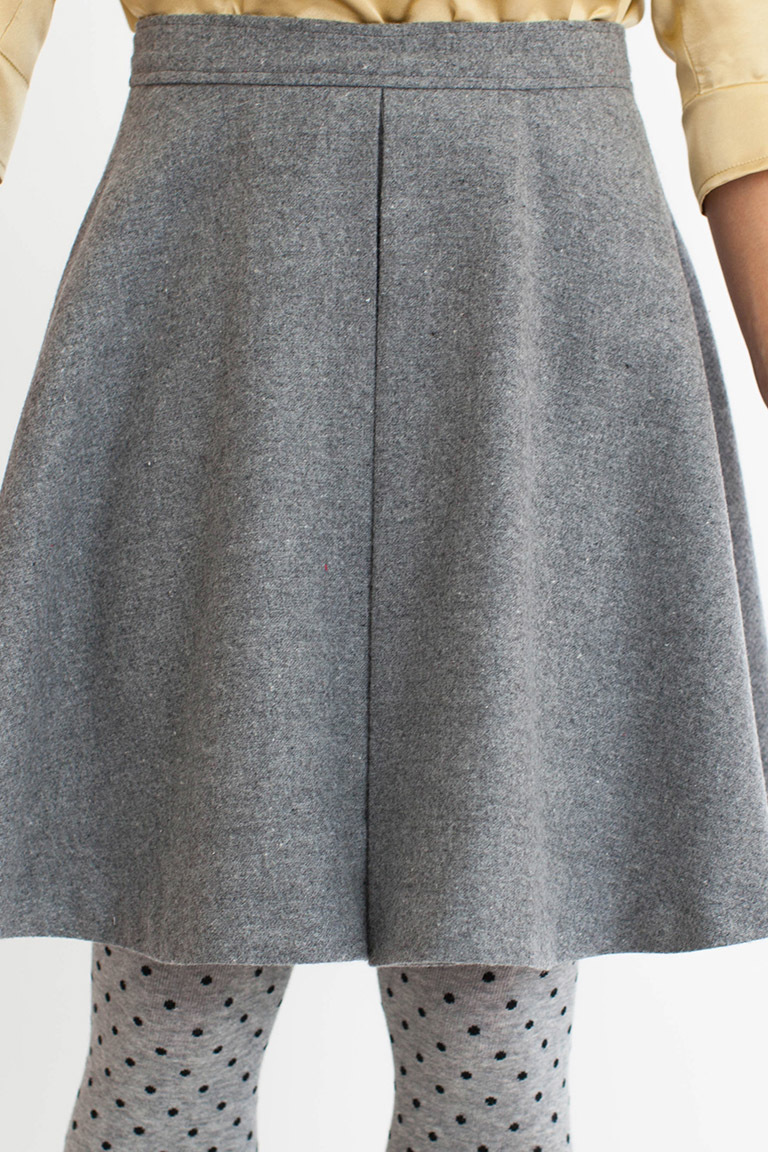
The gray Brooklyn skirt is cut from a 180-degree half circle with a front box pleat. The pleat puts additional cloth into the center of the skirt, opening beneath its smooth waistband.
5. Pleated Skirt
| Pleat | How the Cloth Is Folded |
|---|---|
| Knife | Each fold lies in one direction, with a regular amount of fabric tucked underneath. |
| Box | Two outward-facing folds frame a broad, flat face. The cloth underneath opens on both sides. |
| Accordion | Closely spaced alternating folds open like a fan, creating a finely ridged surface. |
The tan-and-cream skirt carries its geometric print into narrow folds from the elasticated waist to the hem. The pattern spreads across a larger area as the pleats open around the legs. Stitching through the upper part of a pleat controls the level where its extra fabric spreads around the legs.

6. Wrap Skirt
The Siena wrap skirt has an internal button to hold the panel underneath in place during dressing. The fabric wraps across it to reach a tie at the side, securing a double layer across the front.
The outer edge of this floral mini curves upward over one thigh, revealing a small area of the panel beneath it. Coverage during sitting and walking comes from the depth of this overlap. The additional cloth extends the skirt’s flat width beyond its fastened waist circumference.
A faux-wrap skirt carries the layered front on a closed body. The overlap is sewn in place, and a separate zip or elasticated waist provides the opening for dressing.

7. Sarong Skirt
The sarong has a long history in Indonesian dress. The Metropolitan Museum of Art describes the Javanese sarung as a rectangular textile sewn into a tube. The garment is pulled up around the body and secured at the waist. Sarongs are worn by men and women, in everyday clothing and for ceremonies, as documented by Jakarta’s art museums.
Contemporary sarong skirts also use wrapped cloth drawn into a knot, with folds radiating from the fastening across the hips.
The brown Cassandra skirt makes that draped shape part of a pull-on garment. Its front twist is fixed in place. The twist draws the waist into a shallow V and holds the long folds above the high opening in the skirt.

8. Tulip Skirt
A tulip skirt’s rounded hip section narrows toward the hem. Slanted front pleats create that fullness on Sew Over It’s plum skirt, with the side seams curving inward below them. Back darts and a curved waistband fit the upper edge to the waist.

9. Gathered Skirt
A 120 cm fabric edge drawn into a 60 cm seam has a 2:1 gathering ratio. In that example, half the original edge length is taken up in small folds. Cloth thickness affects how much bulk gathers at the join.
The orange Cleo skirt has gathers directly beneath a flat front waistband that continues into an elasticated section at the back. The fabric spreads over the hips and around the pockets. An elasticated waist has a stretch range recorded by its relaxed and extended measurements.
A fitted yoke can carry the upper part of a gathered skirt farther down the body. Moving the gathered seam to the yoke’s lower edge starts the fullness beneath it. A drop-waist skirt uses this lower position around the hips.

10. Tiered Skirt
The Campbell skirt’s deep bottom tier extends from around the knees toward the ankles. Its gathered upper edge joins a narrower panel above it, which in turn hangs from the next section. These horizontal joins divide a tiered skirt into stacked lengths of cloth, spaced according to each panel’s depth. The panels grow wider down the skirt to give the lower tiers room to swing. Along the joins in this checked skirt, narrow strips of fabric form small ruffles above the gathers.

11. Bubble Skirt
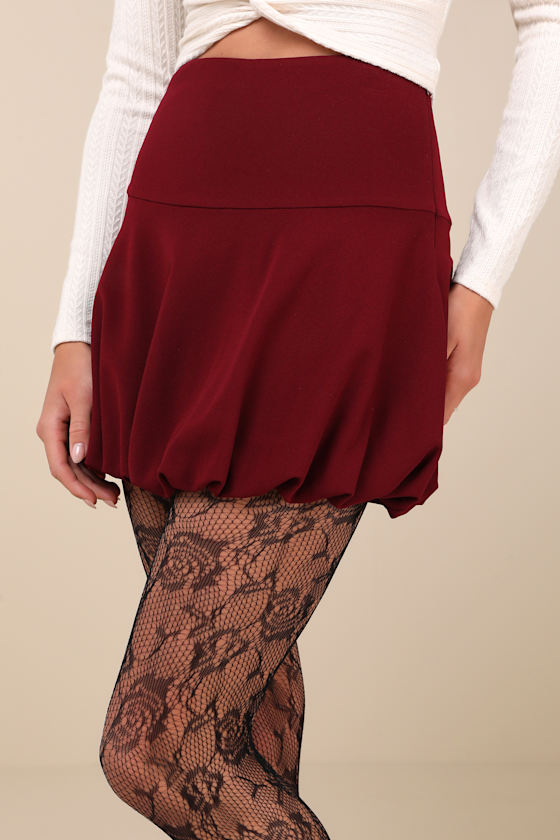
Inside a bubble skirt, the lower edge of the outer fabric is lifted and secured to a shorter lining or gathered onto elastic. The cloth hanging above that attachment rounds outward. On this wine-red mini, elastic pulls the hem into small folds beneath the curved stretch crepe knit. A wide, smooth waist panel supports the gathered body of the skirt.
12. Godet Skirt
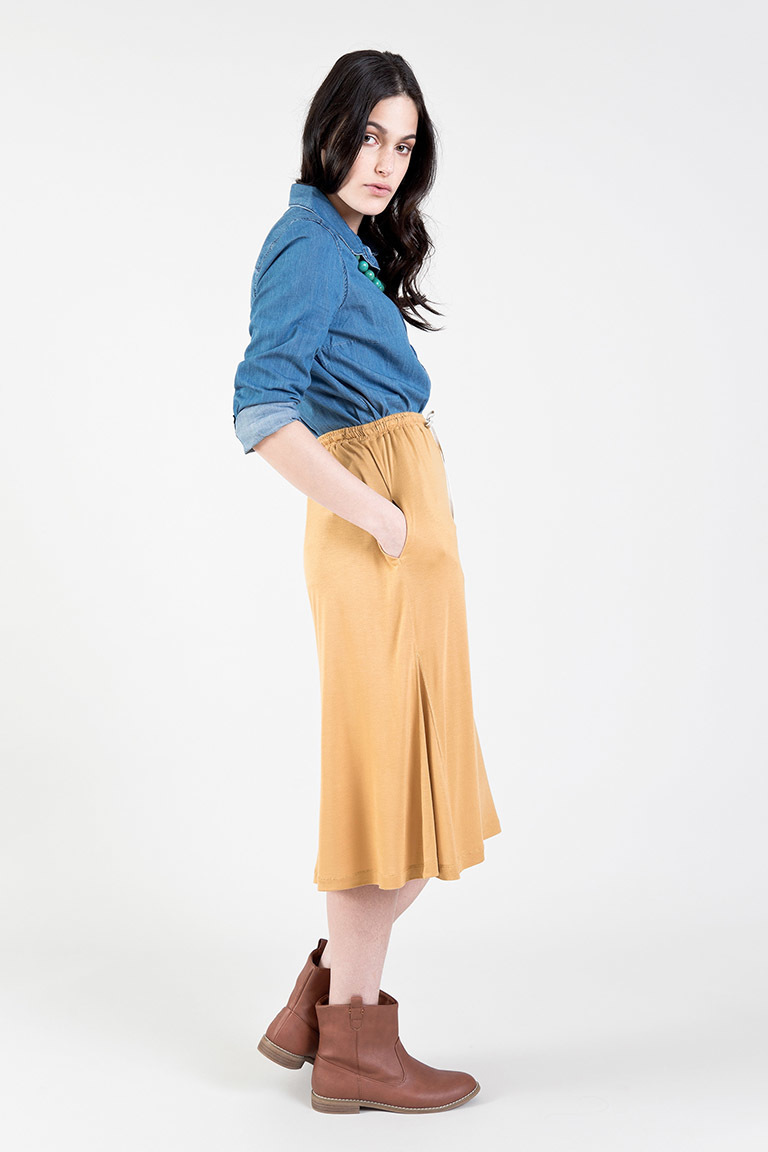
The mustard Sabrina skirt has a wedge-shaped insert below one side pocket. This godet contributes extra width at the hem to a design made with a drawstring waist and a knit specified to have at least 25% stretch.
Extra fabric extends downward from the godet’s pointed top. This tip is sewn into a skirt seam at the level where the flare is to begin, and the insert widens below it to add sweep at the hem. The shaping can be repeated around the skirt with several godets. The fabric above the insertion points keeps its original fit.
13. Mermaid Skirt
The white Clara fishtail skirt spreads across the floor behind the wearer. Its flare begins around the lower legs, beneath a fitted section through the hips and thighs.
Room through the fitted knee area, together with any fabric stretch, determines how much the legs can separate in a step.
Long panels called gores form this flare through the extra width cut into their lower edges.

14. Asymmetric Skirt
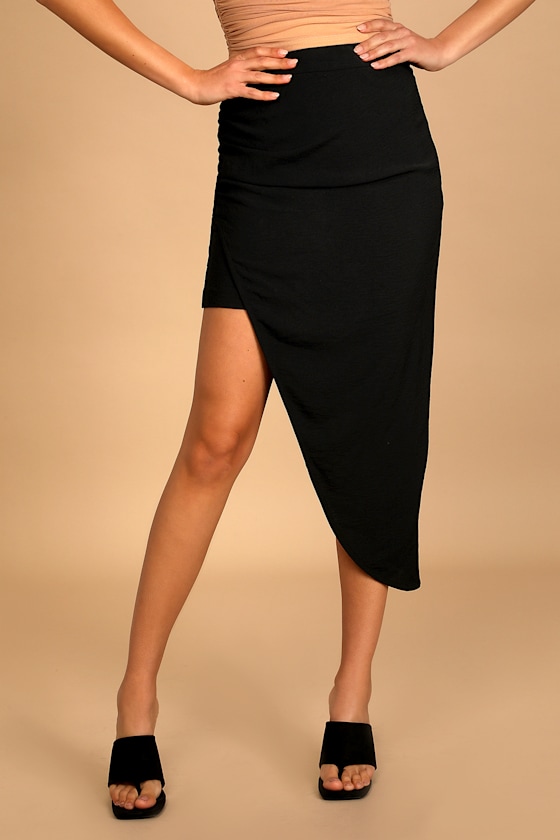
The tan ruched top ends just above the high waist of the black skirt. Its gathers draw angled lines across the torso, continuing into the folds at the skirt’s hip. The asymmetric hem drops from high on one thigh to the opposite calf. Black open-toe mules finish below the sloping edge.
15. Handkerchief-Hem Skirt
A square of cloth with a central waist opening forms a handkerchief hem as its four corners drop around the legs.
The same pointed edge can be built into a skirt with shaped panels or overlapping layers. That construction allows a fitted section through the hips above the uneven hem.
The red polka-dot skirt opens into its long tips near the knees. Its lining finishes above them, leaving the outer fabric translucent around the calves. Each tip moves separately, opening gaps around the legs as the skirt swings.

16. High-Low Skirt
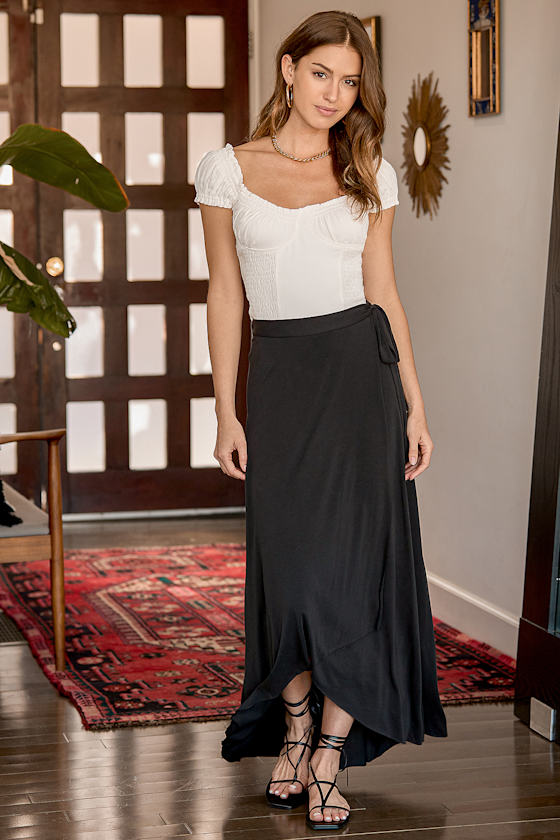
The hem on this black wrap skirt drops an extra 12 inches, about 30.5 cm, at the back.
The curved front opens above the strappy sandals. At the sides, the jersey falls toward the ankles and continues into the longer back. Adding the listed 30.5 cm to the front waist-to-hem measurement gives the back length, measured from the waistband’s wearing position. Shoe height affects how close the trailing edge comes to the floor.
17. Slip Skirt
During sewing, a bias-cut slip skirt hangs for the fabric to settle before its hem is finished. The cloth can lengthen under its own weight, changing the line that will eventually be leveled and sewn.
This movement comes from the diagonal direction of the cut. At 45 degrees to the woven grain, the threads can shift against one another, letting the fabric yield around the hips and fall into soft folds below them. Many slip skirts use this cut to create the close, fluid shape associated with an underskirt.
Long panels hang from a narrow waist finish to a lightly flared hem. In satin or charmeuse, reflected light travels along their folds. The mocha skirt shows those broad highlights down the legs, above pointed-toe pumps in the same warm brown range.

18. Denim Skirt
Denim midi skirt combines a fabric name with a length. The pink Dana skirt is also straight cut, with sides that hang almost vertically from the hips.
Denim is woven with diagonal twill lines across the cloth. Its weight helps the Dana’s front panels and curved pockets hold their shape. The zip fly, belt loops and pocket construction come from jeans, incorporated here into a skirt that reaches below the knees and opens at the front split.

19. Cargo Skirt
Large external utility pockets give the Avery mini its cargo styling. Its two front flaps fasten with pale metal buttons, framed by brown stitching against the indigo denim. The pocket design affects storage and the shape around the legs:
- A pocket’s flap fastens over the opening with a button or snap to cover the contents.
- Bellows folds let a cargo pocket expand outward as it fills, adding volume to the skirt at that point.
- The Avery places its large pockets across the front, concentrating their depth over the lap.

20. Tennis Skirt
A spare tennis ball can be tucked under the fitted inner-short hem of the NikeCourt Advantage skirt. Drop-in pockets on those shorts provide more storage. This combined garment belongs to the skort category: shorts built into a skirt.
The lightweight woven fabric spreads through its pleats during movement, with the built-in shorts covering the thighs beneath it. Mesh in the elastic waistband, which joins the layers, lets air pass through the waist area.

21. Kilt Skirt
The red lines of the Vera skirt’s green tartan continue across its flat front to the side pleats. A kilt skirt carries this flat overlapping front, called an apron, with pleating around the sides and back. The Vera fastens with two buckles beside its pleated section.
In pleating to sett, the tartan pattern determines the folds’ positions. A kilt maker aligns the exposed stripes and blocks of color to reproduce the complete repeat across the pleated area. Cloth tucked inside each fold supplies the depth that opens during movement.

22. Tulle Skirt
The small openings in tulle’s fine net let light through, creating translucent layers that gain depth of color where the mesh overlaps. Gathering them into a waistband or tiers spreads fabric around the body. Short ballet tutus use densely arranged layers of stiff net to hold the skirt out from the hips.
On the pink skirt, black dots run through several rows of loose ruffles. The raised outer layers spread apart in movement, revealing individual edges and different depths of pink where the mesh overlaps. The lining ends above the outer hem, so the lower layers show the legs through the net.

Mini, Midi and Maxi Skirt Lengths
A skirt’s length name places its hem on the body. The position shifts with the wearer’s height and the level of the waistband.
| Length | Where the Hem Falls |
|---|---|
| Mini | Above the knee, commonly around the thigh. A micro mini has a particularly short hem high on the thigh. |
| Knee-length | At or close to the knee. |
| Midi | Below the knee and above the ankle. Tea-length usually refers to a calf-length hem within this range. |
| Maxi | Around the ankles or toward the floor. Floor-length styles extend close to the ground in the shoes worn with them. |
A product’s waist-to-hem measurement starts at the top of the skirt. A low-rise style begins lower on the hips, so a given fabric length reaches farther down the leg. Measurements for uneven hems record the full range of distances from the waist to the edge.
How Fabric Changes a Skirt’s Shape
At a gathered seam, the cloth is compressed into a small space. Cotton poplin holds distinct folds below it. A thick cloth adds bulk inside the seam, and the accumulated weight hangs from the waistband. Interfacing supports that waistband around the fastening and along its upper edge.
Farther down the skirt, soft crepe and rayon challis fall into close folds around the legs. Satin reflects light over those curves; its name describes a weave that can use fibers such as silk or polyester. A smooth lining helps the skirt slide over tights as the outer cloth moves.
Waist and Hip Measurements
A skirt’s body-size chart uses measurements taken around the wearer. For the hip entry, the tape goes around the fullest part of the seat and stays level.
Finished garment measurements include the room built into the cut. For a fastened, non-stretch waistband laid flat, a width of 38 cm corresponds to approximately 76 cm around. Compare that circumference with a measurement taken around the body at the height where the waistband will sit.