What Is Ribbed Fabric? Stretch, Shrinkage and Cuff Uses
Ribbed fabric has raised, parallel lines separated by recessed channels. In clothing, the term usually refers to rib knit, a fabric made with alternating columns of knit and purl stitches. The columns spread apart when pulled across their width, giving the material room to stretch around the body.
That flexibility makes rib knit useful for fitted T-shirts, tanks, dresses, underwear and sweaters. At garment edges, ribbing forms cuffs, neckbands and hem bands that expand during dressing and draw back toward their resting size afterward.
Rib describes the fabric’s construction. Its fiber content may be cotton, wool, viscose, polyester or a blend, often with elastane added. Construction, fibers and finishing all influence how far the fabric stretches, how well it recovers and how its dimensions change in the wash.
Recognizing Rib Knit: 1×1, 2×2 and Wider Ribs
Look closely at the raised part of a rib and you can see small V-shaped knit stitches stacked in columns. The purl columns sit in the channels between them. On fine, relaxed ribbing, those channels can close so closely that the fabric initially looks almost smooth. A gentle sideways pull reveals the recessed stitches.
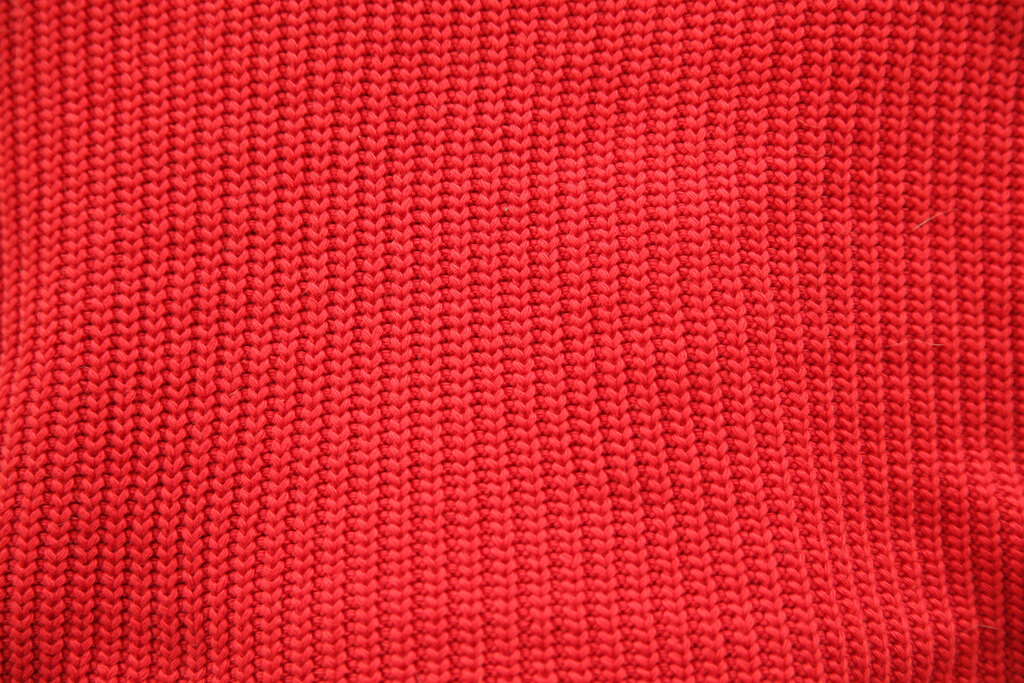
A vertical column of stitches is called a wale. A row running across the fabric is a course. The numbers in a rib description count the repeating knit and purl columns:
| Construction | Repeating arrangement | Visible texture |
|---|---|---|
| 1×1 rib | One knit column, one purl column | Closely spaced ridges |
| 2×2 rib | Two knit columns, two purl columns | Ridges formed by pairs of stitches |
| 3×3 rib | Three knit columns, three purl columns | Wider stitch groups at a comparable yarn size and gauge |
Basic machine-knitted rib uses two needle beds. Balanced constructions such as 1×1 and 2×2 have a similar appearance on both sides and generally lie flat at the cut edges. Single jersey has a knit face, a visibly different reverse and a tendency to curl. Interlock has smooth, similar faces; its intermeshed structure restricts the movement of neighboring columns. These differences help identify the common knit constructions.
Rib width also depends on yarn thickness and machine gauge. A fine 2×2 rib can have smaller ridges than a chunky 1×1 sweater rib. Unequal repeats, such as 2×1, give different proportions of raised and recessed stitches on each face. Variegated ribs combine several widths in a larger repeat. The numbers describe this arrangement; stretch performance comes from measuring the finished fabric.
How Much Does Rib Fabric Stretch?
A cotton rib can stretch even with an all-cotton fiber composition. Pulling across the ribs opens the channels and changes the shape and position of the knitted loops. Lengthwise extension involves a different movement of those loops, so the two directions can give different results.
Elastane adds an elastic component to the yarn system and helps the fabric recover after extension. Spandex and elastane are names for the same fiber category; LYCRA® is a brand. A label reading “95% cotton, 5% elastane” gives composition by weight. The stretch percentage is measured separately on the fabric.
For example, a 10 cm span extended to 15 cm has increased by 5 cm:
Stretch = (extended measurement − starting measurement) ÷ starting measurement × 100
(15 − 10) ÷ 10 × 100 = 50% stretch
The effort needed to reach 15 cm also matters. Two samples may reach that distance with noticeably different resistance. In a cuff, that resistance affects the pressure around the wrist; in a fitted top, it affects how the garment feels across the chest and shoulders.
Recovery describes the return after the pull is released. The remaining increase in size is fabric growth. A sleeve pushed up the forearm or a knee bent during sitting holds the fabric under tension for longer than a quick hand stretch. ASTM’s description of stretch and growth testing distinguishes these effects and explains why prolonged loading matters in clothing.
For a practical home comparison:
- Lay the swatch flat and relaxed. Mark two points 10 cm apart, leaving space between the marks and the cut edge.
- Pull evenly to a comfortable resistance. Record the distance between the marks and how long the pull is held. A reading of 15 cm gives the 50% extension above.
- Release the swatch and leave it flat for one minute. If the marked span measures 10.5 cm, its remaining growth is (10.5 − 10) ÷ 10 × 100 = 5%. Record the one-minute rest with the result. Further recovery may occur during a longer rest.
This hand check gives an approximate comparison. A laboratory method specifies the load or extension, specimen preparation and measurement conditions.
Repeat the check across the ribs and along them. Fabric sold as “four-way stretch” extends along both axes, and each direction needs its own measurement. A bodysuit uses lengthwise extension between shoulder and crotch as well as widthwise extension around the torso. A rib suitable for a loose T-shirt may therefore behave quite differently in a close-fitting bodysuit.
Does Ribbed Fabric Shrink?
Yes. Rib knit can shrink during washing and drying. The amount depends on the fibers, loop structure, processing history and care procedure. Length and width are separate measurements: a sample can shorten more than it narrows, and some constructions or conditions produce growth in one direction.
Cotton knit can retain tension from knitting, dyeing, finishing and handling. Washing wets and swells the fibers; the yarns and loops gain an opportunity to move toward a more relaxed arrangement. During drying, moisture leaves the structure and the fabric can consolidate further. Tumbling adds mechanical movement that promotes this relaxation.
The delivered fabric’s dimensions also reflect decisions made at the mill. Yarn size, stitch length and finished width influence its dimensional behavior through processing. Pulling a knit lengthwise during processing can lengthen it and reduce its width.
Mills use relaxation drying and compaction to reduce the shrinkage remaining before cutting. Compaction mechanically brings the structure into a shorter, more consolidated state. A fabric sold as preshrunk has undergone shrinkage-control processing; its wash test establishes the residual change under the stated conditions.
Wool has an additional mechanism. Agitation in water can cause the surface scales of untreated wool fibers to interlock, producing felting and contraction. Shrink-resist treatments for wool modify that surface behavior. The care label identifies the washing and drying procedures suitable for the particular garment.
A cotton-elastane rib combines stretch recovery with the dimensional behavior of its whole construction. The starting measurement changes after laundering. Consider this calculated example, using assumed readings from the same marked span:
| Measurement stage | Distance between marks | Comparison |
|---|---|---|
| Before washing, relaxed | 10.00 cm | Original dimension |
| Washed, dried and rested | 9.60 cm | 4% shrinkage from the original dimension |
| Stretched after washing, then released and rested for one minute | 10.00 cm | 4.2% growth from the washed dimension |
The final growth calculation is (10.00 − 9.60) ÷ 9.60 × 100 = approximately 4.2%. The two 10 cm readings occur at different stages. Measuring recovery from the washed 9.60 cm baseline reveals the growth produced by subsequent stretching. Keep a separate baseline for each laundering stage and record the stretch duration and recovery interval with it.
For a home wash trial, mark a 25 cm square inside a larger swatch, leaving fabric beyond each side. Measure it flat and relaxed. Wash and dry it using the care procedure intended for the finished garment, then let it rest under the same conditions used for the starting measurement.
An illustrative result would be:
| Direction | Before laundering | After laundering | Shrinkage |
|---|---|---|---|
| Across the ribs | 25 cm | 24 cm | 4% |
| Along the ribs | 25 cm | 23.5 cm | 6% |
Shrinkage = (starting measurement − final measurement) ÷ starting measurement × 100
The width result is (25 − 24) ÷ 25 × 100 = 4%. Along the ribs, (25 − 23.5) ÷ 25 × 100 = 6%. These figures describe the example sample. A sample that finishes larger is recorded as growth, with its direction identified.
Record wash temperature, cycle, drying method and number of laundering cycles beside the measurements. Repeated cycles reveal whether the dimensions continue to change. For professional testing, AATCC specifies TM135 for fabrics and TM150 for garments, with defined preparation, laundering and measurement conditions.
Body fabric and rib trim also need to work together after washing. On a sweatshirt, compare their directional changes under the same care procedure, then launder a sewn sample. Sleeve length, cuff height, relaxed cuff circumference and the joining seam show how the combination behaves. Greater contraction in the trim can gather the sleeve more tightly; greater contraction in the sleeve can change the fullness above the cuff.
Why Ribbing Works for Cuffs
A sweatshirt cuff passes through several shapes during wear. It opens around the hand, rests at the wrist and may stay stretched around the forearm when the sleeve is pushed up. The material needs enough extension for dressing and enough recovery to return toward the intended wrist size after those movements.
Ribbing achieves this through the movement of its columns and the recovery of its yarns. Cuffs are usually cut with the ribs running along the sleeve, placing the widthwise stretch around the arm. Folding the fabric gives a smooth outer edge and a double layer. That extra layer changes the feel and resistance of the band.
Cuff height influences fit too. A tall cuff reaches farther up the arm, where the circumference may be larger. A narrow band concentrates its contact in a smaller area. The intended wrist fit, cuff height and ease of pulling it over the hand therefore belong in the same fitting trial.
Fabric sold specifically as ribbing often has a firmer handle than a light rib intended for a draped top. A sweatshirt cuff needs enough substance to sit comfortably against the sleeve fabric and retain its shape after wear. A fine T-shirt sleeve can use a lighter band. Wool sweater cuffs may be knitted directly into the sleeve, with the stitch pattern changing where the sleeve body begins.
The supply format affects construction:
- Flat ribbing is cut to size and joined into a loop. The pattern controls both circumference and folded height.
- Ready-made cuffs have established dimensions and construction. The sleeve pattern is matched to the selected trim.
- Tubular ribbing can form a cuff with no lengthwise joining seam when the tube has the required circumference. A 10 cm laid-flat tube measures approximately 20 cm around. Wider tubes can also be cut into separate pattern pieces.
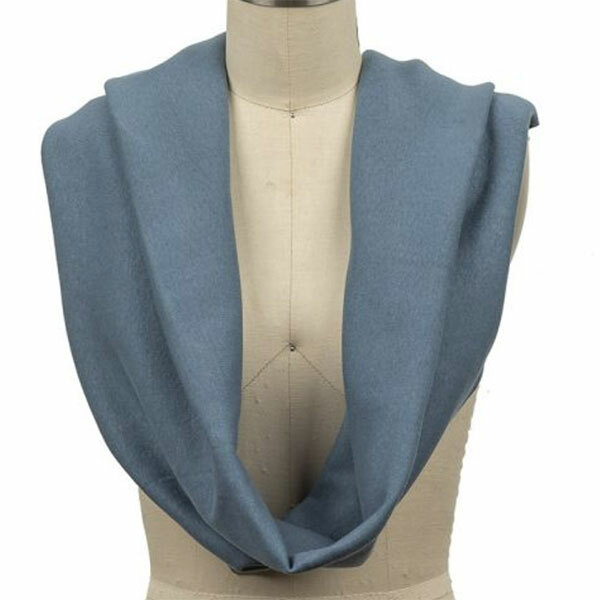
These ribbing formats are used for sweatshirt and jacket trims as well as other garment edges. On joggers, ankle cuffs have to open over the heel during dressing. Their resting circumference is selected for the desired ankle fit, with heel passage included in the sewn trial.
Working Out a Folded Cuff Size
For a trial cuff measuring 17 cm around and 6 cm high when finished, a flat pattern piece measures 19 × 14 cm with 1 cm seam allowances. This example uses a rectangle joined at its ends and folded in half.
| Pattern dimension | Calculation | Cut measurement |
|---|---|---|
| Around the cuff | 17 cm finished circumference + 1 cm at each joining end | 19 cm |
| Through the height | Two 6 cm layers + 1 cm on each raw attachment edge | 14 cm |
Joining the ends takes up 2 cm of the rectangle’s circumference. Folding the height produces a 7 cm double layer; the attachment seam uses 1 cm, leaving 6 cm visible. For an existing sewing pattern, use its stated seam allowance and check whether the supplied piece already includes it.
Suppose the sleeve opening measures 20 cm along the stitching line. The 17 cm cuff is 85% of that opening. This is a trial proportion for the sample. The rib’s resistance, recovery and thickness determine how that proportion feels in the finished garment.
During attachment, the cuff has to reach the sleeve’s 20 cm opening:
(20 − 17) ÷ 17 × 100 = approximately 17.6% extension
If the hand requires a 24 cm opening during dressing, the same cuff has to extend farther:
(24 − 17) ÷ 17 × 100 = approximately 41.2% extension
Both calculations start from the cuff’s relaxed 17 cm circumference. The second describes hand passage, so it is the more demanding extension in this example. A comfortable fit also depends on the force needed to reach that opening. Check the finished loop with its joining seam and folded layers, then check it again after attachment.
The relationship between wrist size and relaxed cuff size is often described as ease. A cuff smaller than the wrist has negative ease and remains stretched during wear. A cuff with positive ease sits more loosely. Desired fit can vary between a light top, a sweatshirt and an outerwear sleeve.
Use fabric prepared with its intended care method for the trial. Include pushing the sleeve up the arm and returning it to the wrist. If the cuff circumference changes during fitting, recalculate both the attachment extension and the opening needed for the hand. Finished height can be adjusted separately through the rectangle’s other dimension.
Following the Same Cuff Through a Wash
The 17 cm cuff in the cutting example needs approximately 41.2% extension to reach a 24 cm hand opening. Its resting circumference after laundering sets the extension needed the next time it is worn.
Assume that separate swatches show 4% contraction around the cuff and 2% contraction around the sleeve opening under the same laundering procedure. These are illustrative inputs. Applying them to the 17 cm cuff and 20 cm sleeve gives the following planning calculation:
| Quantity | Before washing | Estimate from the separate swatch changes |
|---|---|---|
| Relaxed cuff circumference | 17.00 cm | 17 × 0.96 = 16.32 cm |
| Sleeve opening at the stitching line | 20.00 cm | 20 × 0.98 = 19.60 cm |
| Cuff circumference as a share of sleeve opening | 85.0% | 16.32 ÷ 19.60 = 83.3% |
| Cuff extension to reach the sleeve opening | 17.6% | (19.60 − 16.32) ÷ 16.32 = 20.1% |
| Cuff extension to reach the 24 cm hand opening | 41.2% | (24 − 16.32) ÷ 16.32 = 47.1% |
Percentages in the final two rows use the cuff circumference as their denominator. The sleeve contracts by 0.40 cm and the cuff by 0.68 cm in this example, changing their attachment relationship. The hand opening remains 24 cm, so more extension is required during dressing.
The general relationship is washed cuff-to-sleeve ratio = original ratio × cuff retained fraction ÷ sleeve retained fraction. Here, 0.85 × 0.96 ÷ 0.98 = approximately 0.833. Matching the two contraction percentages would preserve their proportion in this calculation, and the smaller cuff would still need additional extension over the same hand.
This model applies separately measured, freely relaxing swatch changes to each component. A sewn seam couples the materials, so the washed garment establishes their actual dimensions and fit.
The hand-opening calculation can also be worked backward. Suppose a washed, folded and sewn trial cuff reaches 45% extension at an acceptable dressing force and recovers within the fit requirements set for that sample. With a 24 cm hand opening, the corresponding washed circumference is 24 ÷ 1.45 = approximately 16.55 cm. Allowing for the assumed 4% residual contraction gives a starting circumference of 16.55 ÷ 0.96 = approximately 17.24 cm, before adding joining seam allowances.
In symbols, starting circumference = hand opening ÷ [(1 − s) × (1 + e)], where s is residual circumferential shrinkage and e is usable extension, both expressed as decimals. The 45% value belongs to this assumed trial; it represents the behavior of the washed cuff assembly. Wrist comfort and the resulting sleeve fullness set the remaining fitting decisions.
For prewashed yardage, use the dimensional change still measured after that preparation. Each measurement record should identify the rib lot, body fabric, care procedure and stage at which the cuff circumference was taken.
Calculate cuff fit after washing
Follow a cuff from its starting circumference to the opening needed for dressing. The calculation combines directional shrinkage with a chosen usable extension.
The starting values are an illustrative example. Replace them with measurements from the same material lots and care procedure. Enter residual shrinkage if the material has already been prewashed.
Calculated dimensions and extension
| Quantity | Starting state | After-wash estimate |
|---|---|---|
| Relaxed cuff circumference | 17.00 cm | 16.32 cm |
| Sleeve opening | 20.00 cm | 19.60 cm |
| Cuff as a share of sleeve opening | 85.0% | 83.3% |
| Extension to sleeve opening | 17.6% | 20.1% |
| Extension for hand passage | 41.2% | 47.1% |
At 45.0% usable extension, the estimated washed cuff opens to 23.66 cm. The entered hand opening is 24.00 cm.
A starting cuff circumference of 17.24 cm corresponds to a 24.00 cm hand opening at that extension, with the same shrinkage assumption.
The circumference calculation excludes joining seam allowances. Wrist comfort, cuff height and sleeve fullness are established during fitting.
Calculation basis
Retained fraction = 1 − shrinkage (%) ÷ 100
Washed circumference = starting circumference × retained fraction
Cuff / sleeve ratio = cuff circumference ÷ sleeve opening
Required extension (%) = max(0, opening ÷ relaxed cuff − 1) × 100
Starting cuff for chosen extension = hand opening ÷ [(1 − rib shrinkage ÷ 100) × (1 + usable extension ÷ 100)]
The estimates apply freely measured swatch contractions to the cuff and sleeve separately. Joining the two materials constrains their movement; actual after-wash measurements come from the sewn garment. All inputs should describe the same care stage. The entered usable extension describes the washed assembly.
Rib Neckbands, Waistbands and Hem Bands
On a zip-front jacket, the rib hem meets the zipper at two front edges. Closing the zipper makes their alignment visible. Around the body, a shorter band draws the fabric into a smaller circumference, creating fullness above the seam. Its finished height is measured from the joining seam to the folded edge.
A sweatshirt hem band forms a continuous loop. Its fit depends on where it sits on the body and how much of the sweatshirt is intended to gather above it. The band also extends during dressing as the garment passes over the shoulders.
Neckbands follow a curved opening. Their length is developed from the neckline’s stitching-line measurement, finished band width and the recovery of the rib. A wider band reaches farther inward across that curve, affecting how it lies against the body. After dressing, the sewn neckband should settle smoothly around the neckline. The required head opening belongs in the fit check alongside its resting shape.
At a trouser or jogger waist, ribbing can form a soft outer band around inserted elastic. The elastic supplies additional holding force, and a drawcord may provide adjustment. The pattern determines how those components are secured and how far the complete waistband opens over the hips. Any topstitching through the band becomes part of that opening’s stretch behavior.
Choosing Rib Knit for Tops, Dresses and Loungewear
A ribbed tank, a flowing dress and a winter sweater place different demands on the material. A tank uses relatively little fabric and often fits close to the torso. A long dress hangs from the shoulders and stretches across the bust and hips. In a sweater, yarn bulk and the weight of the whole panel contribute strongly to the way the garment sits.
Cotton rib is common in soft, absorbent tanks, underwear and casual tops. For a closely fitted style, cotton-elastane blends add recovery at areas such as the neckline and elbows. Polyester appears in blends used for everyday clothing and activewear, contributing properties such as wrinkle resistance. These fiber choices affect feel and performance, together with the knit structure and finish.
Viscose, often labeled rayon, is used for ribs with a fluid drape. It suits tops and dresses that fall closely around the body. Modal is another regenerated cellulose fiber used in soft clothing. Lenzing describes the softness and moisture absorption of its modal fibers; the finished knit’s weight and structure further shape how it hangs. Wool ribs are used in sweaters, cardigans and other warm knitwear, from fine layers to bulky pieces.
Weight specifications help describe these choices. 220 GSM means 220 grams per square meter. Two fabrics with that weight can have different thicknesses, stiffness and opacity because their yarns and loop arrangements differ. Ribbing also changes appearance as its channels open across the body.
Shrinkage can change the GSM reading because it changes the area occupied by the fabric. Using the earlier example of 4% width contraction and 6% length contraction, the retained area is 0.96 × 0.94 = 0.9024, or 90.24% of the original area. If the conditioned fabric mass stays constant, a 220 GSM rib would then measure 220 ÷ 0.9024 = approximately 244 GSM. That is an increase of about 10.8% in mass per unit area.
This is an area-and-mass calculation using assumed dimensional changes. An actual postwash GSM result also reflects any mass change from removed finish or lint and the sample’s moisture condition. Compare supplier weights at the same preparation and conditioning stage; record delivered and washed values separately when both matter to the garment specification.
For a fitted garment, hold the swatch at approximately the extension it will experience over the bust or hips. Place it over the intended underwear color in daylight to assess coverage. A larger piece suspended from its upper edge shows its drape more clearly than a small swatch held in the hand. For a dress, the length of the panel adds weight to that observation.
Pattern fit then connects the material to the garment. A design with negative ease has a finished circumference smaller than the body and uses the fabric’s stretch to reach the wearing size. Follow the pattern’s required extension in each direction. In loungewear, a seated trial puts the seat and knees under sustained tension; after standing, the shape in those areas shows how the rib recovers during use.
Cutting and Sewing Rib Fabric
Prepare the yardage with the intended care method, then let it relax flat before laying out the pattern. Support the full piece on the cutting surface so hanging fabric adds little tension. Align the rib columns with the pattern grainline. For pieces cut on the fold, check that the columns on both layers run parallel; a single-layer layout makes that alignment easier to see.
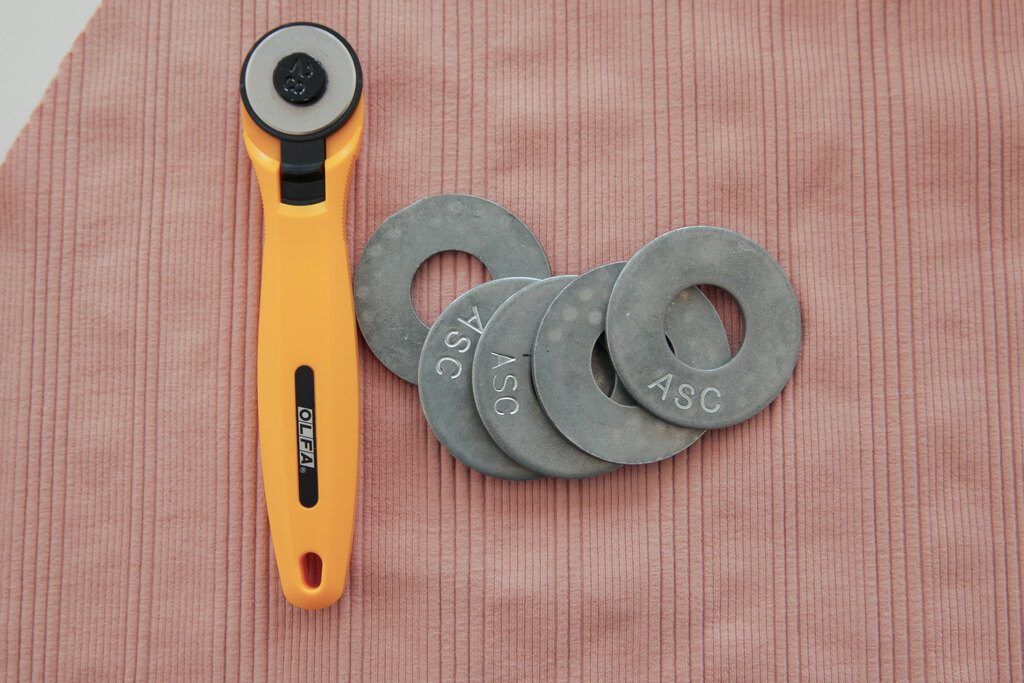
At the machine, the seam needs to accommodate the movement expected in that part of the garment. Overlocking and suitable stretch stitches provide extensibility. Knitwear thread selection also considers seam elongation, strength and comfort. Shoulder seams on a heavy or fluid rib garment may use the stabilizer specified by the pattern to help carry the hanging fabric’s weight.
Use scraps to establish the needle, thread and stitch combination. SCHMETZ specifies jersey needles for many knits and stretch needles for highly elastic fabrics containing elastane. Test through the number of layers present in the actual seam.
Feed the fabric through the machine with its weight supported. On a serger, differential feed changes how the front and rear feed dogs move the fabric. Increasing the ratio can help a stretchy seam lie flat; Brother’s explanation of differential feed shows how this adjustment controls rippling.
For cuff attachment, mark corresponding points on the cuff and sleeve opening. Distribute the difference evenly between those points, extending the cuff to meet the sleeve. The attachment stitches need to extend far enough for the finished opening to pass over the hand.
Washing and Drying Ribbed Clothing
Use the temperature and cycle stated on the garment’s care label. For machine-washable ribbed tops, turn them inside out before washing; fine items can go in a mesh laundry bag. Close exposed zippers on other items in the load. Wool garments require the washing method and detergent appropriate to their care instructions.
When lifting out a wet garment, support its body and sleeves together. Water adds weight, and an unsupported section can lengthen as it hangs. Smooth the rib columns gently and return cuffs and bands to their normal shape.
Wool sweaters are dried flat unless the label permits tumble drying. A towel or drying mesh supports the body and sleeves; keep the full garment on that surface. For any ribbed garment labeled for tumble drying, use the stated setting. Let it cool and relax before comparing its dimensions with earlier measurements.
Allow the fabric to dry completely before storing it. Heavy ribbed sweaters are stored folded, with the sleeves supported and cuffs at their resting dimensions.