Types of Jeans: What Each Name Means
A brand that lists high-rise wide-leg ankle jeans in rigid stone-washed denim has put five choices into one product name: the rise, the leg shape, the length, the fabric and the wash. Most types of jeans are an option from one of those five lists. The remaining types are named for a wearer, as mom and skater jeans are, or for extra pockets and panels sewn onto the pair.
None of these words has a standard measurement behind it, so a straight leg or a high rise measures whatever the brand selling it decides. Factories work from numbers. If you order jeans for your brand, every word in the name must reach the factory as a measurement or a physical sample.
Types of jeans by leg shape
Factories specify a jeans leg by its circumference at the thigh, at the knee and at the hem. They double a measurement taken flat across the leg. The hem figure is called the leg opening. A leg opening listed as 40.6 cm (16 in) on a product page is 20.3 cm (8 in) on a spec sheet written in flat halves. Names for leg shapes are shorthand for the way those three figures relate to each other.
| Leg shape | Seat and thigh | Below the knee |
|---|---|---|
| Skinny | Close to the body | Close to the calf and the ankle |
| Slim | Narrower than straight | Slightly loose at the calf |
| Straight | Regular | Knee width kept down to the hem |
| Tapered | Slim to loose | Narrows toward the ankle |
| Carrot | Full | Narrows sharply to the ankle |
| Cigarette | Slim | Narrow, cut off at the ankle |
| Bootcut | Slim or regular | Opens a little over a boot |
| Flare | Close | Opens wide from the knee |
| Bell-bottom | Tight down to the knee | The widest hem |
| Wide-leg | Fitted at the hip | Wide down to the hem |
| Baggy | Loose from the seat down | Loose |
| Barrel, balloon or horseshoe | Loose | Bows outward at the knee, narrows toward the ankle |
Brands build two-word names like slim taper and loose straight with the seat and thigh first and the lower leg second. Cuts that differ only in the second word, such as slim taper and slim bootcut, can share a pattern above the knee. Room increases from skinny through slim, straight and relaxed to loose and baggy.
| Levi's men's cut, size 32 waist | Knee | Leg opening |
|---|---|---|
| Slim taper | 40.0 cm (15¾ in) | 32.4 cm (12¾ in) |
| Slim | 41.3 cm (16¼ in) | 36.8 cm (14½ in) |
| Straight | 44.5 cm (17½ in) | 40.6 cm (16 in) |
| Relaxed | 49.5 cm (19½ in) | 41.9 cm (16½ in) |
| Slim bootcut | 43.2 cm (17 in) | 45.7 cm (18 in) |
| Loose straight | 52.7 cm (20¾ in) | 43.2 cm (17 in) |
| Baggy | 59.7 cm (23½ in) | 48.3 cm (19 in) |
| Barrel | 59.7 cm (23½ in) | 47.0 cm (18½ in) |
Straight is supposed to mean a leg that keeps its knee width down to the hem. If you order the hem at the knee's measurement, the leg will look wider at the bottom than the straight jeans your customers already wear. Levi's straight cut is 3.8 cm (1½ in) smaller at the hem than at the knee, and its slim taper loses twice as much. Its relaxed cut is 5 cm (2 in) bigger than the straight at the knee and a quarter of that at the hem.
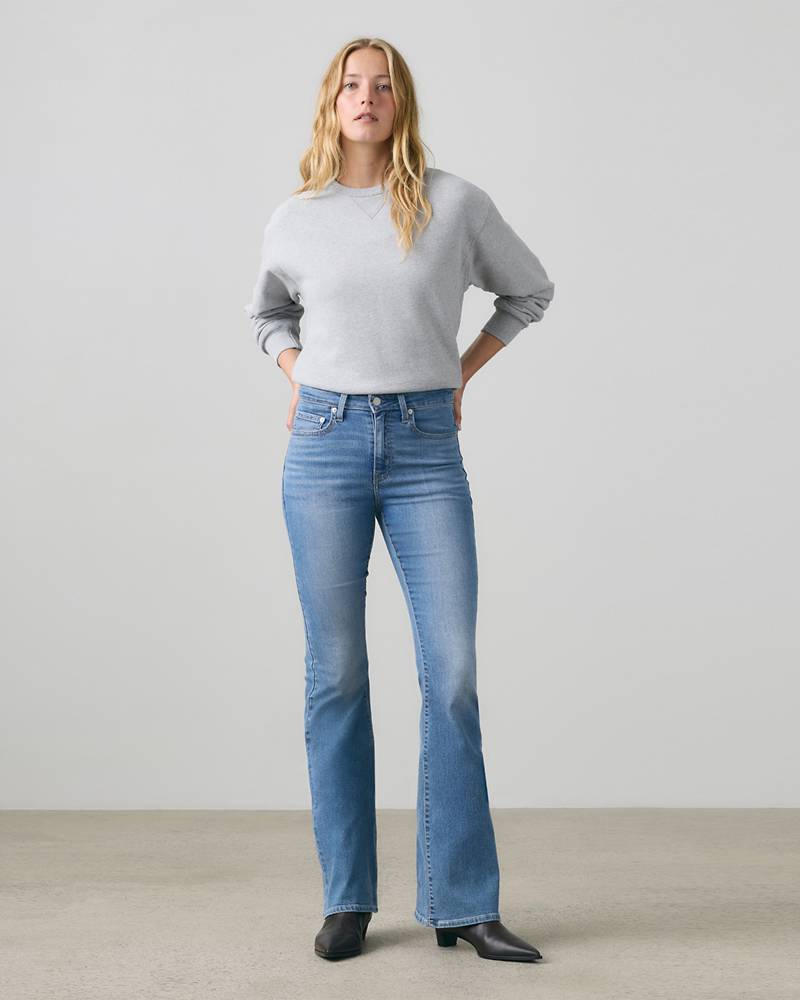
Nobody can tell from the word bootcut or flare where the leg starts to widen. Factories call that point the knee. They place it at a set distance below the crotch. The flare starts higher or lower on the leg according to where they place it. QVC publishes measurements for a women's jean with the knee 33 cm (13 in) down.
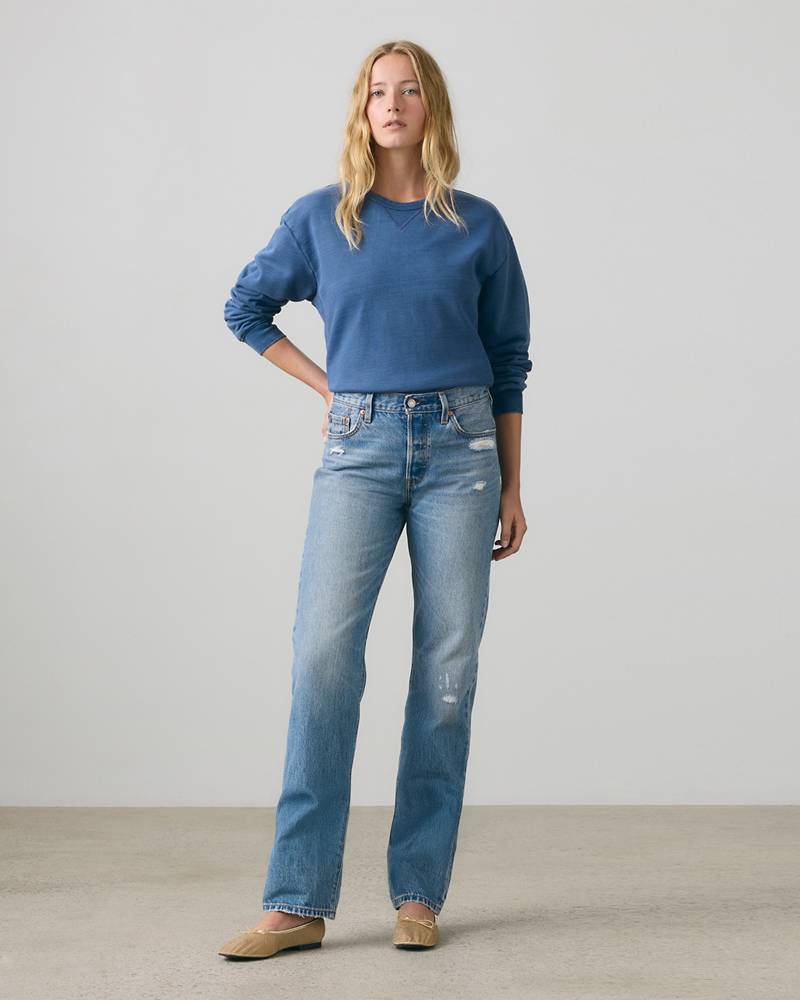
Barrel and baggy legs with a shared knee measurement can sit only 1.3 cm (½ in) apart at the hem. The barrel's curve comes from shaped seams and darts that a factory copies from a reference pair or a paper pattern. Wide and baggy legs cost more than narrow legs for the extra denim in them.
Types of jeans named for a wearer
| Name | Rise | Seat, thigh and leg |
|---|---|---|
| Mom | High | Roomy hip, leg tapered to the ankle |
| Dad | Mid or high | Roomy hip, straight leg |
| Boyfriend | Worn low on the hips | Loose and straight like a men's pair, often cuffed |
| Girlfriend | Varies | A slimmer boyfriend cut |
| Skater | Varies | Baggy and extra long, bunching over the shoe |
Shoppers search for jeans under the names mom, dad, boyfriend, girlfriend and skater. The five names stand for a rise and a leg shape that shoppers recognize. A high-rise taper with roomy hips that is already in your line can go on a product page as mom jeans with no change to the pattern. Customers can check what your mom jean measures when the rise and the leg opening are published beside the name.
Curvy and athletic are fit names that come with a different pattern from the knee up. Either fit is a second pattern that is sampled and graded separately from the regular cut. The curvy version of a cut has more hip and thigh for its waist size and a waistband curved to lie flat at the small of the back. Athletic cuts give men extra seat and thigh over a tapered leg.
Types of jeans by rise
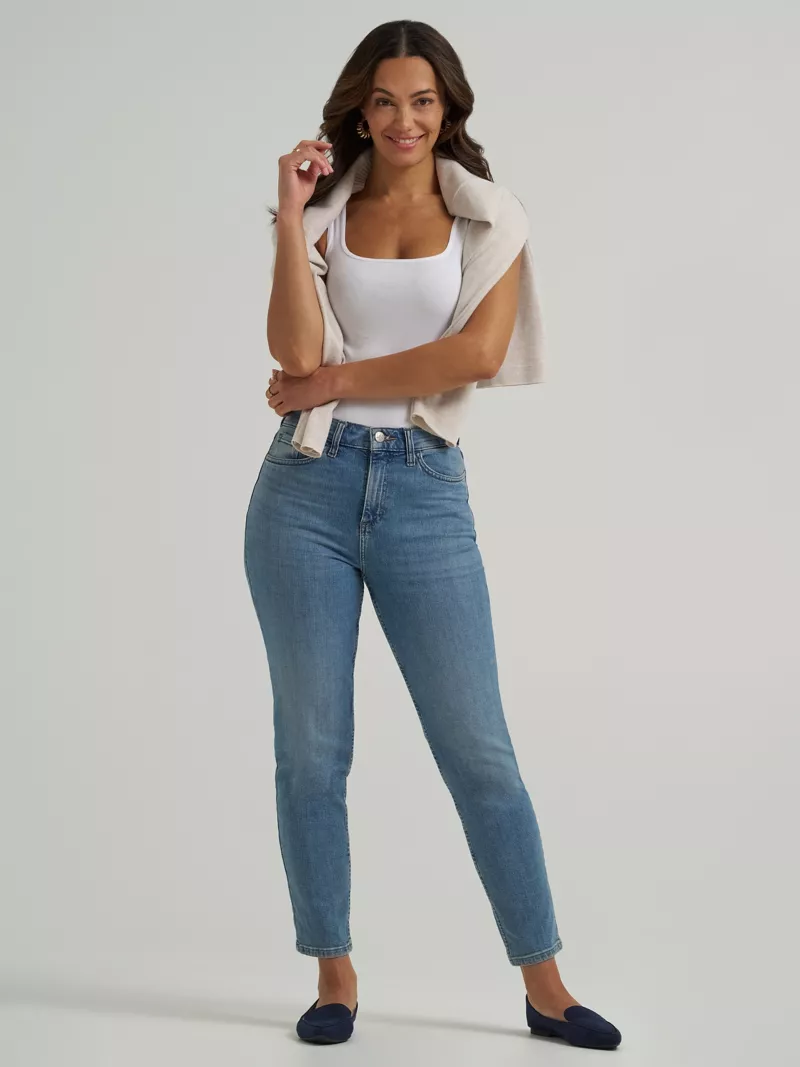
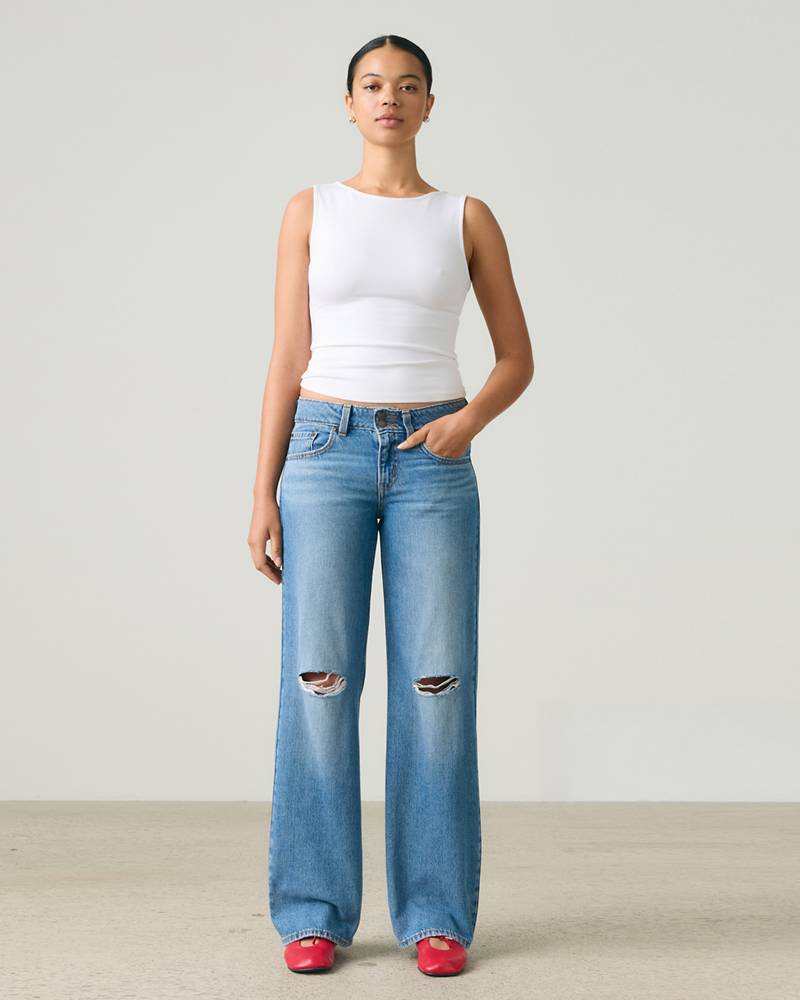
High rise, listed in shops as high-waisted, reaches the natural waist, mid rise stops a little below the navel and low rise sits on the hips. Some brands add super high as a fourth label above high. The front rise behind the label is the length of the front seam between the crotch and the waistband's top edge.
Brands use these labels for where the waistband sits on the body more than for a length on the tape. Levi's calls a 26.0 cm (10¼ in) front rise in women's size 27 a high rise on four of its fitted cuts and a mid rise on its Baggy Dad. Its front rises in that size go from 23.2 cm (9⅛ in) on a low-rise loose pair to 30.5 cm (12 in) on the wide-leg it sells as super high. Any rise sits higher on a short torso. The rise that reaches the waist on a skinny pair stops short of it on a baggy pair that hangs from the hips.
Front rises grow by 1 cm (⅜ in) per size on the chart QVC publishes for one of its women's jeans. Rises quoted for different sizes cannot be compared. Factories that stop the rise at the waistband seam get a shorter figure than factories that measure to the top edge, by the depth of the waistband. The back rise on QVC's chart is 12.7 cm (5 in) longer than the front rise. It covers the seat when the wearer sits. Your choice of rise determines where a tucked shirt or a cropped top meets the waistband and how much height is left for the fly and the front pockets.
Types of jeans by length
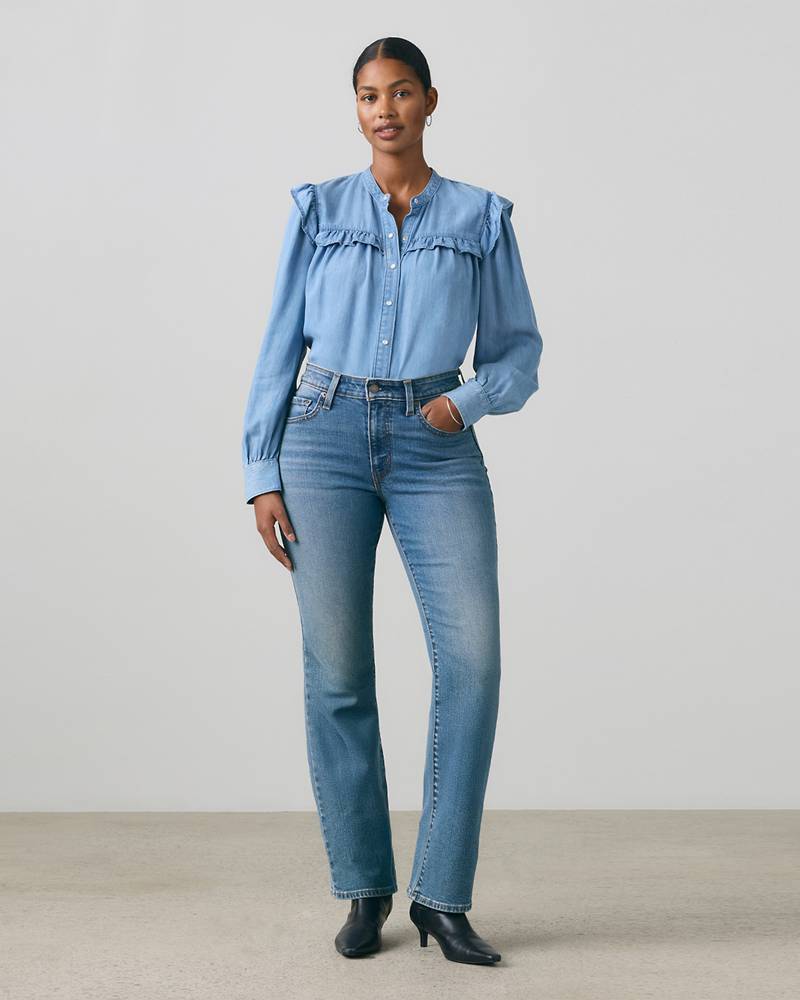
Length names mark where the hem stops: full-length at the foot or over the heel of a shoe, ankle at the ankle bone, cropped a little above it and capri at mid-calf. Wide legs that stop at mid-calf are sold as denim culottes. For the factory, these names are an inseam measured down the inner seam to the hem.
Jeans with wide hems are cut to a longer inseam than narrow jeans in order to cover most of a shoe and its heel. Levi's lists an inseam for its women's flare that is 10 cm (4 in) longer than the inseam of its skinny. Flares cut at the shorter inseam stop above the ankle and are sold as kick flares. Check the length of a bootcut or a flare sample over the shoe it will be worn with. Shoppers judge the length of a flare from the inseam on your product page and from the height of the model in the photo.
| Levi's women's cut, size 27 waist | Leg opening | Inseam | Elastane |
|---|---|---|---|
| Skinny | 25.4 cm (10 in) | 71 cm (28 in) | 2% |
| Straight | 36.2 cm (14¼ in) | 76 cm (30 in) | 1% |
| Bootcut | 45.1 cm (17¾ in) | 81 cm (32 in) | 2% |
| Flare | 52.7 cm (20¾ in) | 81 cm (32 in) | 1% |
| Wide-leg | 55.9 cm (22 in) | 81 cm (32 in) | None |
| Baggy | 61.0 cm (24 in) | 79 cm (31 in) | None |
Cuffed and stacked jeans are cut longer than they are worn, by the depth of the turn-up on a cuff and by the length that a narrow hem holds in folds at the ankle on a stack. Raw hems that are cut and left to fray and split hems with a short slit at the side seam are finishes that leave the inseam as it is. Customers who find a raw-hem pair long can shorten it with scissors.
Men's jeans are sold by waist and inseam, commonly in inseams from 76 to 86 cm (30 to 34 in). Levi's offers several of its women's cuts in three lengths 5 cm (2 in) apart. Shops label them short, regular and long. A single inseam is easiest to sell in ankle and cropped styles, because a hem that lands 2 cm (¾ in) high or low on a customer still reads as cropped.
The denim in a pair of jeans
Mills describe denim by how much a square yard weighs in ounces (oz/yd²) or a square meter in grams (g/m²). The trade calls denim of 410 to 540 g/m² (12 to 16 oz/yd²) midweight and names lighter and heavier denim accordingly. One oz/yd² is 33.9 g/m². Midweight denim goes into most of the jeans people wear day to day and the lighter weights into summer pairs and jeggings. Anything heavier takes months of wear to soften. Shoppers who buy rigid jeans compare pairs by the ounce figure in the listing.
Stretch denim differs from rigid denim, the trade's word for denim without stretch, by the elastane (spandex in American usage) inside the yarns that cross the leg. Cuts that hug the thigh need the stretch at the knee and the seat for the wearer to sit and bend, and a skinny hem lets a foot through only when the denim stretches. Wide and baggy cuts can be made without it. Jeggings, which close with a real fly or a plain elastic waistband, need the most stretch of any jeans and are sewn from thin, highly elastic denim or from a knit printed to look like denim.
The elastane percentage on a fabric sheet is a poor measure of how much stretch the denim has. Levi's sells a women's denim with 1% elastane as low stretch and another with 1% as high stretch. Stretch and recovery are the figures to put on an order for stretch denim. Mills test a denim for how much it stretches and for its recovery, which is how much of that stretch it gives back and what keeps the knees from bagging.
Sample a wide or a barrel leg in the denim that the bulk order will be cut from. Both shapes stand away from the body in stiff denim and collapse toward it in soft denim. Barrel legs sewn in a soft stretch denim read as plain loose legs. Lyocell blended into the cotton makes a denim softer and more fluid than cotton alone.
Selvedge and raw turn up together in product names and mean two separate things. A selvedge pair can be washed and a raw pair can be cut from ordinary wide denim. Jeans in raw denim were never washed after sewing. Customers who know the term complain when a washed pair is listed as raw. Selvedge denim comes off a narrow shuttle loom with a closed strip along its edge that shows on the turned-up cuff of raw and washed jeans alike. Most denim leaves the mill preshrunk under the name sanforized. Denim that was not preshrunk shrinks as much as 10% the first time it is soaked, and jeans sold as shrink-to-fit are cut larger to allow for the loss.
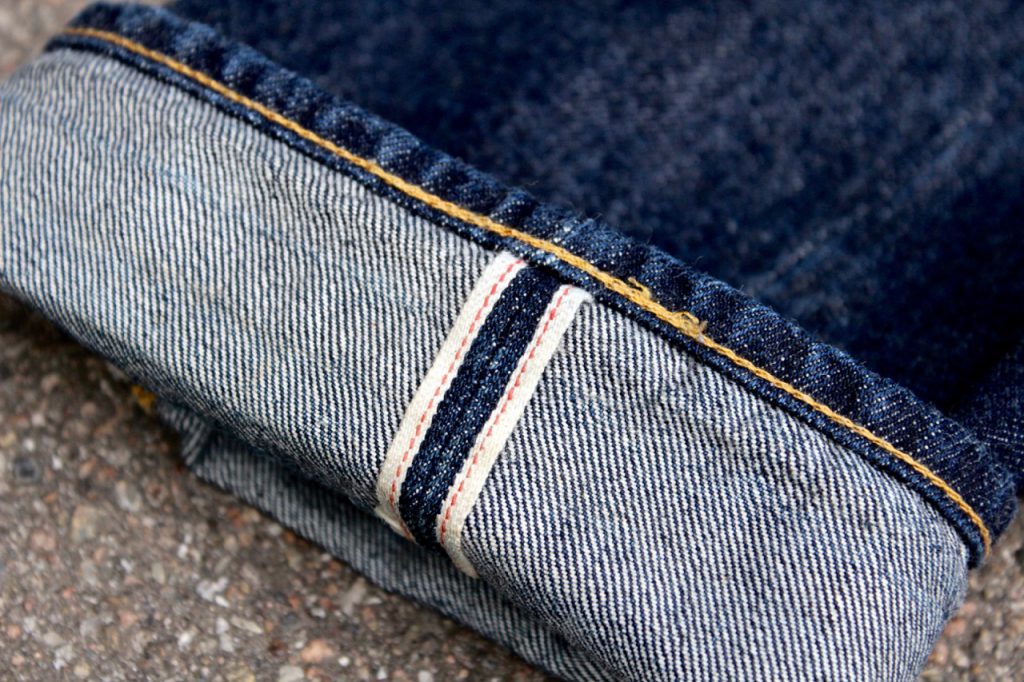
Indigo stays in the outer layer of the lengthwise yarns of blue denim and rubs away to their white core with wear and washing. Laundries take some of it off first. Black jeans get their color from sulfur dye and ecru jeans from undyed cotton. White and colored jeans are bleached or dyed a solid shade through the whole fabric.
Wash names
The wash in a product name is the treatment a laundry gave the jeans after they were sewn. It sets the softness and the final size of the pair along with the color. Only raw jeans skip it. Dark wash and light wash are names for the depth of blue it left.
| Wash or finish | Process | Result |
|---|---|---|
| Rinse | Short wash with no abrasion | Dark blue, softer hand |
| Stone | Tumbling with pumice stones | Faded surface, worn seam edges |
| Enzyme | Cellulase enzyme in the bath, few stones or none | A stone-wash fade with less wear |
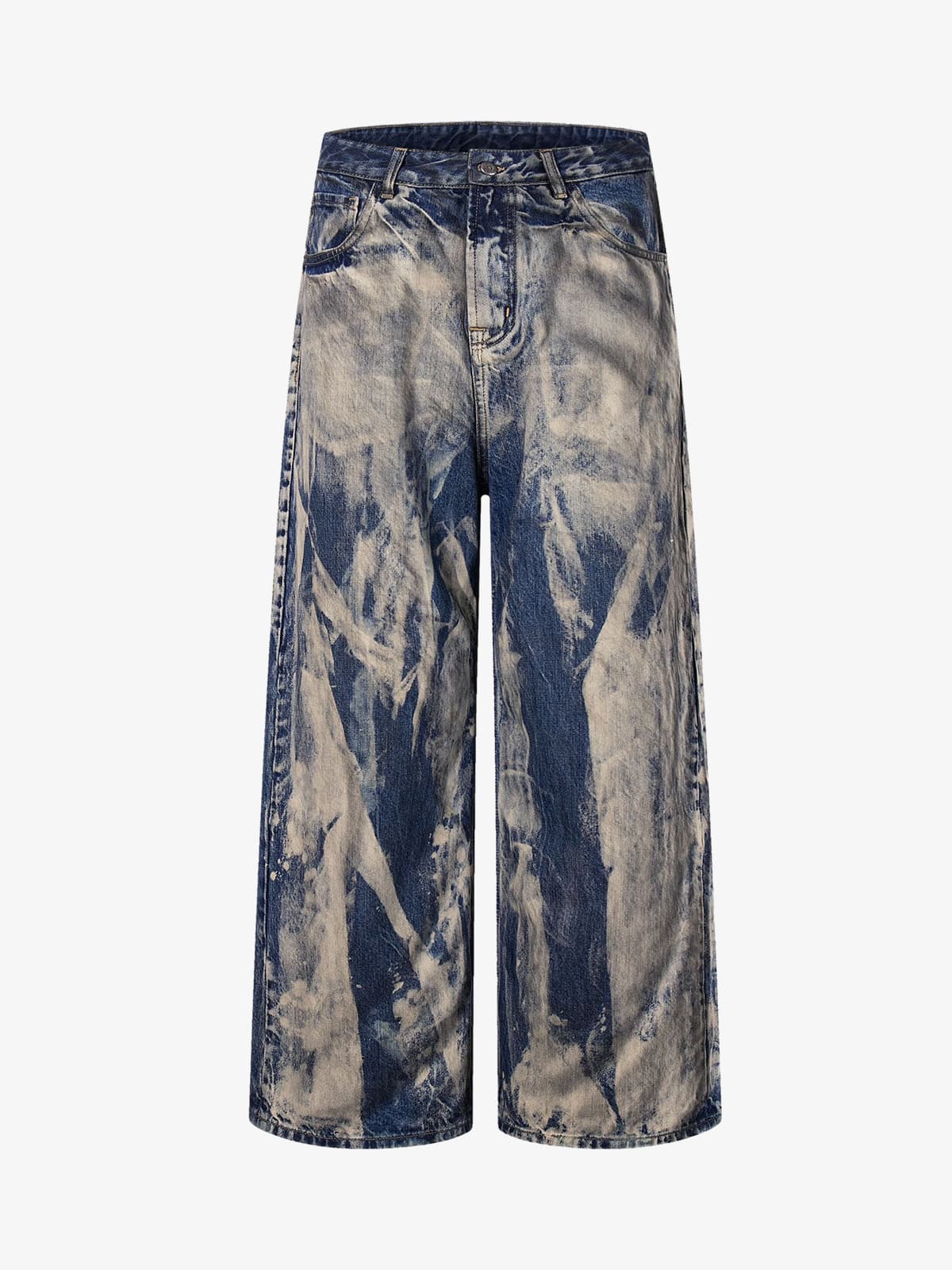
| Acid or snow | Pumice soaked in a bleaching agent | Pale marbling over dark denim |
| Bleach | Bleach in the bath | A lighter blue over the whole pair |
| Whiskers | Hand sanding or laser before the wash | Pale creases fanning out from the fly |
| Distressing and rips | Abrasion or cuts by hand | Worn patches, frayed holes |
| Coating | Resin or wax over the denim | A leather-like sheen |
| Prints, embroidery, appliqué, studs | Decoration on the fabric or the sewn pair | Goes on any cut in any wash |
Your factory gets a process from the wash name and matches the shade to a washed pair you have approved. Shade varies a little from load to load, so you approve a lighter and a darker pair as the limits beside the standard. Recipes approved on one denim come out a different shade on another.
Wash prices rise from a rinse with the chemicals and machine time that a heavier fade takes. Hand work such as whiskers and rips is done pair by pair and costs more than a tumbled wash that treats a whole machine load at once.
Patterns are drawn longer than the finished pair to allow for the shrinkage in the wash. Factories set the allowance from a wash test on the denim of the order. If you change the wash after sampling, the allowance changes and a new sample is needed. The measurements on your size chart are taken after the wash has shrunk the jeans, mostly in length.
Constructions beyond five pockets
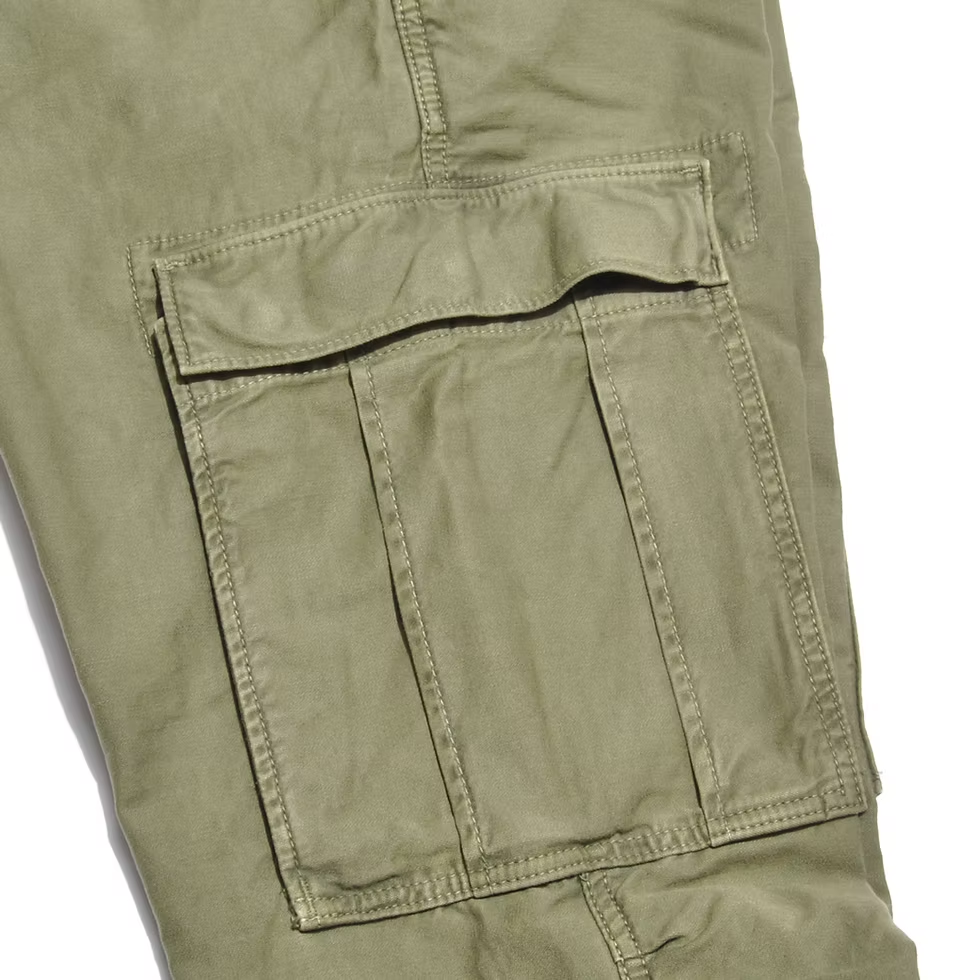
Five-pocket jeans have two curved front pockets, a coin pocket inside the right-hand pocket and two patch pockets on the seat. Workwear builds add parts to that base. Cargo jeans get flapped pockets on the thigh with side pleats that let them open outward, carpenter jeans a hammer loop and a narrow tool pocket on the side seam, and double-knee jeans a second layer of denim over the front of the knee. Factories price builds by pieces and sewing time. A cargo version of your straight jeans therefore costs more than the plain version. Cargo pockets need the thigh room of a loose or wide leg.
Waistband pleats and slanted side pockets turn jeans into denim trousers or pleated jeans. Patchwork and paneled jeans have legs pieced from several denims or washes. Pairs in mixed washes are sewn from pieces that were washed first. Each wash in a paneled pair is approved against its own shade standard.
Cuts for a first order
Leg shapes that fashion writers have moved past keep selling in volume for years. Sales of women's skinny jeans in the United States fell 22% through September 2023 by Circana's retail tracking and still made up 30% of women's jeans sales. Women's jeans as a whole were down 3% over those months. Bootcut, wide-leg and flare jeans together held a 23% share that was 13 points above 2019. Your line can add wide legs and keep a narrow cut for the customers who have not switched.
Cuts that share a denim cost the least to add to a first order. The loose cuts and the straight can come from a rigid midweight denim, but a skinny brings in a stretch denim and a second round of wash approval. Every added inseam or wash multiplies your stock. Six waist sizes of a cut become 18 sizes with three inseams and 36 with a second wash.
Your factory receives a cut as measurements of the base size that the first pattern is drawn in: waist, seat, thigh, knee, leg opening, inseam, front rise and back rise. You get those eight numbers quickest from a washed pair that already fits your customers, measured flat. The base size, near the middle of the size range, is the size of the sample you approve. Other sizes are graded from it by a fixed step per measurement. On QVC's chart, the thigh gains 1.9 cm (¾ in) per size up to size 12 and the leg opening 0.6 cm (¼ in). Legs therefore taper more in the large sizes than in the base size, and you see that only on a sample in the largest size.
Sources
- Levi Strauss & Co., women's jeans guide and product pages, measurements for size 27
- Levi Strauss & Co., men's jeans guide and product pages, measurements for size 32
- Circana, The Future of Skinny Jeans, October 2023
- Denimhunters, Denim Weight
- Denimhunters, Sanforized and Unsanforized Denim
- QVC, garment specifications for item A704909