What Is Selvedge Denim?
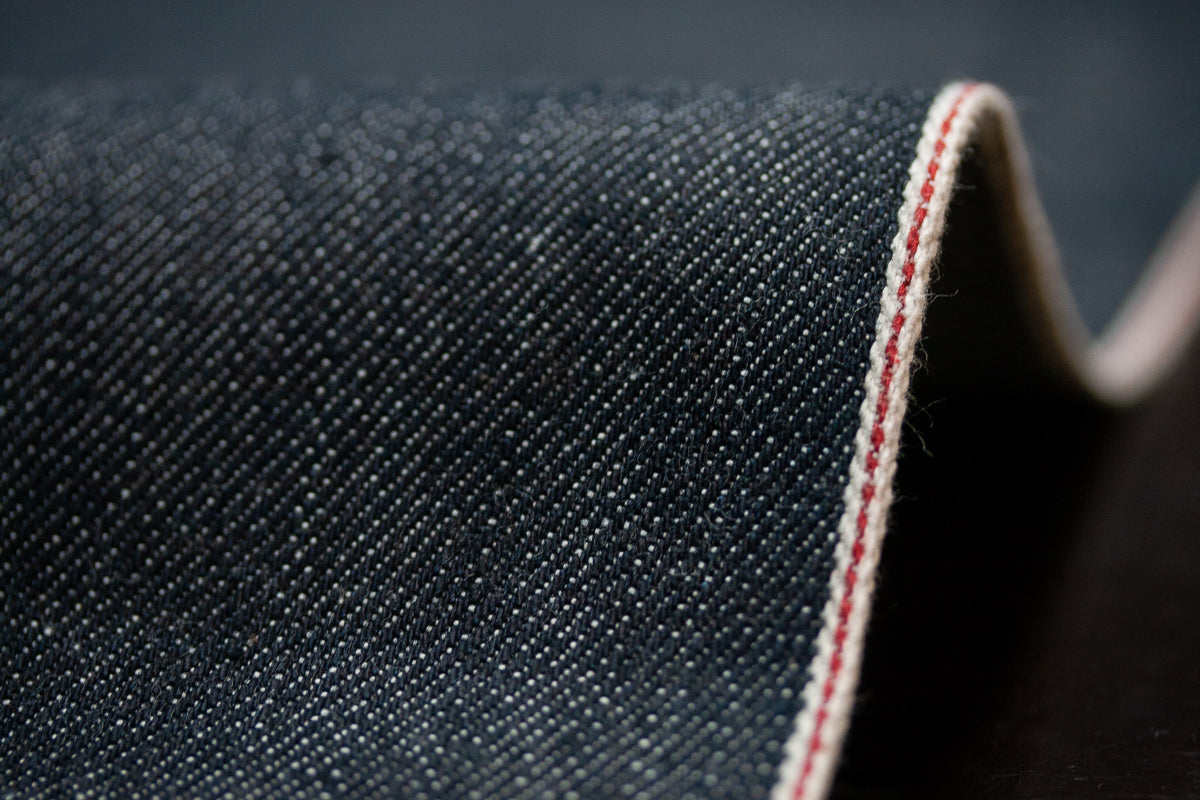
Selvedge denim is denim woven with a self-finished edge, traditionally on narrow shuttle looms. These rolls are commonly around 70–80 cm wide, with the finished edge running along both sides of the cloth.
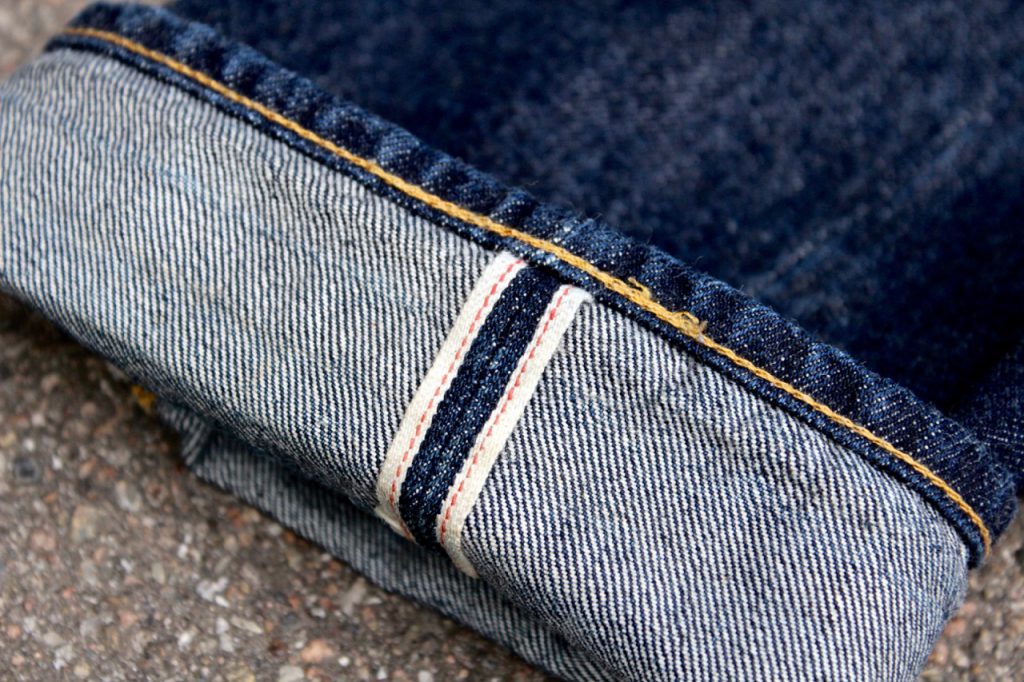
When jeans are cut, the outside edge of a trouser leg can be placed directly beside that woven boundary. After sewing, the selvedge runs inside the outseam, and turning up the hem exposes part of the original fabric edge.
The name comes from self-edge.
The colored yarn often running through it is known as the selvedge ID. Fabric weight, twill, yarn texture, indigo dyeing, shrinkage and finishing all come from other parts of the denim construction.
How the Edge Forms on the Loom
Warp yarns run lengthwise through the loom under tension while the shuttle carries the filling yarn across them. When it reaches the outer warp area, the filling yarn turns and travels back through the next pick, repeating the same movement as weaving continues.
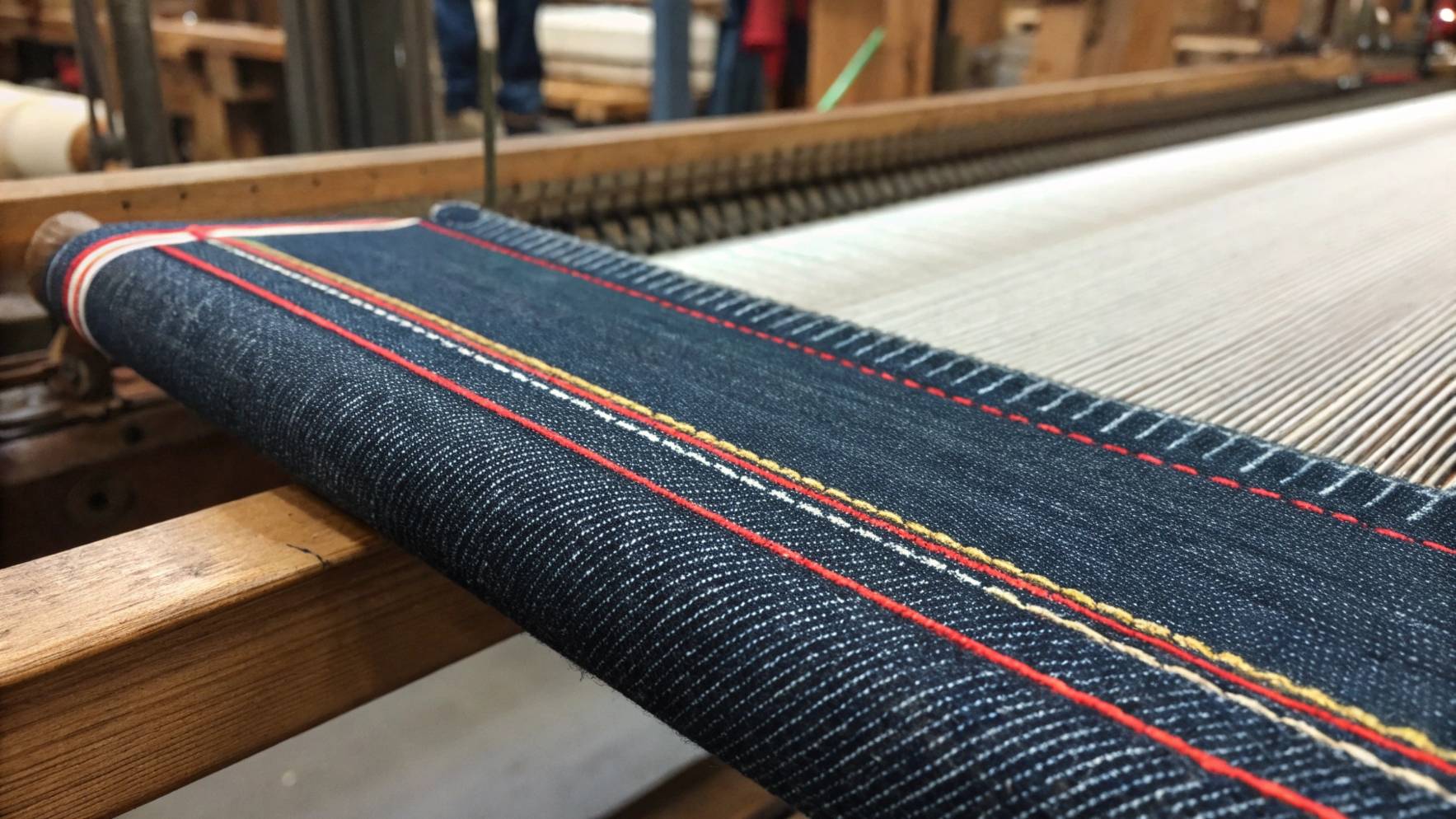
Those returns hold the side of the cloth together because the filling yarn remains continuous around the edge instead of ending there as a row of loose cut yarns.
If a strip is cut from the middle of a denim roll, the new edge immediately exposes yarn ends that can begin to fray. The original selvedge is already closed by the weave itself.
Traditional shuttle looms commonly operate around 140–160 picks per minute. Historical operating looms documented by the U.S. National Park Service run around 140–150 picks per minute.
For denim woven at 40 filling picks per inch, a loom inserting 150 picks each minute has a theoretical cloth advance of:
150 ÷ 40 = 3.75 inches per minute
Actual production is lower once normal loom stops, efficiency losses and the settings required for a particular fabric are included.
What a 31-Inch Roll Means in the Cutting Room
One current commercial selvedge denim is listed as:
100% cotton / 14 oz / 31–32 in width / 7 × 6 / Z-twill
That width is roughly 79–81 cm.
A trouser back already occupies considerable room through the seat and thigh, and the leg has to remain aligned with the warp direction. The pattern edge intended for the outseam also stays close to the selvedge, which leaves less freedom to move large pieces around the marker.
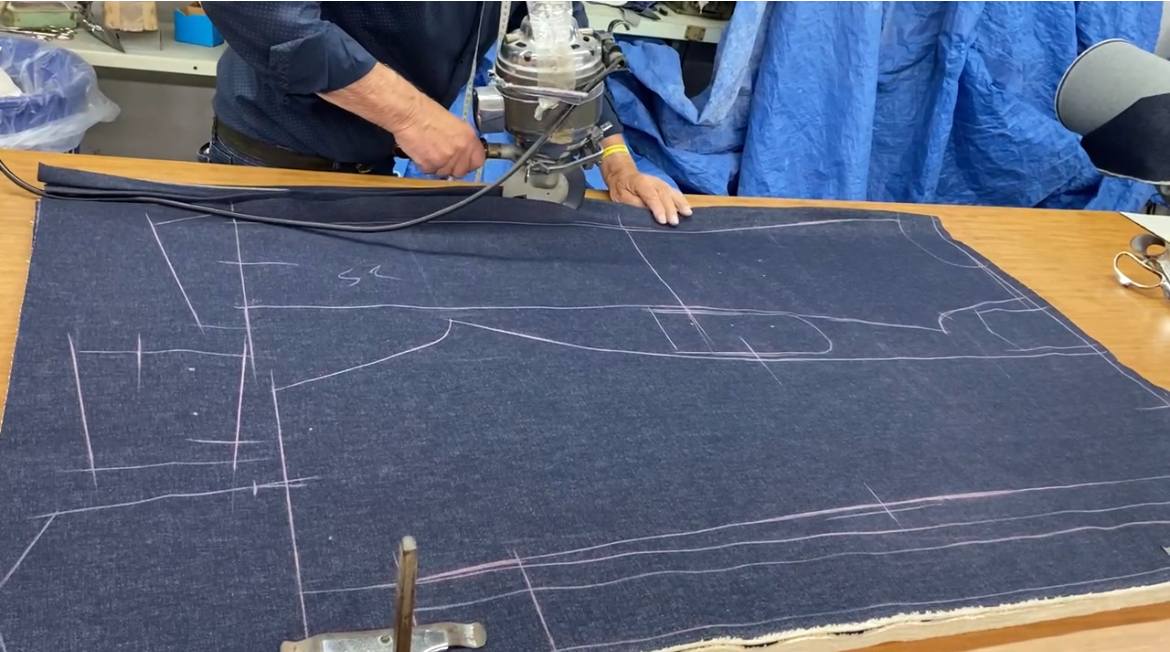
Loose fits use even more width through the thigh and hem. The marker still has to accommodate the waistband, yoke, fly components, pockets and belt loops in whatever spaces remain.
Grading the pattern upward can change the layout again because the hip, thigh and rise grow while the roll stays the same width.
One Running Meter of Narrow Selvedge
At 79 cm usable width, one running meter contains:
1.00 m × 0.79 m = 0.79 m²
A jeans marker never uses every square centimeter of that area. Crotch curves leave awkward spaces, tapered legs create wedges of unused cloth, grain direction restricts rotation, and the selvedge requirement fixes one side of selected panels near the fabric edge.
For that reason, a relaxed wide-leg jean can require noticeably more running length than a narrow straight style cut from the same roll.
Actual consumption comes from the completed marker for the final pattern and size range.
Why the Selvedge Ends Up in the Outseam
The cutter places the relevant leg edge beside the woven boundary, so the selvedge remains attached to that side once the panel is cut.
During sewing, the front and back legs are joined at the outseam. The woven strip ends up inside the seam simply because it was already sitting on that edge of the pattern at the cutting table.
At the bottom of the leg, the hem folds over the same area. Cuffing the jeans exposes part of the original side of the roll.
Faster Weft Insertion Changed Denim Production
Large denim mills eventually moved toward faster ways of inserting the filling yarn.
| Loom type | Typical speed |
|---|---|
| Air-jet | 600–800 picks/min |
| Rapier | 500–700 picks/min |
| Projectile | 300–500 picks/min |
| Traditional shuttle loom | About 140–160 picks/min |
Traditional shuttle weaving near 150 picks per minute operates at a much slower pace because the shuttle carries a yarn package through the shed and has to cross the loom repeatedly.
Modern systems use air or lighter mechanical carriers, allowing mills to run faster and weave substantially wider fabric. That combination suited high-volume jeans production much better.
Narrow shuttle-woven denim later found a different place in the market through Japanese mills, reproduction jeans, raw denim and heritage-focused brands.
The Colored Yarn Inside the Edge
The colored yarn woven into the selvedge is usually called the selvedge ID.
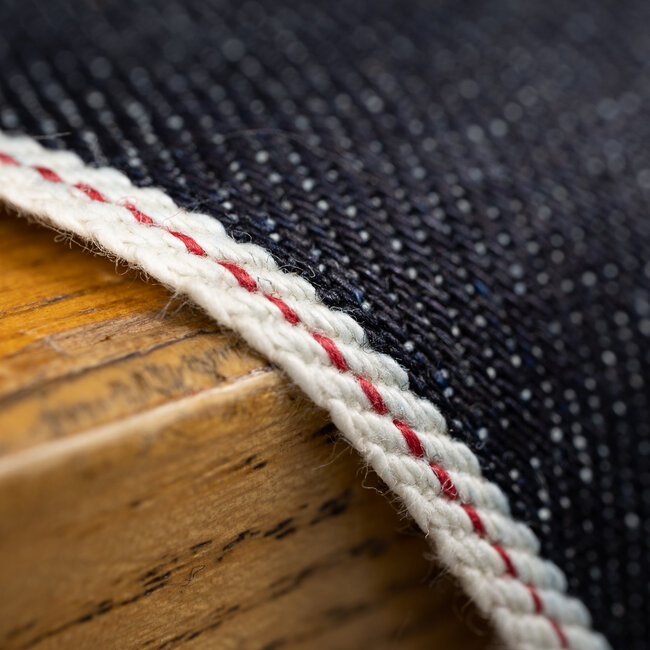
Red became the version most people recognize through American denim history, although current fabrics also use green, blue, gold, pink and other colors.
Historically, mills could use ID colors to distinguish fabrics or customers. Modern brands may choose a color simply because it belongs to a particular fabric or collection.
The ID yarn occupies only a narrow part of the woven boundary.
What 14 oz Tells You
Fourteen ounces per square yard is approximately:
14 × 33.9 = 475 GSM
Typical 14 oz bottom-weight denim can sit around 55–64 warp ends per inch and 38–42 filling picks per inch.
Ends per inch describe warp density across the width, while picks per inch describe filling density along the length. Yarn count then changes how those 475 grams are distributed through the structure.
A mill can therefore arrive at a similar finished weight using another combination of yarn size and density.
Commercial mill cards sometimes contain shorthand such as 7 × 6. That notation should stay exactly as the supplier defines it instead of being reinterpreted later in production.
Twill Across the Fabric Face
Classic jeans denim commonly uses a 3×1 warp-faced twill, which lets more of the indigo warp show on the face and creates the familiar diagonal line.
Right-hand twill is widely used in jeans. Some fabrics reverse that diagonal into a left-hand construction, and broken twill changes direction inside the repeat to create a subtle zigzag.
Broken twill also reduces some of the directional torque that can become visible after laundering.
Where the Surface Texture Comes From
Slub yarn contains planned changes in thickness, so using it in the warp can produce vertical streaks, raised areas and irregular lines across the face of the cloth.
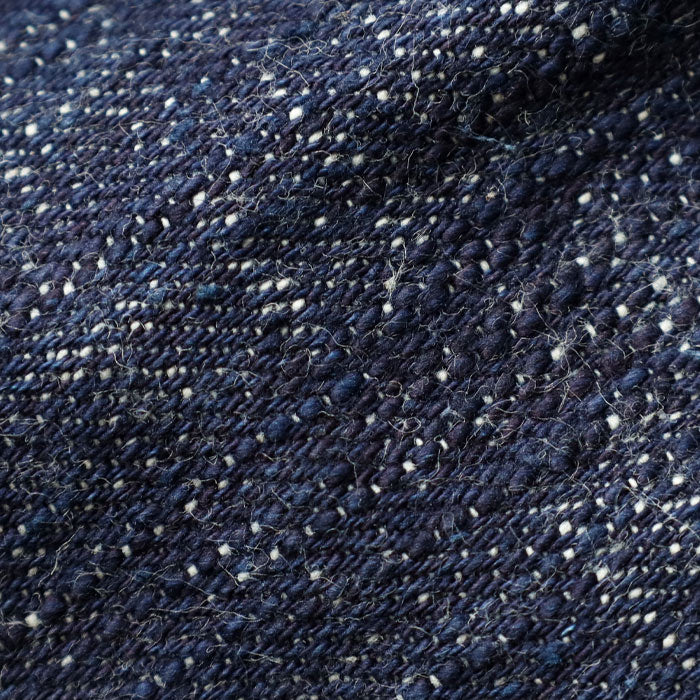
Ring spinning adds another layer of yarn character, while warp density determines how closely those yarns are packed.
Finishing changes the surface again. Singeing removes projecting fibers, sanforization compresses and stabilizes the cloth, and washing relaxes the weave enough to make slub variation more obvious.
A large part of the texture associated with heritage denim is already built into the fabric before sewing begins.
Inside a Rope-Dye Range
A rope can contain roughly 300–400 warp yarns, and industrial ranges may carry 25–50 ropes through the machine at the same time.
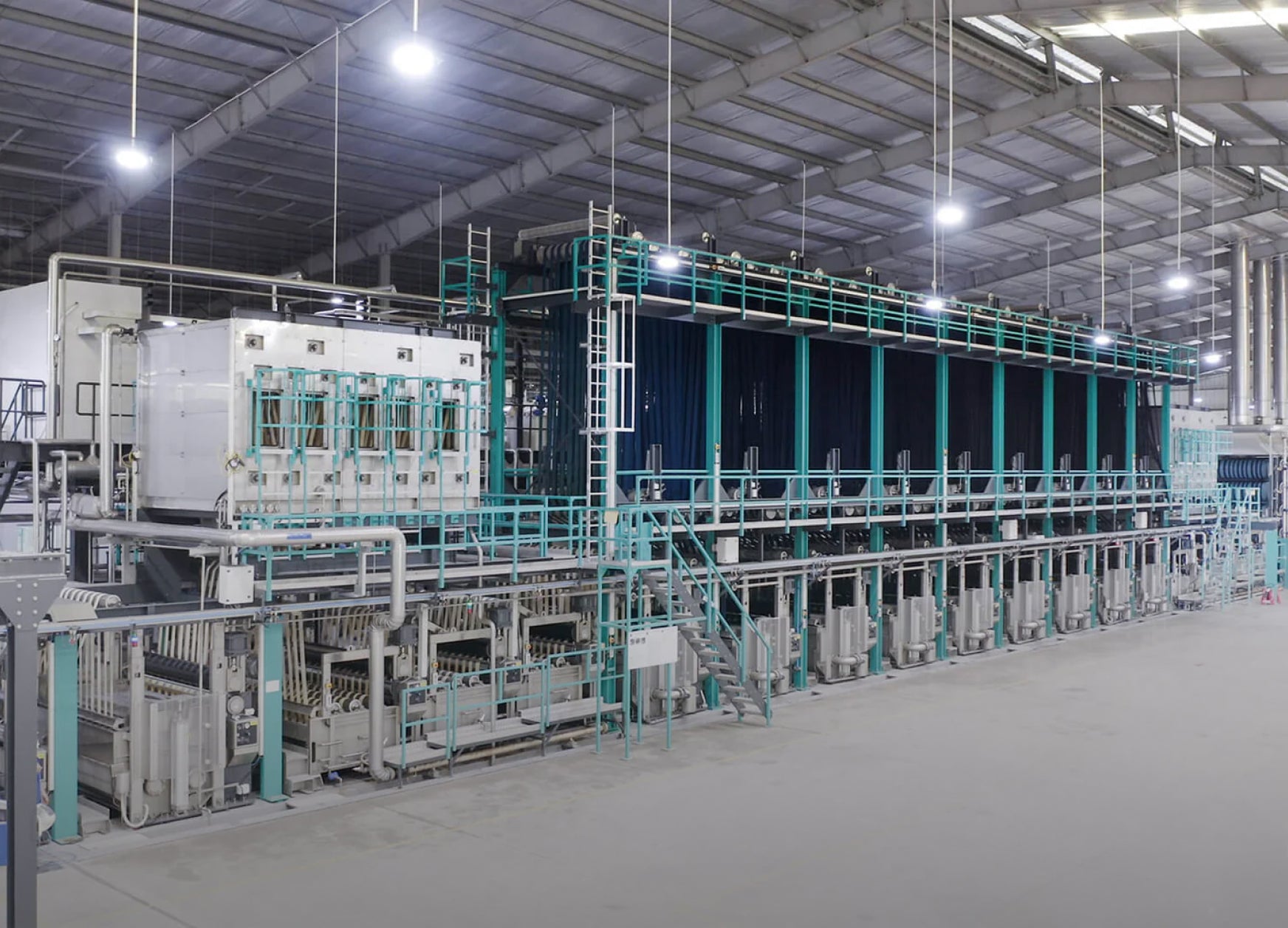
In one documented process, the rope remains submerged in reduced indigo for roughly 15–20 seconds before moving into air, where oxidation turns the dye blue again.
Another dye box follows, and the sequence can repeat several times. Some documented production uses as many as eight dips.
Current industrial rope-dye equipment can be configured with 6–12 boxes, reach 14 indigo dips, and operate at line speeds around 50 m/min.
The final shade depends on the mill's actual combination of indigo concentration, reduction chemistry, immersion time, oxidation time, yarn count and number of dye cycles.
How Wear Reaches the Pale Yarn Core
Rope dyeing can leave much of the indigo concentrated near the outside of the cotton yarn, with the deeper part of the yarn remaining lighter.
Everyday movement gradually removes surface color from the areas that rub and fold most often. Knees develop repeated crease lines, the fabric behind the knee can form honeycomb patterns, and the upper thigh picks up wear from sitting and walking. A phone or wallet can also leave a recognizable outline after enough repeated pressure in the same pocket.
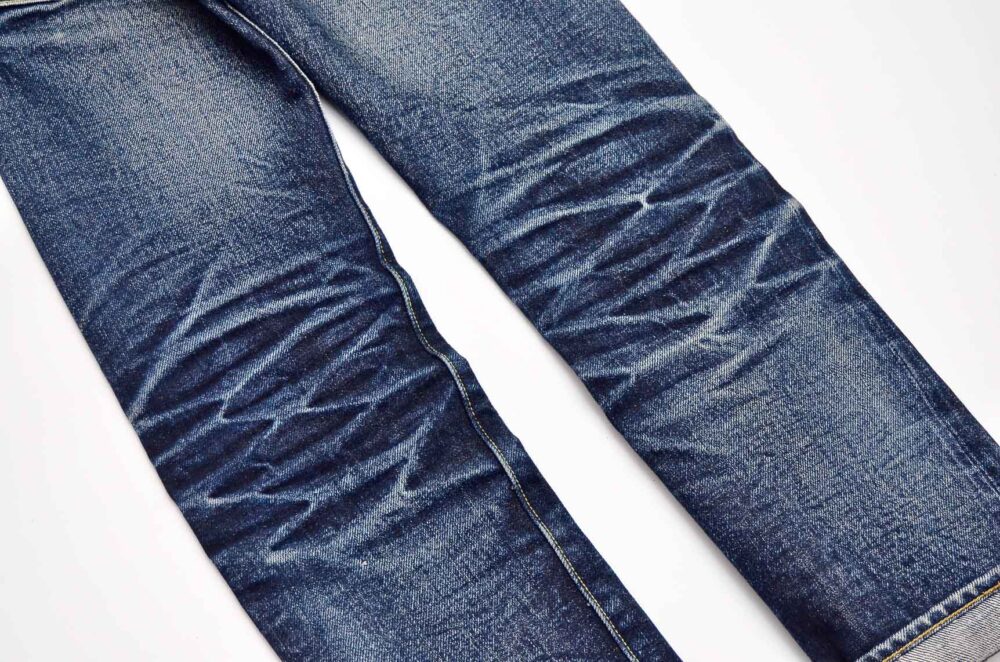
How quickly those areas lighten depends on dye penetration, yarn structure, fit, washing frequency and actual wear.
Loomstate, Sanforized, Raw and One-Wash
Loomstate describes denim that remains close to its condition after weaving.
Sanforization mechanically stabilizes the fabric so less dimensional change remains for later washing.
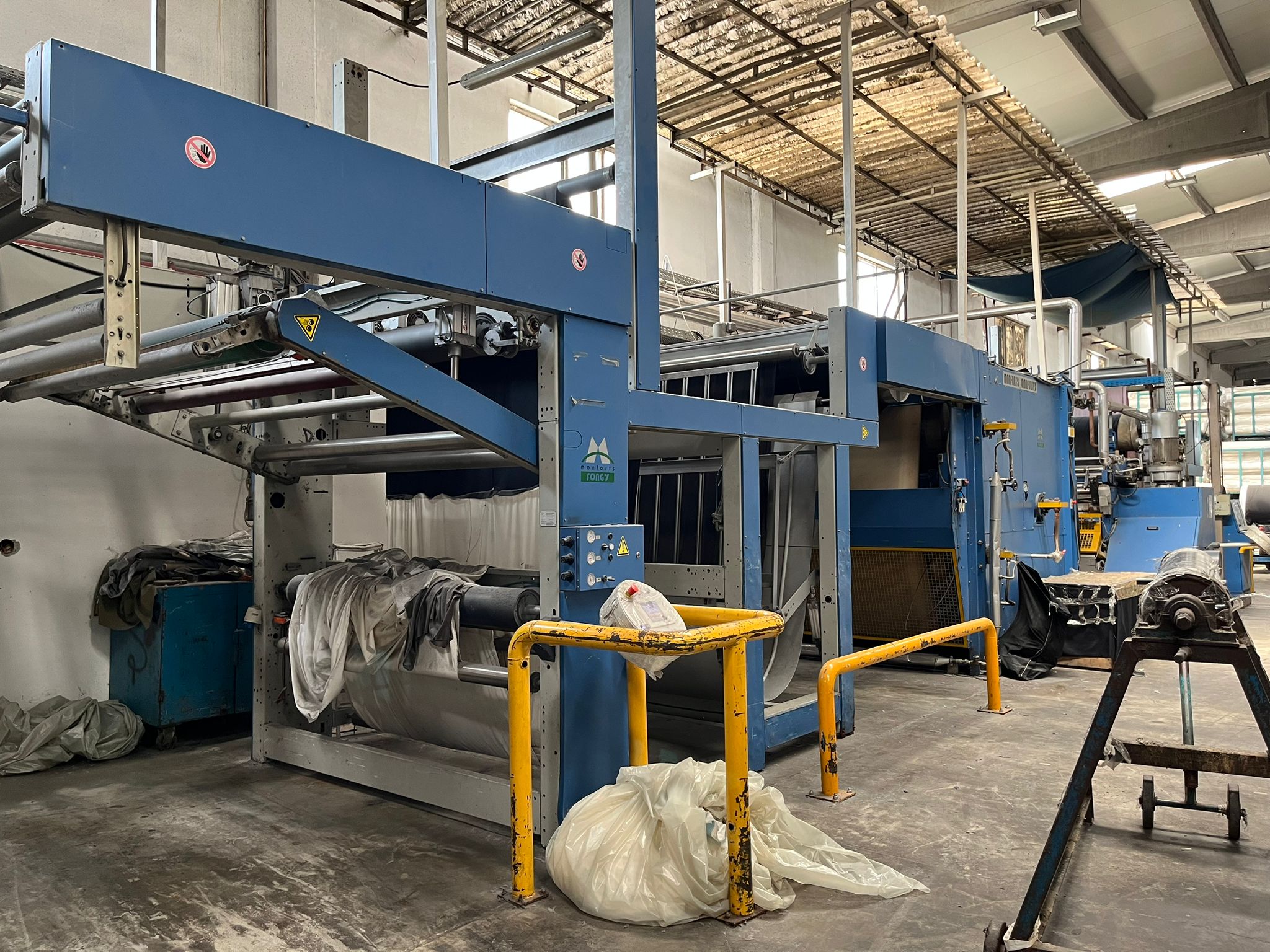
Raw or dry denim reaches the customer without the usual garment washing and artificial distressing used to create a worn appearance.
One-wash means the fabric or completed garment has already gone through an initial wash before sale.
An unsanforized garment may be cut and sewn first, washed once at the factory, and then measured for sale. A sanforized pair can still be sold raw if no appearance wash has been used.
Real Shrinkage Around an Unsanforized Jean
One current 18 oz unsanforized selvedge jean publishes first-soak changes by measurement point rather than reducing the whole garment to one percentage.
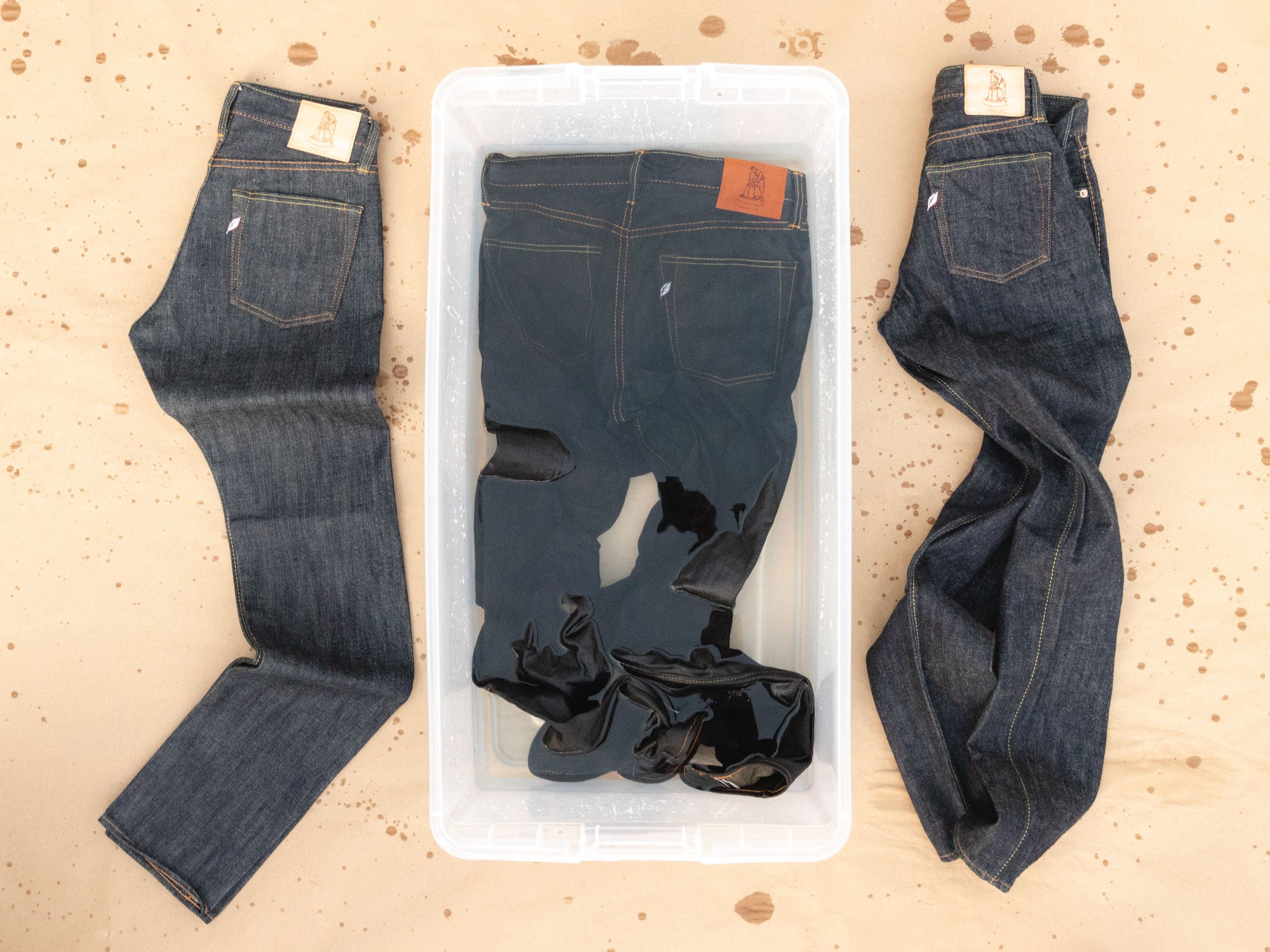
Its waist is expected to lose about 1–2 inches, while the inseam is listed at roughly 1.5–2.5 inches of change. Rise, thigh, knee and leg opening move by around 0.5 inch in the same product guidance.
Wear can later bring the waist back toward its original raw measurement.
In production, the sample room measures fixed points before treatment and returns to those exact positions after the specified soak or wash. A typical sheet records waist, front rise, back rise, hip, thigh, knee, inseam, outseam and leg opening, with water temperature, agitation and drying method kept beside the measurements.
A Real 12 oz Denim That Finishes Around 14 oz
Benzak Denim Developers publishes an unsanforized selvedge program that weighs approximately 12 oz/yd² before washing.
During the factory pre-wash, the cloth contracts and packs more yarn into the finished area. Once the garment reaches its final dimensions, Benzak describes the denim at approximately 14 oz/yd².
The company states that this particular fabric can shrink by up to 10% during the first wash, and the pattern is developed around the dimensions expected after that treatment.
For a production record, the ounce figure therefore needs the stage at which it was measured.
Recording Skew After Washing
Twill structure and yarn torque can move the fabric as it relaxes during laundering, sometimes rotating the trouser leg enough to change where the seams hang.
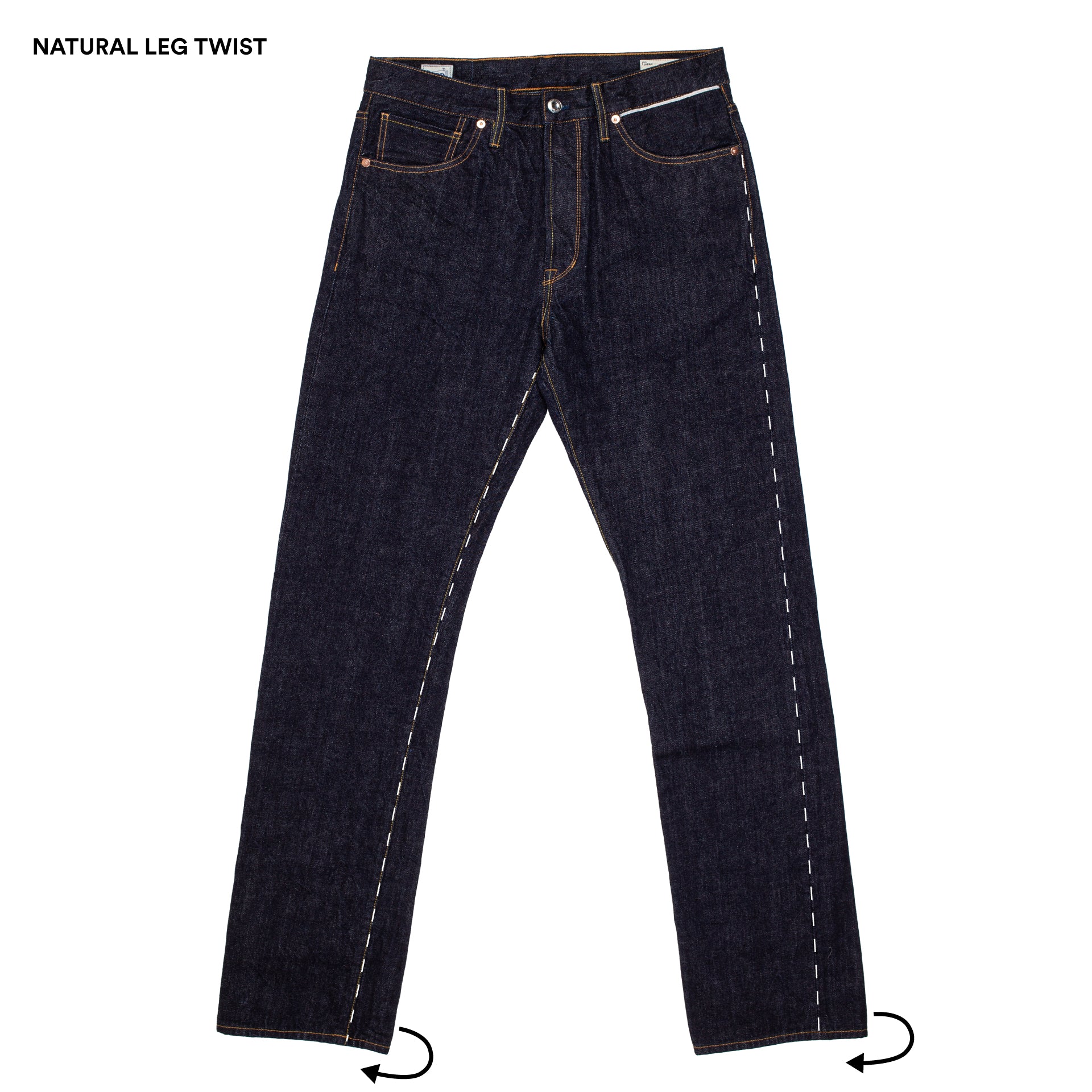
AATCC TM179-2025 measures change in fabric skew after home laundering. The specimen is marked before treatment, washed under the defined procedure and measured again afterward.
Finished garments can also be checked for seam twist when the behavior of the complete sewn leg matters.
Stretch Selvedge in a Finished Roll
One current Naked & Famous Japanese selvedge uses:
12.5 oz / 98% cotton / 2% elastane / shuttle-loom woven
The finished roll still needs measured extension and recovery before a slim pattern is developed around it.
ASTM D3107-26 covers woven stretch, growth and recovery and includes test tension options of 1.35 kg / 3 lb and 1.8 kg / 4 lb.
Those results give the pattern maker the usable stretch and residual growth of the cloth being cut.
Where Heavy Denim Challenges the Sewing Machine
A flat 14 oz denim weighs about 475 GSM.
At the hem, that material is folded into several layers, and the outseam runs directly through the stack. The machine has to maintain feeding and stitch formation while the thickness changes over a very short distance.
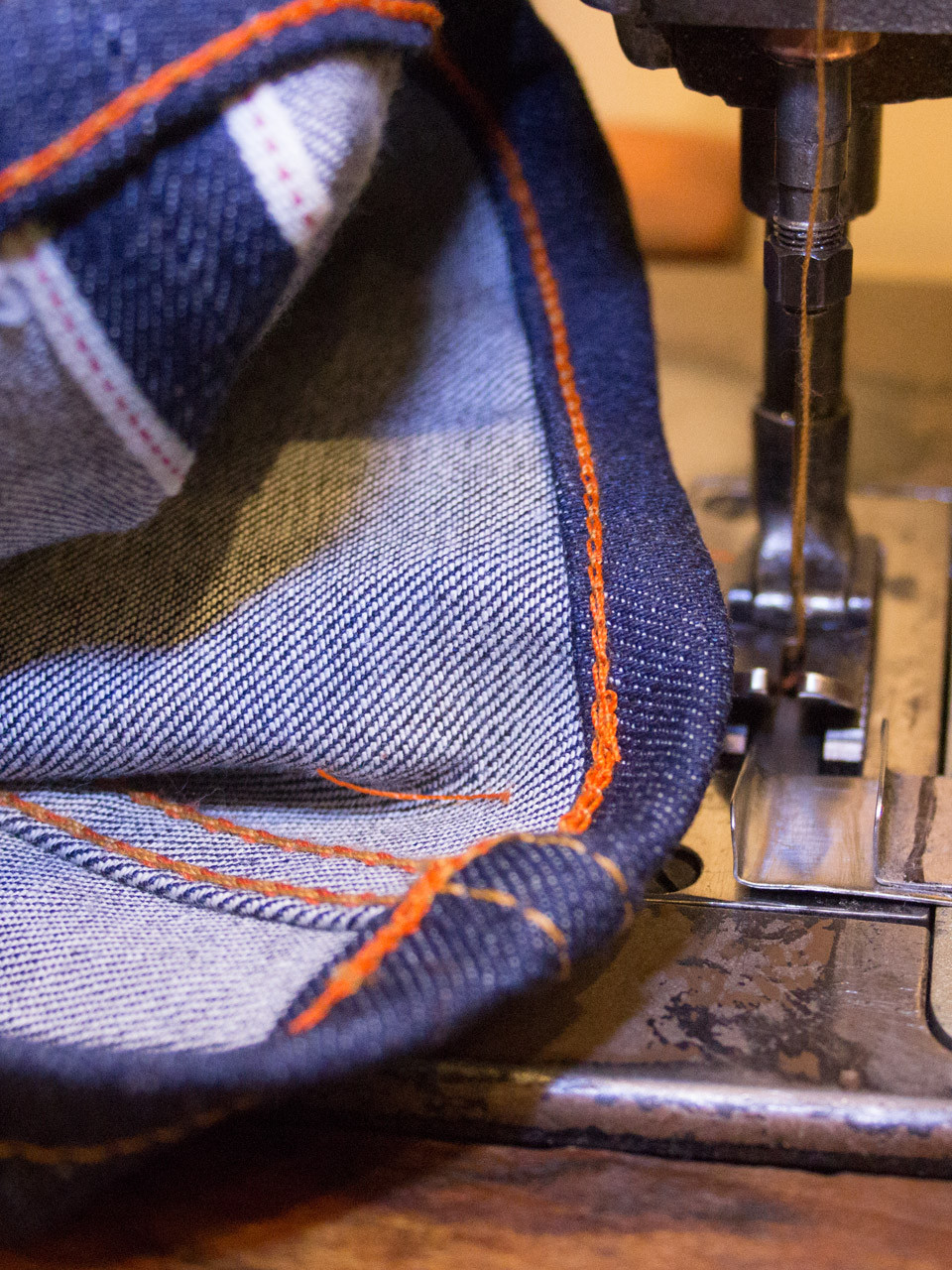
Coats' industrial jeans guidance commonly uses around 10–12 stitches per 3 cm for many sewing operations.
Published outside-leg setups using a 401 stitch include Nm 125–140 needles with heavy needle thread around Tex 105. Seat and riser seams can use a 401 × 2 construction within the same general needle range.
A production trial is sewn through the actual hem and outseam intersection because that is where needle penetration and feeding become harder to control.
What Belongs on a Selvedge Denim Specification
A detailed material line might read:
100% cotton / 14 oz finished weight / 79 cm usable width / 3×1 right-hand twill / slub warp / rope-dyed indigo warp / natural filling / red-ID selvedge / sanforized
The mill may also provide yarn construction, ends and picks per inch, dimensional-change results, skew, tensile strength, tear strength and crocking.
For stretch selvedge, the finished-roll extension and recovery results belong with the fabric record. Unsanforized programs carry their before-and-after garment measurements together with the exact wash procedure used.