What Is Screen Printing and What Do the Screens Cost?
A four-color chest logo on 50 white T-shirts needs four screens before the first shirt is printed. Screen printing pushes ink through a stencil on a fine mesh screen. A screen prints one color. The four cost $60–180 at $15–45 apiece, and the 50 shirts share that setup at $1.20–3.60 a shirt.
From artwork to screen
Screen printers split the artwork into one film per ink color and coat a frame of fine mesh, usually polyester, with light-sensitive emulsion. Ultraviolet light shone through the film hardens the emulsion except where the artwork blocks it. The emulsion left soft there washes out with a water spray. The open mesh that remains is the stencil for that color.
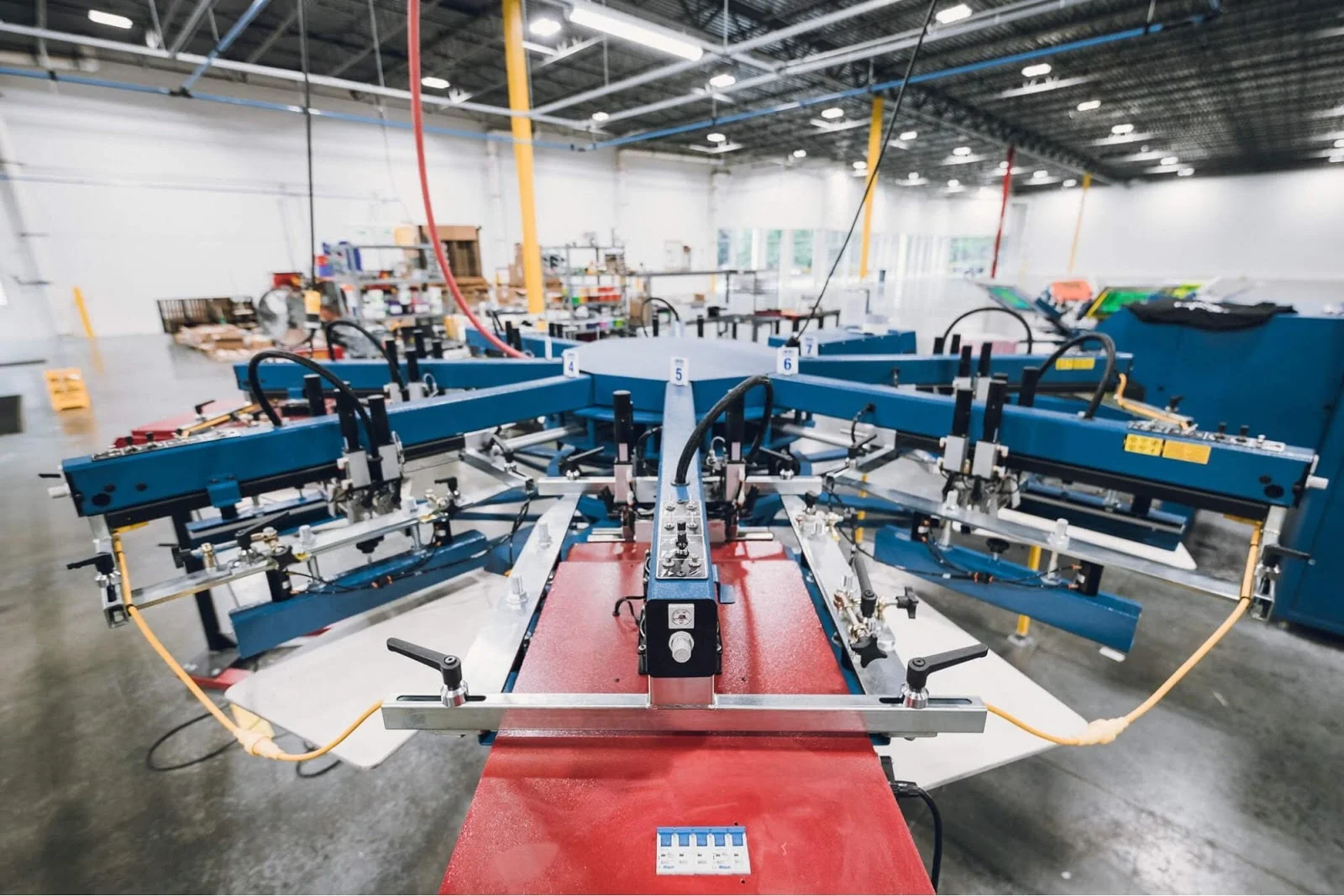
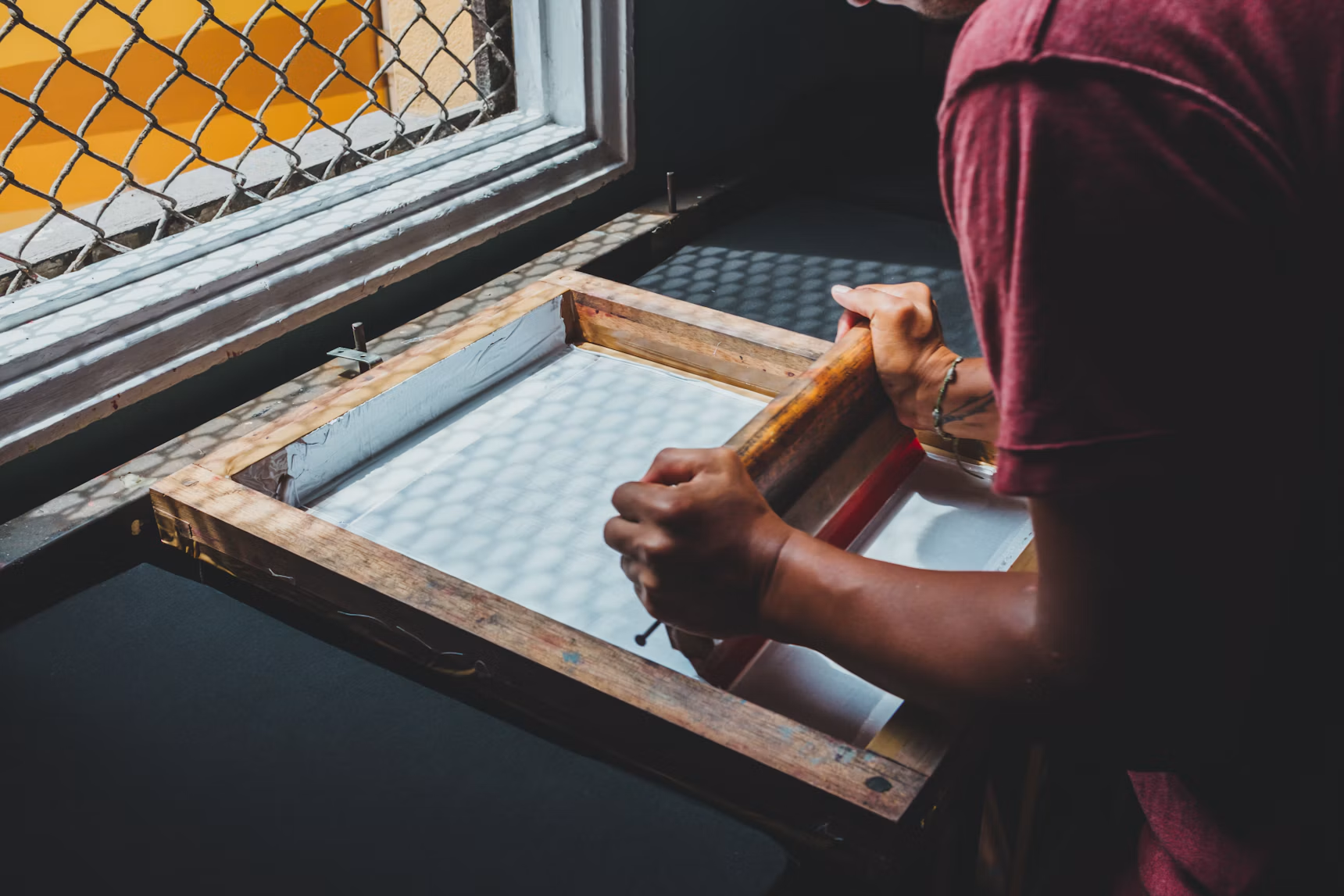
The press holds the garment flat on a board under the screen. A squeegee drawn across the mesh pushes ink through the stencil onto the fabric.
Photos and soft gradients print as halftone dots, at 40 to 65 lines per inch (lpi) on garments. Divide 240 by the line count and you get the distance in feet at which the dot pattern stops being visible. For a 60 lpi print that distance is 4 feet.
Plastisol, water-based or discharge
| Ink | On the fabric | On dark garments | Drawbacks |
|---|---|---|---|
| Plastisol | Sits on the surface as a solid film, thicker to the touch than water-based ink | The best choice for dark blends | A rubbery, plastic feel |
| Water-based | Soaks into the fibers and feels soft | Can look dull; white garments suit it best | The least vibrant of the three; longer drying at a higher energy cost |
| Discharge | Water-based, mixed with an activator that pulls out the garment's dye where it prints; the most natural feel | Can give the best results of the three on dark cotton | Prints properly only on 100% cotton; blends discharge to different degrees, and results vary with the fabric's original dye |
Plastisol is PVC resin mixed with a plasticizer. Older formulas used phthalates as that plasticizer. Printed designs and inks count as plasticized material in the EU. Articles sold there since 7 July 2020 may not contain four phthalates, DEHP, DBP, BBP and DIBP, at a combined 0.1% or more of that material by weight.
Discharge ink is made with zinc formaldehyde sulfoxylate and can give off formaldehyde gas. Clothing sold in the EU is capped at 75 mg/kg of formaldehyde. Jackets and coats moved from a 300 mg/kg limit to that cap on 1 November 2023. Have a discharge-printed sample for an EU order lab-tested against that cap before bulk.
How many screens a design needs
Chest colors repeated on the sleeve need separate sleeve screens. Two red motifs on the chest of a FashionMe racing long sleeve came off one screen. The stencil fixed the gap between them.
Photo prints on white shirts use transparent CMYK process inks. The fabric of a dark shirt would show through them. Full-color art on dark garments goes through simulated process instead. White goes down first and is dried briefly under a heater. The opaque colors then print one after another without drying in between. One of them is a highlight white.
| Screens | |
|---|---|
| One-color left chest logo on a white tee | 1 |
| Full-color photo in CMYK on a white tee | 4 |
| Four-color chest logo and a one-color sleeve print | 5 |
| Clip-art of stuffed animals in a wagon on a child's cotton dress, in simulated process at 55 lpi | 6 |
Setup cost per shirt
Ten screens for a five-color design printed on the chest and the back come to $150–450. The charge belongs to the design and gets divided among the shirts in the order.
| Shirts in the order | Setup per shirt |
|---|---|
| 50 | $3.00–9.00 |
| 100 | $1.50–4.50 |
| 300 | $0.50–1.50 |
| 500 | $0.30–0.90 |
The unit price is a separate figure from the setup. Print size and the number of placements change it on a FashionMe hoodie.
Printers wash the ink and emulsion out of their screens after a run and reuse the mesh for other designs. Reorders placed after the screens are cleaned need fresh screens and another setup charge.
DTF needs no screens; its price follows the area of transfer film used. For 50 pieces of a full-color design, ask for a DTF price next to the screen-print one.
Curing plastisol
Plastisol stays liquid until heat makes the resin absorb the plasticizer and the ink sets into a solid print. The standard grade cures at 160 °C (320 °F) through the full thickness of the ink film.
Undercured ink cracks and holds up badly in the wash. A pull test on the print measures only how far the ink stretches. To check the cure, wash a sample as many as five times on the care settings you plan for the label. The settings that give the longest print life are:
- a cold wash with the garment turned inside out
- mild detergent and no bleach
- low heat in the dryer
- no iron directly on the print
Light colors on dark garments
Light plastisol colors on a black garment need white ink printed under them first. This underbase goes through mesh of only 110 to 156 threads per inch. A lower thread count lets more ink through. The extra white makes a light design on black feel heavier than one printed straight onto a white shirt. Three to five seconds under a flash dryer leave the white dry to the touch, and the colors print over it.
That white is one more screen in the count. A three-color plastisol design on a black hoodie takes four. Discharge needs no white on dark cotton. Three colors on a black 100% cotton tee stay at three screens.
The disperse dyes in dark polyester can move up into a light print under curing heat and stain the white. Prints on these fabrics use a low-bleed, low-cure plastisol that sets below the standard 160 °C.
Sweatshirts and waffle knits
A halftone dot lands on a fabric fiber perhaps 65% of the time at best. Coarser knits give it fewer chances. A dot that misses leaves a microscopic drop of ink on the underside of the screen. If that droplet gets printed on the next pass, the effect matches printing the dot twice. Halftones are hard to print on sweatshirts because of these droplets, and printers drop the line count for them by at least 10 lpi.
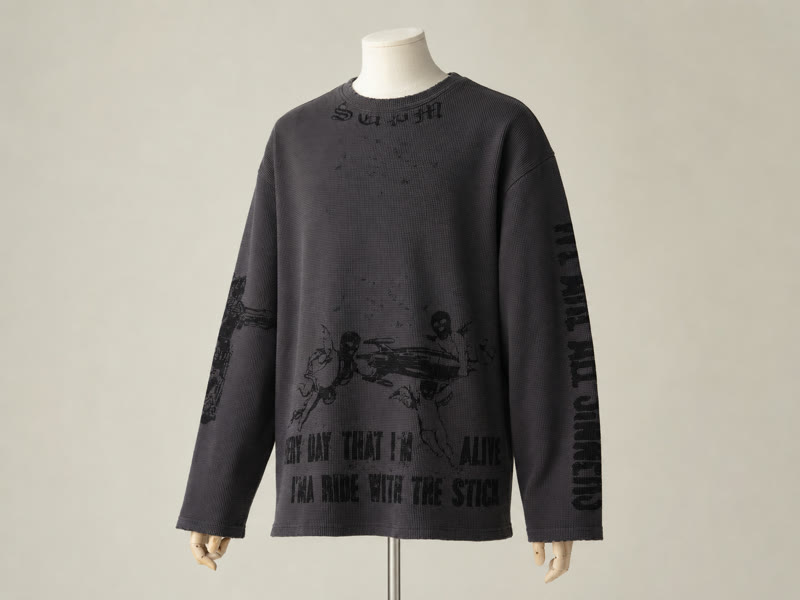
Dark lettering on a charcoal waffle-knit long sleeve from FashionMe had to stay readable against a washed color and a raised grid. The grid showed through the ink. The larger graphics had gaps and broken strokes that made them look distressed. Ink coverage and darkness changed how prominent a graphic looked, and so did the spacing between print zones. The next review of the print positions, and of how strongly the areas stood out on the washed shirt, would work from the full layout.
Graphics printed on cut panels
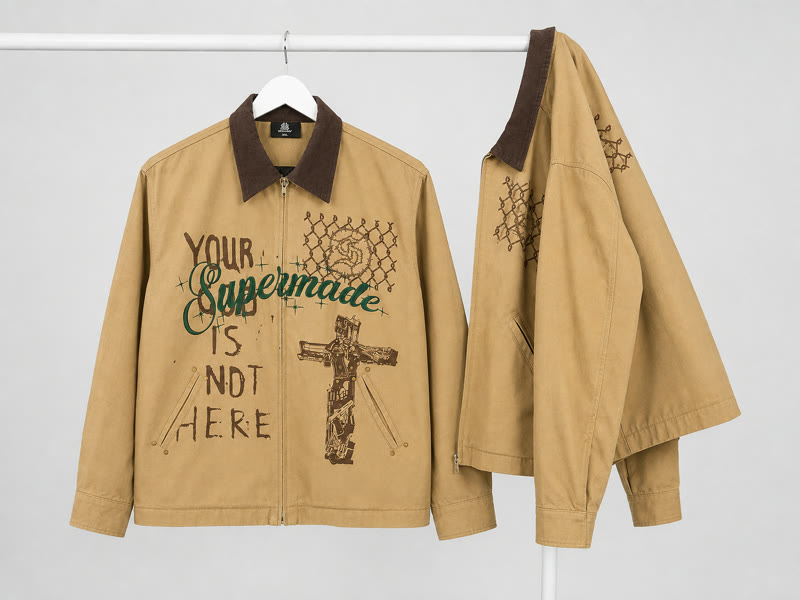
Green script on a FashionMe sand-colored zip jacket ran across the center-front zipper and over brown lettering and a chain-link motif at chest height. The brown graphics were meant to look worn. The green script needed to read clearly where it overlapped them. Lower graphics sat beside the openings of the slanted pockets. The jacket was printed in flat panels before sewing. The layout for these separate prints allowed for the space the zipper and pockets took up and for how the two front panels would meet. The artwork formed one complete front after the panels were sewn together.
The white lettering on the racing long sleeve went onto separate black sleeve panels. Panel printing needs garments cut for your order. Made to Order is the FashionMe route for that, and its minimum is 50 pieces per color.
Files to send with the artwork
FashionMe screen prints in-house and works out the setup price from the artwork and where it sits on the garment. Measure positions to the visible edge of the artwork; a transparent margin around the exported file doesn't count. A chest graphic running from 8 cm to 26 cm below the center-front neckline seam leaves 6 cm of clear fabric above a kangaroo pocket that starts at 32 cm. Send these with the artwork:
- the final print size and the number of ink colors, location by location
- a raster file at 300 pixels per inch at print size, such as 3,600 × 2,400 pixels for a 12 × 8 in print
- your editable master file and a vector copy with outlined lettering for prints that need it
- print positions from fixed points: center front and the high point shoulder for a chest logo, center back and the neck seam for a back print
- for a graphic across a front zipper, a finished-size drawing against the closed fastening that marks its visible width and the gap between the printed sections
- hoodie artwork that stays clear of the kangaroo pocket and the sleeve and hood seams
- a wide back graphic checked against the back of your smallest size
- the name of any raised or specialty effect, such as metallic ink
- the ink type; for EU orders, phthalate-free plastisol
- the fabric and garment colors (note dark polyester; sherpa and other high-pile fleece can't be screen printed)
- any garment wash, and whether printing comes first
- quantities by color and size
Matching ink colors on a strike-off
A strike-off is your design printed on a piece of the actual body fabric. Ink looks different on a black body than on an oatmeal one. A style sold in those two colors needs two strike-offs.
Name two light sources for the color check on your tech pack and mark one as primary. If you sell to a retailer that specifies lights, its pair takes priority. D65 daylight and TL84 are a common choice otherwise. TL84 is the fluorescent that represents store lighting in Europe and the Pacific Rim. Check that the strike-off:
- shows the whole design, or at least one full repeat of an all-over print
- was printed on pre-washed fabric if the garments are washed before printing
- matches your ink colors under the primary light
Printed samples that match the approved strike-off get your sign-off in writing. Rejected strike-offs push the launch back by another round, and a round across the industry typically takes two to ten business days.
Common print faults
| On the sample | Cause |
|---|---|
| A gap where two colors should meet | One screen sat out of position |
| White showing around the colors on a dark garment | The white layer wasn't printed slightly smaller than the colors over it |
| Top colors separating from the white | The white was overcooked under the flash at 110–127 °C (230–260 °F) |
| Blisters in low-bleed ink | Curing above 182 °C (360 °F) re-melted the ink film |
Garments washed after printing need a second check of the print position and the fabric around it when they come back from the wash.
Timeline at FashionMe
Quote requests through the quote form get a tiered price back within 24 hours. The print on a Made to Order style is developed with the garment sample during the 7–12 days of sampling. Production takes 15–20 days after the sample is approved.
Stock Match starts at 10 pieces in the garment colors already available and takes 7–10 days.