Types of Jackets: A Visual Guide to 19 Styles
A jacket is a sleeved outer garment worn over shirts, T-shirts or knitwear, usually with a front opening and a hem near the waist or hips. The category includes tailored blazers, work jackets, weather shells and insulated winter styles. Its cut determines the shape through the shoulders and body. Fabric, lining and insulation influence the weight, texture and warmth of the finished garment.
A denim bomber carries the rounded body and gathered hem of a bomber in a denim shell. Jackets often take their names from the cut, outer fabric or lining.
1. Bomber Jacket
The ribbed band at the bottom of a bomber draws a roomy body into the waist. Fabric gathers above it, giving the jacket its rounded profile. The sleeves often have the same generous volume, held at the wrist by knitted cuffs.
That shape sits particularly well above a visible trouser waistband. A black bomber over a gray T-shirt, wide blue jeans and low leather sneakers leaves a short, rounded top above the long denim legs. The T-shirt can tuck into the jeans, showing the junction between the bomber’s ribbing and the belt. A padded version adds depth through the chest and upper arms.
Bomber also covers several flight-jacket designs. The buttoned A-1, point-collared A-2 and low-collared MA-1 belong to that history.
On an MA-1, the knitted collar continues the treatment used at the wrists and waist; a zipped utility pocket sits on the upper sleeve. These details appear in Alpha Industries’ account of flight-jacket development.

2. Varsity and Baseball Jacket
The large letter on a varsity jacket comes from school and college athletics. Its thick chenille surface, team lettering and award patches turn the chest and back into places for names and achievements. A traditional letterman jacket gives those patches a wool body, often with contrasting leather sleeves. Striped ribbing runs around the neck, wrists and waist. The snap fastenings make another line of small circles down the front. Cream sleeves against a navy body emphasize the shoulders, with the dark torso continuing down to the waistband.
Baseball jackets share the short athletic shape. Satin shells and lightweight woven fabrics are common versions. The leopard-print example pictured here uses a zip and matching fabric throughout. Its print continues into loose pants, and plain black shoes finish the outfit below the patterned hems. The knitted collar and gathered lower edge retain the outline found across varsity jackets.

3. Harrington Jacket
The Baracuta G9 establishes the familiar Harrington pattern: a two-button standing collar, slanted flap pockets, raglan sleeves and ribbing at the hem. Across the back, its umbrella-shaped yoke forms a shallow, curved flap. The red-based Fraser tartan appears inside the jacket and around the open front.
Its collar can stand close around the neck. The short body ends near the upper hip.
A brown Harrington with a white polo, dark straight jeans and penny loafers keeps the neckline compact. The polo’s collar sits inside the jacket collar, and the exposed white fabric separates the brown jacket from the face. In a suede-textured version, light catches the nap across the shoulders and sleeves, producing soft changes in tone on a fairly simple cut. The two-way zip on the G9 allows the lower front to open over the waistband.

4. Denim and Trucker Jacket
Levi’s dates its familiar Trucker Jacket to 1967. The Type III pattern has two flap chest pockets, metal buttons and front seams that taper toward the waist. Those seams give the denim a fitted outline through the lower torso.
The pointed collar, button placket and pocket flaps create several layers of fabric across the front. On a washed jacket, raised seams and folded edges often catch the lightest fading. The black example’s collar rings sit above this familiar construction; the close-up shows the grain of the denim beneath the hardware.
Denim itself travels across jacket patterns. It can form a straight chore coat, a roomy overshirt or a gathered bomber. “Denim jacket” therefore includes several lengths and pocket arrangements.
A pale blue trucker over a black T-shirt, charcoal pants and black leather shoes gives the wash a clear outline. Double denim carries the fabric farther through the outfit: a faded jacket over dark indigo jeans makes the waist easy to read, especially with a tucked white tee and brown belt.
The waistband tabs on many truckers adjust the lower edge, drawing the back closer to the body. Cuffs fasten with metal buttons through small overlapping bands of denim.

5. Biker Jacket
A black biker over a white tee, a long black skirt and lace-up boots puts several different lengths into the same outfit. The jacket ends at the waist, the skirt carries the black downward, and the boot shaft sits under its hem. Across the chest, broad lapels frame the white cotton. Silver hardware adds small points of reflection along the front and sleeves.
The diagonal zip creates those lapels. It crosses an overlapping front panel; when the jacket is open, the panel folds outward from the collar. Shoulder tabs, a waist belt and zipped cuffs belong to many classic biker designs. Their placement gives the garment a recognisable front even in a plain color. Leather and faux leather both appear in this pattern. Sleeve zips open the cuff so a hand can pass through, then close it around the wrist.

6. Racer Jacket
The throat tab in the white jacket’s close-up fastens across a small standing collar. Below it, the front zip runs down the torso with a slight offset. This compact neckline belongs to the racer family, including the café racer: a short leather or faux leather jacket with a close body and a simple zipped front. Seams across the shoulders and elbows add shape to the sleeves. In this example, the scorpion hardware occupies the collar tab itself, concentrating the decoration near the face. A narrow crewneck fits inside the collar, leaving a small strip of the inner layer visible above the zip.

7. Chore Jacket
Three rectangles sewn onto the outside of a blue cotton jacket give the classic French-style chore coat much of its identity. One pocket sits on the chest. Two larger pockets sit near the hips, with their openings facing upward.
The fabric continues straight past the trouser waistband. A turn-down collar and a row of buttons complete the basic pattern. Cotton twill, denim and duck canvas give these jackets enough body to hold the patch pockets flat. The stitch lines around the pocket edges remain part of the visible design.
The pictured denim variation has a zip front, a dark collar and artwork across its large outer pockets. The pockets retain their rectangular outlines beneath the prints. A white tee, straight brown pants and brown leather shoes would keep the rest of an outfit close to the jacket’s workwear proportions.
American chore coats also use heavier duck fabrics and different pocket layouts. Carhartt’s Rugged Flex duck chore coat specifies 11.4-ounce fabric, triple-stitched main seams and lower pockets with both top and side entry. The side openings give the hands access behind the main pocket faces.

8. Zip-Front Work Jacket
A quilted lining adds an inner construction to a zip-front work jacket. Stitching holds the padding between layers of fabric, extending through the torso and sometimes into the sleeves. The outer body keeps its workwear details: a substantial zip, reinforced seams and accessible front pockets. Turn-down collars, chest zips and waist tabs appear on familiar Detroit-style and Eisenhower-style cuts.
The short hem usually meets the pants near the upper hip. Elastic sections can gather the back or sides at that level. On the washed cropped work jacket pictured, a gathered band draws the back in above the hips. The broad sleeves hang from lowered shoulder seams, and contrasting rows of stitching mark their cuffs.

9. Field Jacket
On an M-65-derived field jacket, the waist adjustment runs through the body above the lower pockets. Drawing it in gathers the fabric around the middle. The chest keeps its room, and the lower panels spread over the hips. That adjustable shape belongs to a jacket designed to carry layers and pockets across a relatively long torso.
Olive field jackets suit a cream crewneck, straight indigo jeans and brown boots. A little gathering at the waist brings the cream knit into view through the open front. The hem extends over the top of the jeans, with the lower pockets sitting on either side of the fly. Alpha’s M-65 Mod Field Jacket has two chest pockets, two lower pockets and further pockets inside. Flaps cover the outer openings; a covered front fastening runs between them. Its drawcords sit at the waist and hem.

10. Shirt Jacket or Overshirt
“Shacket” is a combined name for shirt and jacket. The garment carries a shirt collar, a button front and shirt-style cuffs, with additional fabric weight or layering room.
An olive overshirt worn open over a gray tee, blue jeans and suede sneakers creates a light outer layer with a long vertical opening. The shirt tail can hang over the waistband; straight-hem versions make a squarer shape at the hips. In colder weather, a roomy coat can cover the same combination, leaving the overshirt collar and button placket visible inside.
Heavy wool, cotton twill and lined versions all use the overshirt name. The fabric composition and lining account for much of the difference in their weight.

11. Coach Jacket
A coach jacket gives a team name or back print a broad, relatively flat panel. Large lettering sits between the shoulder blades, clear of the front pockets and fastenings.
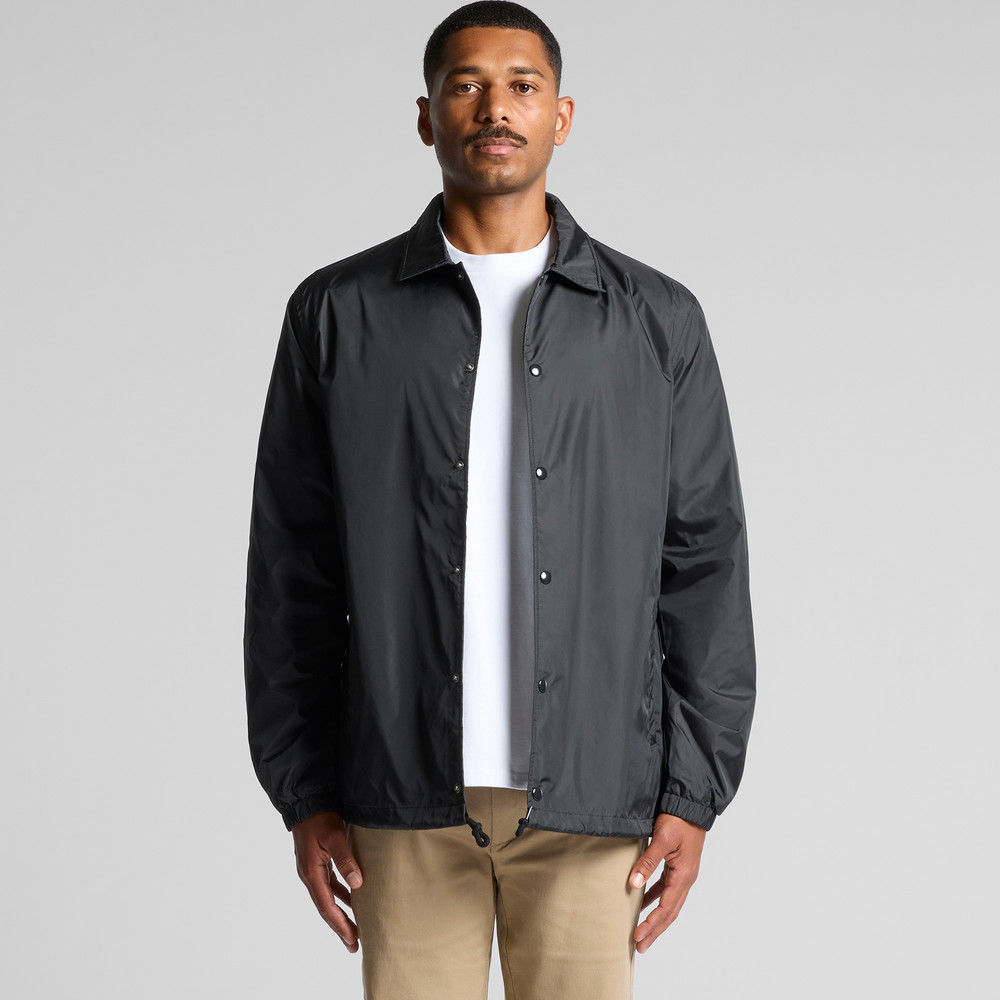
The lightweight woven body hangs straight from the shoulders to a drawcord hem. A pointed collar and snap front identify the familiar sideline style, often with elastic at the wrists. Dark nylon, a white sweatshirt, loose chinos and canvas sneakers carry the athletic shell into an everyday outfit. The sweatshirt’s ribbed neck shows just inside the pointed collar, and its lower band can sit under the jacket’s straight hem. Pulling the drawcord gathers that lower edge around the sweatshirt.
12. Track Jacket
A track jacket forms the upper half of a tracksuit. Stripes can travel from its collar down the arms and continue along the matching pants.
In the photographed outfit, the blue jacket is paired with very wide faded jeans and black-and-white sneakers. The sleeve stripes stop near the waistband, and the denim opens outward below them. A dark beanie repeats the darker areas of the chest graphic. The jacket’s short body exposes the belt, giving the loose jeans a visible starting point at the waist.
The traditional knitted track top often uses tricot, a flexible fabric that falls in soft folds through the chest and elbows. Ribbed cuffs close around the wrists. Raglan sleeves, cut from the neckline down toward the underarm, carry stripes over the shoulder in a continuous curve. Woven track jackets also appear in lightweight sports collections.

13. Windbreaker
A windbreaker is built around a light, closely woven shell that reduces the passage of wind. Its front opening, cuffs, neck and hem regulate the remaining airflow. Elastic cuffs gather the sleeves at the wrists; a drawcord or elasticated lower edge pulls the body closer over the pants.
The white jacket’s full zip reaches the top of a standing collar. Opening it releases the front from the throat downward. Its thin shell gathers into small folds beneath the chest print, with room for a T-shirt or light knit inside.
Hooded pullover versions are often described as anoraks. A short zip or buttoned opening extends from the neck into the chest, and a large pouch can sit below it. The hood is attached around the neckline, covering the back of the head and folding onto the shoulders when lowered.

14. Rain Jacket or Waterproof Shell
Rain meets several parts of a waterproof jacket. A water-repellent finish helps droplets bead on the outer fabric. A membrane or waterproof coating provides the barrier within the shell. Tape covers the sewn seams, closing the small holes made by the needle. The hood, cuffs and front fastening complete the garment’s coverage.
Patagonia describes the fabric finish and membrane in its waterproof-material development account. DWR stands for durable water repellent and refers to the surface treatment.
A hood brim projects beyond the forehead, directing runoff away from the face. Adjustments around the opening and crown position it around the head. At the wrists, cuff tabs close the sleeves over an inner layer; a longer back hem extends the shell’s coverage over the seat.

15. Softshell Jacket
Stretch through the elbows and shoulders is central to a softshell. Its flexible fabric moves with bent arms and returns toward its original shape. Many versions bond a woven outer face to a light fleece backing, combining that movement with a little insulation. Gore’s description of softshell construction places flexibility and a softer inner surface among its main characteristics.
A close charcoal softshell works over a fine knit and straight chinos, with low leather sneakers completing the outfit. The stretch accommodates the arms within a fairly narrow sleeve. During active use, the fabric’s breathability and zip opening help release heat. Weather protection comes from the particular weave, finish and any membrane incorporated into the jacket.

16. Fleece Jacket
Raising fibers from knitted fabric produces fleece’s soft pile. Air held between those fibers supplies insulation. The process gives the fabric depth across its surface, visible in the small shadows between the fibers.
The bright pink face of this reversible jacket shows that pile across its body and sleeves, continuing into the gathered cuffs. Camouflage fabric folds over the edge of the standing collar. With a white cotton tee, a long black skirt and black ankle boots, the pink jacket adds a full, soft upper layer above the straight skirt.
Polartec’s Fleece Series includes Micro, 100, 200 and 300 weights. Those named weights cover different amounts of bulk and warmth. Woven pocket panels and smooth linings can be added to a fleece jacket; a woven lining also changes the passage of air through the garment.

17. Puffer and Quilted Jacket
Fill power starts with a measured quantity of down. The test records the volume occupied by one ounce under specified conditions. A higher result means greater loft for that weight. In a finished jacket, fill weight records the actual amount of down placed inside. REI describes this laboratory measurement.
The filling sits between the shell and lining in stitched compartments. Their width and depth affect how far the jacket swells from the body. The photographed down jacket uses horizontal channels through the chest and arms. Synthetic insulation also appears in quilted jackets, including thin liners designed to sit beneath another outer layer.
A cropped black puffer with a gray sweatshirt, higher-rise blue jeans and substantial black shoes puts most of the volume above the waistband. The jeans meet the jacket hem, and the sweatshirt’s collar sits inside the padded neck opening.

18. Shearling and Sherpa-Lined Jacket
Wool showing around a collar or folded cuff reveals one of the characteristic edges of a shearling jacket. Shearling retains the wool on the sheepskin or lambskin, so the hide and wool form the two faces of the material. Seams and turned edges can expose that construction around the front opening.
On a brown shearling-style jacket, a cream knit repeats the collar’s pale color. Dark straight jeans and brown boots complete the outfit below the heavy jacket. A high, broad collar surrounds the neck and spreads over the shoulders when folded down.
Sherpa is the term commonly used for a pile fabric with a similar woolly surface. It appears as a collar trim, hood lining or full inner layer.
The black quilted hooded jacket shows a pale pile edge around the hood and diamond quilting inside the body. The separate surfaces are visible along the open front.

19. Blazer
The roll of a blazer’s lapel comes from the way its front is shaped and pressed. Fabric turns outward from the collar toward the buttoning point, forming a continuous fold across the upper chest.
Inside, canvas or fusible reinforcement can support that shape. Shoulder padding and shaped seams give the jacket further structure.
Blazer commonly names a tailored jacket worn with separate pants. Wool, cotton and linen versions appear in this category, with soft and more structured constructions. A navy blazer over a white T-shirt, full gray pants and loafers brings tailoring into a relaxed outfit. The tee’s round neck sits between the lapels; the pants fall from the waist into a broad leg.
A soft shoulder follows the arm more closely, and room through the chest lets the front hang in a relatively straight line. Patch pockets add visible fabric rectangles below the waist, with their stitched edges tracing the pocket shape.

Jacket Measurements
A jacket that already fits can be measured flat using the same points as the product chart. A chest width of 62 cm beneath the armholes corresponds to an approximate circumference of 124 cm.
| Measurement | Position | Part of the Fit |
|---|---|---|
| Chest width | Flat across the body beneath the armholes | Room through the chest and inner layers |
| Body length | The chart’s stated neck or shoulder point to the hem | Where the jacket ends against the pants |
| Sleeve length | Shoulder seam, neckline or center back to the cuff, as specified | Cuff position with the arm relaxed |
| Hem width | Across the fastened lower edge | Space around the waist or hips |
Size labels often correspond to a range of wearer measurements. The finished jacket incorporates extra room for movement and layers, recorded in a garment-size chart. Ribbing and elastic may also have relaxed and stretched dimensions.