Types of Coats: 14 Styles, Fits, Fabrics, and Outfit Ideas
A coat is an outer garment worn over an outfit for warmth and protection from the weather. Most coats extend below the hips, with space for layers underneath. The coat’s length and shape determine how much of the shirt, trousers or skirt remains visible.
Coats include tailored wool overcoats, belted trenches, hooded parkas and soft wrap styles. Their lengths, collars and fastenings shape how they sit over an outfit. Fabric and lining affect their weight, warmth and movement.
The names describe different parts of a garment. Cocoon refers to the silhouette, shearling identifies a material, and quilting describes how layers are stitched together. A single coat can carry more than one of these names.
1. Trench Coats
A trench coat is easy to recognize from its broad lapels, overlapping front and belt. Traditional versions also carry shoulder straps, buckled cuffs and a flap across the upper back. The skirt usually reaches the knee or calf, giving the belt a generous length of fabric to gather.
The honey-colored Burberry Kensington shows that arrangement clearly. Its cotton gabardine has a tightly woven twill surface, and Burberry describes this particular coat as shower-resistant. The shoulder line is structured; the body has space for light layers.
- Storm shield: the extra panel across the back adds an overlapping layer over the shoulders.
- Throat latch: the short strap fastens across the neck when the collar is raised.
With the trench open, a striped shirt and straight indigo jeans remain visible from neck to ankle. Fastening the belt gathers the front panels and shifts the emphasis to the waist. A soft knot slightly to one side leaves the buckle hanging along the skirt of the coat.


2. Mac Coats
A navy mac over a gray suit leaves the shirt collar, tie and trouser crease in view. Its straight body sits over the jacket, and the coat’s small turned-down collar rests close to the neck. The front usually has one row of buttons, often covered by a strip of cloth called a fly front.
Mac is a familiar name for this simple raincoat shape. Cotton versions can feel crisp and hold a slight space around the body. Raglan sleeves, which run diagonally from the collar toward the underarm, give some macs a softer shoulder line. Set-in sleeves place the seam around the armhole.
The Mackintosh Dunkeld shown here has a concealed button fastening, bonded Raintec cotton and taped seams. Mackintosh specifies a waterproof construction for this model. On any raincoat, the fabric specification and seam treatment establish its rain protection; the style name describes its appearance. A detachable liner, where included, adds another layer inside the same outer shell.
3. Peacoats
The peacoat’s short, heavy shape comes from naval outerwear. Its double-breasted front places a broad overlap across the chest; wide lapels open into a deep V. Large buttons, near-vertical hand pockets and a hem around the upper thigh make the design recognizable.
Schott’s 740 peacoat uses a dense melton wool blend and anchor buttons. Melton has a compact, felted surface that supports the collar and lapels. The cloth keeps the lapels broad and the lower edge fairly straight. A raised collar brings the same dense fabric around the sides of the neck.
The closed front is useful for judging the fit. The overlapping panels should sit flat, with room across the upper back for the layer underneath. Strained buttons and diagonal creases across the chest indicate tension. The short hem also makes the length of an underlying blazer easy to see, so the two garments need to be tried together when the coat is intended for tailoring.

4. Duffle Coats
The toggles on a duffle pass through loops attached to the opposite front panel. On a dark coat, pale rope makes each fastening conspicuous. The loops also leave a little movement between the panels, with a separate throat tab closing the opening beneath the hood.

Here the three fastenings cross a black coat worn with cuffed jeans and lace-up shoes. Pale denim at the ankles repeats the rope’s color. The coat ends above the knee, leaving the turn-ups and shoes fully visible. Its shoulder panel lies over the upper sleeves, and the hood rests at the back of the neck.
Gloverall makes this Original Monty with a generous body, large patch pockets and wooden toggles. The dense wool blend supplies the substantial feel of the coat. A chunky sweater occupies some of the room inside; its neckline sits beneath the hood. The roomy body and the fabric’s weight give this duffle a loose, fairly straight hang from shoulder to hem.
5. Overcoats
Overcoat is the broad name for a substantial outer coat worn over other clothes, including suits. Wool is common, with lengths around the knee and below. Tailored versions borrow lapels, pockets and shoulder construction from jackets, allowing the coat to sit over a complete set of indoor clothes.
Several more specific names appear within this family.
| Name | What the name usually describes |
|---|---|
| Topcoat | A lighter tailored outer coat, commonly worn in milder weather. Retailers use topcoat and overcoat with some overlap. |
| Chesterfield | A long, tailored overcoat with a formal jacket-like front. A velvet upper collar is a familiar detail on traditional versions. |
| Polo coat | A roomy tailored coat, often double-breasted, with broad lapels, patch pockets and turned-back cuffs. Camel and brown are familiar colors. |
| Covert coat | A tailored style associated with country clothing, often single-breasted, with a contrasting collar and rows of stitching near the hem and cuffs. |
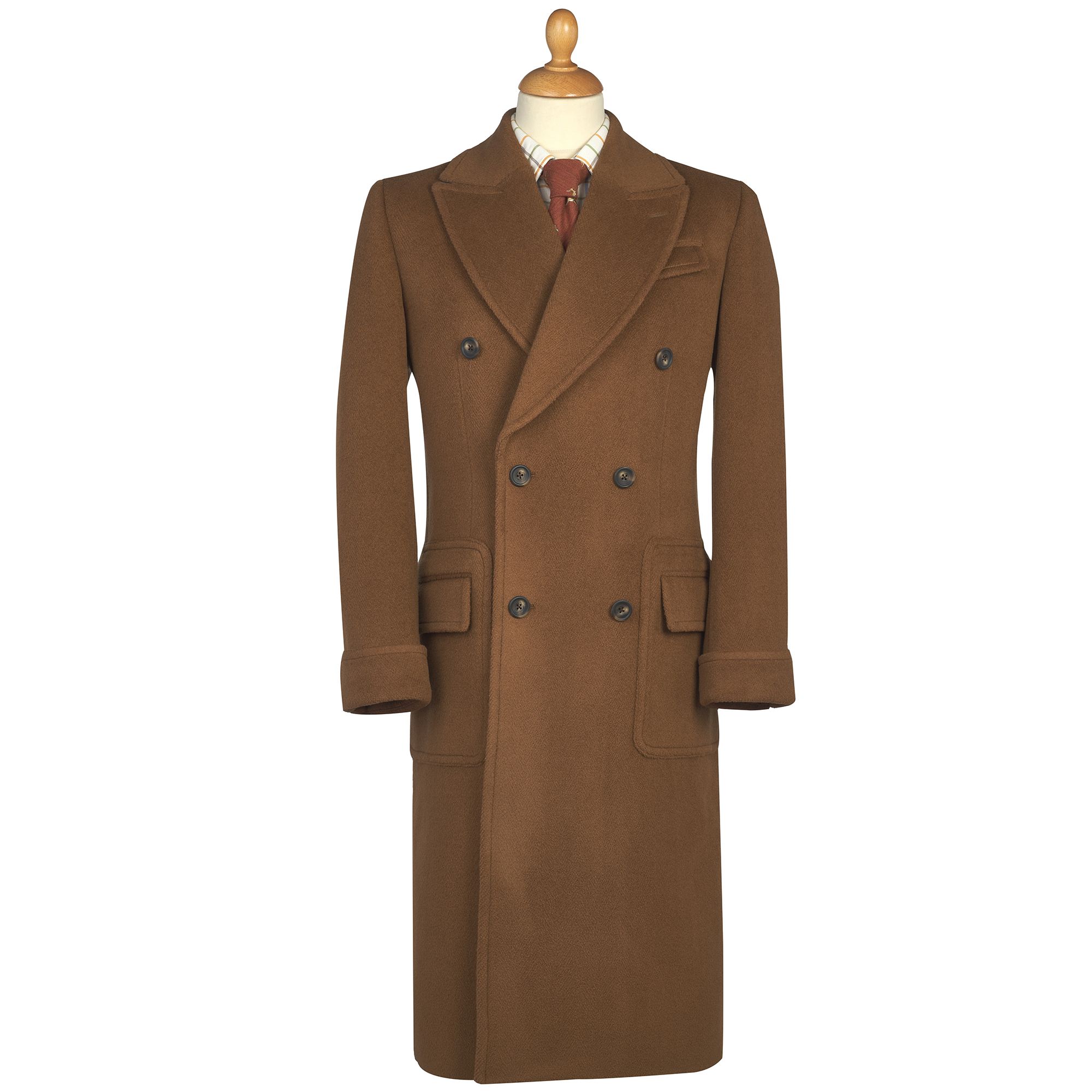
The Cordings polo coat has large flapped patch pockets and deep cuffs in chestnut wool. These details remain visible across its long front. A brown herringbone suit, cream shirt and dark tie extend the same warm palette underneath.
For an overcoat worn with a suit, the jacket shoulders and sleeves take up space inside the coat. The chest measurement, armhole and upper sleeve all contribute to the fit. A smooth sleeve lining helps the coat slide over a jacket sleeve, and a back vent opens the lower part of the coat as the wearer walks.
6. Wrap Coats
The belt gives a wrap coat its waist. Wide front panels cross over each other, and soft fabric gathers beneath the tie. Robe coat is another name used for this shape. The collar may have long lapels or a rounded shawl edge that continues down the front.
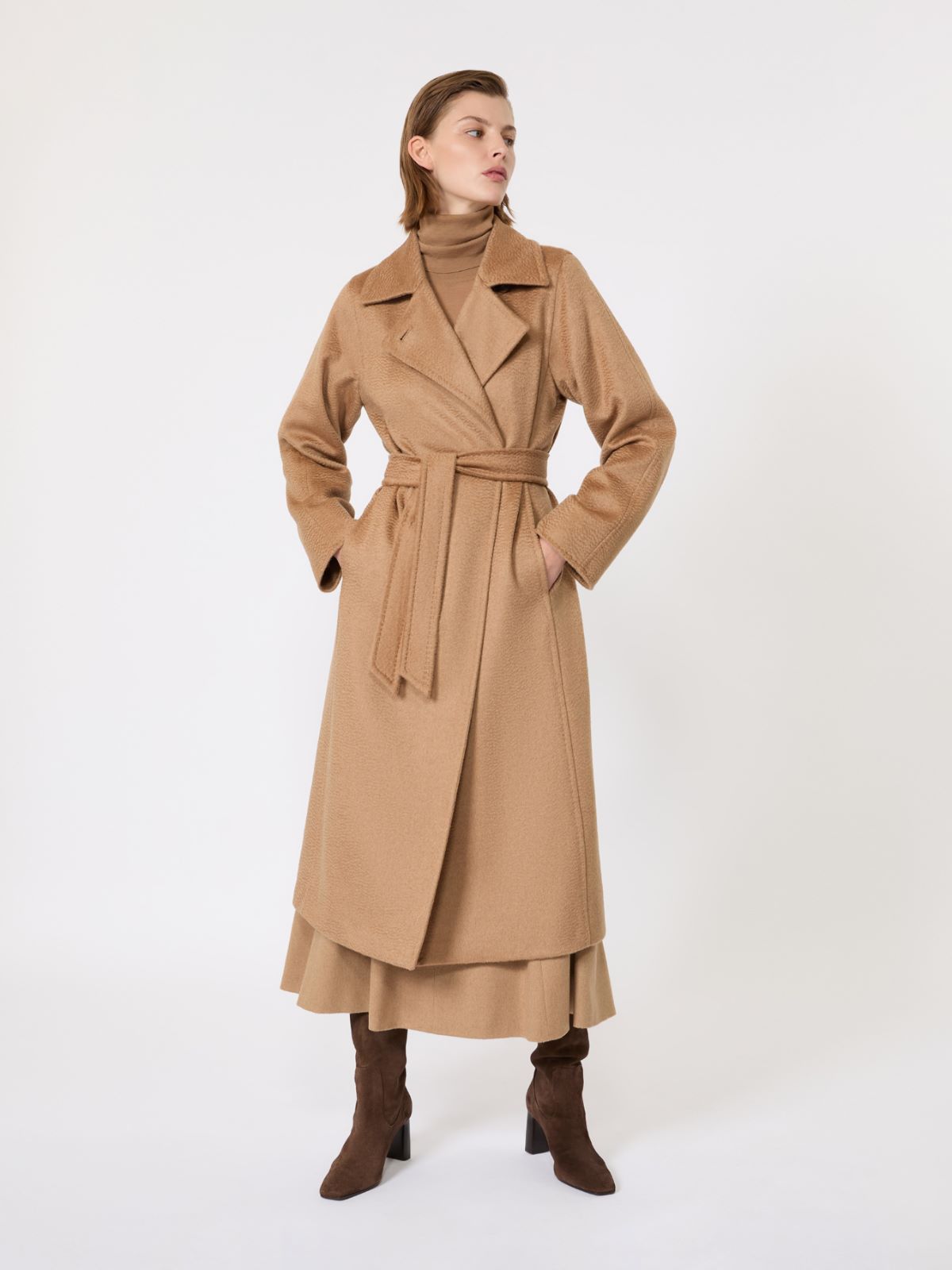
Max Mara’s Manuela coat has a straight cut, wide lapels and a matching belt. In the photograph, the tie holds the coat close above wide camel trousers. The trouser fabric continues below the coat hem, with dark flat shoes visible at the floor.
Belt position changes the gathering. A tie at the natural waist draws fabric inward above the hip. A loosely fastened belt leaves longer, softer folds through the front. The supplied belt loops determine where the belt sits, which makes their position useful to check during a fitting.
Double-faced wool appears in many wrap coats: two finished fabric faces form one cloth, with carefully closed edges around the collar and front. Other versions have a separate lining, as the Manuela does. Once seated, the overlapping panels spread across the lap; their width determines how much coverage remains below the belt.
7. Cocoon Coats
The widest point of a cocoon coat usually sits through the body or hip. The cloth curves inward again toward the hem, forming an oval outline. A side view reveals how much of that volume sits across the back.
Two coats with similar chest measurements can hang very differently through the lower body. On a cocoon, curved seams or shaped panels create the rounded outline. The sleeve can stay fairly narrow, concentrating the fullness around the torso.

The rose-colored Harris Wharf London version uses felted wool, slim sleeves and raw edges. Its narrow lapels leave a broad area of cloth across the front. A fine knit underneath fits within the sleeves, and straight ankle-length trousers follow a narrower line below the curved body.
The lower opening deserves its own fit check. Room across the chest and room for a walking stride occur in different parts of this cut. A back vent or a sufficiently wide hem allows the legs to move beneath the inward curve.
8. Cape Coats
Cape coats fall from the shoulders in wide panels. Many have arm slits or openings along the sides, leaving a sweater’s sleeves visible. The loose fabric also changes how a bag is carried: a handheld bag hangs below the hem, and a shoulder strap can gather the cape at one side.
The hem opens outward as the arms move. Wool gives that broad shape some body; a short cape can end near the hip, and longer versions reach the knee or calf. A collar or hood frames the face above the expanding lower edge.
In this Holland Cooper example, brown herringbone wool spreads over a slim outfit and tall brown boots. Shearling trims the hood and hem. The small handheld bag stays fully visible beneath the cape. Long gloves or fitted sweater sleeves cover the wrist and forearm where the arm openings expose them.

9. Parkas
Gloves fit into the large lower pockets of a parka, and smaller belongings have zipped compartments higher on the chest. This arrangement spreads storage across a long body that covers the seat and upper thighs. A hood and a flap over the front zip enclose the top half of the garment.

The Fjällräven Nuuk gives those details a substantial winter construction. Its hood has a wire-supported edge and detachable faux-fur trim. The coat combines synthetic insulation with a waterproof lining. The lower pockets open from the top and also have access at the sides, where the hands naturally meet the front of the coat.
A drawcord gathers the waist through this otherwise generous body. The two-way zipper opens at the hem for sitting, leaving the upper section fastened. The hood adjustment brings its opening closer around the face.
Parka also appears on lighter cotton shells and fishtail designs with a split extension at the back. Their hoods, long bodies and utility pockets give them a family resemblance. For warmth, an insulated model contains its own padding; a light shell has room for a separate fleece or sweater.
10. Puffer Coats
A down puffer can carry a label such as 600-fill-power or 800-fill-power. The number describes the down’s loft under test conditions. Fill weight records a separate measurement: the amount of insulation placed inside the coat. Together with the shell, distribution of fill and construction, these details help explain its warmth.
The fill sits inside the puffer’s raised sections. Horizontal channels spread it across the body; chevrons create diagonal lines, and smaller panels can follow the waist. Synthetic filling also produces the padded puffer shape.
Patagonia’s Down With It Parka has chevron-shaped channels, shaping seams and a knee-length hem. The down-filled body encloses the torso and upper legs. Its hood is removable, and the shell has a water-repellent finish intended to shed light moisture.
Long puffers make the openings especially noticeable in use. A two-way zipper releases the lower panels for stairs or a seat. Cuffs close the sleeves around the wrists, and the collar determines how much space remains for a scarf. A ribbed beanie and lace-up boots sit neatly at either end of the padded silhouette.


11. Quilted Coats
A short white top, loose blue jeans and sneakers are visible inside this long black quilted coat. The open front exposes the waistband and the full width of the denim. Small diamonds continue across the side panels, giving a broad expanse of dark fabric a repeated surface pattern.
Those lines are structural. Quilting stitches the outer cloth, filling and inner layer together. The stitches hold the layers in place and divide the surface into sections. Diamonds, squares and curved waves can be used across a coat, with the padding sitting between the lines.
The Barbour Marsett shown here has a cotton collar and polyester filling. A collar, binding or pocket edge can introduce a second fabric around the quilted body.
Quilting also appears in the linings of wool and leather coats. In those garments, the stitched pattern sits inside the outer shell. The construction can therefore be visible across the whole coat or confined to an inner layer.
12. Shearling Coats
Shearling combines a skin surface with the fleece attached. A coat can place the fleece inside for a soft lining, turn it outward as the visible surface, or use a reversible construction. The leather face may have a smooth finish or a suede-like nap.
The JOSEPH Caspian is made from sheepskin and has pockets on both sides. It reverses between leather and fleece, with a two-way zip running into the collar. The black fleece face is shown below.
Turned-back cuffs and broad collars can expose both surfaces at once. Flat seams keep the joins relatively smooth against the body; pronounced seams make the panel construction visible on the outside. A fine-gauge turtleneck sits neatly inside a thick shearling collar, and straight denim gives the coat’s broad shape room over the hip.
Care follows the skin as well as the fleece. The Caspian’s instructions specify cleaning by a leather specialist. The correct method for an individual coat comes from its care label, including instructions for any separate trim or lining.

13. Teddy Coats
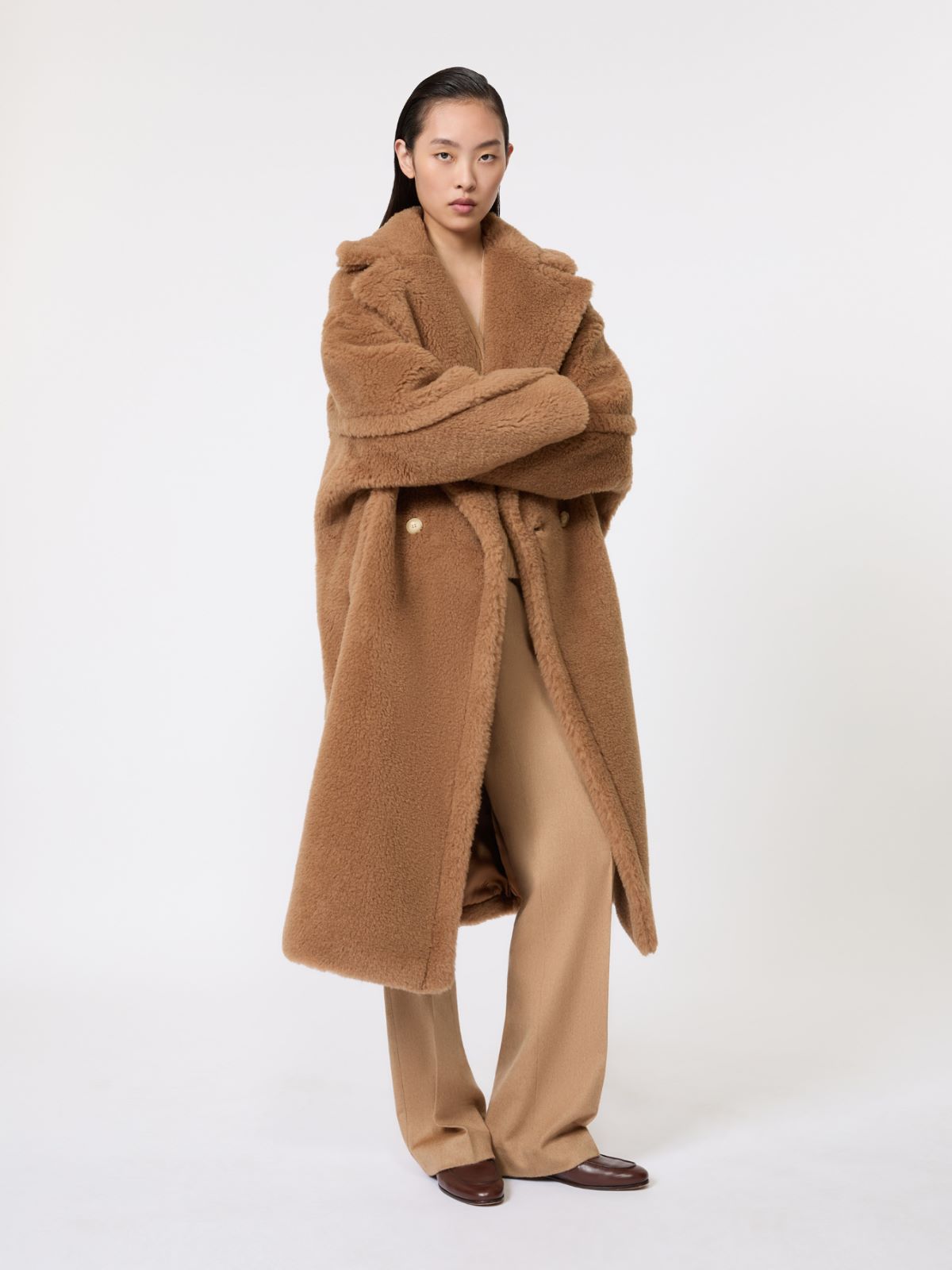
The camel-colored Max Mara Teddy Bear coat lists camel wool and silk in its composition. Other teddy fabrics use wool blends or synthetic fibers on a textile backing. The shared feature is the dense, fluffy pile that gives the surface its soft, rounded appearance.
Here that pile spreads across large lapels and dropped shoulders. The crossed arms show how much space the sleeves occupy, and the long front hangs open over wide beige trousers. Smooth trouser fabric forms folds beneath the thick coat surface, with dark shoes showing at the hems.
Pile changes the visible edge of a garment. A lapel looks softer as fibers extend past its outline; a wide cuff gains fullness from both the cut and the fabric. The backing and lining influence how the coat falls underneath that surface. Soft folds at the open front show the flexibility of the fabric beneath the pile.
14. Leather Coats
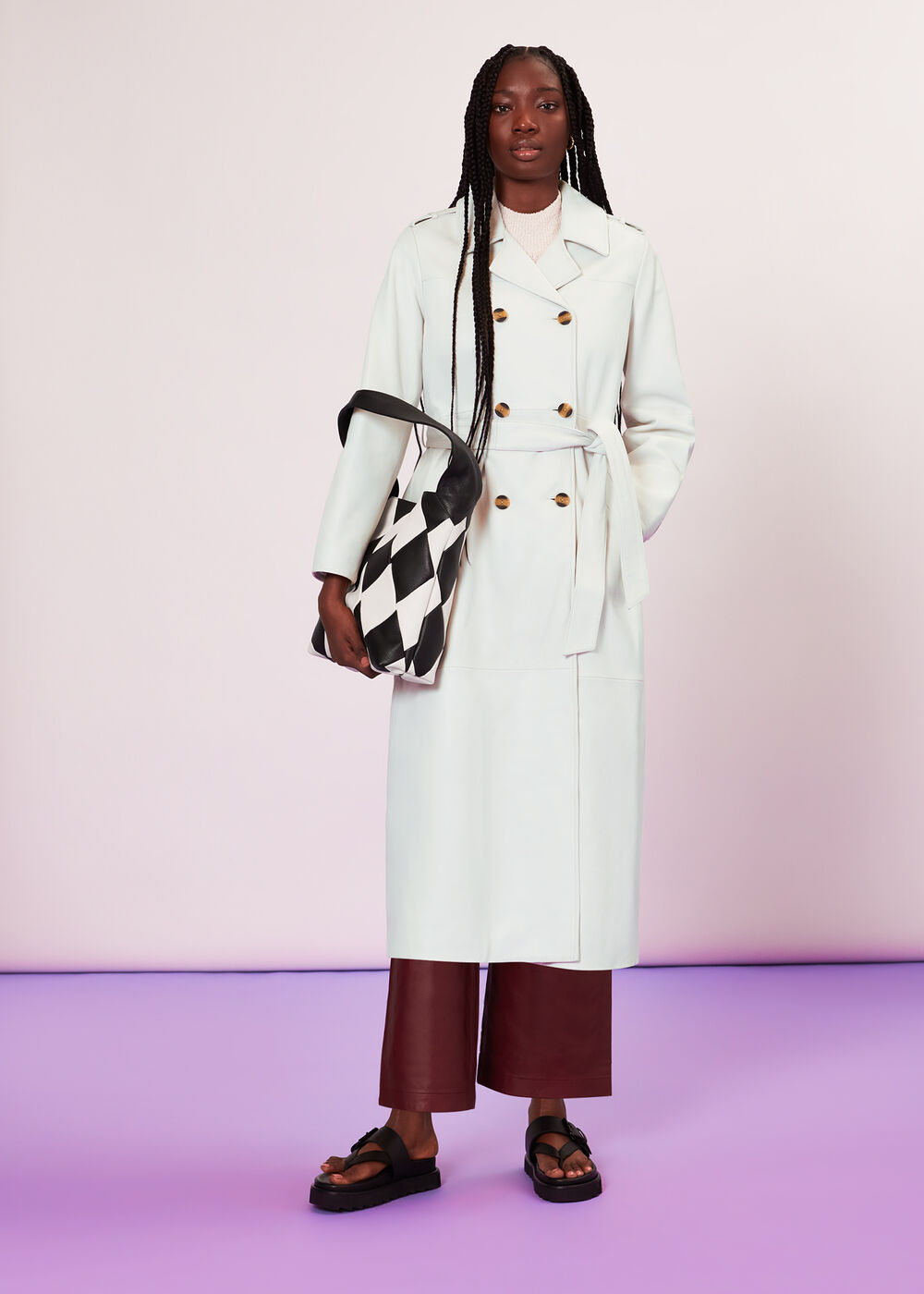
The white leather trench has broad lapels, a tied waist and two rows of brown buttons. In this Whistles Gemma outfit, cropped burgundy trousers appear below the hem. Chunky dark sandals and a black-and-white checked bag add clearly defined shapes around the coat.
Leather coats borrow several cuts already used in woven cloth. A trench carries a belt and overlapping front; a car coat has a straighter body and a simpler fastening. Long tailored versions use lapels and a back vent. Supple leather gathers into folds at a tied waist, and firmer leather holds a more pronounced shape through the shoulders and skirt.
The material description gives the hide type and finish. Glossy leather reflects light along creases, grained leather shows texture across a broad panel, and suede has a soft nap that changes appearance as its fibers move. Faux-leather coats use a coated textile and have their own composition and care instructions.
A leather coat needs room over the intended sweater at the elbow and upper arm, where movement bends the material repeatedly. The lining should move freely with the sleeve. A broad hanger supports the shoulders in storage, and cleaning products should match the coat’s specific leather finish and care label.