Best Activewear Manufacturers: 10 Suppliers for Custom Collections
An activewear collection can begin with a few coordinated pieces and grow through repeat orders. The opening budget needs to cover development, samples and the quantities allocated to each color. A production quotation should identify the garments being made, the work included in the price and the conditions that determine the delivery date.
Specifications and ordering terms are supplier-published and were checked on September 16, 2026. Final quantities and delivery dates are established in the project quotation.
FashionMe
FashionMe coordinates sourcing and garment production through a factory network. Brands can submit photographs, videos, sketches or tech packs for a quotation. Its activewear range includes leggings, sports bras, bike shorts, running shorts and training tops. Made to Order starts at 50 pieces, with published sampling times of 7–12 days and production times of 15–20 days.
Coordinated garments using one fabric are assigned a production lot through cutting and sewing. The production file records the fabric article, composition, weight, color and stretch direction. Sample changes update the corresponding pattern, measurement chart and construction instructions before bulk cutting. Activewear checks include waistband recovery, seam recovery and opacity under stretch. Colorfastness to perspiration follows the method and acceptance level specified for the order.
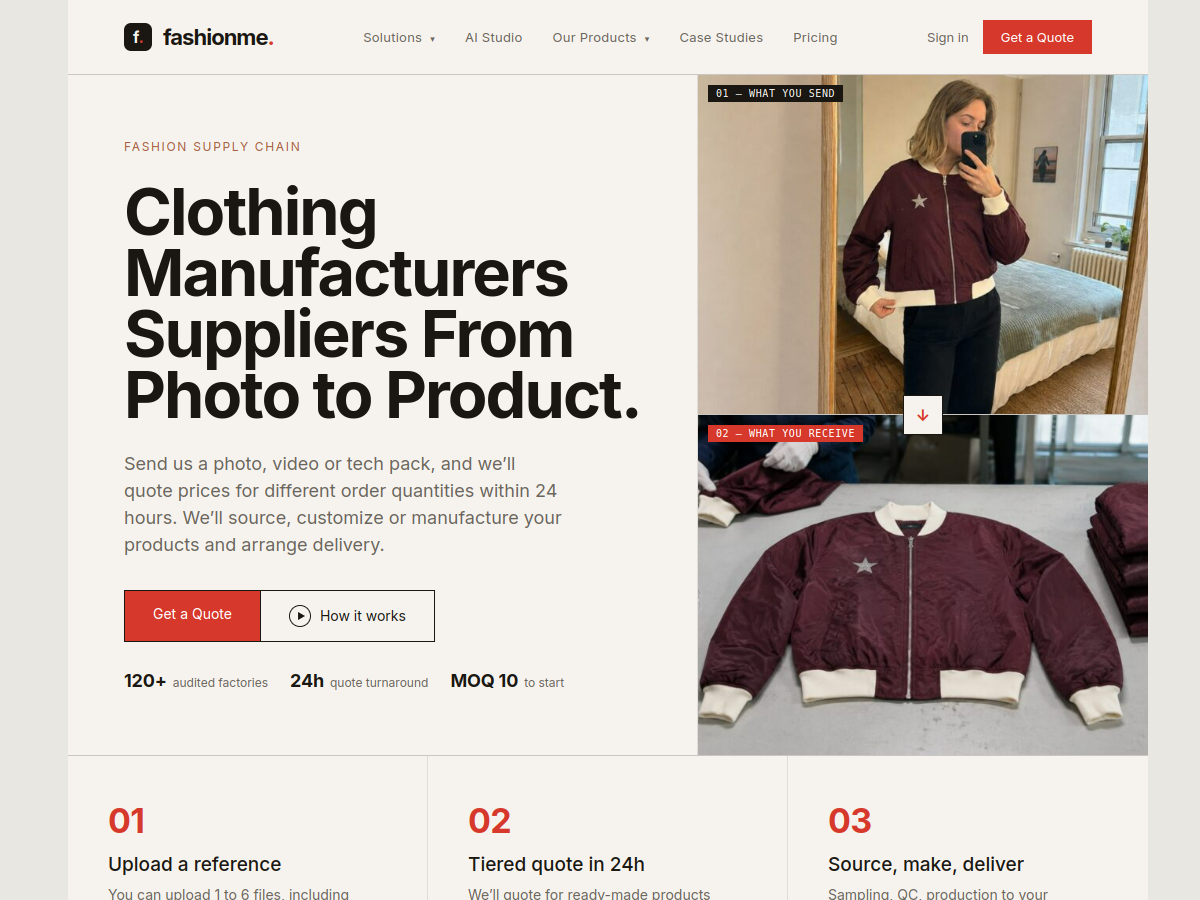
Made to Order includes 100% final inspection, and customers receive photographs of their goods before shipment. Stock Match sources existing garments from 10 pieces, with a published lead time of 7–10 days. It uses sample-pull inspection as standard, with full inspection available as an additional service.
Stock orders can include hang tags, branded packaging and label replacement. FashionMe’s pricing page lists a separate minimum of 50 units per style for woven or printed label replacement.
Activewear Bali
Activewear Bali’s minimum quantities apply at three levels within a purchase order.
| Order type | Minimum total | Minimum per style | Minimum per size and color |
|---|---|---|---|
| Custom designs | 300 pieces | 30 pieces | 3 pieces |
| Ready-to-order designs | 250 pieces | 30 pieces | 3 pieces |
| Top-up orders | 150 pieces | 30 pieces | 5 pieces |
An order containing custom and ready-to-order activewear has a 300-piece combined minimum. Top-ups become available after the first bulk order and use existing styles in stocked colors.
The ready-to-order collection has existing patterns and size grading. Custom designs enter the company’s in-house pattern-development service, which uses 2D AutoCAD. Production covers leggings, sports bras, shorts, tops and court-sport garments, using flatlock and coverstitch sewing. Its stocked Comfort Luxe fabric contains 77% recycled nylon and 23% spandex at 230 GSM. Branding options include jacquard elastic waistbands, heat-pressed logos and garment labels.
Custom samples cost twice the wholesale garment price plus a US$30 development fee per style. The development fee is credited against the bulk deposit. Ready-to-order styles carry no development fee.
The dedicated timeline page lists 2–4 weeks for sampling after fabrics and accessories are available. The manufacturing overview gives 1–3 weeks, depending on complexity. Bulk production is listed at 3–5 weeks after sample confirmation, and the physical sample must be returned before production starts.
Create Fashion Brand
A single pair of Create Fashion Brand’s seamless leggings can be purchased for evaluation. The Portuguese-made product has a high waist and gathered back detail, using 88% polyamide and 12% elastane at 250 GSM. Its product page offers private-label customization from 50 pieces per style and color.
CFB’s general ordering policy lists 100 units per style and color for blank customization and 150 units per style and color for full custom development. The 50-piece offer is attached to the existing seamless-legging product.
At the full-custom minimum, two original designs in three colors require 900 garments. Each of the six style–color combinations contains 150 pieces, with sizes distributed within that allocation.
Original development includes patterns and fittings. The technical team accepts sketches, visual references, material preferences and a bill of materials, and can help prepare the tech pack. CFB publishes 4–6 weeks for samples and 8–10 weeks for final production, subject to complexity and season. Additional sample requests can restart development and incur further charges.
Hingto
Hingto states that clients own their tech packs and designs. The completed tech pack is also the point at which the company confirms the order quantity and color allocation. Its published custom-apparel minimum averages 200 pieces, including mixed sizes; the design and selected fabric determine the final requirement. Colorways can sometimes share that allocation. The sourcing team accepts composition requirements and locates materials beyond its stocked selection. Its production range includes activewear, swimwear and sports clothing for activities such as golf and equestrian use.
Sales and manufacturing operate from Guangzhou, supported by a management team in Sydney.
Lefty Production Co.
A size set from Lefty Production Co.’s Los Angeles sample room can include every size planned for sale. Graded patterns feed into cutting layouts and fabric-yield calculations, establishing how much material the order requires. A design can be reproduced in several fabric articles and colors during sampling, with the production team subsequently organizing the materials delivered for bulk work. Binding, fusing and operations sent to outside specialists fall within its production-coordination service.
Lefty manufactures leggings, sports bras, golf and tennis apparel, and performance basics through cutting, sewing and finishing. Its activewear development discussions include internal components such as a mesh liner inside shorts.
Thygesen Textile Vietnam
Fabric production is included in Thygesen Textile Vietnam’s published 10–12-week standard lead time. Replenishment arrangements can involve holding greige fabric for subsequent dyeing and finishing, or retaining finished garments for later orders.
The starting quantity is 3,000 pieces per design, with 1,000 pieces per color and mixed sizes. Specific materials can raise those requirements.
Sampling usually takes 7–10 days, depending on complexity. Fees are paid in advance and refunded when the bulk order is confirmed. The service extends through technical development, manufacturing, packaging, inspection and logistics. Payment methods include bank transfer and letters of credit. Sea, air and courier shipments are available, with freight charges calculated from the delivery terms, shipment weight, volume and destination.
Petratex
Petratex’s laboratory evaluates color through instrumental readings and visual checks under specified lighting. Its equipment includes a spectrophotometer and a light cabinet offering conditions such as D65, TL84 and TL83. Colorfastness testing covers washing, water, perspiration, light and rubbing, including assessment of color migration onto other fibers. Washing and drying equipment is used for shrinkage testing; physical testing covers abrasion, pilling and seam strength.
The company’s Nosew technology assembles garment components through bonding. Petratex describes products made entirely through this method and identifies Nosew as its registered technology. Its sportswear showroom contains cycling jackets, bib shorts, running shirts, leggings, tops and coordinated women’s sets.
MAS Holdings
Opening the center-front zipper on MAS’s adaptive sports bra releases a folded fabric section beneath it. The extra width allows the garment to pass over the head during dressing. Its adaptive leggings use side openings to assist with pulling them on, and loops at the front pockets provide a grasp point for opening the pocket entrances.
Support is built into other MAS sports bras through layered materials. One construction places laser-cut foam between two material layers, using the cut shape to position support within the bra. The company also documents silicone bonding and engineered underbands.
LYCRA FitSense appears in its lightweight-bra development. The water-based material is screen-printed onto selected areas for localized support. MAS manufactures sports bras using cut-and-sew and seamless technologies.
Eclat
Different structural textures can be knitted into Eclat’s tubular seamless garments. Its development examples include directional stripes and space-dyed effects, with gradients created through yarn-dyeing and dip-dyeing techniques. Ventilation details and localized compression or support appear in its performance-apparel work.
Eclat develops materials and garments through a service covering design, knitting, dyeing and manufacturing. Fabric and trim references are available within its development library. Pattern makers use 2D and 3D software, and designers work with pattern makers and sewing staff during digital and live-model fitting. In-house laboratories evaluate material durability and quality.
Its Stitchfree program includes bonded edge finishing, decorative bonding and three-dimensional welding.
Tefron
Tefron’s Jordan facility integrated knitting, dyeing, finishing and sewing in 2019. The company established production in Vietnam in 2022, then acquired a Romanian facility and began operations in India in 2023. Seamless apparel is a longstanding part of its manufacturing work.
The published production network covers Jordan, Romania, Vietnam, Cambodia, China, India and El Salvador. Sales, design and innovation centers are located in Canada, Israel and the United States.
Preparing the First Activewear Order
An opening enquiry can use one row for every style and color, with the size quantities beside it. Include the planned reorder dates and identify garments intended to share a fabric. For a coordinated set, each garment needs its own quantity allocation. Ask the supplier to confirm the minimum attached to every design, color and material before the sample order is placed.
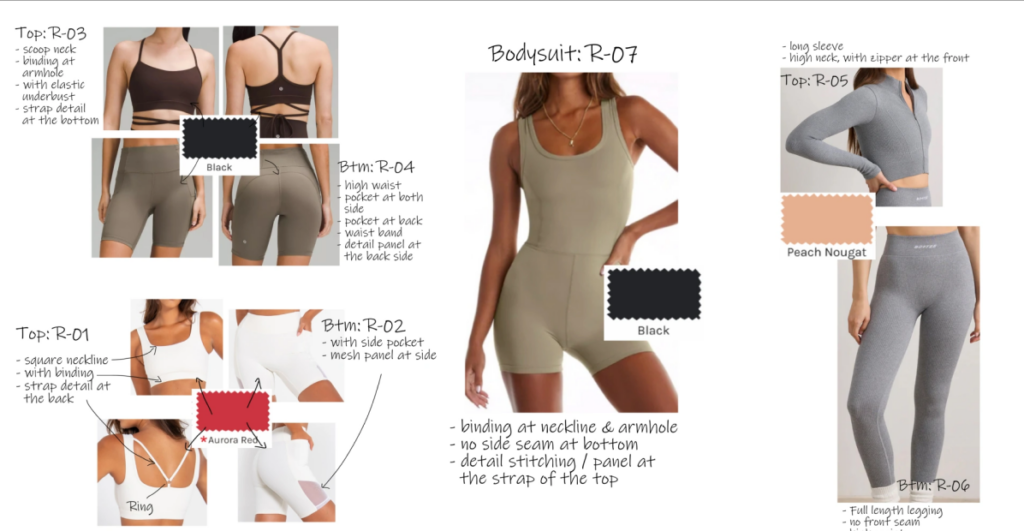
The development file should include front-and-back drawings, finished measurements and a bill of materials. A removable-cup sports bra needs its lining, cup pockets, insertion openings, cups and strap hardware identified. FashionMe records these components against the garment pattern and uses separate shell and liner patterns for two-layer running shorts.
A written quotation should separate development charges from the bulk unit price. Request the cost of the first sample, revisions, grading and commissioned testing. Include decoration, labels and packaging in the same cost review, and record the currency, payment stages and quantity covered by each quoted rate.
Write the event that starts the production period beside the lead time. Depending on the supplier, this may involve material arrival, sample confirmation or return of the physical sample. Activewear Bali requires the sample back before bulk production; Thygesen includes fabric production within its standard lead time.
The order should identify the proposed production site. Shipping can then be quoted against the destination, delivery method and packed shipment details, with dispatch and expected arrival recorded separately.
Reviewing the Samples
Label each sample with the style, size, fabric reference and revision date. A size set provides garments across the selling range, allowing fit comments to be attached to the actual size being reviewed. Lefty includes size testing in its pre-production service.
During fitting, record what happens at the waistband and underband through the movements relevant to the garment. Check the position of the gusset, cup coverage, strap adjustment and access to pockets or removable padding where those components are present. Attach requested changes to a finished measurement or a marked location on the sample.
Material tests should use the intended production fabric and color. The request needs to specify the property being assessed, test method, conditioning or washing procedure, and acceptance level. Petratex’s laboratory lists seam strength, abrasion, colorfastness to perspiration and shrinkage among its testing capabilities.
For bonded construction, include joins made with the proposed production materials in the evaluation and record their condition after the agreed washing procedure. Keep the results with the fabric article, color and sample revision tested.
Before bulk cutting, the order file should contain the pre-production sample reference, finished measurements, tolerances and material list. Attach the color and size quantities, artwork dimensions, label positions and packing instructions. Fabric reserved for later orders should be recorded by article, color, lot number and retained quantity.