Custom Shock-Absorbing Insole
A founder in California was starting an insole brand called NUVE and sent us a video with one question: could we find an insole that behaved like that?
01 — Reading the brief
The video showed three insoles, and the founder had already taken the brief apart for us. The green one showed the shock absorption they wanted. They chose the Nike for its shape, with an ordinary retail insole included as a baseline for the improvement they expected from NUVE.
For a factory quotation, we had a material and a structure to specify for NUVE, using selected features from the three references. “Absorbs like this one” would also be checked in a test that a sample could pass or fail. We would judge the submitted samples against the green insole, with every supplier quoting and sampling to the same written requirements.
02 — Writing the spec before contacting anyone
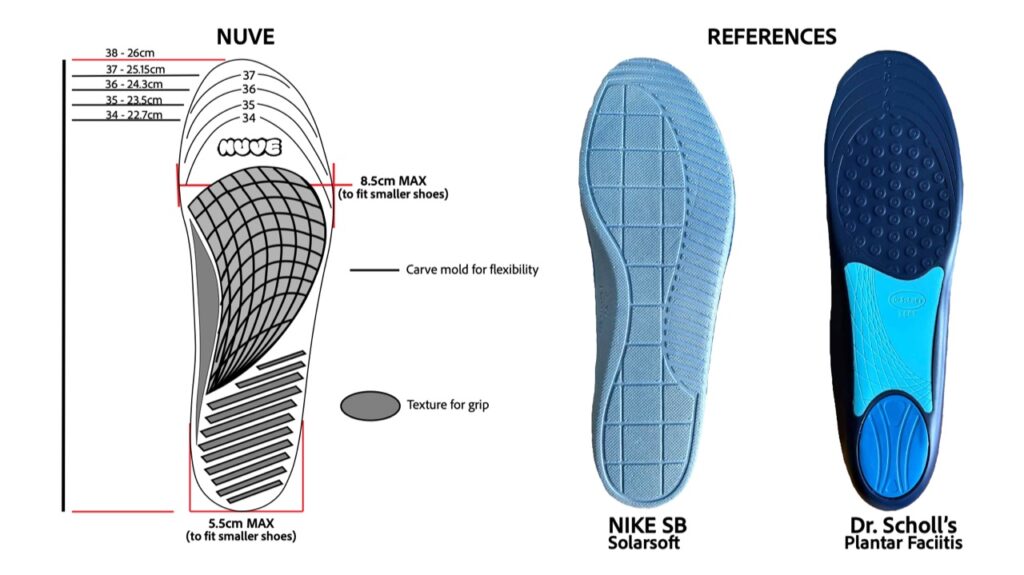
We wrote the product definition first, and it ran to five pages. It covered sizes 34–38 and 39–44, with a stated length for every size: 22.7–26 cm across the smaller run and 26.6–30 cm across the larger one. Maximum forefoot widths were 8.5 cm and 9.2 cm, respectively, to keep the insoles narrow enough for smaller shoes. The insole design included flex zones to allow bending, a textured underside for grip and arch support.
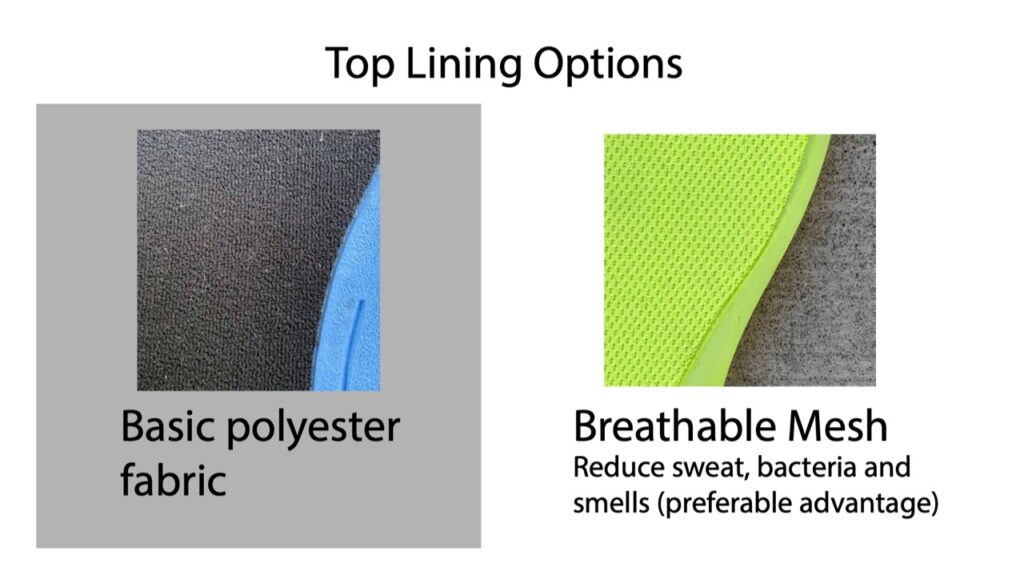
Sorbothane was named in the material brief for shock absorption. A single material could be used if it provided the underfoot comfort as well. The layered option put memory foam over a Sorbothane base, with the upper layer supplying comfort. Basic polyester was the cheaper lining option. We preferred breathable mesh for the requested breathability, sweat management, bacterial control and odor reduction.
We referred to the Nike SB Solarsoft for shape. The NUVE outline was drawn alongside reference photographs, with lengths and maximum widths marked for the two size runs. A supplier could check the requested contour against the photos and the dimensions on the drawing. Page four expressly excluded the reference’s molds, branding and marks. The finished insole carried only NUVE’s logo.
The founder shipped us the green insole itself. It stayed on the bench throughout the project as the reference for the shock absorption we were trying to match.
That changed the question we put to suppliers from “can you make an insole” to “can you hit this” — and it gave all of them the same target instead of their own interpretation of a video.
03 — Sampling until something passed
We requested samples using the five-page spec, our written interpretation of the brief. Sampling and testing took seven rounds. Each of the six unsuccessful rounds removed a class of material from our shortlist. The founder’s green insole was on the bench for every test. In the filmed round, a bottle was dropped onto the candidate materials and the reference insole. We compared their responses to decide whether a sample matched the behavior the founder wanted.
The result
We ran the final comparison with the founder’s insole beside our sample. The same bottle was dropped repeatedly onto each one from similar heights. It settled upright on our sample, matching the reference response. The finished insole had breathable mesh over a shock-absorbing base in NUVE’s own shape.
The founder ended up with a brief broken into separate requirements and a five-page spec that factories could quote against. We had found a material combination that matched the insole they sent us and demonstrated it in the final side-by-side drop test.