Skirts Manufacturing
Fitted woven skirts take their waist and hip shape from darts and curved seams. Tiered skirts are assembled from gathered sections, with each section cut to its own height and circumference.
FashionMe offers Stock Match from 10 pieces and Made to Order from 50 pieces.

Waist and Hip Shaping
In a darted skirt, the front and back panels are cut with the dart intake included. The side-seam curves retain the required hip width.
The waistband is sewn to the skirt's waist seam after the darts or waist pleats are closed. The attachment length excludes seam allowances and fastening extensions.
Changes to the skirt's waist seam are carried through to the waistband pattern. Seat adjustments change the back panel's width, length or dart distribution. These corrections are made to the sample pattern before grading.
Waistband and Elastic Construction
A two-layer contoured waistband is assembled from shaped outer and inner pieces. Fusible interlining supports the assigned layer. The upper seam is sewn and turned, with understitching securing its allowance to the inner waistband. The inner lower edge encloses the skirt's waist seam allowance.
Elasticated skirts use an elastic loop inside a casing or an elastic band attached directly to the upper edge. The elastic cut length includes the joining allowance. The casing fabric circumference limits the maximum opening.
In a multi-channel waistband, each channel contains a separate elastic loop and has its own insertion opening.
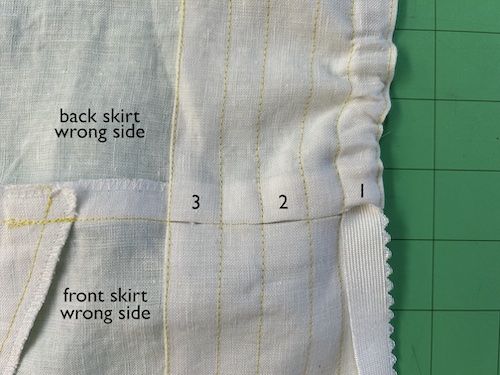
Zipper and Top Closure
A concealed zipper is sewn into an open side or center-back seam. Each tape is attached separately, followed by the remaining garment seam below the zipper. When the zipper crosses the waistband seam, that seam aligns on both sides of the closed zipper.
The facing or lining is attached clear of the moving slider. A separate waistband extension carries its specified button or hook-and-bar above the zipper.
Stitching too close to the zipper elements increases the force needed to open and close the zipper.

Pleated Skirt Production

Machine pleating feeds fabric from a roll through equipment that forms repeated folds. Pattern pleating places individual fabric panels inside a mold and exposes them to steam. Radial molds form sunray or sunburst panels with narrower folds near the waist and wider folds toward the hem.
For parallel pleated panels, excluding seam and closure allowances:
Net panel width = finished span + total hidden pleat intake.
Example: 40 cm + (8 pleats × 5 cm hidden intake per pleat) = 80 cm.
The pleat layout establishes fold count, direction, spacing and any stitched-down length. A closing seam positioned inside a designated fold is concealed when the pleats lie closed. Pleat retention is evaluated on the actual fabric after its specified care treatment.
Bias-Cut and Circular Hems
True-bias panels are cut at 45 degrees to the straight grain. Staystitching stabilizes cut edges within the seam allowance. The panels remain supported during sewing so their weight does not stretch one layer against the other.
Bias-cut and circular skirts are leveled after hanging and settling. Longer sections are marked and trimmed before hemming. Finished skirt length is measured to the completed hem edge, excluding the turn-up allowance.
Slits, Vents and Wrap Fronts
Slit length is measured from the reinforced seam stop to the finished hem. Both edges are finished separately.
An overlapping vent contains extensions cut into the adjoining panels. In a lined pencil skirt, the shell and lining have separate vent shapes. The lower corners are sewn and turned, while the upper vent attachment secures the overlap. The lining attachment allows the vent to open during movement.
Wrap overlap is measured with the waist fastenings closed. The overlap dimension, fastening positions and intended wearing height are recorded in the size specification.

Lining Assembly

The lining's upper edge joins the waistband or facing, and its opening is finished around the zipper or other closure.
A free-hanging lining has a separately finished hem above the outer skirt's hem. A bagged lining joins the shell at the lower edge, with an allowance in the lining length for that connection.
Shell and lining lengths are measured separately after the specified garment finish. The lining must not pull the outer hem upward.
Pocket Assembly
In-seam pocket bags attach to adjoining skirt panels. The side seam closes above and below the hand opening and continues around the pocket bag. Understitching holds the inner edge toward the bag, and stitching at the opening ends secures the attachment.
Pocket opening positions are measured from the waist reference. The upper and lower ends align across the pair. On a side-zip style, the pocket bag remains clear of the zipper assembly.
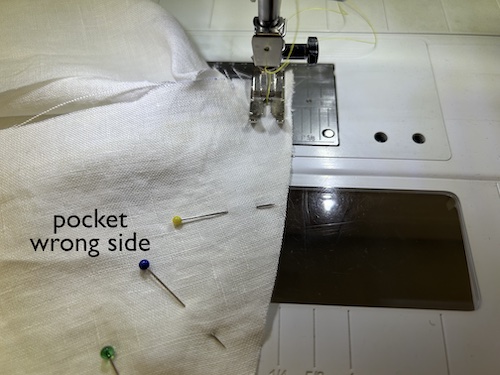
Gathered Tiers and Ruffles
Matching marks divide adjoining tier edges into corresponding sections. Gathering reduces each longer section to its matching attachment length.
For a separate waistband and stacked, non-overlapping tiers:
Finished skirt length = finished waistband depth + the sum of the visible tier heights.
Joining allowances are excluded from this finished-length calculation. A separate ruffle has its own cut length and finished depth, measured after edge finishing.
Border prints and decorative selvages are positioned at the intended finished tier edge before cutting.
Cutting and Sewing Operations
The cutting marker contains the shell panels and the waistband, facing, pocket or lining pieces used by the style. Grainlines establish each component's orientation. Directional prints and required stripe or check matching are positioned before cutting.
The stitch type is specified for each sewing operation:
| Operation | Stitch type |
|---|---|
| Lockstitched assembly | 301 |
| Overlock edge finishing | 504 |
| Five-thread safety seam | 516 |
| Blind hemming | 103 |
Grading and Finished Measurements
Grading changes the skirt panels and their connected waistband, facing and lining pieces. Dart placement follows the graded body. A pleated skirt's size specification defines the fold count, spacing and intake for each size.
| Measurement | Finished-garment reference |
|---|---|
| Waist | Closed waistband at the stated measuring line; flat width and circumference are identified separately. |
| Hip | Across the skirt at the specified depth below the waist. |
| Length | From the named waist edge to the finished hem at the front, back and sides. |
| Sweep | Hem width or circumference, with pleats and openings in the stated position. |
| Slit or vent | Finished opening length and, for a vent, extension width and overlap direction. |
| Elastic waist | Relaxed opening and the specified extended opening. |
Out-of-tolerance measurements are recorded and rechecked after correction.
Final Inspection and Packing
The fastened skirt is inspected for waistband alignment, zipper travel, pocket access and hem balance. Pleated styles add fold direction and stitched-down length to the inspection. For lined skirts, inspection also covers lining clearance and free movement at any slit or vent.
Open seams, skipped stitches, fabric pulls, stains, press damage and broken fastenings are recorded separately from measurement faults. Repaired garments return to inspection. The packing instruction specifies fold direction, size identification and any required garment support.
