FashionMe · Fabrics
what is viscose fabric
Viscose fabric is woven or knitted cloth made with regenerated cellulose fiber. The cellulose usually begins as dissolving-grade wood pulp, which is chemically converted into a viscous spinning solution, passed through very small spinneret holes and regenerated as solid cellulose in an acidic bath.
The word viscose identifies the fiber route, not a particular weave, knit or fabric weight. After fiber production, viscose may be spun as staple yarn or used as continuous filament, then turned into challis, jersey, rib, crepe, twill and many other fabrics.
A lightweight viscose dress fabric can therefore feel completely different from a dense viscose trouser fabric even when both carry the same 100% viscose fiber declaration.
What 100% Viscose Actually Tells You
A 100% viscose label gives the fiber content. GSM, yarn count, yarn twist, usable width and fabric construction still need to be specified separately, while shrinkage, stretch, spirality, pilling, abrasion and colorfastness have to be measured on the finished material.
In U.S. textile labeling, viscose falls within the rayon fiber category. Bamboo can also supply the cellulose used to manufacture viscose, and wording such as viscose made from bamboo can identify that raw-material source when the claim is properly supported.
Once the cellulose has gone through the viscose process, the finished textile fiber is regenerated cellulose.
Why Viscose Falls Into Soft Folds
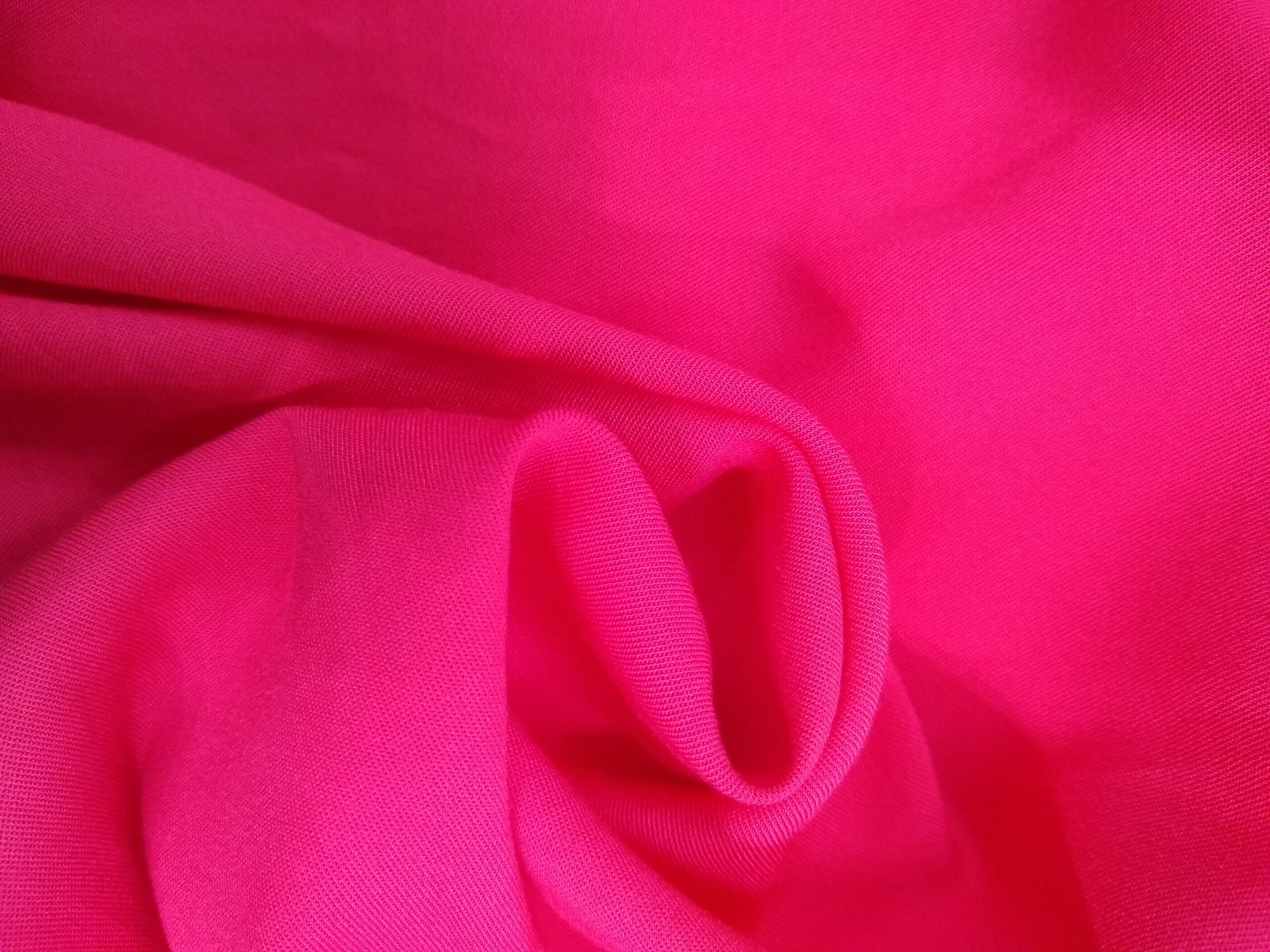
Hang a meter of lightweight viscose over the edge of a cutting table and the cloth often drops into narrow, fluid folds instead of holding a broad, rigid shape.
That appearance cannot be explained by fiber density alone. Published viscose density sits around 1.50–1.54 g/cm³, while PET is generally around 1.36–1.41 g/cm³, so viscose is not unusually light at the fiber level.
GSM measures fabric mass. A fabric marked 130 GSM contains about 130 grams of material per square meter, yet that number says little about bending stiffness. Fiber fineness, yarn twist, yarn spacing, weave or knit density and finishing all affect how the cloth bends once it is hanging.
A softly finished challis made from fine viscose yarn can collapse close to the body, while a denser twill made from the same fiber holds a much clearer shape.
Water Changes the Fiber, Not Just the Handfeel
Viscose absorbs considerably more moisture than polyester, with published moisture-regain figures commonly sitting around 12–14% under standard textile-conditioning conditions.
Water also changes the mechanical properties of the fiber.
| Property | Viscose | Lyocell | Cotton |
|---|---|---|---|
| Moisture regain | 12–14% | 11–13% | 7–9% |
| Water retention | 85–100% | 60–75% | 38–55% |
| Dry elongation | 17–25% | 10–17% | 7–10% |
| Wet elongation | 21–23% | 17–19% | 12–14% |
| Dry tenacity | 20–27 cN/tex | 35–42 cN/tex | 24–36 cN/tex |
| Wet tenacity | 10–15 cN/tex | 26–38 cN/tex | 26–40 cN/tex |
For the viscose values in this dataset, tenacity drops from 20–27 cN/tex in the dry state to 10–15 cN/tex when wet. During dyeing, washing, hydro-extraction and wet finishing, the fabric may therefore be moving through rollers, guides and extraction equipment while the swollen fibers are mechanically weaker.
A Real Viscose Rib Knit Lost 11.9% in Length
A 2024 study tested 1×1 rib fabrics made from ring-spun, rotor-spun and air-jet-spun viscose yarns. The samples were washed at 40°C on a mild cycle under EN ISO 6330:2012 with phosphate-free ECE reference detergent, then air dried; dimensional change was measured using EN ISO 3759 and EN ISO 5077.
Average lengthwise dimensional change across the viscose rib fabrics was approximately −11.9%.
That is a substantial movement for a garment fabric, although the figure belongs specifically to the rib constructions and wash procedure used in that experiment. It should not be turned into a blanket shrinkage allowance for every viscose fabric.
Following One Viscose Jersey Through the Mill
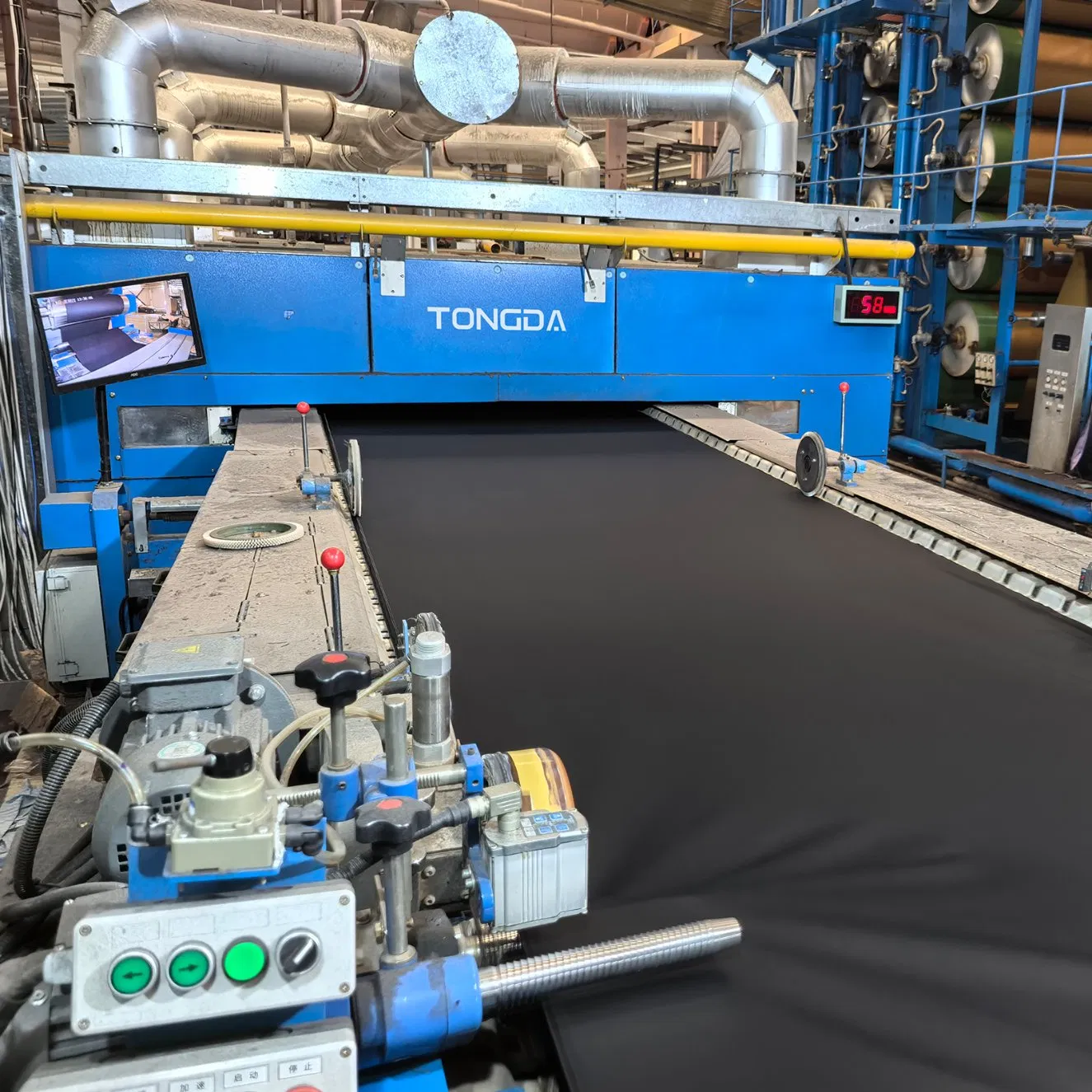
An industrial study tracked full-feeder Lycra viscose single jersey through heat setting, dyeing and tumble drying, and the fabric mass changed noticeably as processing progressed.
| Shade group | Grey fabric | After heat setting | After dyeing and tumble drying |
|---|---|---|---|
| Light | 226 GSM | 146 GSM | 190 GSM |
| Medium | 230 GSM | 153 GSM | 195 GSM |
| Dark | 240 GSM | 160 GSM | 209 GSM |
Heat setting was carried out at 190°C for 60 seconds. The dark sample entered the process at 240 GSM and later measured 209 GSM after dyeing and tumble drying.
Dimensional movement was also recorded. A 350 mm reference on the dark fabric later measured about 370 mm in length and 369 mm in width, reported as +5.71% and +5.43% growth.
Post-heat-set spirality across the light, medium and dark shade groups measured +1.7%, +2.1% and +2.2%, while bursting strength remained around 162–168 kN/m².
The figures came from one continuous production sequence, so they show how much a viscose jersey can change before cutting even begins.
What a Viscose Fiber Looks Like Under a Microscope
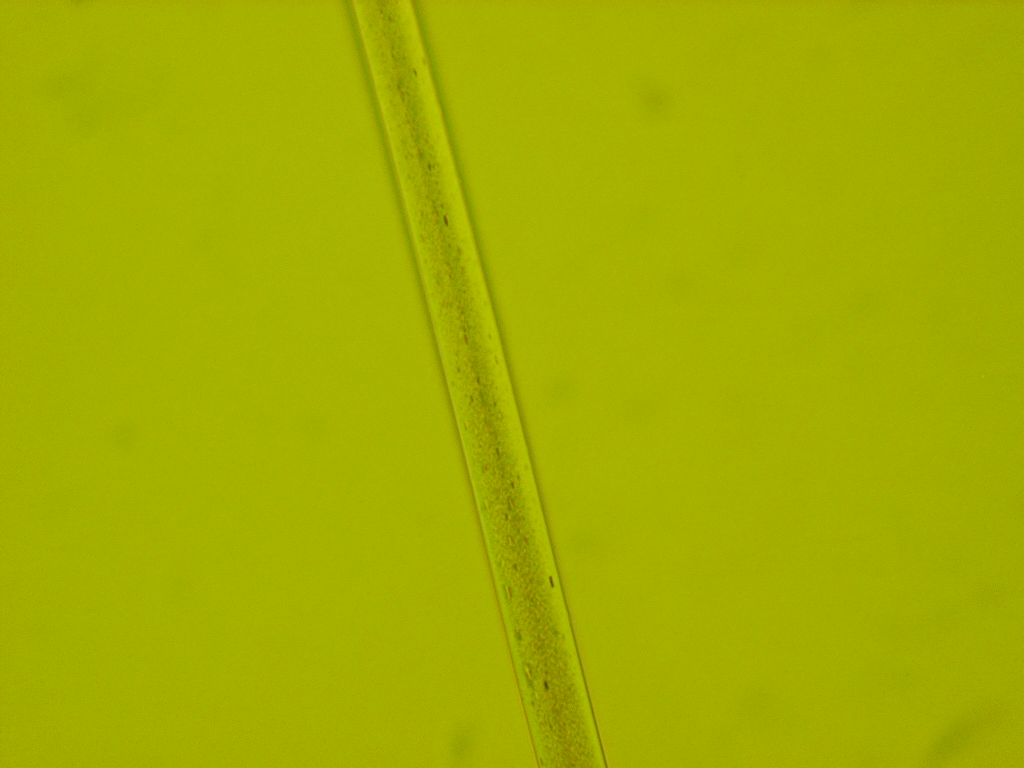
Conventional viscose commonly shows a serrated or multilobal cross section, with fine longitudinal striations running along the fiber surface. Recent SEM work has reported approximately 4–6 lobes in particular regenerated-viscose samples.
This outline forms during wet spinning and remains with the fiber during yarn manufacture.
When staple viscose is twisted into yarn, the irregular surfaces create many small contact points inside the bundle. Changing yarn twist changes how tightly those fibers pack and therefore affects the yarn before weaving or knitting adds another level of structure around it.
How Wood Pulp Becomes Viscose Fiber
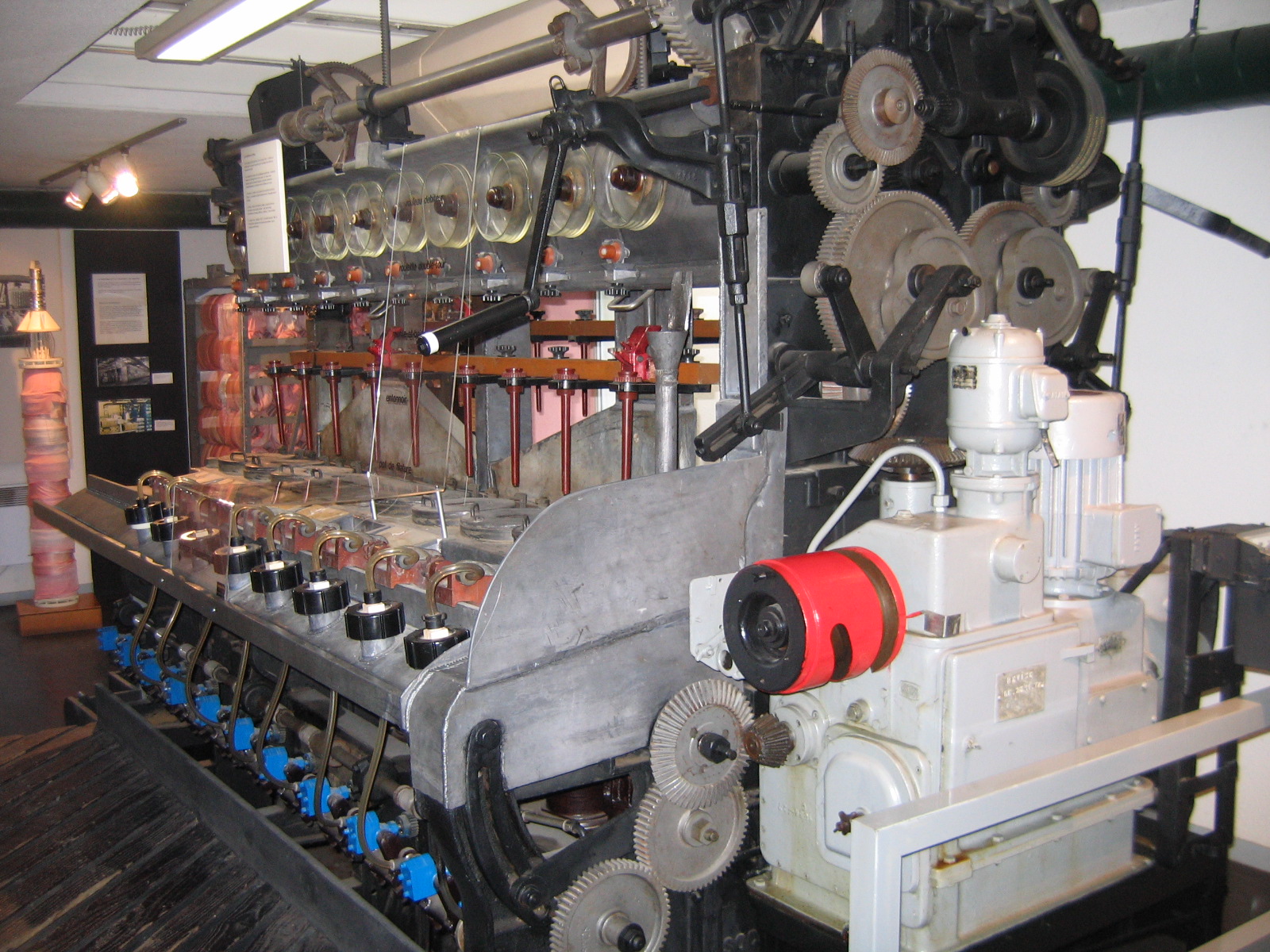
The process begins with dissolving pulp, which is treated with sodium hydroxide to form alkali cellulose before undergoing controlled aging.
Carbon disulfide is introduced during xanthation. The resulting cellulose xanthate is dissolved in dilute sodium hydroxide, forming the thick spinning solution known as viscose.
Before spinning, the solution is filtered to remove solid contamination and deaerated to remove trapped gas. Spinnerets then meter it into an acidic coagulation bath, where cellulose regenerates as solid filament.
Stretching, washing, desulfurizing and finishing follow the spinning bath. For staple production, the filament is cut to the length required by the yarn system; one commercial apparel-type specification is around 1.5 denier × 38 mm.
Continuous-filament viscose remains uncut.
The Yarn Can Change the Fabric Before Knitting Starts
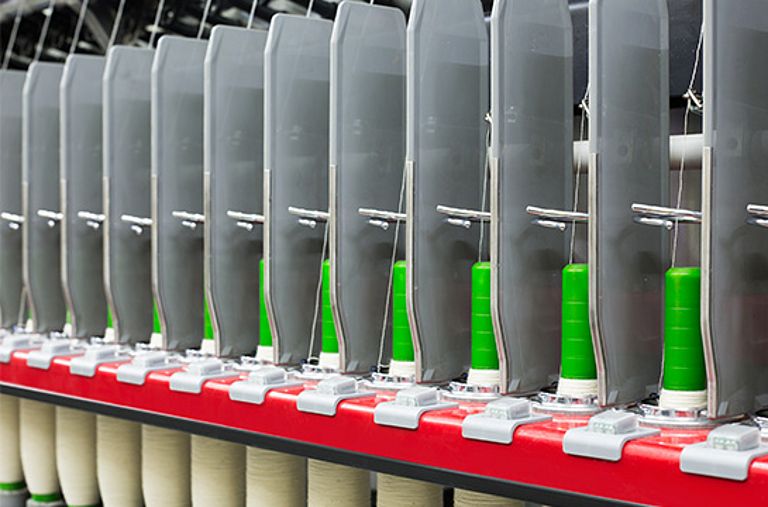
One rib-knit study used three viscose yarns whose linear densities were all close to 20 tex.
| Yarn system | Linear density | Tenacity | Hairiness |
|---|---|---|---|
| Ring spun | 19.9 tex | 16.80 cN/tex | 6.47 |
| Rotor spun | 20.1 tex | 13.98 cN/tex | 4.36 |
| Air-jet spun | 20.2 tex | 14.52 cN/tex | 3.75 |
The ring-spun yarn carried about 751 twists per meter, while production of the air-jet yarn used 0.6 MPa air pressure.
Although the yarn counts were close, measured hairiness ranged from 3.75 to 6.47, which later showed up in differences in the knitted fabric surface.
Pilling After 7,000 Rubs
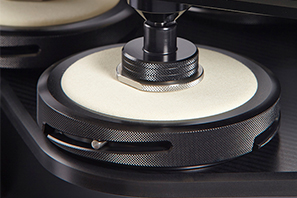
Modified Martindale testing under EN ISO 12945-2:2020 gave the following results after 7,000 rubs:
| Yarn system | Dry-relaxed pilling grade |
|---|---|
| Ring spun | 2.0 |
| Rotor spun | 2.5 |
| Air-jet spun | 3.5 |
After wet processing, the corresponding grades were 2.5, 3.0 and 3.5.
A separate experiment on 100% viscose plain weave produced a much earlier visible surface change. When viscose rubbed against viscose, the specimen reached Grade 1.0 after only 125 rubs; with a standard wool abradant, it reached Grade 2.0 after 500 rubs.
Under one 7,000-rub condition in that study, image analysis counted as many as 540 individual pills.
Abrasion Lasted Tens of Thousands of Rubs
Abrasion was measured separately under EN ISO 12947-2:2016, where the endpoint was physical specimen breakdown rather than visual pilling.
Dry-relaxed viscose 1×1 rib fabrics failed between 35,000 and 50,000 rubs. After wet processing, breakdown occurred between 30,000 and 40,000 rubs.
Those figures describe a different failure mechanism from the pilling grades above, even though both tests use Martindale equipment.
Breaking Strength After Wet Processing
The ring-spun viscose rib measured 304.8 ± 20.6 N in lengthwise breaking strength before wet processing and 182.7 ± 18.3 N afterward.
Lengthwise elongation at break also fell, moving from 50.8 ± 0.9% to 37.7 ± 2.2%.
The rotor-spun specimen recorded 204.7 ± 12.6 N before wet processing and 203.0 ± 17.2 N afterward. In this sample set, the effect of wet processing therefore depended strongly on the yarn and fabric structure rather than producing one fixed strength loss across every viscose knit.
Dark Viscose Needs Real Colorfastness Numbers
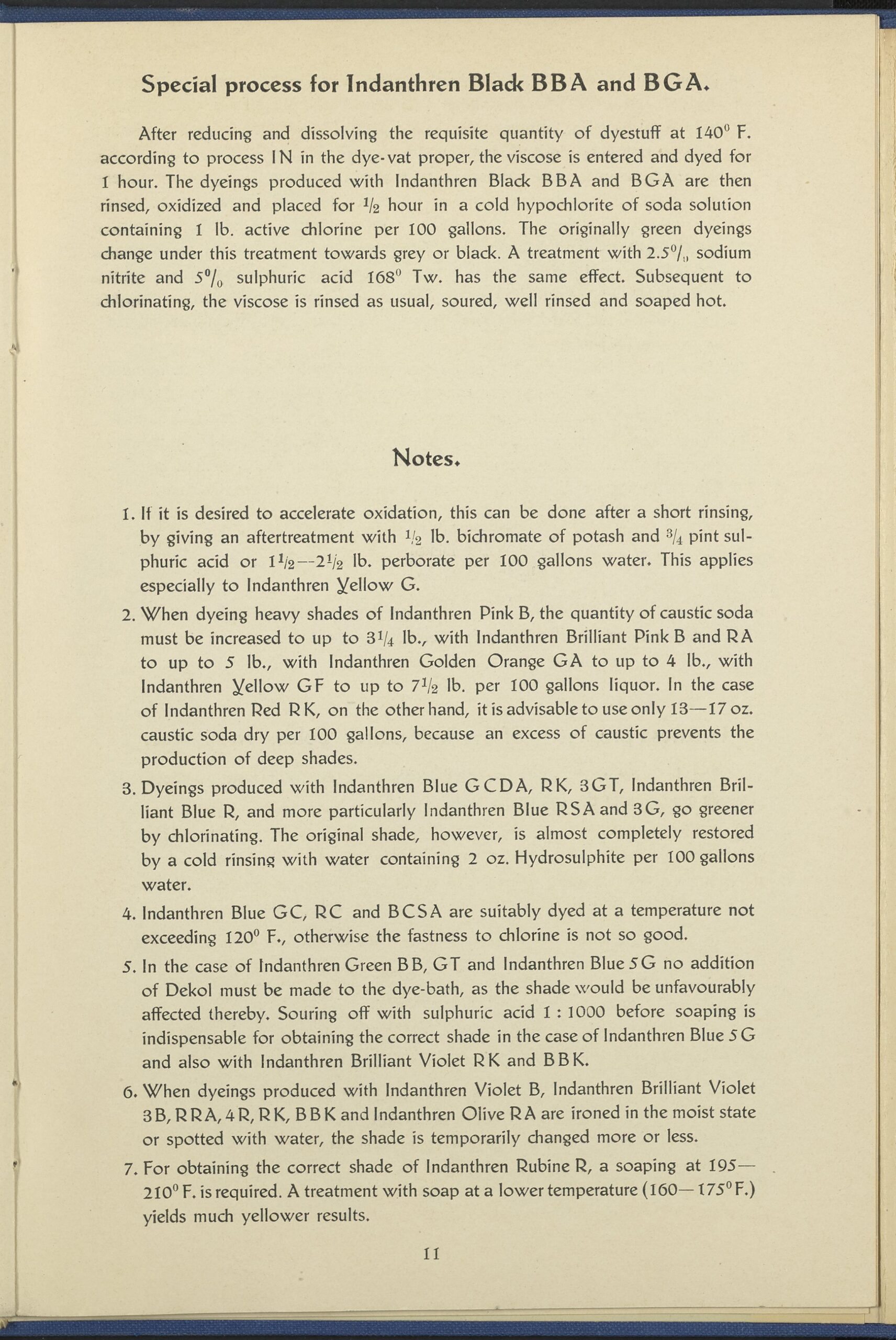
A reactive-dye study on viscose knit used washing-off times of 10, 20 and 40 minutes at 80°C, 95°C and 110°C.
- wash color change: Grade 4–5
- cotton staining: Grade 4–5
- nylon staining: Grade 4–5
- polyester staining: Grade 4–5
- dry rubbing: Grade 4–5
- wet rubbing: Grade 3–4
Another treatment using cationic modification and a rubbing-fastness enhancer reached around Grade 4–5 wet rubbing.
For a dark garment that sits next to pale lining, binding or underwear, those wet-rubbing results matter more than a visual shade check on the roll.
Indigo Can Be Added During Fiber Production
Natural-indigo pigment has also been introduced during viscose spinning. Reported finished-fabric results included washing color-change grades from 3–4 to 4–5, dry rubbing from Grade 4 to 5, wet rubbing from Grade 4 to 4–5, and light fastness from Grade 4–5 to 5.
The individual result changed with pigment concentration.
A Woven Viscose Seam Reached 182.67 N
An ASTM interlaboratory dataset included a woven viscose reference fabric whose warp-direction fabric strength averaged 297.31 N.
The sewn seam averaged 182.67 N, giving a seam efficiency of 61.48%. At 3 mm seam slippage, the reported force was approximately 147.14 N.
Repeatability standard deviation was 8.36 N for warp fabric strength and 8.03 N for sewn-seam strength.
These numbers help explain why seam construction needs to be tested on a soft woven viscose before using it in fitted areas, pockets or armholes.
Modal and Lyocell Sit in the Same Fiber Family
Modal and lyocell also begin with cellulose, although their fiber structures and manufacturing routes produce different wet mechanical behavior.
| Property | Lyocell |
|---|---|
| Degree of polymerization | 550–650 |
| Crystallinity | 0.62 |
| Dry tenacity | 35–42 cN/tex |
| Wet tenacity | 26–38 cN/tex |
| Moisture regain | 11–13% |
The conventional viscose values reported in the corresponding dataset were 290–320 degree of polymerization, 0.39 crystallinity, 20–27 cN/tex dry tenacity, 10–15 cN/tex wet tenacity, and 12–14% moisture regain.
Modal is also a regenerated-cellulose fiber, manufactured under conditions intended to improve wet mechanical performance.
Lyocell Uses NMMO
Lyocell dissolves cellulose in an NMMO-based solvent system before spinning. Modern plants recover most of that solvent for reuse, and Lenzing reports NMMO recovery reaching 99.8% in its lyocell process.
The chemistry differs from the xanthation route used to make conventional viscose.
Carbon Disulfide in Viscose Production
Conventional viscose manufacture uses sodium hydroxide during alkali-cellulose preparation, carbon disulfide during xanthation and sulfuric acid during regeneration.
Modern recovery systems can capture a large share of the sulfur chemicals. Lenzing reports carbon-disulfide recovery above 90% under the stated CAP and WSA operating conditions.
Within the company's reporting scope, sulfur emissions from CS₂ and H₂S were 8,427 tonnes in 2024 and 7,086 tonnes in 2025.
Wood sourcing sits elsewhere in the supply chain, with systems such as FSC and PEFC used to document certified or controlled forest sources.
When Bamboo Supplies the Cellulose
Bamboo can be processed into dissolving pulp and used as feedstock for viscose production. The cellulose then goes through the same chemical conversion and regeneration stages used to manufacture viscose fiber.
For U.S. labeling, wording such as viscose made from bamboo can identify that source when the claim is substantiated.
What Viscose Looks Like in Clothing
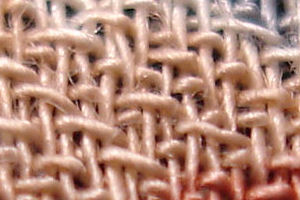
A lightweight challis is commonly used for flowing dresses and blouses because its woven construction bends easily. Rib fabric brings much more mechanical stretch through its knitted loops, while single jersey works well for soft tops, dresses and loungewear.
Adding elastane changes recovery and can make the fabric more suitable for fitted garments. Twill gives viscose a denser diagonal structure and noticeably more body.
Continuous-filament viscose can produce a smoother, more lustrous surface because there are no exposed staple ends from spun yarn.