What Is Spandex?
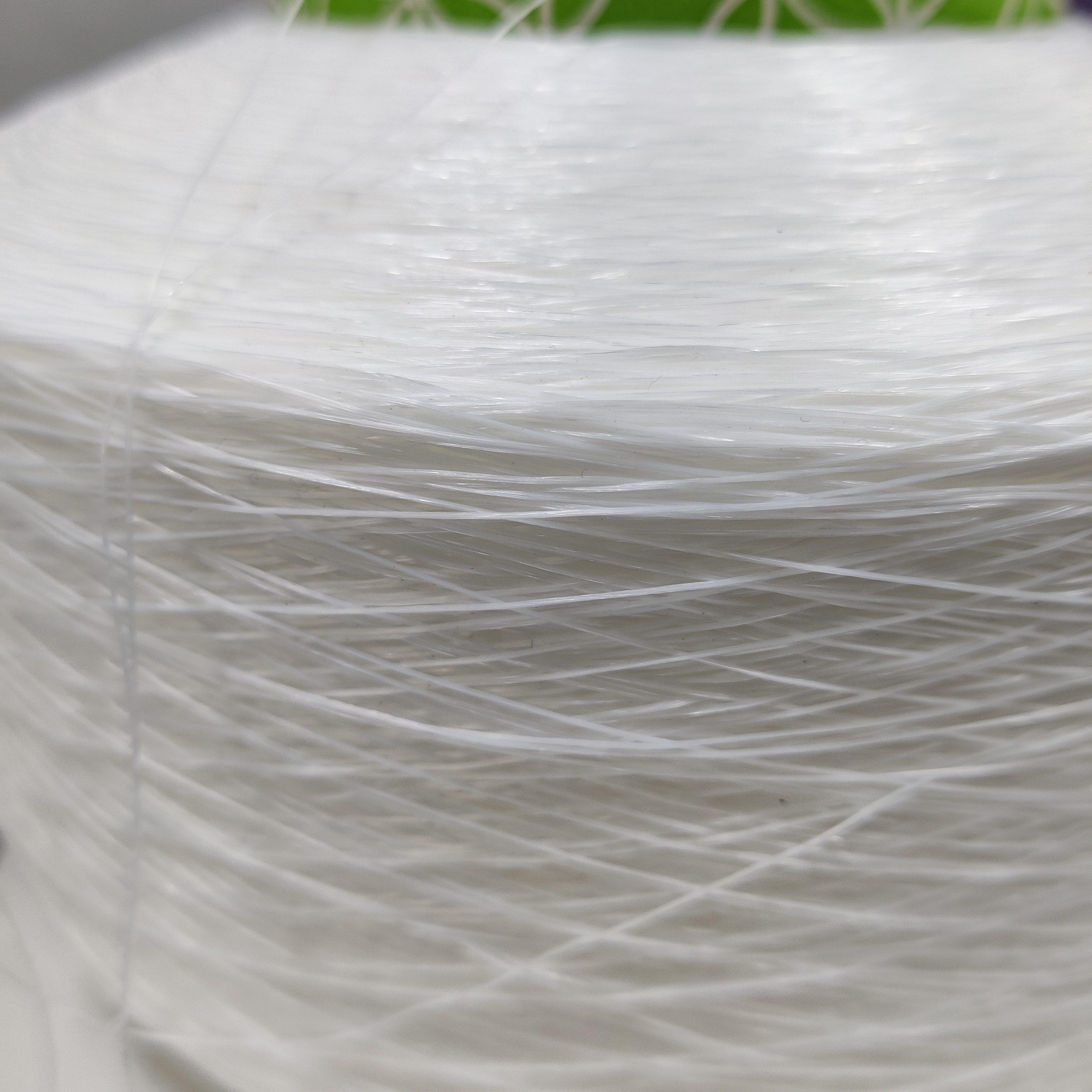
Spandex is a manufactured elastic fiber made from segmented polyurethane. Under the U.S. legal definition, the fiber-forming substance contains at least 85% segmented polyurethane. It is normally used with cotton, polyester, nylon or other fibers rather than making up most of a garment by itself.
A pair of stretch jeans may contain only 2% or 3% spandex. The elastic filament can run through yarn after yarn across the cloth, so that small share of the total fiber weight can influence movement through a much larger area.
Spandex fiber has exceptionally high elongation. CottonWorks gives at least 200% elongation, with some fibers reaching about 800%. A filament capable of that movement becomes much more restricted after it is built into a fabric, where other yarns and the textile structure control how far the finished material can extend.
Why Spandex Is So Elastic
The polyurethane structure contains flexible molecular regions connected through firmer domains. Pulling the filament changes the arrangement of those flexible sections and allows the fiber to lengthen. Once the force is removed, the polymer moves back toward its relaxed arrangement.
That movement happens inside a very fine filament. In a cotton-spandex T-shirt, most of what you see and touch can still come from cotton. In denim, the spandex may sit inside a yarn and remain almost invisible from the surface.
Spandex is therefore a fiber, not a particular fabric construction. Jersey, denim, rib, interlock and swimwear fabric can all contain it.
Spandex, Elastane and LYCRA®
The generic name most familiar in the United States is spandex. Elastane is widely used for the same fiber family in international textile terminology.
LYCRA® is a brand of elastane fiber. The original LYCRA® fiber was invented in 1958, and The LYCRA Company now produces many different LYCRA® fibers for different textile applications.
A garment label may therefore read 95% cotton / 5% elastane, even though an American product description might refer to the same generic type of elastic fiber as spandex. A LYCRA® hangtag identifies a branded fiber used in the textile.
How Spandex Becomes Part of a Fabric
Commercial spandex is commonly produced through solution spinning. Polyurethane polymer is prepared as a solution and passed through tiny spinneret openings. During dry spinning, solvent is removed from the emerging streams and continuous elastic filaments remain.
Textile mills describe the size of those yarns with units such as denier and dtex. A 70-denier yarn weighs 70 g per 9,000 m; 70 dtex records 70 g over 10,000 m.
The way the filament enters a fabric depends on the construction.
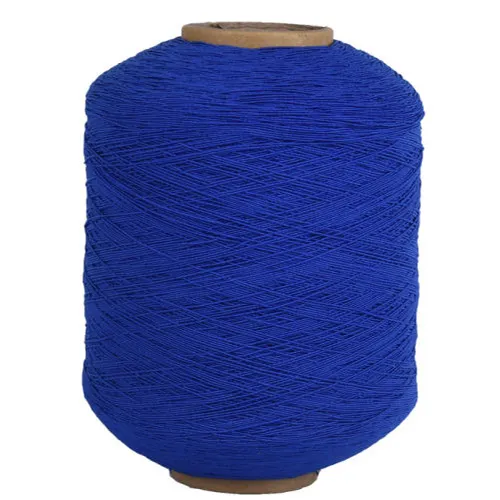
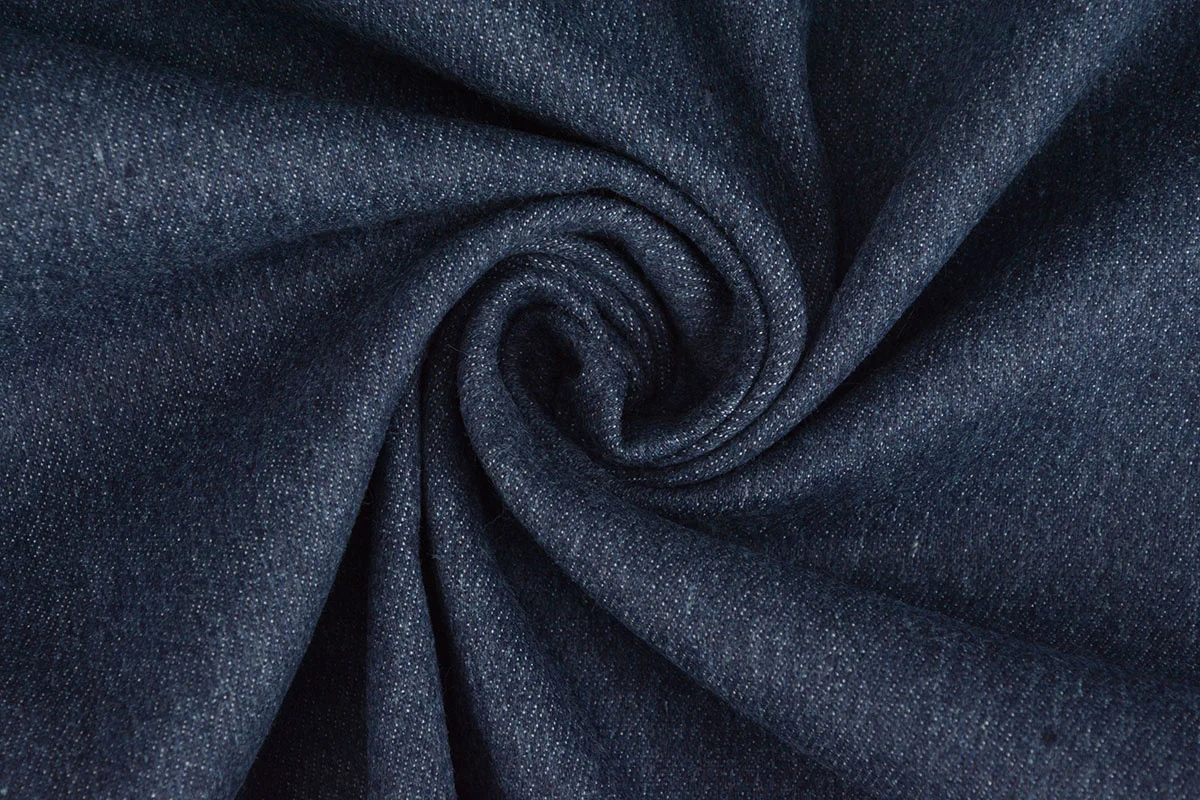
Stretch denim commonly uses core-spun yarn. Spandex travels through the center while cotton fibers twist around it. CottonWorks describes this method as an established route for producing elastic denim yarns.
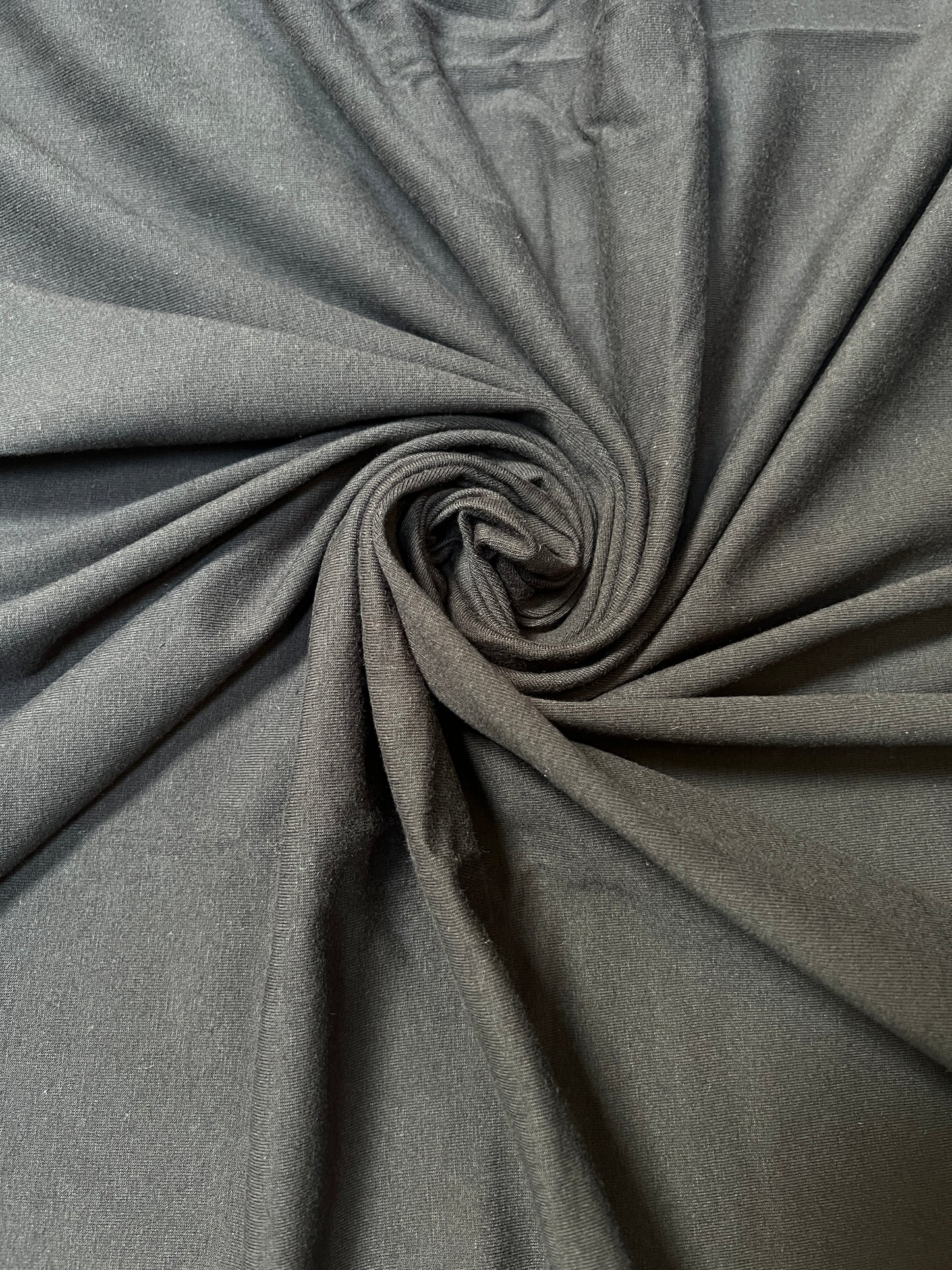
A knit can feed the elastic yarn directly during loop formation. In a plated single jersey, the main yarn forms the visible surface and spandex runs repeatedly through the knitted structure.
CottonWorks has published actual Fabricast constructions using 97% cotton / 3% spandex plated single jersey, along with a 98% cotton / 2% spandex 3/1 twill example.
Why Only 2% or 3% Can Make a Difference
A label reading:
97% cotton
3% spandex
records fiber content by weight.
In a simplified 100 g example, roughly 3 g of the fiber content is spandex. That filament can still repeat throughout thousands of knitted loops or sit inside filling yarns running across the whole width of a woven fabric.
This is also why the number on the care label cannot be used as a stretch percentage.
Suppose two marks are placed 100 mm apart on a fabric sample. During a specified test they move to 140 mm:
(140 − 100) ÷ 100 × 100 = 40% extension
A fabric labeled 5% spandex can produce a value such as 40% under a particular test, because composition and finished-fabric movement are measured in different ways.
Yarn size, spandex feed, stitch length, weave or knit density, finished width and processing all affect the result.
Stretch Is Only Half of the Wear Behavior
Consider a fabric that starts at a 100 mm gauge length and is extended to 150 mm. After the load is removed and the prescribed recovery period has passed, the marks settle at 104 mm.
The remaining 4 mm is growth left after extension.
That behavior becomes visible in garments around knees, elbows, waistbands and seats. Sitting keeps trouser fabric extended around the knees and hips for long periods, so the material's recovery becomes important after the wearer stands again.
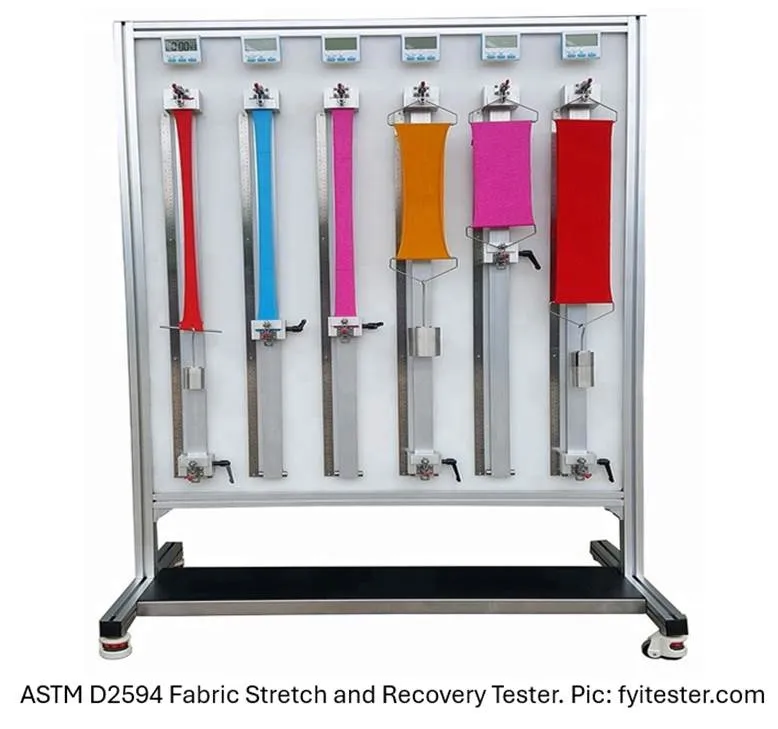
ASTM D2594/D2594M-21 covers stretch and growth measurements for knitted fabrics having low-power stretch. Fabric stretch is measured under a known load, and growth is evaluated after a known extension has been applied and removed.
Stretch woven fabrics use methods such as ASTM D3107-26. Its current scope includes woven fabrics with more than 12% stretch under the conditions covered by the standard, with 1.35 kg (3 lb) and 1.8 kg (4 lb) tension options.
A supplier's figure such as “45% stretch” is therefore much more useful when the test method, fabric direction and test conditions are attached.
What Spandex Does in Jeans and Leggings
In many stretch denims, the elastic core yarn is placed in the filling direction across the width of the cloth. Once cut into jeans, that movement is available around areas such as the waist, hips and thighs.
The denim can still keep a cotton-dominated surface because the elastic filament sits inside a cotton-covered yarn.
Leggings ask more of the elastic structure. The fabric begins extending as the garment passes over the hips, remains under tension around the waist and thighs, and moves farther during actions such as squatting.
Spandex percentage alone cannot describe how firm leggings will feel. A dense knit can require substantial force to extend even when another fabric carries a similar fiber composition. GSM, yarn size, loop dimensions, elastic-yarn specification and garment measurements all contribute.
The same principle applies to the phrase four-way stretch. It refers to useful movement in both principal fabric directions. It does not identify a particular spandex percentage.
A Fabric Can Stretch Without Spandex
Knitted loops can create movement even when the yarn itself has little elasticity. A 100% cotton jersey usually gives across its width because its loops change geometry as the material is pulled.
Mechanical stretch can also be engineered into woven cotton.
Cotton Incorporated's NATURAL STRETCH technology uses 100% cotton and lists typical filling-direction stretch of 10% to 18%, depending on fabric weight and weave. Its process controls the woven structure and finishing to create additional weft crimp without elastomeric yarn.
So the presence of stretch in a garment is not, by itself, proof that spandex is present.
Finishing Changes the Way Spandex Fabric Behaves
A newly knitted stretch fabric has not reached its final dimensions.
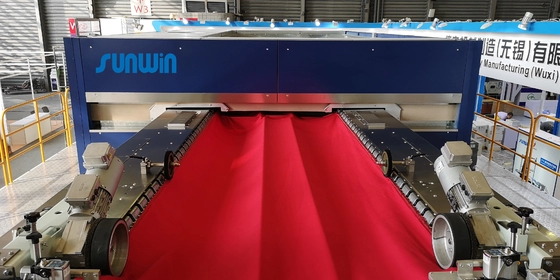
Dyeing, drying, width control and heat setting change the way the loops and elastic yarn sit in the finished cloth. If a knit is held wider during finishing, its resting geometry changes. Fabric density, GSM and available extension can move with it.
Heat setting is particularly important in many elastane constructions because time, temperature and tension affect dimensional stability and the state of the elastic component.
These values are set for the actual fabric being produced. A process developed for one cotton-spandex jersey should not be treated as a universal recipe for every elastane fabric.
For repeat orders, mills commonly need more than the fiber composition to reproduce the original result. Finished width, fabric weight, yarn details and processing conditions can all matter.
What Chlorine Does to Spandex
Swimwear adds chemical exposure to the repeated stretching already happening around the body.
ISO 17608:2015 provides a method for measuring the resistance of bare elastane yarn to chlorinated swimming-pool water through breaking-force retention. The standard was reviewed and confirmed again in 2026.
The ISO scope also states that results obtained from bare yarn cannot be used to predict the performance of the finished fabric. A swimsuit contains other fibers, knit geometry, dyes and finishes that affect its behavior in use.
This is one reason swimwear suppliers may specify elastane developed for repeated pool exposure rather than relying only on the percentage printed on the composition label.
Reading a Spandex Fabric Specification
The description:
95% cotton / 5% spandex single jersey
identifies the fiber blend and general construction, but a production fabric normally needs more information attached to it.
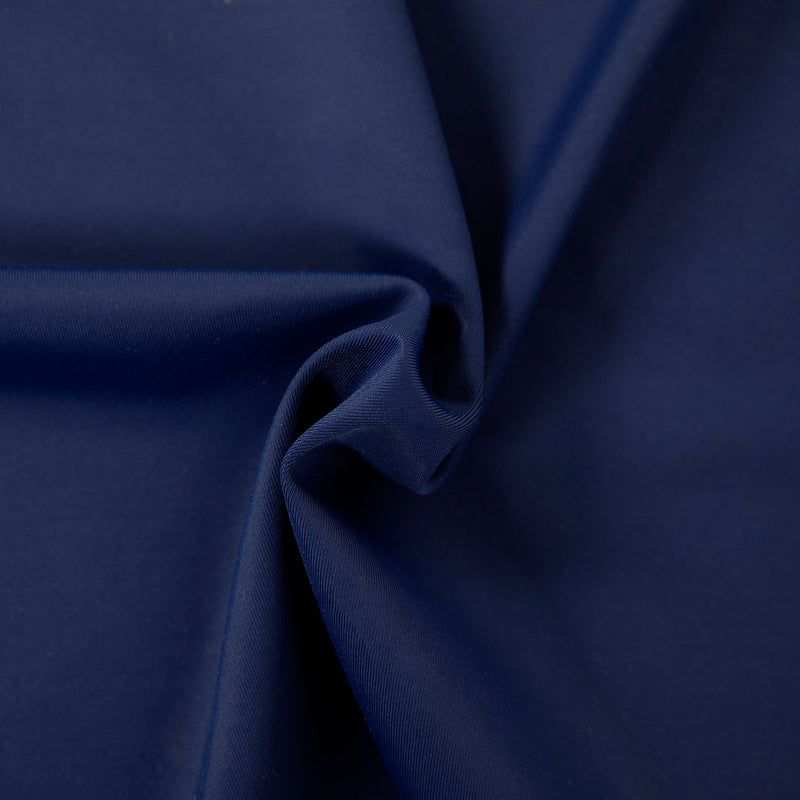
A working record can include the finished GSM, usable width, cotton yarn count, spandex denier or dtex, plating method, stretch in each direction, growth or recovery result, shrinkage test and confirmed physical swatch.
The stretch figures should carry their test conditions. Shrinkage needs the laundering method used to produce the result. The physical swatch preserves hand and surface characteristics that are difficult to capture with composition percentages alone.