What Is Jersey Fabric? Why T-Shirts Default to It
Jersey fabric is a knit formed from interconnecting loops of yarn. The familiar fabric in a plain T-shirt is usually single jersey, with fine V-shaped stitches on the outside and a different, more rounded stitch texture on the inside. Its loops can change shape under tension, giving the cloth the flexibility needed for a pullover worn close to the body.
A cotton jersey T-shirt combines cotton fibers with this knit construction. Mills also knit jersey from polyester, viscose, modal, and blends containing elastane. The chosen yarn and the way it is knitted and finished determine much of the fabric’s weight, surface feel, and behavior.
Single jersey suits the garment at several stages: it accommodates movement during wear, forms a relatively even face for decoration, and can be knitted continuously on productive circular machines. The finished fabric can become a thin undershirt, a fitted stretch tee, or a substantial casual T-shirt.
Recognizing the Structure
At a T-shirt’s bottom hem, the outer face and reverse can be seen together. On the face, the legs of each stitch form a small V. These stitches stack into vertical columns called wales. The reverse shows the curved portions of the loops, which give it a more horizontal, bumpy appearance. Fine yarn can make this difference difficult to see without magnification.
Jersey belongs to the weft-knit family. New loops are drawn through existing loops as the yarn travels across the fabric; each horizontal row is called a course. One set of needles repeats the plain knit stitch to produce single jersey.
In a woven cotton shirting, lengthwise warp yarns cross with widthwise weft yarns. That interlacing holds the yarns in a comparatively fixed grid. A typical plain woven cotton shirt therefore gets much of its movement allowance from its cut, including the room across the shoulders and chest. Stretch yarns and other woven constructions can change that behavior.
A folded, stitched hem contains single jersey’s tendency to curl at a cut edge.
Why T-Shirts Default to Jersey
Reaching forward changes the distance across the upper back. In jersey, the curved yarn paths can open and rearrange to accommodate that movement. A plain cotton tee gets some of its stretch from this geometry, even with a 100% cotton composition.
Single jersey generally gives more across its width than along its length. With the stitch columns running down a T-shirt body, that widthwise movement follows the chest and waist. The amount of give depends on the yarn, loop dimensions, and finishing, so the same basic construction can serve a loosely knitted undershirt or a firmer casual tee.
A T-shirt can therefore accommodate movement with a simple body and sleeves. Its pattern supplies room through the chest and armhole, and the knit can extend locally as the wearer bends or raises an arm. In a fitted tee, the cloth may already be under slight tension when the wearer is standing still. Raising an arm asks it to extend further, making the fabric’s resistance to pulling part of how restrictive the sleeve feels.
Recovery describes how closely the fabric returns to its resting dimensions after stretching. A sleeve may pull easily over the upper arm and then remain slightly enlarged. Its stretch has made dressing possible, and its recovery affects the fit afterward. Elastane can increase the fabric’s ability to return after extension. It is also sold under the generic name spandex.
The neckline concentrates these demands into a small area. It has to expand as the shirt passes over the head, then settle around the neck. The neckband’s dimensions and recovery contribute to that fit, and the seam attaching it has to allow the required extension. Sewing thread and stitch formation therefore influence how stretchy the finished opening feels.
Under an overshirt, a thin jersey tee can settle into small folds around the waist and underarms with relatively little bulk. The cloth bends around the body and the garment above it. This makes a supple, lightweight jersey useful for an undershirt as well as a tee worn on its own.
How Much Stretch a Fitted Tee Uses
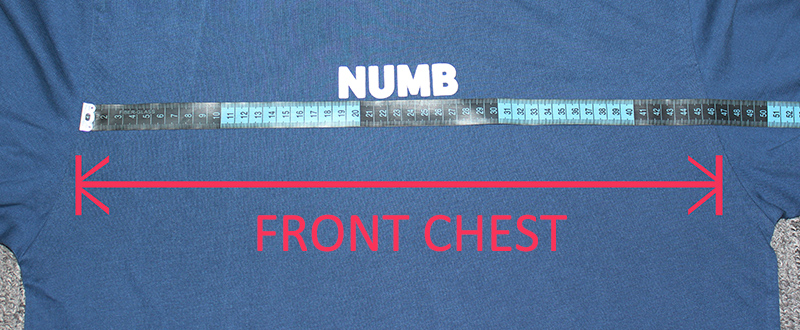
A fitted knit pattern can have a finished circumference smaller than the corresponding body measurement. Patternmakers call this negative ease. The fabric stretches across the body as the garment is put on.
For a worked sizing example, use a body chest circumference of 100 cm and a relaxed T-shirt width of 48 cm, measured flat at the same chest level. Doubling that flat width gives a garment circumference of 96 cm. The cloth has to extend by 4 cm to reach the body measurement:
Required circumferential extension = (100 ÷ 96 − 1) × 100 = approximately 4.2%.
An assumed 3% reduction in chest width after laundering leaves the shirt measuring 46.56 cm flat, giving a circumference of 93.12 cm. Reaching the same 100 cm body measurement requires approximately 7.4% extension from its new resting dimensions.
These figures are a sizing calculation using chosen inputs. They describe extension around the chest at rest. Reaching, sitting, and breathing add movement, and the force needed to extend the fabric affects the sensation of tightness. A jersey that reaches 7.4% extension under a light pull will feel different from one that needs a stronger pull to reach that point.
How Mills Produce Jersey at Scale

On a circular knitting machine, needles arranged around a cylinder form loops in sequence. Yarn arrives from packages through multiple feeding points, and the cloth emerges as a continuous tube.
Each active feeder can form a course during a revolution of the machine. A machine running with 60 active feeders can produce 60 courses in one revolution. This arrangement gives plain jersey a productive manufacturing route: the same stitch repeats across the fabric, and multiple feeds build its length continuously.
Mayer & Cie. publishes an unfinished-fabric production example for its Relanit 4.0: 36.59 kg of single jersey per hour. The stated conditions are a 30-inch cylinder, 28-gauge machine, 50 rpm, 85% efficiency, and 125 GSM fabric. Those conditions define the example. The company also identifies body-size fabric for white T-shirts as an application of the machine.
The tube gives a T-shirt manufacturer two useful cutting routes. A tube finished to the appropriate body width can supply the shirt body with its sides already connected. The garment still needs its neckline, shoulders, sleeves, and hems assembled. For open-width production, the tube is slit lengthwise and spread flat, allowing separate front and back panels to be cut. Side seams then provide room for shaping those panels.
T-shirt assembly consists of a relatively small group of repeatable operations, including joining shoulders, attaching the neck trim and sleeves, and finishing the hems. Fabric production and garment construction fit together around a simple product.
This production efficiency helps explain jersey’s commercial appeal. The price of a particular tee also includes its yarn, dyeing, finishing, cutting yield, and sewing. A fine combed yarn and several finishing treatments add processing to the same basic jersey construction. Heavier fabric increases material consumption for a given pattern, which helps account for the wide price range among jersey T-shirts.
Cotton, Polyester, and Jersey Blends
A fiber label helps explain how the cloth responds to moisture and how its surface feels. The knit construction then determines how that yarn behaves as a sheet of fabric.
| Jersey composition | Contribution from the fibers | Effect in a T-shirt |
|---|---|---|
| 100% cotton | Cotton absorbs moisture into the fiber. The yarn can be prepared and spun in several ways. | An absorbent fabric whose surface can range from relatively dry and textured to smooth and soft. |
| Cotton/polyester | Polyester lowers the proportion of highly absorbent cotton in the blend. Yarn structure and finishing also affect water retention. | A way to adjust the moisture response of a cotton-containing tee; the blend ratio is part of the specification. |
| Polyester | Polyester has low moisture absorption within the fiber. Liquid can still travel through spaces in the yarn and fabric. | Sports jerseys can be engineered for spreading moisture and drying through their yarns, construction, and finish. |
| Viscose or modal blends | These regenerated cellulose fibers can produce soft, fluid fabrics. Finer fibers in Lenzing’s modal range allow delicate, lightweight constructions. | Useful for tees intended to fall into soft folds against the body. |
| Cotton/elastane | Elastane supplies additional elastic stretch and recovery. | Useful when the body or sleeves are designed to remain close fitting through repeated movement. |
Cotton jerseys can also be finished for a particular moisture response. Cotton Incorporated’s TransDRY technology uses treated yarns to alter absorption and spreading. How those yarns are incorporated into the fabric influences the result.
A label reading “95% cotton, 5% elastane” states the proportions by mass. Actual stretch is measured on the finished fabric under an applied force. Two jerseys with that composition can have different resistance to pulling because the elastic yarn, knitting settings, and finishing differ.
Airflow and Moisture During Wear
Air passes through the spaces within a fabric. Their size and arrangement affect air permeability, the amount of air that can flow through the cloth under specified conditions. A dense knit restricts that passage. A more open jersey construction can allow greater airflow, which helps explain the use of light jerseys in warm-weather tees.
Perspiration moves through the cloth as liquid enters absorbent fibers and spreads through spaces between fibers and yarns, exposing more moisture to evaporation from the surface. The amount of water held in a shirt affects how long it stays damp. Air movement, humidity, and the area over which the moisture spreads also influence drying.
A fabric description such as “breathable cotton jersey” covers only part of this behavior. For example, a dense cotton jersey can absorb perspiration and offer limited airflow through its tightly packed stitches. An open construction changes the passage of air even when its fiber content stays the same. Garment fit adds space around the body, allowing air to circulate through the neck, sleeves, and hem.
Why Two Cotton Jersey Tees Can Feel So Different
The description combed ring-spun cotton jersey starts with decisions made before knitting. Combing removes shorter cotton fibers during yarn preparation, making it possible to spin finer yarns and influencing the finished fabric’s feel. Ring spinning draws and twists prepared fibers into yarn. These processing stages affect the yarn from which every stitch is formed.
Yarn size changes the scale of the stitches. In the English cotton count system, Ne 30/1 identifies a finer single yarn than Ne 20/1. Using a finer yarn gives the knitter different possibilities for the fabric’s weight and surface. The result also depends on the amount of yarn fed into each stitch and the number of stitches occupying a given area.
Reading GSM in the Finished Garment
GSM means grams per square meter. At 180 GSM, one square meter of fabric weighs 180 grams. A 240 GSM jersey contains one-third more mass over the same area.
Stanley/Stella’s published product sheets identify the shell of each of these T-shirts as single jersey. Their main cotton specifications include different yarn routes and weights.
| Published style | Fabric weight | Yarn preparation and spinning | Size M half-chest | Size M body length |
|---|---|---|---|---|
| Crafter STTU170 | 155 GSM | Combed, ring-spun cotton | 52 cm | 72 cm |
| Creator 2.0 STTU169 | 180 GSM | Combed, ring-spun cotton | 53.5 cm | 73 cm |
| Freestyler STTU788 | 240 GSM | Carded, open-end cotton | 58 cm | 76 cm |
These published examples span 155–240 GSM within the same knit construction. The 240 GSM style uses a carded, open-end yarn, showing one of the yarn choices available for a substantial tee. Specifications were checked on September 19, 2026; color-specific composition notes remain part of each product sheet.
Doubling the size M half-chest measurements gives 107 cm for Creator 2.0 and 116 cm for Freestyler. That is 9 cm of additional garment circumference. The wider pattern changes the room around the body alongside the heavier fabric.
In a comparison using the same pattern, an increase in GSM adds fabric mass to the garment. How the outline changes also depends on how easily the cloth bends. A supple, heavier jersey may hang in deep folds. A firmer construction can hold a broad sleeve opening away from the arm and give a boxy body a more pronounced shape.
Fabric handle includes how the cloth feels against the fingers and how it bends or compresses when held. A jersey can have a soft surface over a substantial, firm body. Thickness and bending resistance help explain that combination alongside its GSM.
Opacity also changes with the way the cloth is used. Stretch across a fitted upper arm opens the spaces between loops, making a pale fabric more transparent in that area. The same jersey can provide greater coverage where it hangs loosely. Yarn coverage, color, and the intended amount of stretch all contribute to the result.
Finishing Changes the Hand
After knitting and dyeing, the mill can alter the surface and flexibility of the cloth. An enzyme treatment can reduce surface fuzz. Silicone softeners can give a smoother, more lubricated feel. Mechanical sanding produces a different surface by abrading it, creating a fine, soft texture.
Compaction changes the fabric’s dimensions by compressing the structure lengthwise. More of the fabric’s mass then occupies each meter of finished length, and the GSM can rise. A specification for a tee therefore uses the finished weight after the agreed processing. The unfinished cloth coming off the knitting machine may have a different weight per square meter.
The Surface Behind a Graphic Tee
A plain jersey face offers a relatively even background for a chest logo or a full-front design. Fine stitch columns give printers a surface on which small lettering and edges can be reproduced clearly, provided the yarn surface and printing process suit the artwork. Visible fuzz and pronounced yarn irregularities can change the appearance of fine detail.
Fiber content becomes important when choosing inks and preparation. In the direct-to-garment workflow documented by Epson, printing white ink on cotton requires the appropriate pretreatment. Polyester uses its specified polyester pretreatment. The preparation and curing instructions belong to that printing system and the selected fabric.
A broad, heavily deposited print can also stiffen the front panel. That changes the drape across the chest even when the jersey underneath matches the sleeves and back. Where the artwork crosses an area that stretches during wear, the printed layer has to accommodate that extension.
Where Rib, Interlock, and Piqué Fit
Rib at a crew neck gives the opening widthwise extension around a single jersey body.
| Construction | Structure or surface | Use around T-shirt design |
|---|---|---|
| Single jersey | Fine stitch columns on the face, curved loops on the reverse; cut edges can curl | Flexible bodies and sleeves |
| Rib | Alternating face and back stitch columns that open across the width | Extensible neckbands, cuffs, fitted tops, and tanks |
| Interlock | Two rib structures interlocked during knitting, with similar faces on both sides | Smooth tops with a more stable fabric body |
| Piqué | Knit and tuck stitches create a textured surface | Polo shirts and casual tops with visible texture |
Interlock belongs to the double-knit group and may appear in listings as “double jersey.” Its connected structure adds stability, including resistance to edge curling. Two sets of needles form the cloth during knitting.
What Wear and Washing Change
A jersey tee can change dimensions as stresses introduced during production relax. Knitting, dyeing, and finishing move the cloth under tension; washing and drying give the yarns and loops an opportunity to settle into a different arrangement. The resulting shrinkage depends on the fabric and its processing history.
A small percentage can be visible in the fit. If a body length of 70 cm becomes 67.9 cm after laundering, the reduction is 2.1 cm, or 3%. On a cropped tee, that moves the hem noticeably. Chest width and sleeve length can change by different amounts, so the garment may acquire different proportions as well as becoming smaller.
Mills use relaxation drying and compaction to reduce the dimensional change left for subsequent laundering. “Preshrunk” describes a treatment intended to limit that remaining change. A useful wash result includes the temperature, drying method, and number of cycles, because each is part of the conditions under which the dimensions were measured.
Rotation can appear independently of a shorter body. A side seam may move toward the front as the knit relaxes. Yarn torque, the orientation of the stitches, and finishing affect this behavior; the result is often called spirality or garment twist.
Over repeated wear, friction can raise surface fibers and entangle them into small pills. The blend, fiber dimensions, yarn structure, and finishing influence how readily this happens. Contact beneath the arms or against another garment can expose particular areas to repeated rubbing.
How Shrinkage Changes the GSM Reading
Shrinking reduces the area occupied by a piece of cloth. Mechanical compaction can increase the weight per unit area by compressing the fabric lengthwise. The same mass-to-area relationship helps explain a GSM change after laundering.
Take a 1 m by 1 m panel weighing 180 g under consistent dry measurement conditions. For this calculation, assume it loses 5% in each direction and retains its mass. Its new dimensions are 0.95 m by 0.95 m, giving an area of 0.9025 m².
Calculated GSM after shrinkage = 180 g ÷ 0.9025 m² = approximately 199.4 GSM.
The panel has become smaller and carries the same mass over less area. This example explains how a shirt can feel more compact after washing. The calculation holds mass and measurement conditions constant; actual measurements also reflect any fiber loss, finish removal, and differences in moisture content. A reported GSM therefore needs its measurement stage, such as finished fabric before laundering or conditioned fabric after a specified wash.