FashionMe · Fabrics
What Is Chiffon?
Chiffon is a lightweight, sheer woven fabric made from fine yarns with a high level of twist. Traditional chiffon is usually woven in a plain weave, with each weft yarn passing over one warp yarn and under the next. The construction looks simple on paper, though the yarns make the finished fabric quite distinctive.
Fine yarns keep the cloth thin enough for light to pass through it. Strong twist creates the slightly grainy, crepe-like surface you can feel when chiffon is rubbed gently between the fingers. Because there is so little fabric mass, a hanging piece falls into narrow folds and moves with very little force.
Chiffon can be made from silk, polyester, nylon and regenerated cellulose fibers. The fiber changes the hand, strength, static, heat response, moisture behavior and price. The word chiffon refers to the fabric itself rather than one particular raw material.
Actual chiffon constructions vary widely. One published polyester chiffon used 75-denier yarn in both directions, 97 warp ends per inch, 69 weft picks per inch and a finished weight of 79.2 GSM. An experimental Muga silk chiffon used approximately 60–70 denier yarn twisted to 2,000 turns per meter, with 84 ends and 58 picks per inch.
Reading a Chiffon Fabric Specification
A mill may describe a fabric like this:
75D × 75D / 97 × 69 / plain weave / 79.2 GSM
The first figures describe yarn size. Denier measures how many grams 9,000 meters of yarn weigh, so 9,000 meters of 50D yarn weighs 50 grams and the same length of 75D yarn weighs 75 grams.
The next figures describe how closely the yarns are packed. In a construction marked 97 × 69, there are 97 warp ends across one inch of fabric and 69 weft picks along one inch.
GSM is measured separately and tells you how much one square meter of the finished fabric weighs.
Commercial chiffon shows how much these numbers can move. A lightweight polyester version may use 50D × 50D yarn and finish around 55 GSM at 150 cm wide. Other 50D products are sold around 49 GSM, and 75D versions can reach roughly 78 GSM. The published 75D × 75D polyester chiffon mentioned above weighed 79.2 GSM.
Those details matter when a fabric has to be reproduced. A request for “55 GSM chiffon” still leaves the yarn size, density, twist, width and finish open.
What the Twist Does
The texture of chiffon becomes easier to understand when the yarn is examined before weaving.
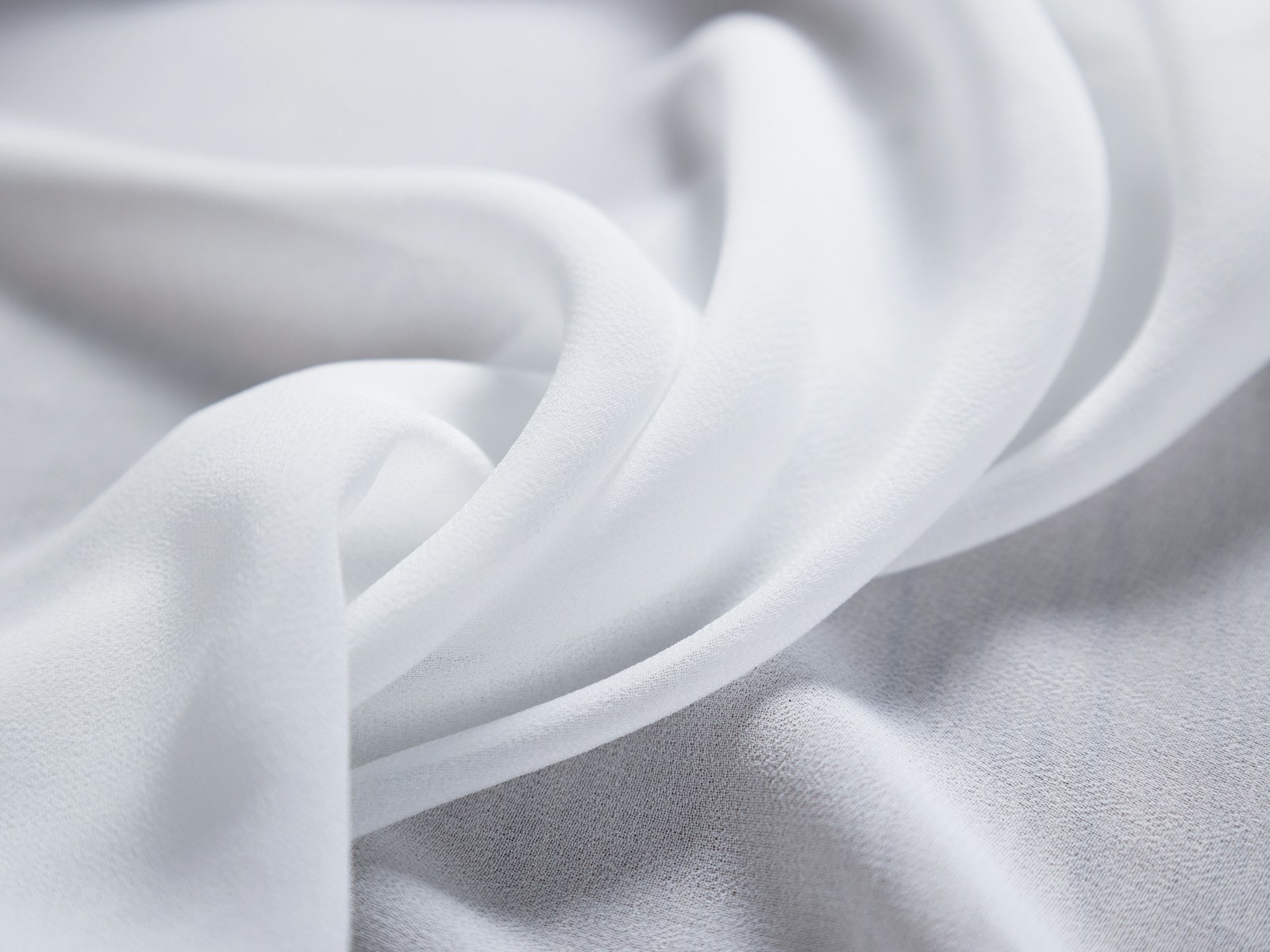
One Muga silk chiffon study used yarn around 60–70 denier with 2,000 turns per meter. The warp was arranged with S- and Z-twisted yarns, and the weft used S twist. The finished construction reached 84 ends and 58 picks per inch.
After the fabric relaxed, the study recorded roughly 18% crimp in the length direction and 15% across the width.
High twist stores torque in the yarn. Once the fabric goes through wet processing and relaxation, that torque affects how the yarn sits inside the weave. The surface develops tiny irregularities instead of lying completely flat.
That is where much of chiffon's dry, lightly sandy feel comes from.
For a fabric that has to be reproduced closely, the mill can record yarn information in detail:
Warp: 50D polyester filament, Z twist, confirmed TPM
Weft: 50D polyester filament, S twist, confirmed TPM
TPM means turns per meter.
Silk Chiffon and Momme
Silk chiffon is often sold by momme, usually written as mm. One momme is approximately 4.34 GSM.
| Momme | Approx. GSM |
|---|---|
| 5 mm | 21.7 GSM |
| 6 mm | 26.0 GSM |
| 8 mm | 34.7 GSM |
| 10 mm | 43.4 GSM |
| 12 mm | 52.1 GSM |
Commercial silk chiffon is available across roughly 5–12 momme, with 6, 8, 10 and 12 momme appearing regularly in supplier ranges.
Width varies as well. Silk chiffon is often sold at 44 inches, around 112 cm, or 54 inches, around 137 cm. Polyester apparel chiffon is commonly closer to 148–150 cm wide.
That width difference becomes very real when a long dress is costed. Moving a skirt marker from 150 cm fabric to 112 cm fabric removes about 38 cm of cutting space across every row of the marker. Large skirt panels that once fitted side by side may have to be placed one below another.
How Heavy Is Chiffon?
There is a large gap between an extremely fine silk chiffon and a heavier synthetic version.
- 5 momme silk chiffon is about 21.7 GSM.
- 8 momme silk chiffon is about 34.7 GSM.
- A commercial 50D polyester chiffon can sit around 49–55 GSM.
- A 75D commercial polyester chiffon may be around 78 GSM.
- The published 75D × 75D polyester chiffon weighed 79.2 GSM.
- One satin chiffon example made with 50D × 50D yarn is listed at 85 GSM.
Fabric weight can be checked using methods such as ASTM D3776/D3776M or ISO 3801.
Bulk production usually adds a tolerance to the target. A requirement of 55 GSM ±5% allows finished fabric from about 52.25 to 57.75 GSM.
The tolerance has to stay attached to the target number. “Approximately 55 GSM” is too loose for production control.
Why Chiffon Is Transparent
Look at a chiffon swatch against a window and the yarn grid is easy to see.
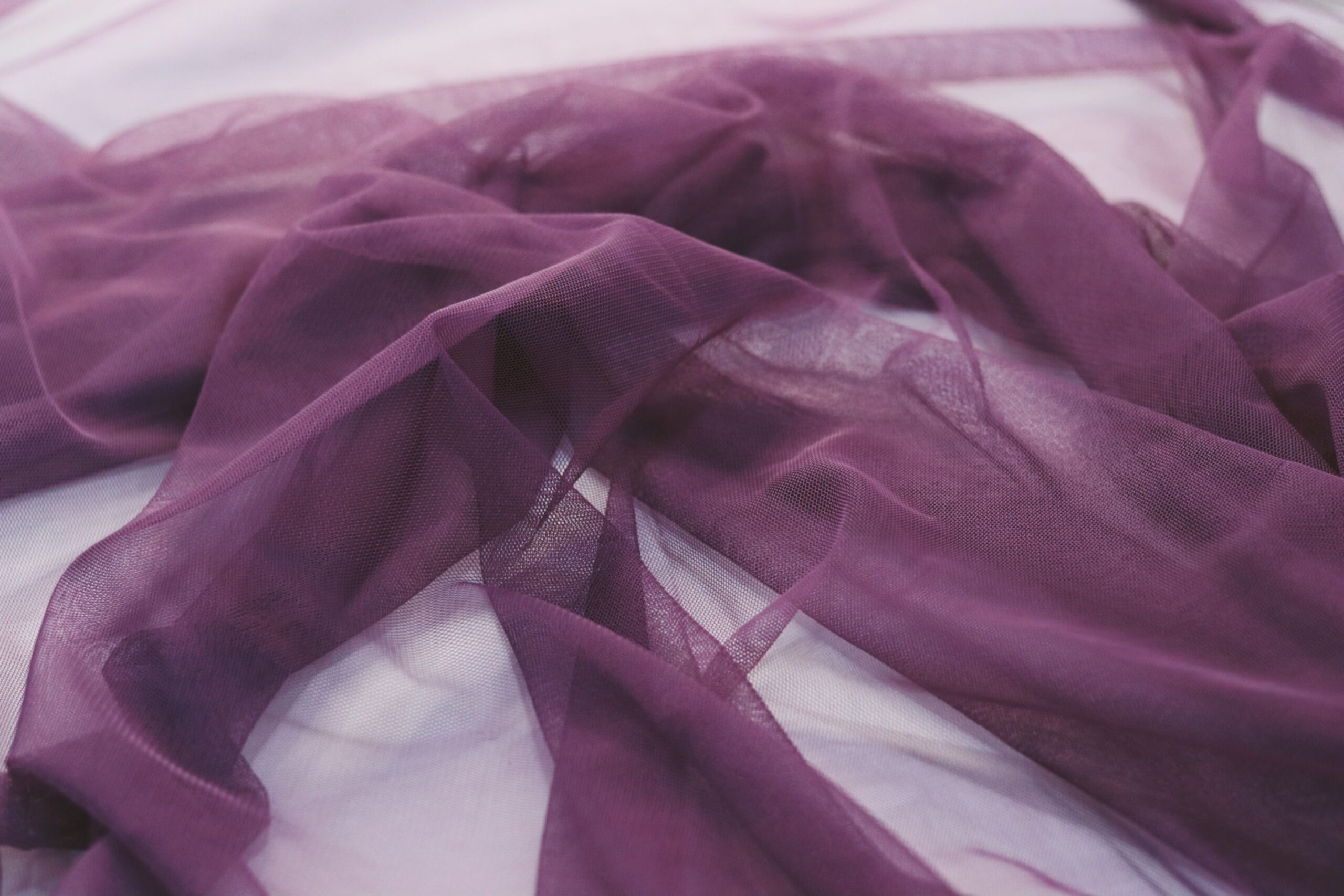
The amount of light coming through depends on yarn thickness, the number of warp and weft yarns in the fabric, color, finish and how many layers are stacked together.
A single 50 GSM layer places relatively little material between the eye and whatever is underneath it. Three complete layers put 150 grams of chiffon across every square meter of garment area, spread over three separate woven surfaces.
Gathering changes the appearance even more.
If a 300 cm skirt panel is gathered into a 100 cm waistband, the gather ratio is 3:1. Near the waist, folds place much more fabric into each centimeter of finished width. Lower down, the folds open and the fabric becomes visibly more transparent.
Lining color also changes what the finished garment looks like. Pale pink chiffon over white lining can appear noticeably different from the same chiffon over beige or pink.
For a light-colored dress, opacity is best checked with the real lining, layer count and gather ratio.
Drape Can Be Measured
Chiffon is often described as flowy because it collapses easily into soft folds. That behavior can also be measured.

ISO 9073-9 uses a circular fabric specimen placed over a smaller support disc. The unsupported portion falls around the edge and creates a projected shape. That projection is used to calculate a drape coefficient.
A very flexible chiffon hangs into deeper folds around the support. A firmer fabric spreads farther outward.
ASTM D1388 provides another way to study fabric stiffness by measuring bending length and flexural rigidity.
These measurements become useful when a replacement chiffon matches the original in GSM and composition but hangs differently once several meters are cut into a skirt.
What Chiffon Does Inside a Dress
Take a dress made with 55 GSM polyester chiffon.

The sleeves use one layer. The skirt uses two layers over an opaque lining. Around the waist, both skirt layers are gathered at 3:1.
The lower skirt contains 110 GSM of chiffon before the lining is counted. Near the waist, the folds place considerably more fabric into the same finished circumference.
The seams are visible through the cloth too. Wide folded seam allowances create darker strips beneath pale chiffon, which is one reason narrow enclosed seams are common on sheer garments.
Long flared skirts introduce another issue. Parts of a circular hem sit close to the straight grain, others move toward the bias. The bias areas can lengthen after the fabric has been cut and left hanging.
During development, a factory can hang the sample for a fixed period, level the hem, then use the same procedure for bulk production.
Chiffon, Georgette, Organza and Voile
All four fabrics can look light and sheer from a distance.
Chiffon usually feels fine and slightly crepey. When lifted from one point, most of the fabric drops close to the hand in narrow folds.
Georgette has a stronger pebbled texture and usually feels more substantial.
Organza is much crisper. It holds itself farther away from the body and forms broader, firmer shapes.
Voile is often smoother, particularly in cotton versions, with the softer hand of a lightweight plain-woven fabric.
For development work, the comparison can go beyond touch. GSM, yarn size, EPI, PPI, bending length and drape measurements make the differences easier to record.
Cutting Chiffon
Chiffon moves easily across a smooth cutting table. On a long skirt panel, a few millimeters of movement near the top can leave the hem noticeably uneven farther down.
Single-layer cutting is useful for pieces where accuracy matters. Pattern weights help keep the cloth in place without repeatedly lifting it, and sharp scissors or a fresh rotary blade reduce the amount of fabric pushed ahead of the cutting edge.
The grain line should be checked along the full length of a long pattern piece.
Very unstable chiffon can be supported with tissue during cutting and the first sewing operations.
Sewing Chiffon
SCHMETZ lists 60/8 and 70/10 Universal or Microtex needles for chiffon.
A 60/8 needle has an approximate blade diameter of 0.60 mm. A 70/10 is approximately 0.70 mm.
The rest of the sewing setup needs to be confirmed on the actual fabric. Production records can include the thread size, stitch type, stitch length, machine tension, presser-foot pressure and seam allowance.
A useful record might read:
Needle: Microtex 60/8
Thread: confirmed Tex size
Stitch: lockstitch
Stitch length: confirmed on sample
Seam allowance: confirmed on sample
French seams are common on sheer fabrics because the raw edge is enclosed. A finished width of about 1/4 inch, or 6.35 mm, is commonly used on chiffon.
For a narrow silk-chiffon hem, one documented method starts with a 5/8-inch / 15.9 mm allowance. The first stitching line is sewn roughly 1/2 inch / 12.7 mm from the edge. The excess is trimmed close to the stitching before the edge is rolled and sewn again.
What Seam Slippage Looks Like
Sometimes a chiffon seam develops an opening even though the sewing thread is still intact.
The fabric yarns beside the stitching have shifted.
ISO 13936-2 measures this type of seam slippage. For apparel fabrics weighing 220 GSM or less, the method uses a 60 N load.
Typical test conditions include an initial clamp spacing of 100 mm and an extension rate of 50 mm per minute. After loading, the opening at the seam is measured in millimeters.
A test report may look like:
Warp direction: 3 mm
Weft direction: 1 mm
Load: 60 N
The maximum allowed opening is then set in the buyer's quality specification.
Fitted hip seams, close armholes and narrow bodices are useful areas to check because normal wear places considerable force across those seams.
Strength and Dimensional Stability
Chiffon can also be tested for breaking strength, tear strength and dimensional change.
ISO 13934 covers tensile testing for woven fabrics. Part 1 uses a strip method, while Part 2 uses a grab method. Results are usually recorded separately in the warp and weft directions.
A specification may state:
ISO 13934-2
Warp minimum: X N
Weft minimum: Y N
Tear propagation can be measured through the ISO 13937 series. ISO 13937-1 uses the Elmendorf pendulum method and reports the force required to continue an initiated tear.
Dimensional change after washing and drying is covered by ISO 5077.
One commercial 85 GSM polyester satin chiffon gives a real supplier specification of less than 3% shrinkage in both warp and weft.
A brand using 3% as its own bulk limit could record:
Length change: maximum ±3%
Width change: maximum ±3%
Method: ISO 5077
Wash and drying procedure: specified separately
A Chiffon Fabric Specification
A production fabric sheet can contain:
| Field | Example specification |
|---|---|
| Main fabric | 100% polyester high-twist chiffon |
| Weave | Plain 1/1 |
| Warp yarn | 50D polyester filament |
| Weft yarn | 50D polyester filament |
| Twist | Confirmed S/Z arrangement and mill TPM |
| Finished weight | 55 GSM ±5% |
| Nominal width | 150 cm |
| Minimum cuttable width | 147 cm |
| Color | Approved lab dip |
| Finish | Matte, soft hand |
| Seam slippage | ISO 13936-2, 60 N, maximum opening stated in mm |
| Dimensional change | ISO 5077, limits stated for length and width |
| Tear strength | Selected ISO 13937 method with minimum force in N |
| Drape | Approved physical swatch or ISO 9073-9 target |
| Needle trial | Microtex 60/8–70/10 |
| French seam width | Approximately 6.35 mm where required |
The cuttable width is the useful number for marker planning. Selvage and damaged edge sections stay outside it.
Printing, Pleating and Embellishment
Large prints change once chiffon is gathered.


A flower measuring 24 cm across on flat fabric may be broken across several folds around a 3:1 gathered waist. Ruffles turn during wear, exposing the reverse side of the print as they move.
Pleating changes usable width. If a 150 cm flat panel measures 75 cm after pleating and relaxation, only 75 cm of visible width remains. Fabric consumption has to be calculated from that finished measurement.
Polyester chiffon can hold heat-set pleats. The approved sample should record the process settings used by the pleating supplier, including temperature and dwell time.
Embroidery adds concentrated weight to a fabric that may weigh only a few dozen grams per square meter. A dense 20,000-stitch motif can pull the surrounding cloth inward.
Beads add their weight at individual attachment points. Hanging the decorated sample vertically shows how the chiffon reacts once gravity begins pulling on those areas.
Washing and Pressing Chiffon
Care depends on the complete garment: chiffon fiber content, dye, lining, fusible materials, printing, pleats, embroidery and trims.
GINETEX ironing symbols use maximum sole-plate temperatures of 120°C for one dot, 160°C for two dots and 210°C for three dots.
A fine polyester chiffon should be tested at the confirmed temperature chosen for the garment before bulk pressing begins.
After pressing, the fabric can be checked for surface shine, flattened crepe texture, edge distortion, color change, seam puckering and visible adhesive.
Wash testing should also be done on the finished sample. Record the garment measurements before cleaning, run the specified wash and drying procedure, then measure the same points again and calculate the percentage change.