Types of T Shirts: 32 T-Shirt Styles, Fits, Necklines, Sleeves, Fabrics, and Finishes
“T-shirt” can mean very different clothes once the cut changes. An oversized heavyweight tee can have shoulders several centimeters past the natural shoulder, sleeves close to the elbow, and a body wide enough to sit away from the torso. A baby tee is almost the opposite shape: short through the body, close through the chest, with small sleeves and a hem around the waist.
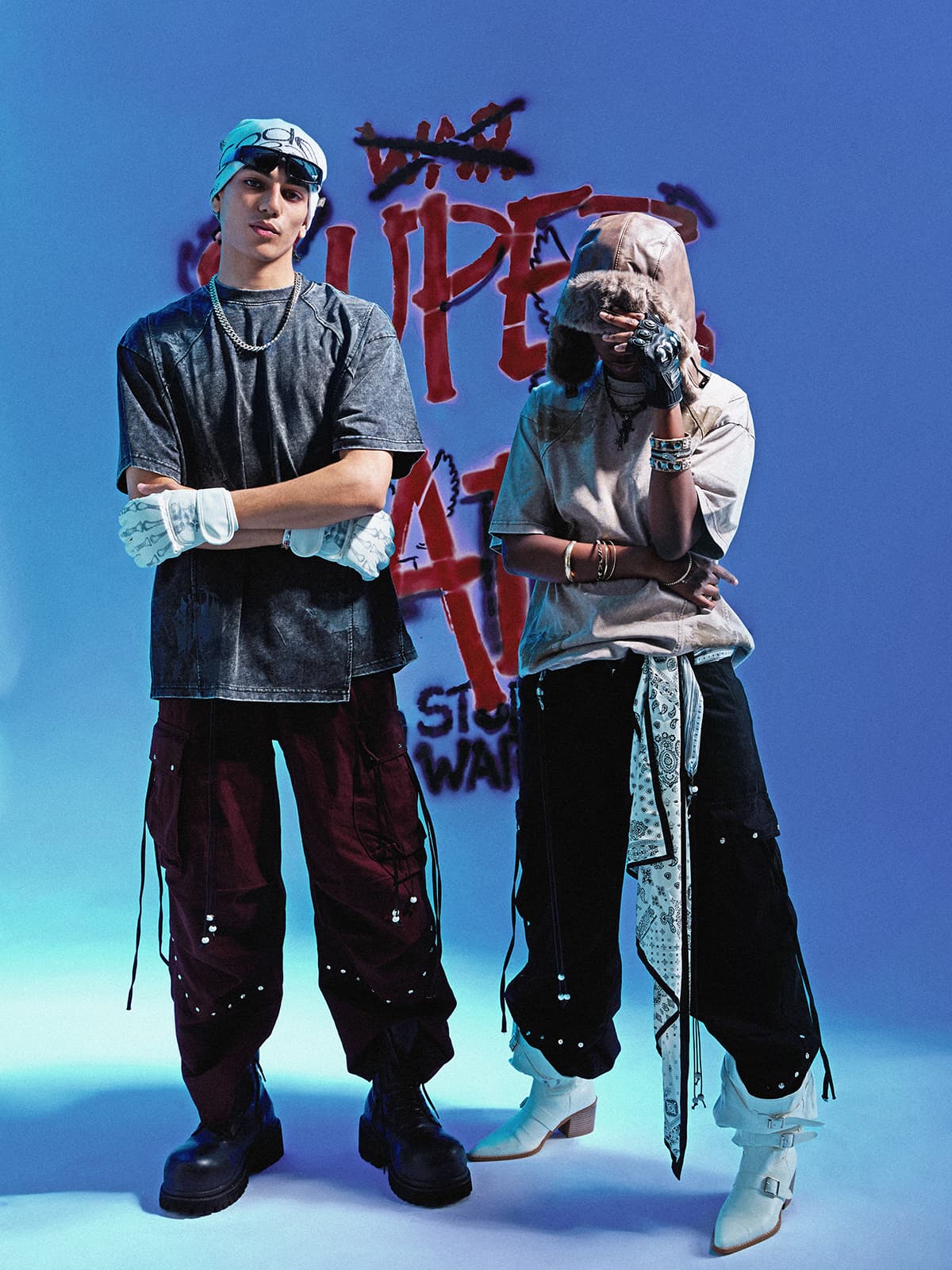
Boxy tees are everywhere in streetwear because their width sits high on the body and leaves more of the trousers visible. Graphic tees use the same basic shapes, then change completely depending on whether the print is a small chest mark, a full-front design, or a large back graphic. Vintage-wash tees get much of their look from faded color and softened cotton. Ringer tees, raglan tees, Henleys, V-necks, cropped tees, longline tees, muscle tees, and performance tees each have a recognizable construction that changes how the shirt sits in an outfit.
The useful difference is visible on the garment itself: where the shoulder falls, how wide the sleeve opens, where the hem ends, how much room sits through the chest, and whether the fabric hangs softly or holds a firm shape. A fitted rib tee with wide jeans creates a compact upper body and a much larger trouser silhouette. A boxy heavyweight tee with the same jeans spreads the volume across the shoulders and chest as well. An oversized graphic tee pushes that scale farther through the sleeve and body.
Types of T Shirts at a Glance
| T-Shirt Type | Main Identifying Feature | Usual Visual Effect | Common Outfit Direction |
|---|---|---|---|
| Crew Neck T-Shirt | Round rib neckline | Compact upper body | Jeans, cargos, jackets |
| V-Neck T-Shirt | V-shaped neckline | Longer open neckline | Straight trousers, denim |
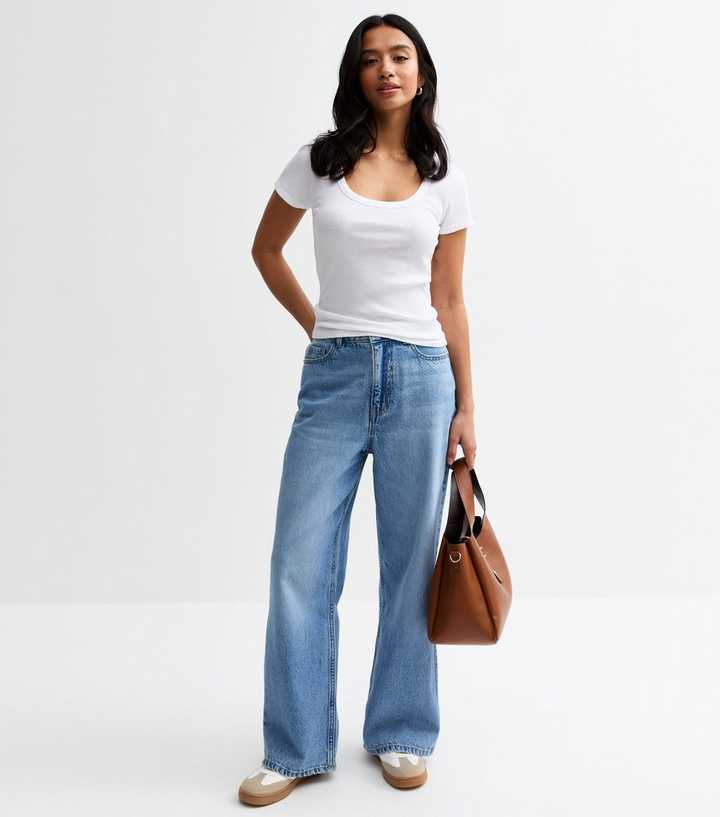
| Scoop Neck T-Shirt | Wide curved neck | More open shoulder and chest area | Skirts, relaxed trousers |
| Henley T-Shirt | Button placket at neck | Vertical neckline detail | Denim, workwear |
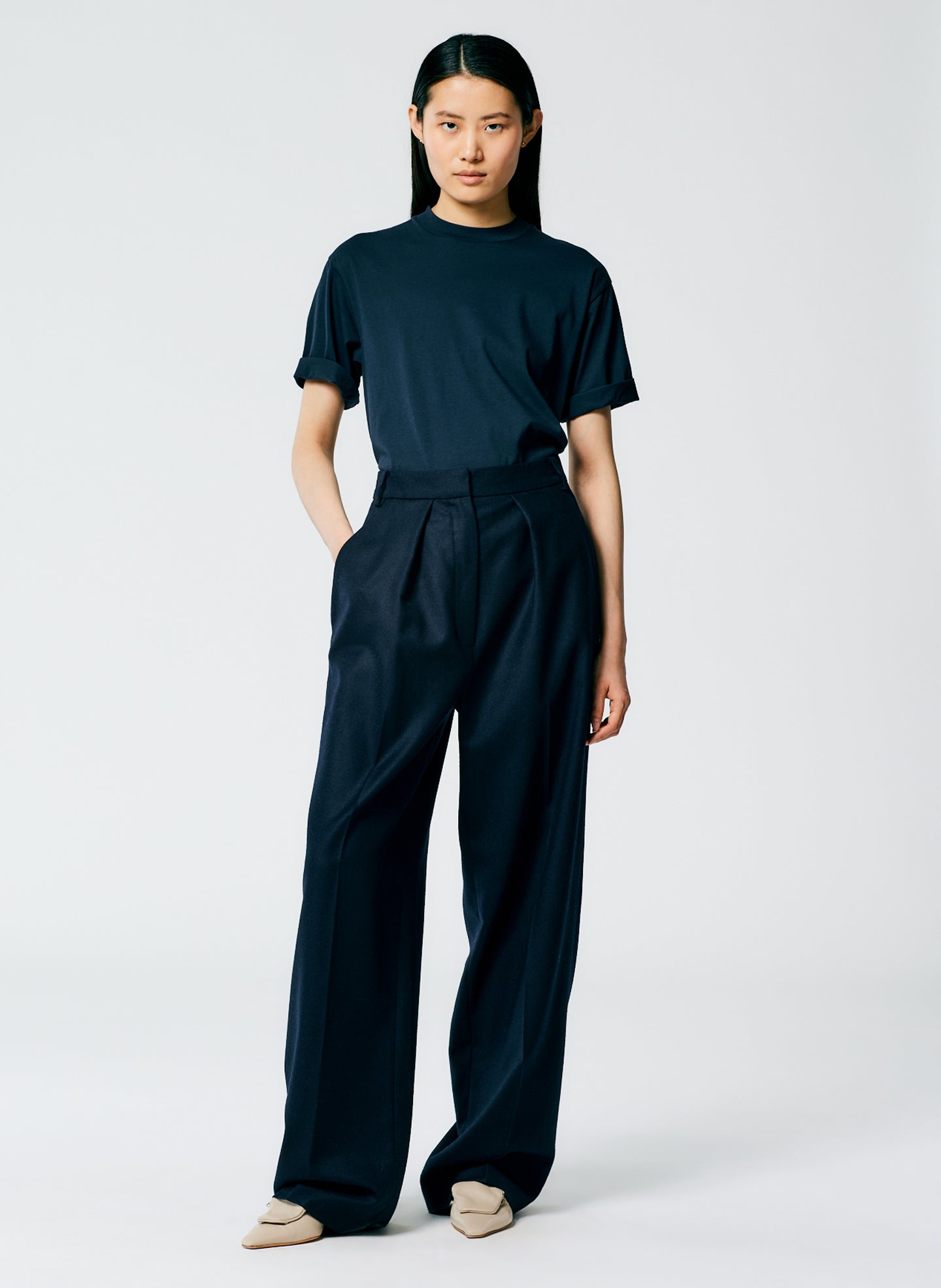
| Mock Neck T-Shirt | Higher close-fitting collar | Defined neck line | Wide trousers, jackets |
| Regular-Fit T-Shirt | Moderate body room | Traditional T-shirt shape | Everyday outfits |
| Slim-Fit T-Shirt | Narrow torso | Close body line | Straight or wider bottoms |
| Fitted T-Shirt | Closely follows body | Defined waist and torso | Wide jeans, skirts |
| Relaxed-Fit T-Shirt | Added ease | Soft casual shape | Loose denim, shorts |
| Oversized T-Shirt | Large chest and shoulders | Broad streetwear silhouette | Baggy jeans, cargos |
| Boxy T-Shirt | Wide, relatively short body | Square upper-body shape | High-rise wide pants |
| Baby Tee | Small fitted body | Compact Y2K proportion | Low-rise or high-rise bottoms |
| Cropped T-Shirt | Shortened hem | Visible waistline | Wide jeans, cargos |
| Longline T-Shirt | Extended hem | Longer torso block | Slim or straight pants |
| Drop-Shoulder T-Shirt | Shoulder seam beyond shoulder point | Wider upper body | Streetwear |
| Raglan T-Shirt | Sleeve seam begins at neckline | Rounded shoulder line | Retro sportswear |
| Cap-Sleeve T-Shirt | Very short sleeve | Open upper arm | Skirts, trousers |
| Elbow-Length T-Shirt | Sleeve near elbow | Heavier sleeve proportion | Wide pants |
| Long-Sleeve T-Shirt | Sleeves reach wrist | Extended upper-body coverage | Denim, layered outfits |
| Three-Quarter-Sleeve T-Shirt | Sleeve between elbow and wrist | Retro casual shape | Straight denim |
| Sleeveless T-Shirt | Open armhole | Exposed arms and shoulder shape | Cargos, shorts |
| Muscle T-Shirt | Wide body with large armholes | Broad casual silhouette | Loose pants |
| Ringer T-Shirt | Contrast collar and sleeve rib | Retro sports character | Faded denim |
| Pocket T-Shirt | Chest pocket | Small front focal point | Workwear pieces |
| Curved-Hem T-Shirt | Rounded lower edge | Longer center body line | Layered outfits |
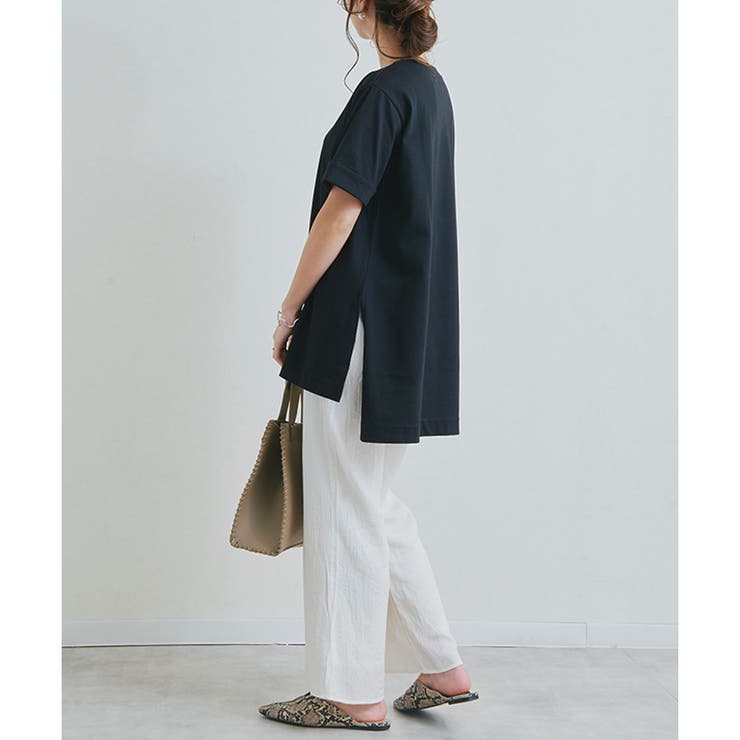
| Split-Hem T-Shirt | Side openings at hem | More movement around hips | Wide trousers |
| Heavyweight T-Shirt | Dense jersey | Firm, substantial shape | Denim, work pants |
| Lightweight T-Shirt | Thin jersey | Softer body drape | Summer outfits |
| Slub T-Shirt | Irregular yarn texture | Visible natural texture | Casual denim |
| Waffle T-Shirt | Raised grid texture | More surface depth | Streetwear, workwear |
| Performance T-Shirt | Technical fabric | Athletic body shape | Training and techwear |
| Graphic T-Shirt | Printed artwork | Strong front or back focal point | Streetwear |
A shirt can combine several of these features, so the complete description may contain three or four style terms.
T-Shirt Types by Neckline
The neckline occupies a relatively small area of fabric, yet it changes the top edge of the entire outfit. The difference is easiest to see around the collarbone, upper chest, and neck.
1. Crew Neck T-Shirt
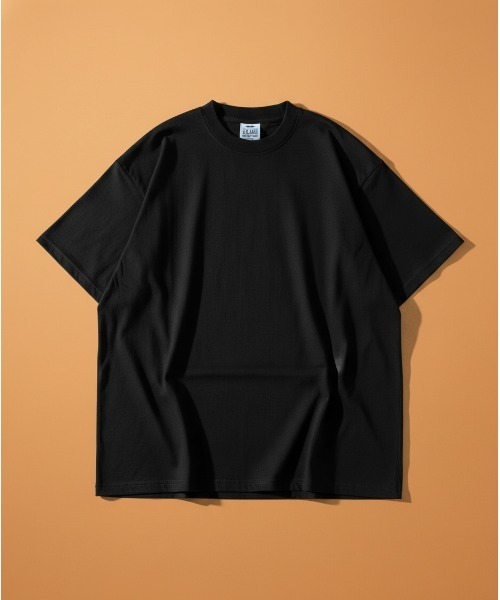
The crew neck T-shirt has a round opening finished with ribbing. The neckline usually sits close to the base of the neck and curves evenly from one shoulder to the other.
This is the shape associated with the standard modern T-shirt.
The rib collar creates a clear upper boundary. On a heavyweight shirt, that rib can stand visibly above the body fabric. On a soft lightweight shirt, it lies flatter against the neck.
A regular crew-neck tee with straight jeans and low-profile sneakers gives the body familiar proportions: moderate shoulder width, a clear neckline, and a hem around the hip.
Change the same crew-neck shape to an oversized pattern and the visual result changes considerably. The collar stays compact as the shoulder line expands outward. That contrast between the small neck opening and broad body is common in streetwear T-shirts.
Crew necks also layer cleanly beneath:
- denim jackets
- bombers
- zip hoodies
- overshirts
- leather jackets
- cardigans
- open button-up shirts
The rib remains visible above most jacket openings, so the T-shirt keeps a clear edge around the neck.
2. V-Neck T-Shirt
A V-neck T-shirt creates two diagonal neckline edges that meet at the center chest.
The actual appearance depends heavily on V depth.
A shallow V ends close to the collarbone. It keeps the opening compact and only adds a small vertical break through the center of the shirt.
A medium V reaches farther down the chest and creates a longer visible neckline.
The V shape directs the eye vertically. Pairing one with straight trousers gives the upper body a longer center line, especially when the shirt has a regular or slim fit.
A fine chain also sits naturally within this opening. On crew-neck shirts, the chain frequently rests across the fabric or directly above the rib. On a V-neck, it occupies the exposed center area.
Fabric makes a visible difference here. Dense cotton gives the V a defined edge. Softer jersey creates a more relaxed opening around the collarbone.

3. Scoop Neck T-Shirt
A scoop neck uses a broad U-shaped curve.
The opening normally travels farther toward both shoulders and sits lower than a crew neck. This exposes a wider section around the collarbone and creates more horizontal openness across the upper body.
The shape suits soft fabrics especially well. Lightweight cotton jersey, modal blends, and fine rib knits can fall smoothly around the neckline.
With high-rise wide-leg trousers, a fitted scoop-neck tee gives the upper torso a compact shape before the trousers expand from the waist.
With a long flowing skirt, the rounded neck echoes the softer lines of the lower half.
The depth and width of the scoop define the final appearance. A shallow scoop stays close to a classic tee. A broad scoop creates a much more open neckline.
4. Henley T-Shirt
The Henley is easy to recognize from the center front.
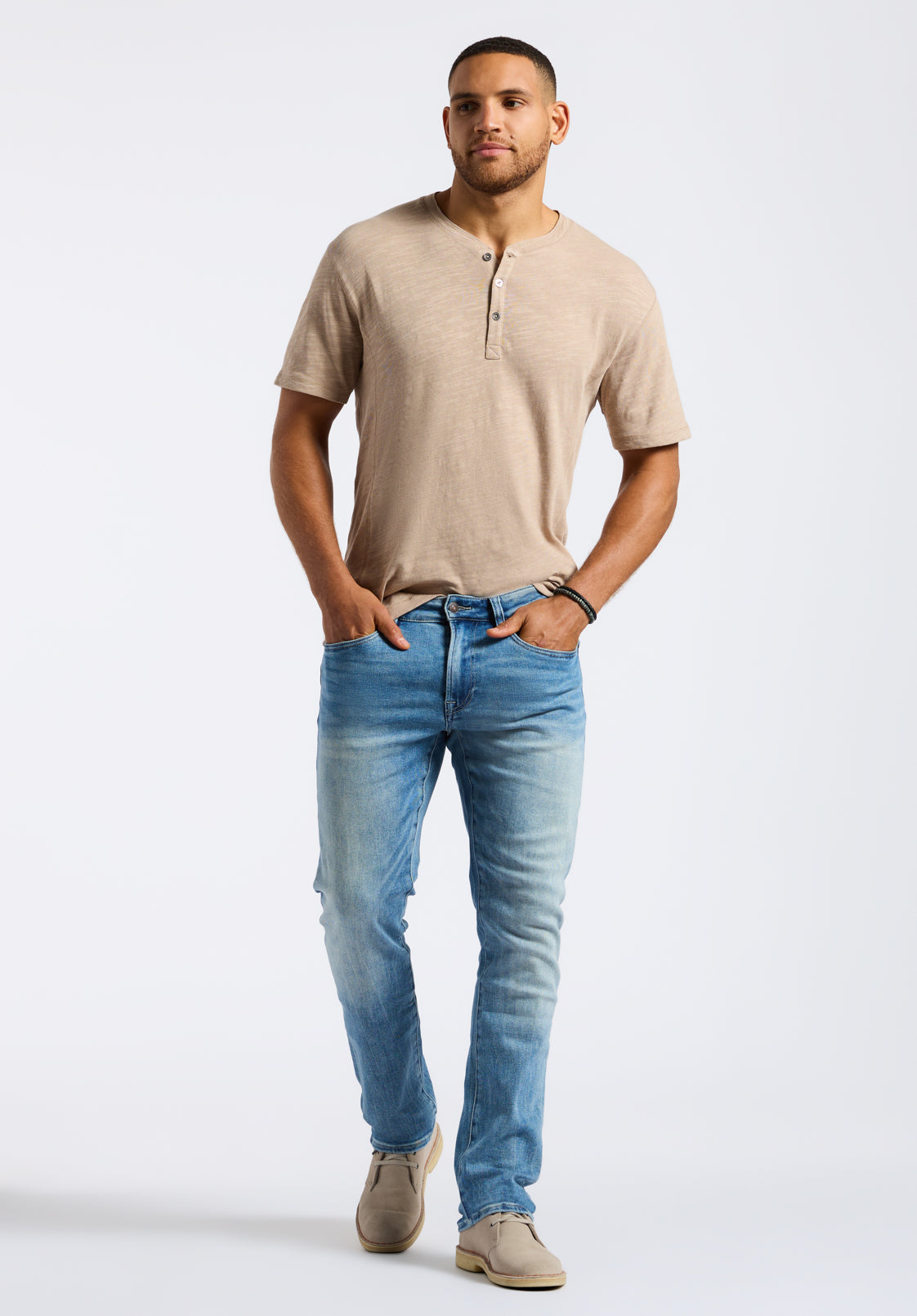
Instead of a continuous rib collar, it has a short vertical placket with buttons. Common versions use two, three, or four buttons.
A Henley therefore has two visible design directions built into one neckline. With the buttons fastened, the upper opening remains compact. With the top buttons open, the placket forms a longer center line through the chest.
That construction adds detail to a plain shirt before graphics, embroidery, or contrasting colors are introduced.
A short-sleeve cotton Henley with straight washed jeans, a leather belt, and simple sneakers has a strong casual workwear feel.
Long-sleeve Henleys appear frequently in heavier jersey, waffle knit, and ribbed fabrics because the extended sleeves give the texture more visible area.
5. Mock Neck T-Shirt
A mock-neck tee raises the neckline several centimeters above a standard crew neck.
The collar usually stands close around the lower neck. It stays shorter than a full turtleneck, so the garment still reads clearly as a T-shirt when paired with short sleeves or a conventional tee body.
The raised collar gives the shirt a sharper upper edge.
A fitted mock-neck tee tucked into wide trousers produces a defined neck, compact torso, and long trouser line.
An oversized mock-neck shirt moves in another direction. A broad chest combined with the close collar creates a strong geometric shape through the shoulders.
This neckline also remains visible beneath a jacket, which makes it useful when the outfit relies on clean layering.
T-Shirt Types by Fit and Body Shape
Fit begins with the relationship between the shirt pattern and the body. Chest width, shoulder position, armhole depth, sleeve width, waist shaping, and body length all influence how much space exists between the fabric and torso.
Two shirts can share the same listed size and still have completely different silhouettes.
6. Regular-Fit T-Shirt
A regular-fit T-shirt follows conventional proportions.
The shoulder seam usually sits close to the natural shoulder point. The body contains enough room for normal movement. The side seam falls almost vertically with a modest amount of ease through the chest and waist.
This creates the familiar everyday T-shirt shape seen with straight jeans, chinos, shorts, and casual jackets.
Regular fit also makes a useful reference when comparing other silhouettes.
A slim tee removes body width.
A relaxed tee adds room.
An oversized tee changes the scale more dramatically.
A boxy tee redistributes volume through width and length.
The regular tee sits near the center of those proportions.

7. Slim-Fit T-Shirt
Look at the shirt from the side and the difference becomes obvious.
A slim-fit tee keeps less excess fabric through the chest, waist, and sleeve. The armhole is usually more compact, and the sleeve follows the upper arm more closely.
The hem can remain at standard T-shirt length, so the defining feature comes from circumference instead of shortening.
Straight dark denim works well with this shape because both parts of the outfit maintain a relatively narrow line.
A light jacket can sit over it with very little fabric gathering around the armholes or waistband.
Slim-fit tees frequently use cotton with a small amount of elastane or naturally flexible fine jersey. That added stretch allows the smaller pattern to move comfortably with the torso.

8. Fitted T-Shirt
A fitted T-shirt uses the shape of the torso as part of the look.
The chest sits close. The side seams follow the waist. Sleeves hug the upper arm. Stretch fabrics are common because the garment needs recovery after being pulled over the body and during normal movement.
This silhouette makes the lower garment much more visible.
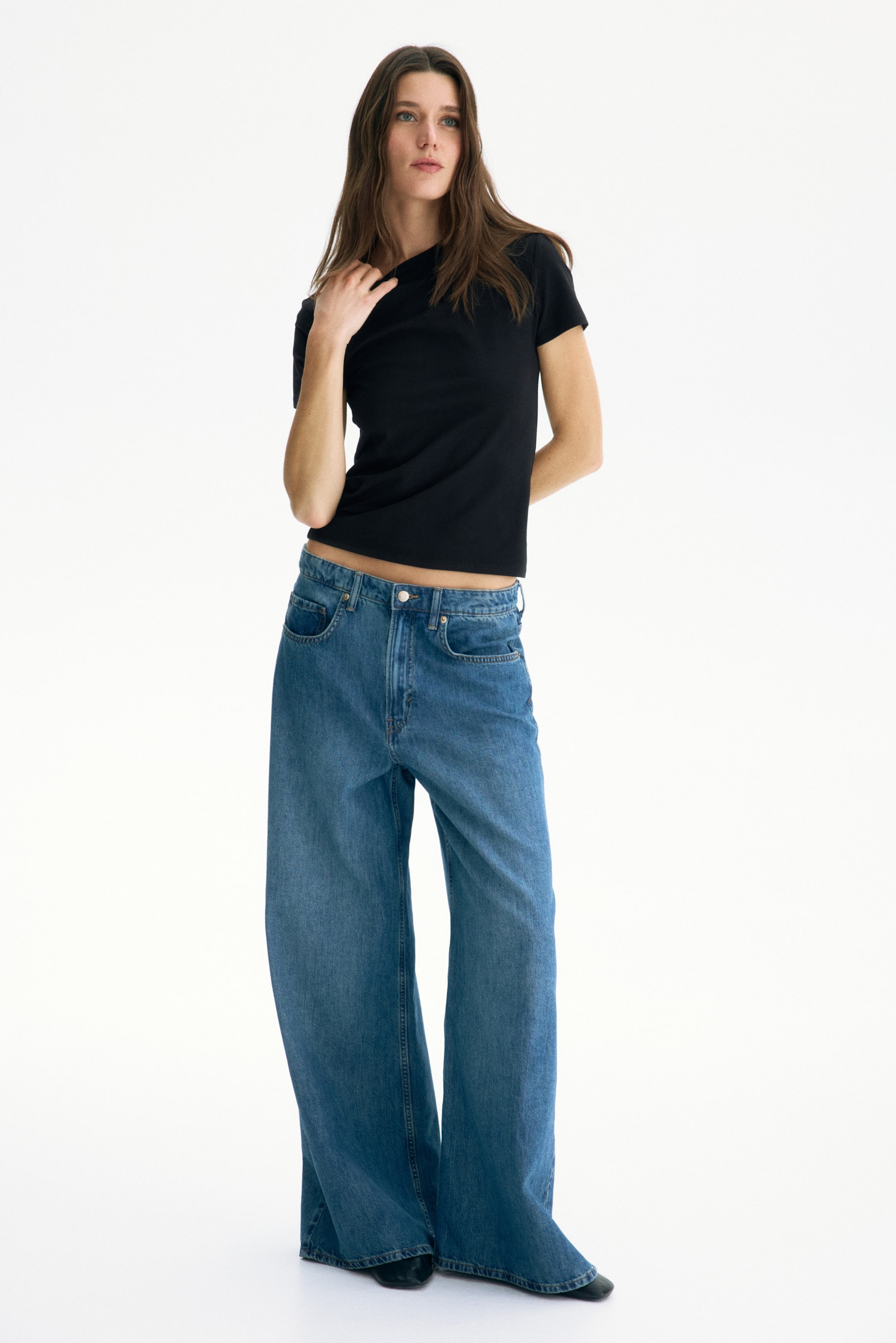
Put a fitted white tee above blue baggy jeans and the contrast in scale appears immediately. The torso stays compact, then the denim expands from the waist toward the shoes.
Pair the same tee with a long skirt and the shirt occupies a small visual area above the waistband, leaving the skirt to form most of the outfit.
Fitted rib tees create another effect because vertical ribs add visible texture across a close body shape.
9. Relaxed-Fit T-Shirt
Relaxed fit adds ease in a quieter way.
The shoulder can sit close to the natural position or slightly beyond it. The chest carries extra room. The sleeve opening becomes wider. The body hangs more freely around the waist.
The shirt still retains normal T-shirt proportions, so the hem usually stays around the hip.
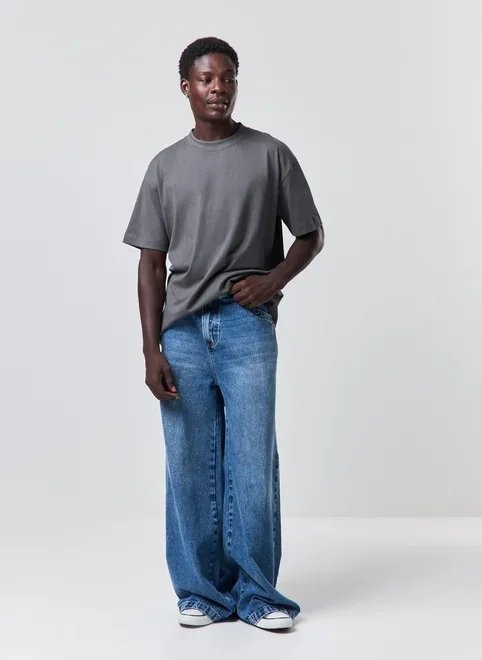
A relaxed tee suits straight and loose trousers especially well. Washed blue jeans, a grey relaxed shirt, and retro runners produce a soft everyday silhouette where the clothing hangs naturally around the body.
Fabric determines how obvious the added room becomes. A soft 160 GSM jersey collapses toward the torso. A denser 240 GSM cotton holds more air between the shirt and body.
10. Oversized T-Shirt
An oversized T-shirt increases the scale across several pattern areas together.
- The shoulder seam sits beyond the natural shoulder point.
- The chest becomes wider.
- The sleeve grows wider and often longer.
- The armhole becomes deeper.
- The body usually gains extra width and sometimes extra length.
Those changes create the broad streetwear silhouette associated with oversized tees.
A heavyweight version can hold the sleeve away from the arm and maintain a wide chest from shoulder to hem. Softer cotton creates more folds through the side seam and lower body.
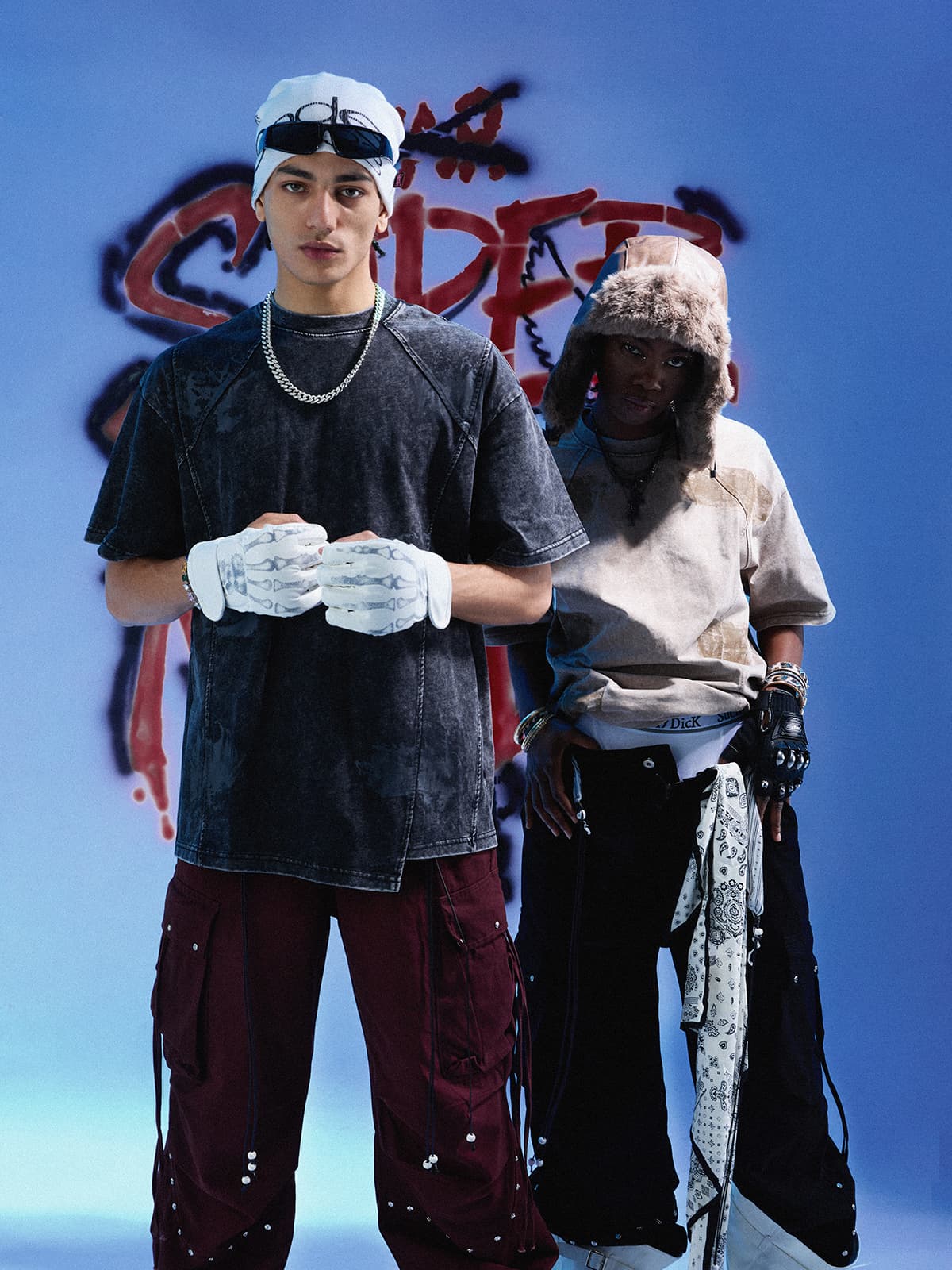
With baggy jeans, an oversized tee creates volume across the entire outfit. A shirt finishing around the upper hip keeps enough denim visible to show the trouser rise and upper-leg shape.
With cargo shorts, a longer oversized tee can reach close to the short hem, making the shirt the dominant block of the outfit.
Shoes affect the balance as well. Chunkier sneakers occupy more space beneath broad trousers. Slim sneakers keep the lower edge lighter.
11. Boxy T-Shirt
Boxy shape comes from geometry.
The body is relatively wide.
The side seams fall straight.
The shirt is often shorter than an oversized tee.
The sleeve commonly has added width.
The result looks closer to a square when viewed from the front.
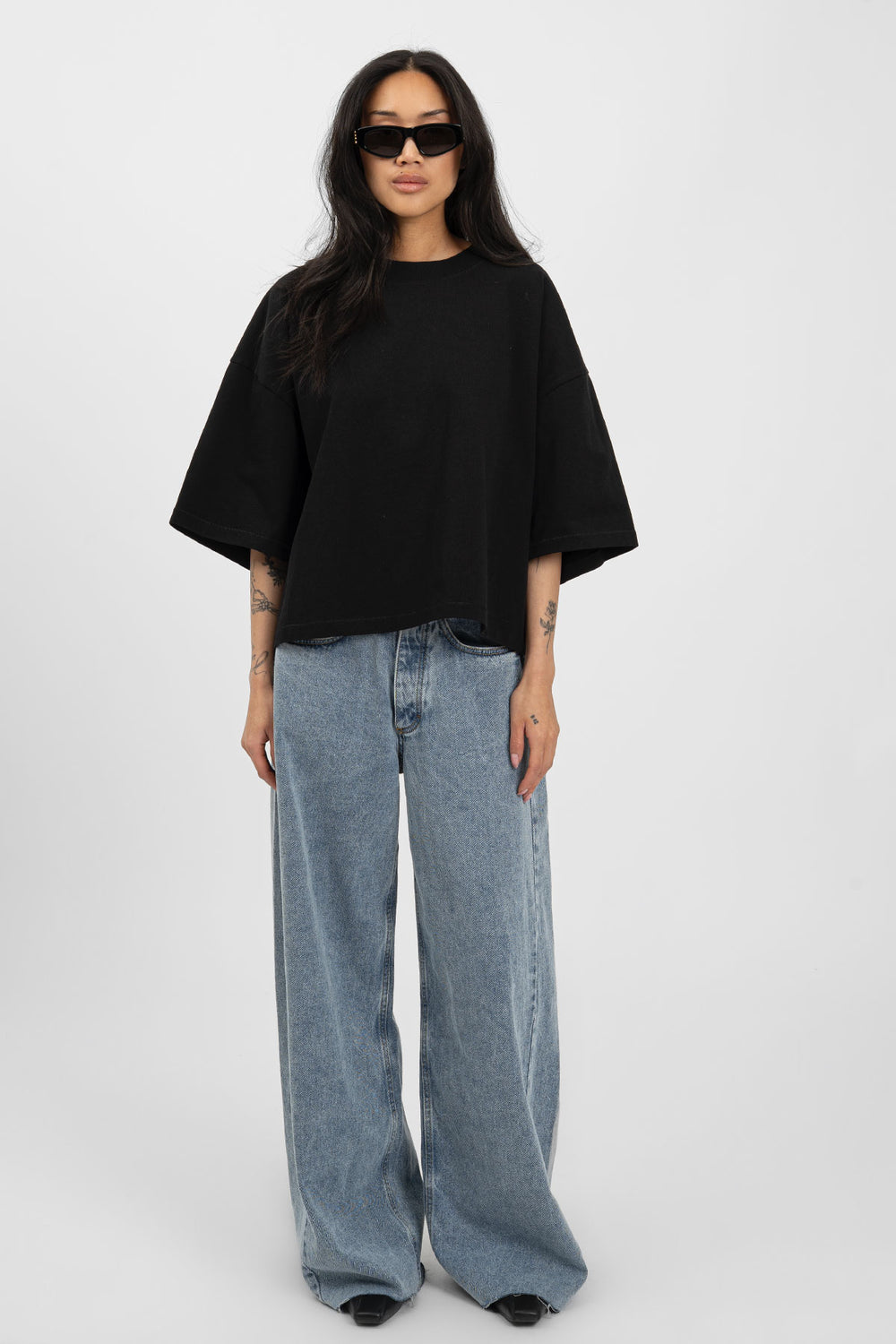
This shorter length changes the relationship between the shirt and trousers. A boxy tee ending around the top of the hip leaves more of the trouser visible, so high-rise jeans and wide-leg pants appear longer from waistband to shoe.
Heavy cotton suits this cut because it keeps the straight lower edge and wide sleeve shape visible.
A black boxy tee, faded grey wide jeans, and substantial sneakers produces a broad upper block with a clearly exposed lower silhouette.
12. Drop-Shoulder T-Shirt
Drop shoulder describes one specific part of the pattern.
Find the shoulder seam and compare it with the end of the wearer’s natural shoulder. On a drop-shoulder tee, that seam sits farther down the upper arm.
This makes the shoulder line appear wider even before extra chest width is considered.
Some drop-shoulder tees remain moderately relaxed through the body. Others use a fully oversized pattern.
The sleeve usually begins lower on the arm, so the upper torso appears broader and more horizontal.
For streetwear, a washed drop-shoulder tee works naturally with loose denim or cargo pants. The wide upper body connects visually with the width of the trousers.
A firm rib collar keeps the center neckline defined inside that larger shoulder shape.

T-Shirt Types by Body Length
Body length is measured vertically from the shoulder area to the hem. Small changes around the waist and hip have a large effect because they determine how much of the trousers, skirt, waistband, and midriff remain visible.
13. Baby Tee
The baby tee carries a very specific set of proportions associated strongly with late-1990s and Y2K dressing.
- The body is short.
- The chest is fitted.
- The sleeves are small.
- The shoulder width stays compact.
- The hem commonly ends around the natural waist or slightly below it.
A small graphic often sits at center chest because that scale fits the limited front area.
Low-rise baggy jeans create the recognizable Y2K shape: compact upper body, visible midsection, broad denim beginning lower on the hips.

High-rise jeans change the same shirt considerably. The waistband rises toward the hem, reducing the visible break between the two pieces and making the legs appear to begin higher.
Baby tees also work with mini skirts, long denim skirts, track pants, and cargo pants.
14. Cropped T-Shirt
“Cropped” tells you where the shirt ends. It leaves the rest of the pattern open.
One cropped tee can be fitted.
Another can be boxy.
Another can carry broad dropped shoulders.
A fourth can use the body width of an oversized shirt and finish abruptly around the waist.
This is why two cropped tees can look completely different even when their hem reaches the same point.
The waistband becomes especially important in styling.
A crop finishing close to a high-rise waistband creates a compact join between shirt and trousers. With wide denim, that keeps the upper body short and exposes the full leg silhouette.
A higher crop paired with low-rise cargos creates more open space around the waist and moves the visual break lower on the body.
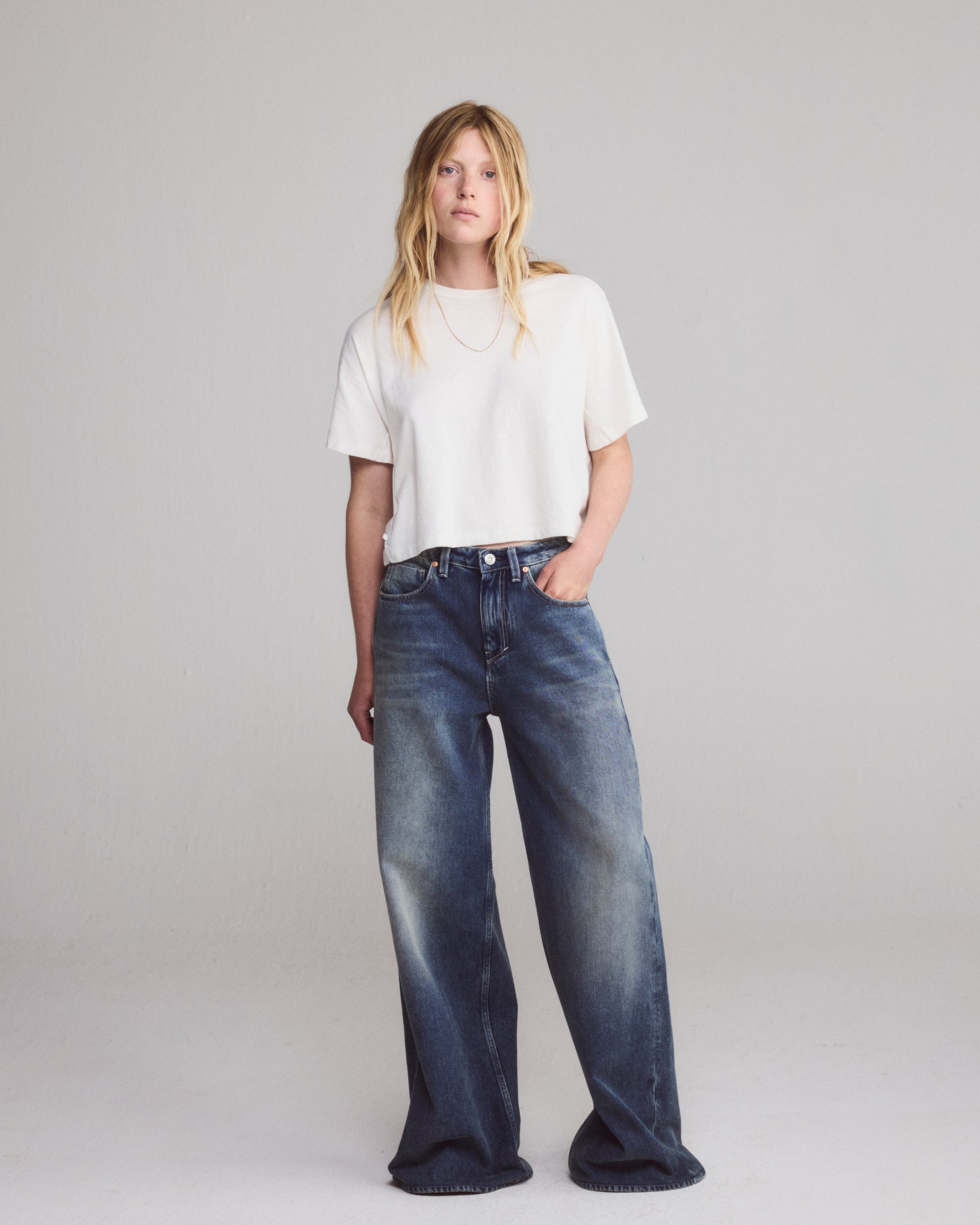
Fabric weight changes the hem as well. Dense jersey produces a straighter edge. Lightweight jersey can curl, fold, or fall more softly.
15. Standard-Length T-Shirt
Standard length usually brings the hem somewhere around the upper or middle hip, depending on the garment pattern and wearer.
That placement gives the shirt enough length to hang naturally over a waistband and enough flexibility for a full or partial tuck.
With straight jeans, the shirt can hang outside and maintain a continuous torso shape.
With high-rise trousers, tucking the hem exposes the waistband and moves the visible leg line upward.
With an open overshirt, the standard tee usually stays inside the outer layer’s overall length, creating a clean layered front.
This is the length found across crew-neck basics, graphic tees, pocket tees, and many regular-fit shirts.

16. Longline T-Shirt
A longline tee extends substantially below conventional hip-level T-shirt proportions.
The extra fabric creates a tall visual rectangle through the torso.
On some styles, the back hem reaches lower than the front. Other versions use a straight extended hem or deep side slits.
Layering brings this length into view.
A longline tee underneath a waist-length bomber leaves several inches of shirt visible below the jacket. That exposed hem creates another horizontal level in the outfit.
Straight trousers keep the lower body relatively narrow beneath the extended top.
A longline tee with skinny or tapered pants creates an especially strong difference between the long upper section and exposed lower leg.

T-Shirt Types by Sleeve and Shoulder Construction
Sleeve style changes the edge of the upper body. The position of the sleeve hem determines how much of the arm becomes part of the shirt silhouette, and the seam connecting sleeve to body changes the shoulder shape.
17. Cap-Sleeve T-Shirt
Cap sleeves cover only the top portion of the shoulder.
The sleeve hem sits high on the upper arm, creating a small rounded extension beyond the shoulder seam.
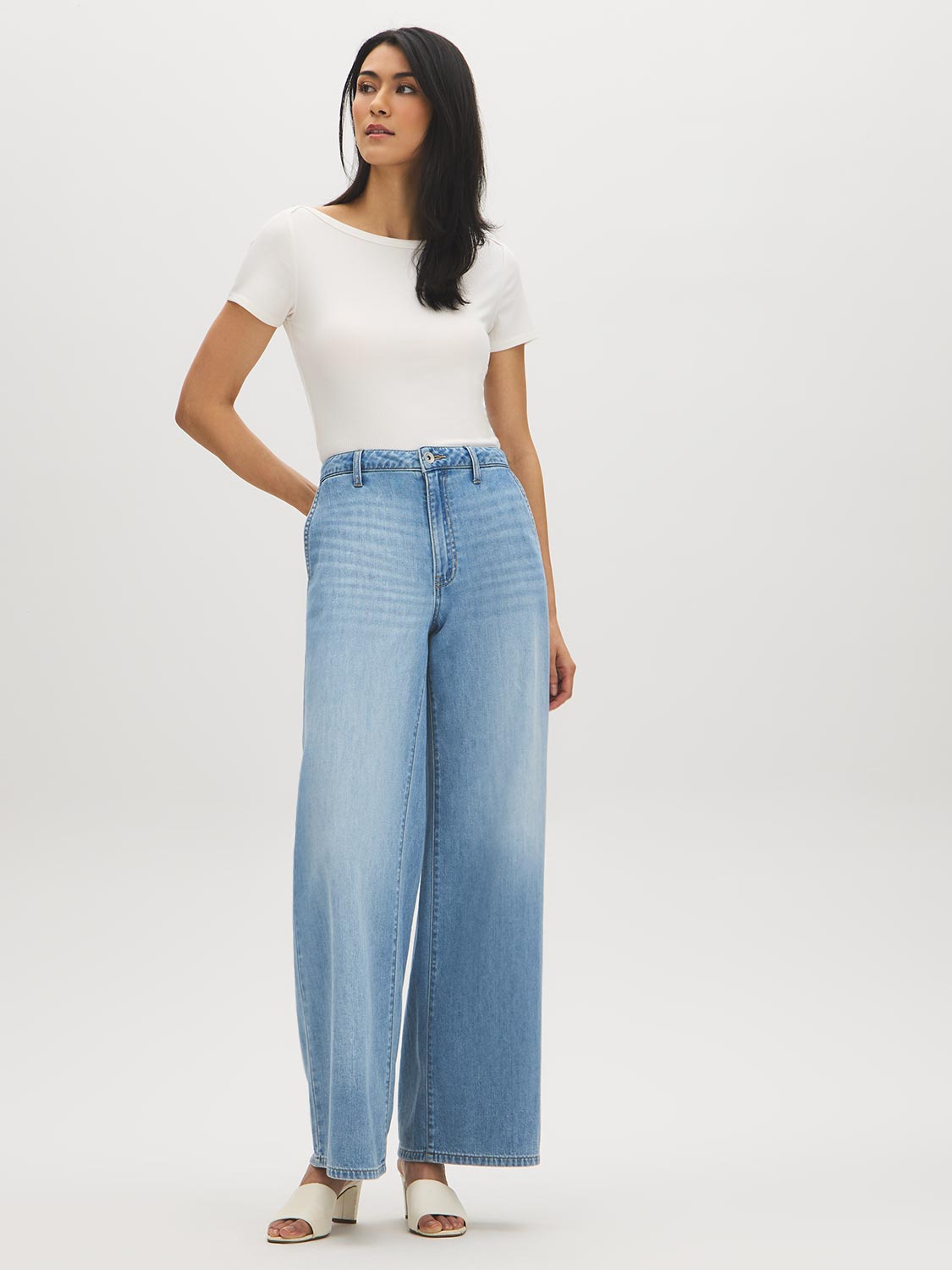
This shape is common on fitted women’s tees because it keeps the sleeve area visually compact.
A cap-sleeve tee tucked into wide trousers creates a narrow upper silhouette with very little fabric around the arm. With a long skirt, the small sleeve keeps most of the visible volume lower in the outfit.
Fine jersey and rib fabric suit this construction because both can follow the shoulder smoothly.
18. Standard Short-Sleeve T-Shirt
This is the familiar T-shirt sleeve that usually finishes around the middle of the upper arm.
Its final appearance depends on sleeve width and shoulder placement.
A fitted short sleeve sits close around the bicep.
A regular sleeve leaves moderate space.
An oversized sleeve can extend toward the elbow and hang several centimeters away from the arm.
The sleeve opening also changes how substantial the shirt appears from the front. Wide sleeves add horizontal space. Narrow sleeves keep the body more compact.
For this reason, “short sleeve” identifies length, then fit supplies the rest of the shape.

19. Elbow-Length T-Shirt
The sleeve extends close to the elbow, giving the upper part of the shirt more visual mass.
On a wide T-shirt, this creates the familiar streetwear proportion where the shoulder drops and the sleeve forms a broad fabric panel around the arm.
The sleeve can cover most of the upper arm, making the shirt appear larger even when the body length remains moderate.
Pair an elbow-sleeve heavyweight tee with baggy jeans and the width carries smoothly from shoulder through hip.
On a boxier shirt, the same sleeve length produces a compact square silhouette with strong horizontal edges.

20. Three-Quarter-Sleeve T-Shirt
Three-quarter sleeves finish between the elbow and wrist.
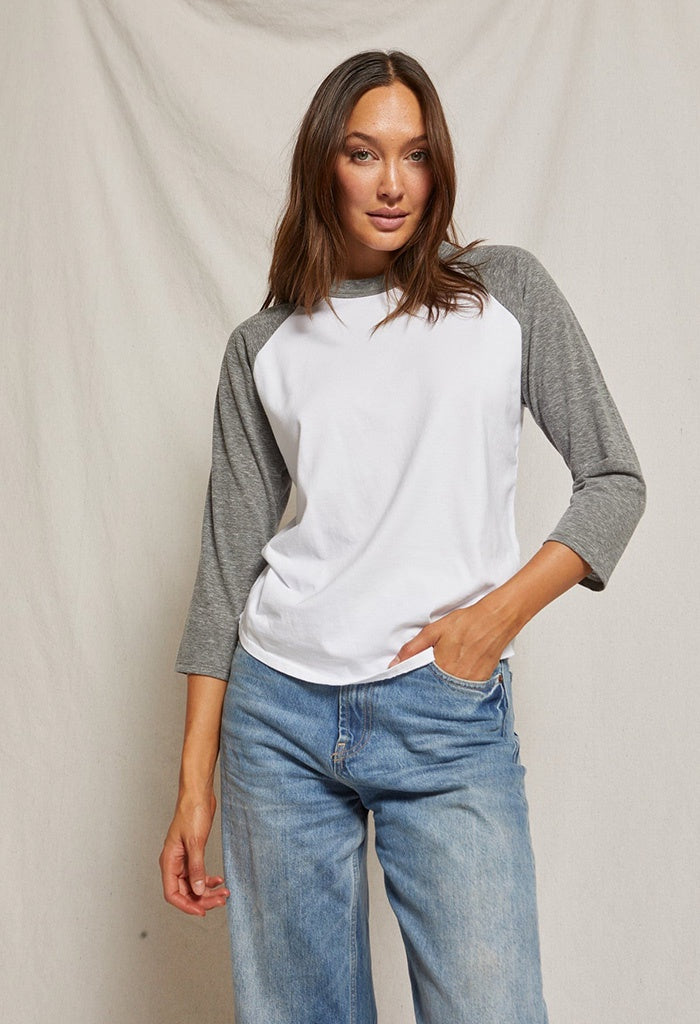
Baseball-inspired shirts frequently use this length with raglan construction and contrast-colored sleeves.
The exposed lower forearm keeps the shirt visibly lighter than a full long sleeve and gives the garment a recognizable retro-sports proportion.
A cream body with dark three-quarter raglan sleeves, straight faded jeans, and retro sneakers forms a complete casual look around that baseball reference.
The longer sleeve also gives contrast colors more area than a standard ringer tee.
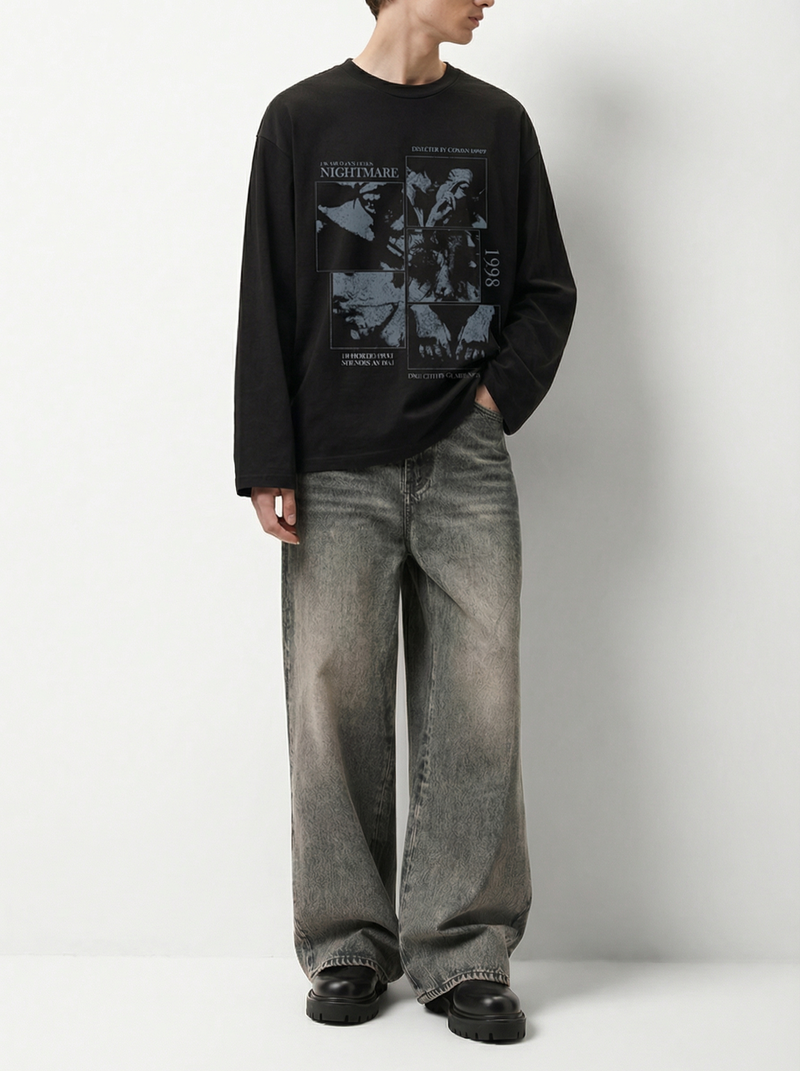
21. Long-Sleeve T-Shirt
Extend a conventional tee sleeve to the wrist and the shirt begins to occupy much more of the outfit.
The body may stay regular, slim, boxy, or oversized.
A fitted long-sleeve tee works as a compact layer beneath jackets and short-sleeve shirts.
An oversized long-sleeve graphic tee creates a broad torso with fabric continuing all the way down the arms.
Streetwear versions frequently use graphics on the chest, back, or sleeves. Sleeve printing makes sense here because the long fabric panel gives artwork a narrow vertical surface.
With loose jeans and skate shoes, a heavyweight long-sleeve graphic tee can carry the complete upper half of the outfit by itself.
22. Raglan T-Shirt
Raglan construction changes the actual seam path.
A conventional set-in sleeve has a seam around the shoulder and armhole.
A raglan sleeve begins at the neckline and travels diagonally toward the underarm.
That diagonal line is visible from both the front and back.
The construction creates a softer transition from neck to sleeve and works especially well with contrast fabric because the entire sleeve panel can carry a separate color.
Classic baseball tees use this feature heavily.
Modern raglan shirts also appear in single-color jersey, where the seam remains visible through stitching even when body and sleeve share one color.

23. Sleeveless T-Shirt
Sleeveless tees keep a recognizable T-shirt body and remove the conventional sleeve.
The armhole becomes one of the major design lines.
A standard sleeveless tee retains substantial shoulder width. A narrower version moves visually closer to a tank top. Streetwear cuts can add extra body width and lower armholes.
High armholes create a neat fitted edge around the shoulder.
Deeper armholes expose more of the side torso and make the garment look looser.
With cargos and substantial sneakers, a wide sleeveless tee creates a strong summer streetwear silhouette. A fitted sleeveless tee with high-rise wide pants creates a much smaller upper shape.
24. Muscle T-Shirt
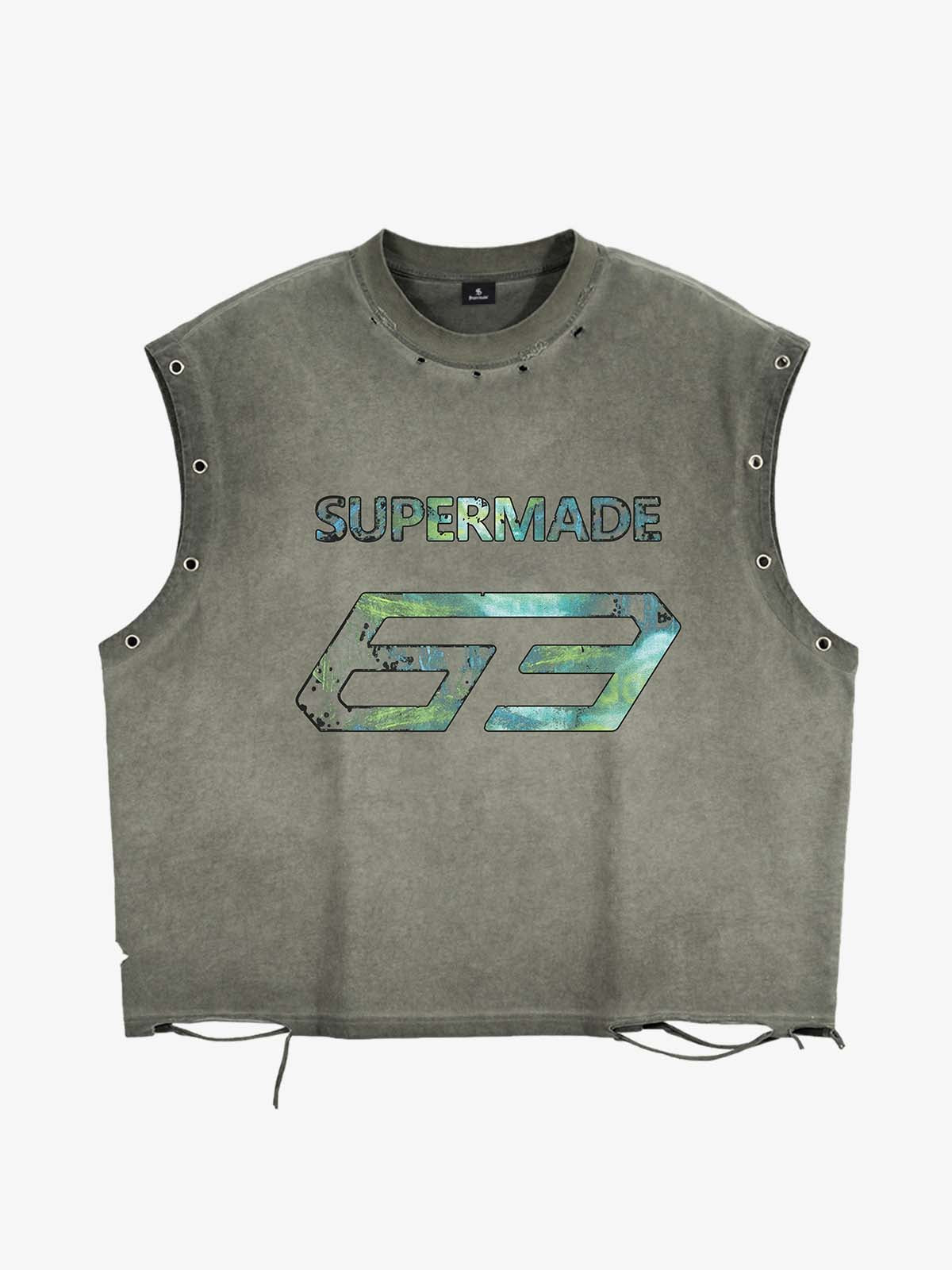
A muscle tee usually combines broad shoulders, an open arm area, and a relatively loose torso.
Some are constructed directly as sleeveless garments. Others use a shape inspired by T-shirts with removed sleeves.
The body can remain long and straight, giving the shirt a large rectangular silhouette.
Deep armholes increase movement and expose more of the side body.
Heavyweight cotton gives a muscle tee a strong shoulder edge and helps the body remain broad.
With washed cargos or loose denim, that structure carries the weight of a streetwear outfit even with the arms fully exposed.

T-Shirt Types Defined by Construction Details
Some T-shirts keep a familiar body shape and gain their identity from one construction feature. These details influence how the eye moves across the garment and how the shirt interacts with other layers.
25. Ringer T-Shirt
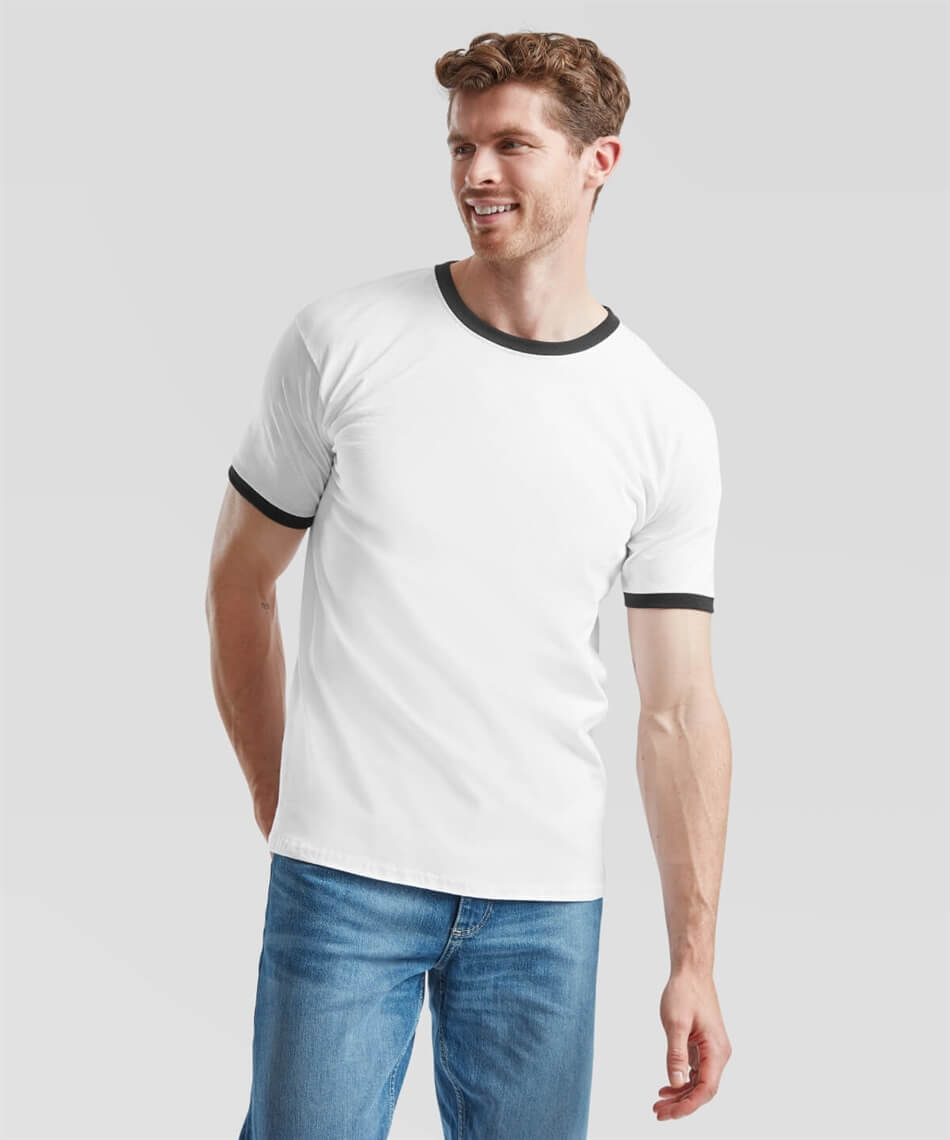
The ringer tee is built around contrast rib.
A typical version has one color across the body and another around the crew neckline and sleeve openings.
White with black rib is common.
Cream with dark green, white with red, grey with navy, and yellow with brown all create a similar retro effect.
The colored edges visually outline the shirt.
This makes even a plain ringer more detailed than a solid crew-neck tee.
Add a small center graphic and the collar, sleeve bands, and print form three separate points of visual interest.
Faded straight jeans work naturally with the 1970s sports association. Short athletic shorts can push the same shirt further toward retro gym styling.
26. Pocket T-Shirt
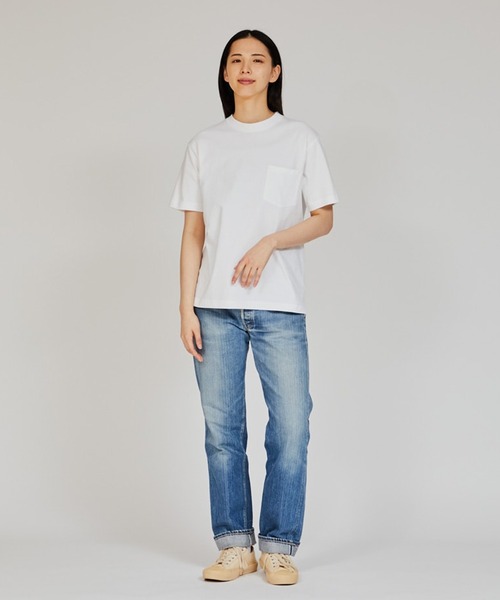
A pocket tee usually carries one patch pocket on the left chest.
The position is more important than the size might suggest. A plain solid shirt has a large uninterrupted front panel. Add a pocket and the eye gains a fixed point near the upper chest.
Heavy cotton gives the pocket a sharper outline through its folded edges and topstitching.
Slub cotton makes the detail softer because the fabric surface already contains irregular texture.
Pocket tees fit easily with carpenter pants, chore jackets, straight denim, and canvas sneakers. The chest detail connects naturally with garments that already use visible utility construction.
27. Curved-Hem T-Shirt
A curved hem drops lower at the center front and back and rises toward the sides.
Viewed from the front, the lower edge forms a shallow arc.
This makes the center section of the torso appear longer than it would with a completely horizontal hem.
Curved hems are frequently used on longline and layered T-shirts because the rounded lower edge remains visible beneath jackets, sweatshirts, and overshirts.
The side area also exposes more of the trousers.
A charcoal curved-hem tee under a cropped bomber creates visible shirt length at the center with more of the trouser appearing near each hip.

28. Split-Hem T-Shirt
A split hem has openings at the lower side seams.
The slit may be only a few centimeters deep or extend significantly farther upward on longline styles.
This detail lets the front and back sections move separately around the hips.
It also creates a visible break at each side, especially when the shirt is long.
Some split-hem T-shirts use a longer back panel. The two hem levels then remain visible from the side.
Loose trousers suit this construction because the side opening reveals part of the waistband and upper trouser as the shirt moves.
T-Shirt Types by Fabric Weight and Surface
Fabric determines whether a T-shirt stands away from the body, collapses into soft folds, stretches around the torso, or carries visible texture.
A cut that looks sharply boxy in dense cotton may look completely different in a thin fluid jersey.
29. Heavyweight T-Shirt
Heavyweight tees use dense jersey with enough mass to hold a clear shape.
There is no single universal GSM dividing every T-shirt into lightweight and heavyweight categories, since fiber, yarn size, knit density, finishing, and manufacturer terminology all contribute to fabric feel. In everyday apparel, shirts marketed as heavyweight commonly occupy the denser end of jersey used for casual tees.
You can usually see the effect before touching the fabric.
- The sleeve stands farther from the arm.
- The hem falls with more weight.
- A boxy body stays broad.
- A dropped shoulder forms a clear line.
- The fabric shows fewer tiny folds across the torso.
This makes heavyweight cotton especially useful for oversized streetwear.
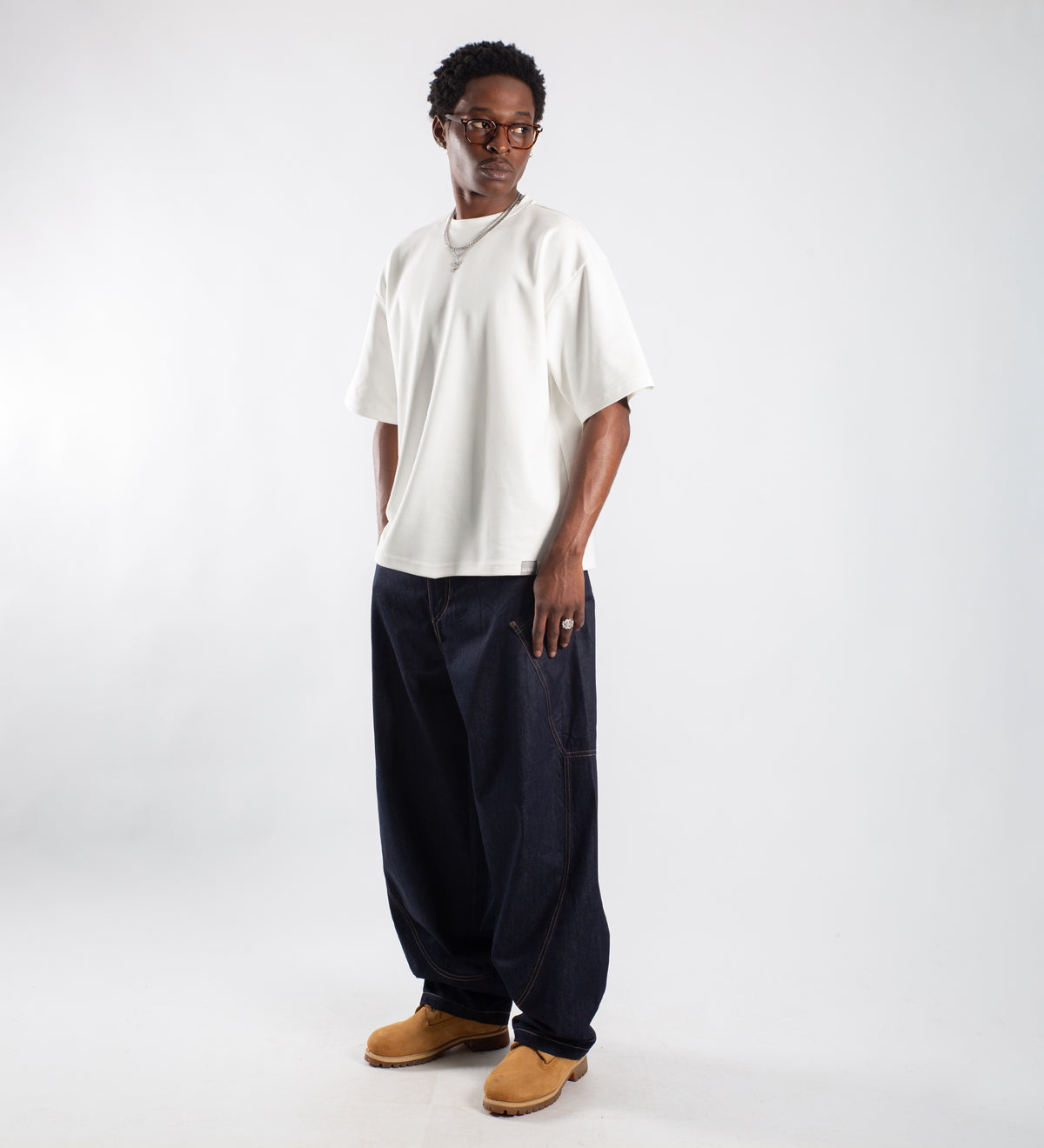
Take a washed black heavyweight tee with a broad chest and elbow-length sleeves. Add faded baggy denim and thick-soled sneakers. The tee keeps its own shape above the jeans, so the outfit gains visible volume through both halves.
Graphics also sit differently on dense fabric. A large front print has a flatter, more stable surface to occupy.
30. Lightweight T-Shirt
Lightweight jersey behaves with much more movement.
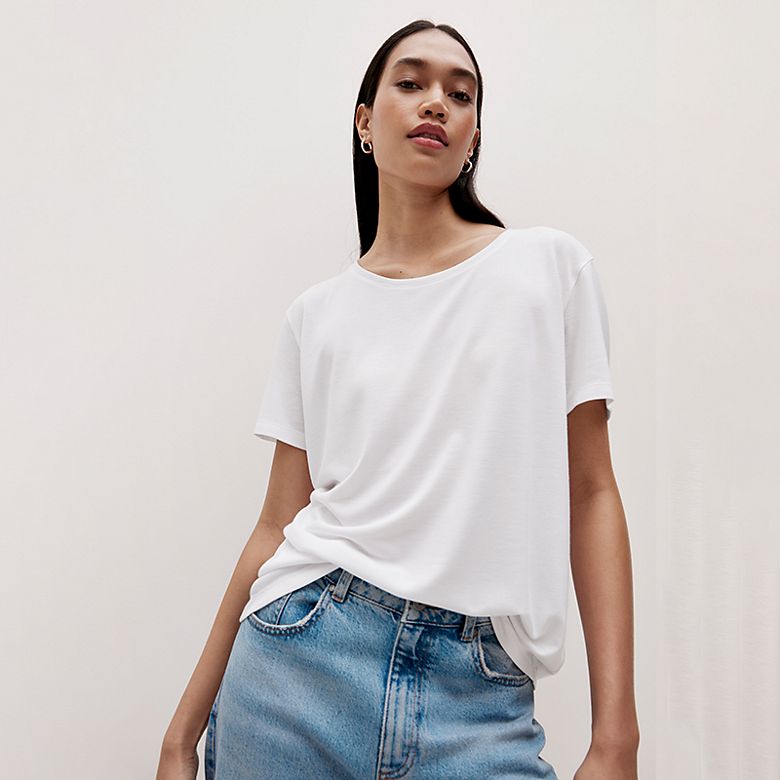
It falls closer to the body, folds more easily around the waist, and creates finer wrinkles around the underarm and side seam.
A loose lightweight tee can still have substantial chest width. The fabric reveals that width through drape rather than firm structure.
This works especially well in warm-weather outfits.
A soft white tee over loose nylon shorts creates an airy upper section. Fine cotton paired with a flowing skirt produces a softer silhouette around the waist.
Lightweight fabric also tucks easily because less material collects inside the waistband.
31. Slub T-Shirt
Slub fabric contains deliberate irregularities in the yarn, creating small changes in thickness across the surface.
Seen close up, the shirt has faint lines, bumps, and uneven texture.
From several feet away, those irregularities make a solid color look less flat.
White slub cotton frequently shows the texture clearly because light catches the thicker yarn areas. Washed grey and muted earth colors develop additional depth from the same surface.
A slub tee works well in simple outfits because the cloth itself supplies detail. Straight denim, suede footwear, and a slub crew-neck tee can create enough visual texture with very little decoration.

32. Waffle-Knit T-Shirt
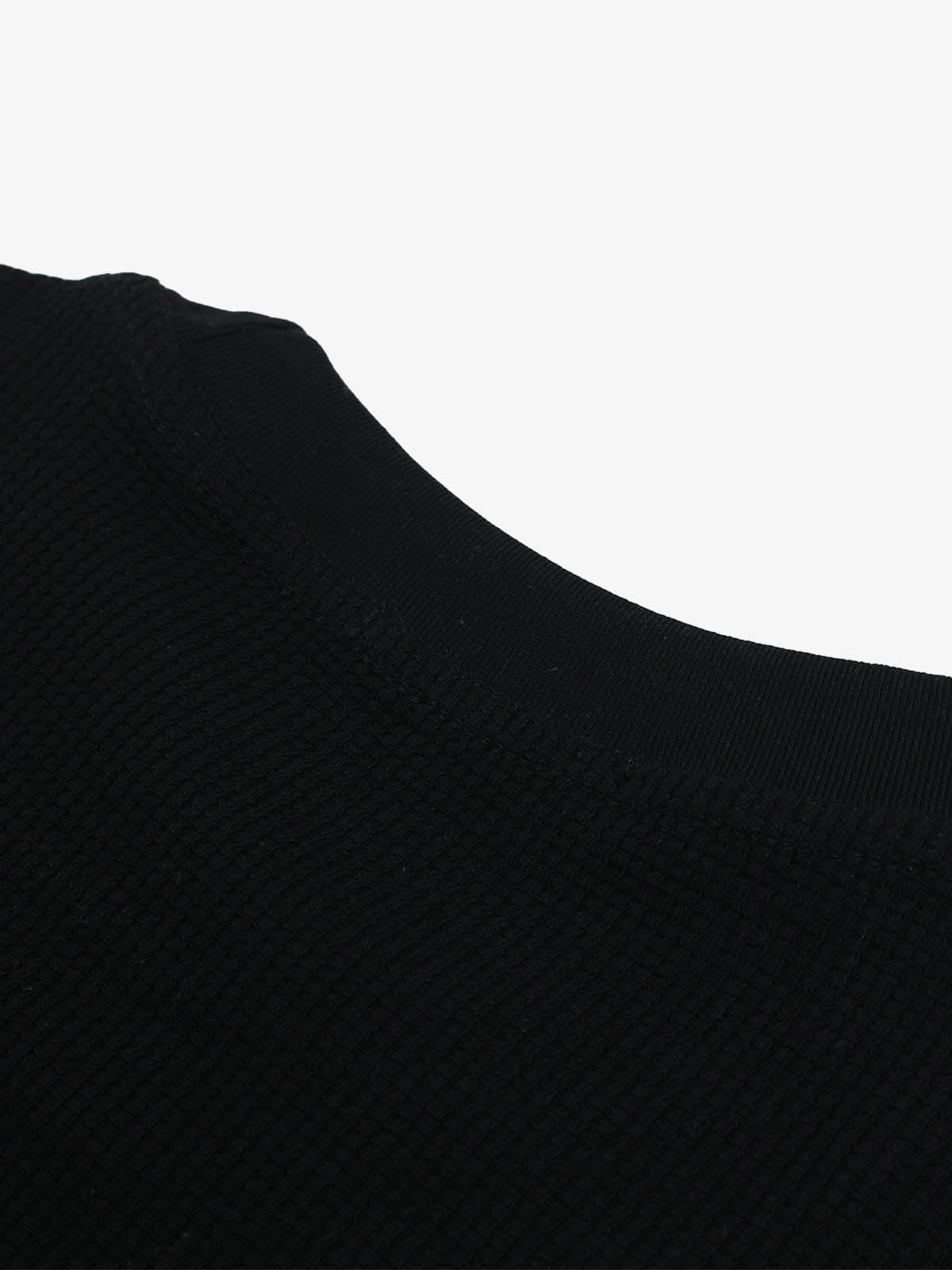
Waffle fabric forms a small raised grid across the surface.
That three-dimensional knit catches shadow between the raised sections, giving the shirt more visible texture than smooth jersey.
The structure also changes how a graphic reads. Printing over waffle fabric places artwork on an uneven surface, so the textile remains visible underneath the design.
A relaxed waffle T-shirt with washed cargos and sneakers has more physical depth than a smooth cotton tee in the same color.
Dark waffle fabric makes the raised pattern especially visible under directional light.
For a streetwear shirt, this allows the fabric itself to become a design feature alongside fit and graphic placement.
Performance T-Shirt
Performance tees use fabrics selected for training, running, gym wear, and other active movement.
Polyester is common. Nylon blends also appear. Elastane adds stretch. Engineered mesh and perforated knit zones can increase airflow through specific areas.
The surface is usually smoother and lighter than a heavyweight cotton streetwear tee.
Pattern construction may add:

- raglan sleeves for a continuous shoulder panel
- stretch seams
- mesh inserts
- shaped side panels
- longer rear hems
- close athletic armholes
The complete silhouette can range from fitted running shirts to loose basketball-inspired training tees.
A technical tee with nylon track pants and running shoes creates a head-to-toe athletic outfit. Add a lightweight shell and the same pieces move naturally into contemporary techwear.
T-Shirt Types Defined by Graphics and Finishing
Color and artwork occupy the surface of the garment, so they can transform a familiar T-shirt pattern without changing the underlying seams.
A plain crew-neck shirt and a heavily washed graphic tee may come from nearly identical pattern blocks. Their finished appearance can still feel completely different.
Graphic T-Shirt
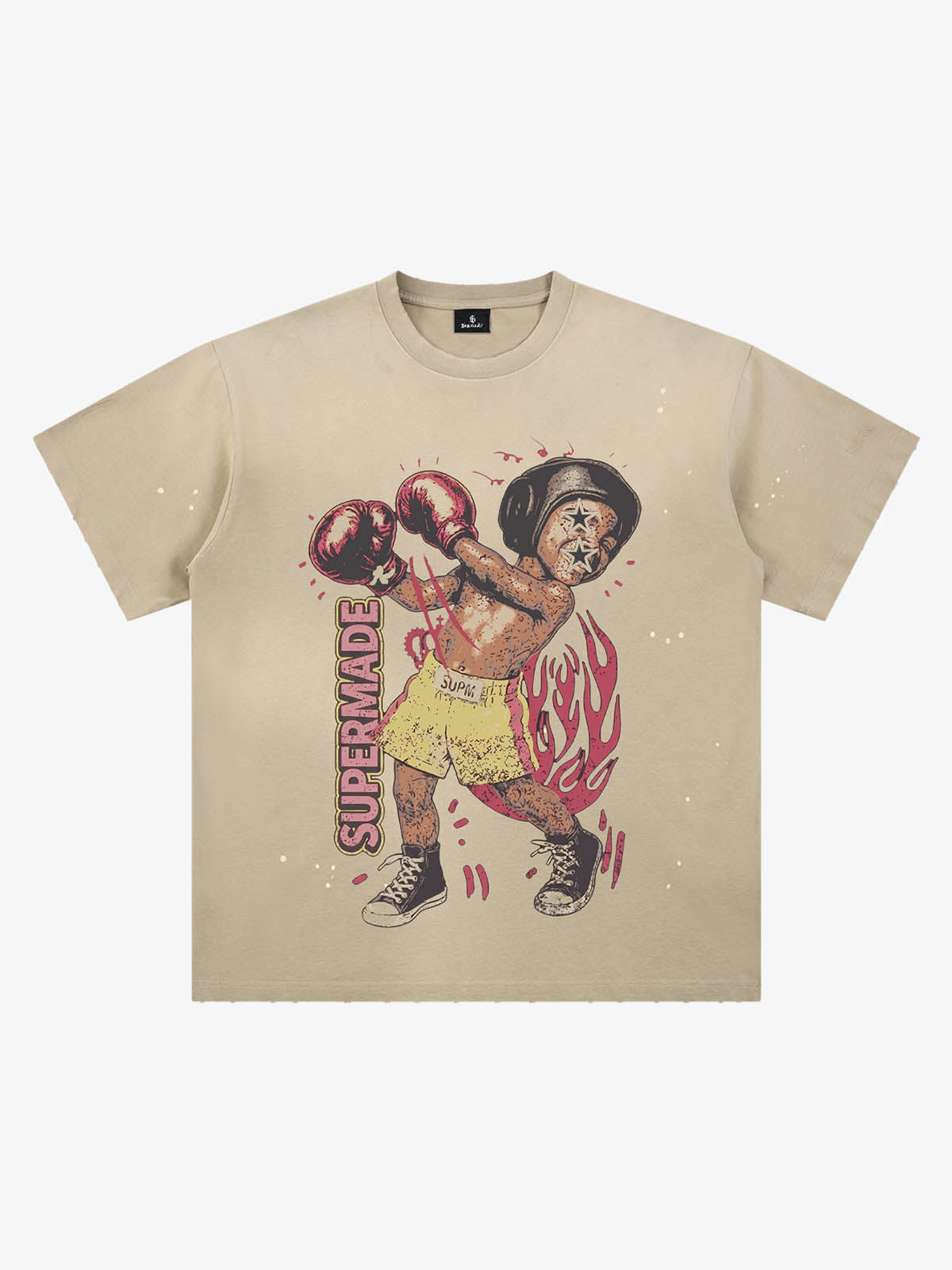
The position and scale of artwork determine how much of the shirt functions as a visual focal point.
A small chest graphic occupies only a limited area. The fabric color remains dominant.
A center graphic pulls attention toward the middle of the torso.
An oversized front graphic can cover most of the visible body panel.
A back graphic leaves the front comparatively clean and gives the rear view a large visual field.
Sleeve graphics add another direction on long-sleeve tees.
Large graphics suit oversized shirts particularly well because the broader chest and back provide more print area.
A washed oversized graphic tee with baggy denim creates a natural streetwear combination. The artwork fills the broad upper shape, then the loose jeans continue the scale below.
Logo T-Shirt
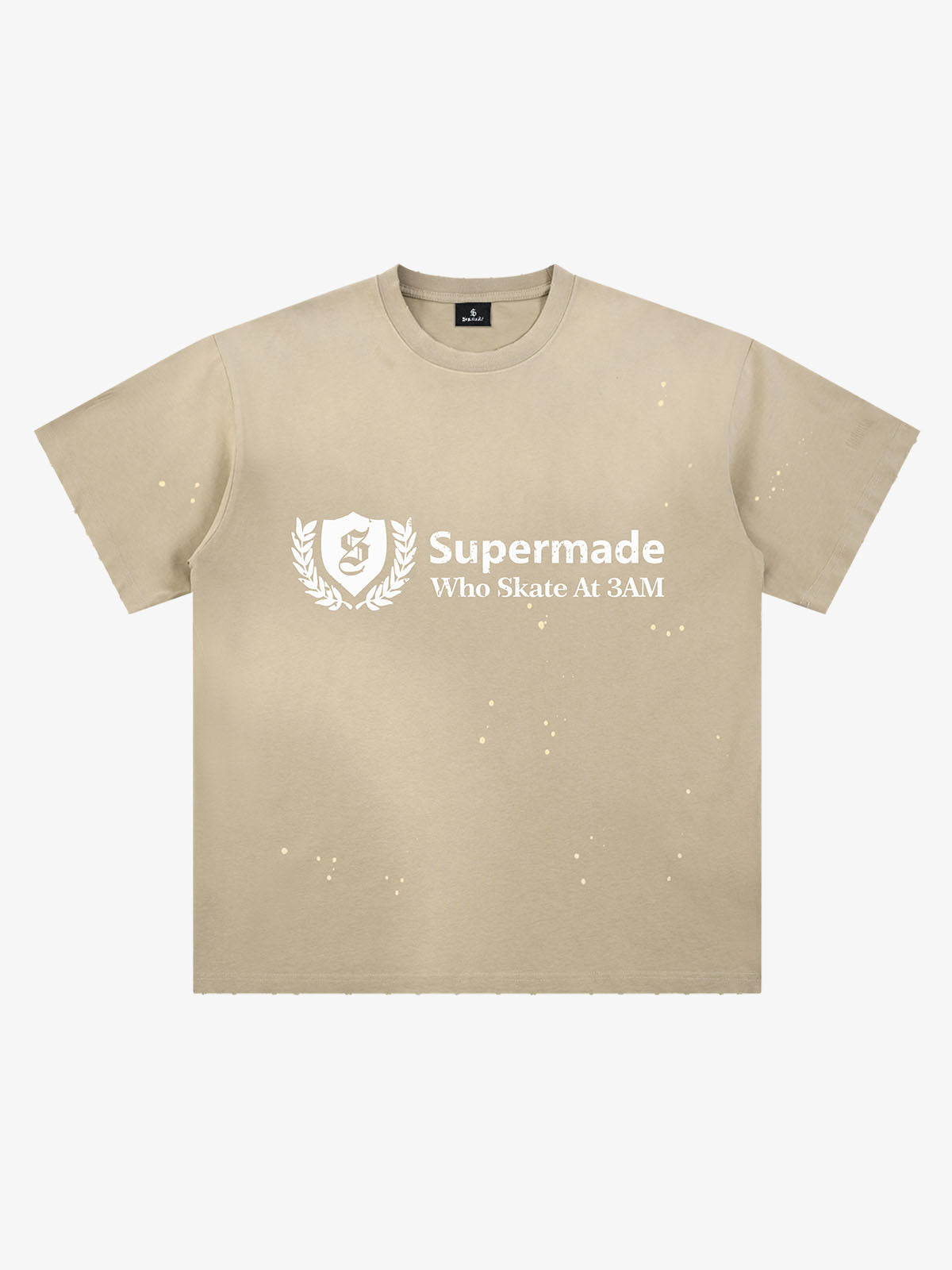
A logo tee uses brand lettering, a symbol, emblem, or recognizable mark as the central decoration.
Scale changes the character immediately.
A small embroidered logo near the chest behaves almost like a pocket-sized detail.
A large printed wordmark becomes the main element across the torso.
Repeated logos create a pattern effect.
A back logo can function more like a graphic tee.
Typography also matters. Wide block lettering adds horizontal emphasis across the chest. Tall condensed lettering creates a narrower vertical element.
With simple jeans or plain cargos, the logo receives enough open visual space to remain clear.
Vintage-Wash T-Shirt
Vintage character often begins with color.
- Deep black can soften toward charcoal.
- Brown can develop dusty uneven areas.
- Navy may appear faded at seams and edges.
- Muted olive can gain a worn military quality.
Garment washing, pigment processes, enzymes, abrasion, and later wear all influence the final surface.
Seams often reveal the effect clearly because their raised areas receive more friction during finishing. Collar edges, sleeve hems, and body hems can show tonal variation.
Pair a charcoal washed tee with medium-blue worn denim, a brown belt, and faded sneakers. Each piece carries a softened surface, giving the outfit visual depth through fabric condition and color.
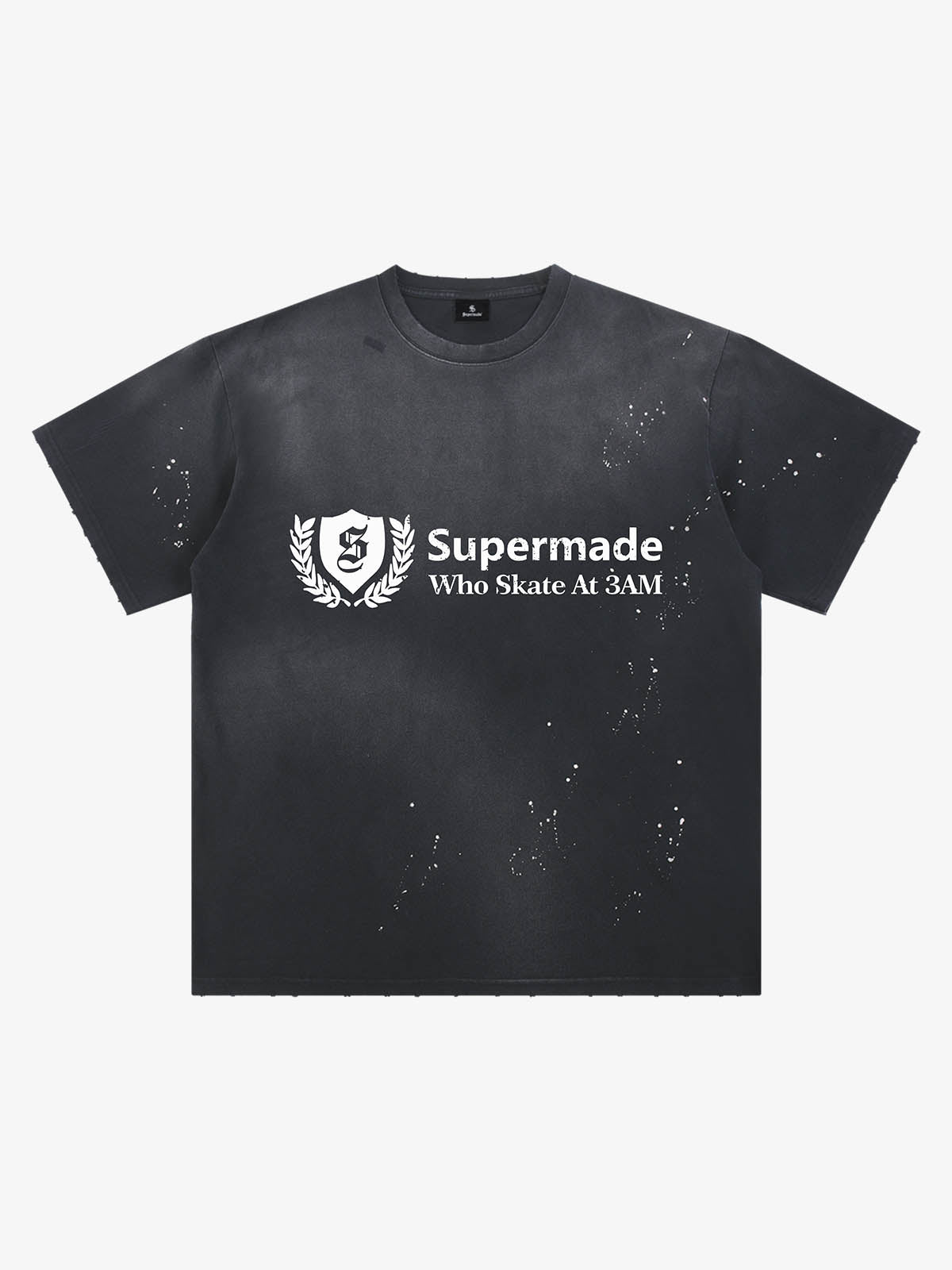
A vintage graphic introduces another layer. Distressed-looking ink, cracked-style artwork, faded lettering, and retro imagery can reinforce the aged appearance.
Acid-Wash T-Shirt
Acid-wash treatments produce more dramatic light and dark variation.
The surface can show clouds, streaks, irregular patches, or high-contrast faded areas.
Black and charcoal shirts make these variations especially visible.
Since the wash already covers most of the shirt, the garment carries strong visual information before a graphic is added.
A wide acid-wash tee with black cargos keeps the outfit in a dark palette and lets the uneven shirt surface provide most of the detail.
Blue acid wash paired with light denim creates a brighter vintage direction.
The exact wash pattern changes from garment to garment when the finishing process produces irregular surface effects, making variation part of the appearance.

Garment-Dyed T-Shirt
Garment dyeing means the shirt receives color after the garment has been assembled.
The dye interacts with the finished seams, rib, body fabric, and stitching according to their fiber content and construction.
This can produce a softer, more lived-in color compared with the very uniform appearance associated with many piece-dyed fabrics.
Muted reds, washed greens, faded browns, dusty blues, and softened blacks suit garment-dyed tees particularly well.
On a heavyweight boxy shirt, garment dye combines strong physical structure with a softer color surface.
That pairing works well with washed canvas trousers, faded denim, and suede footwear.
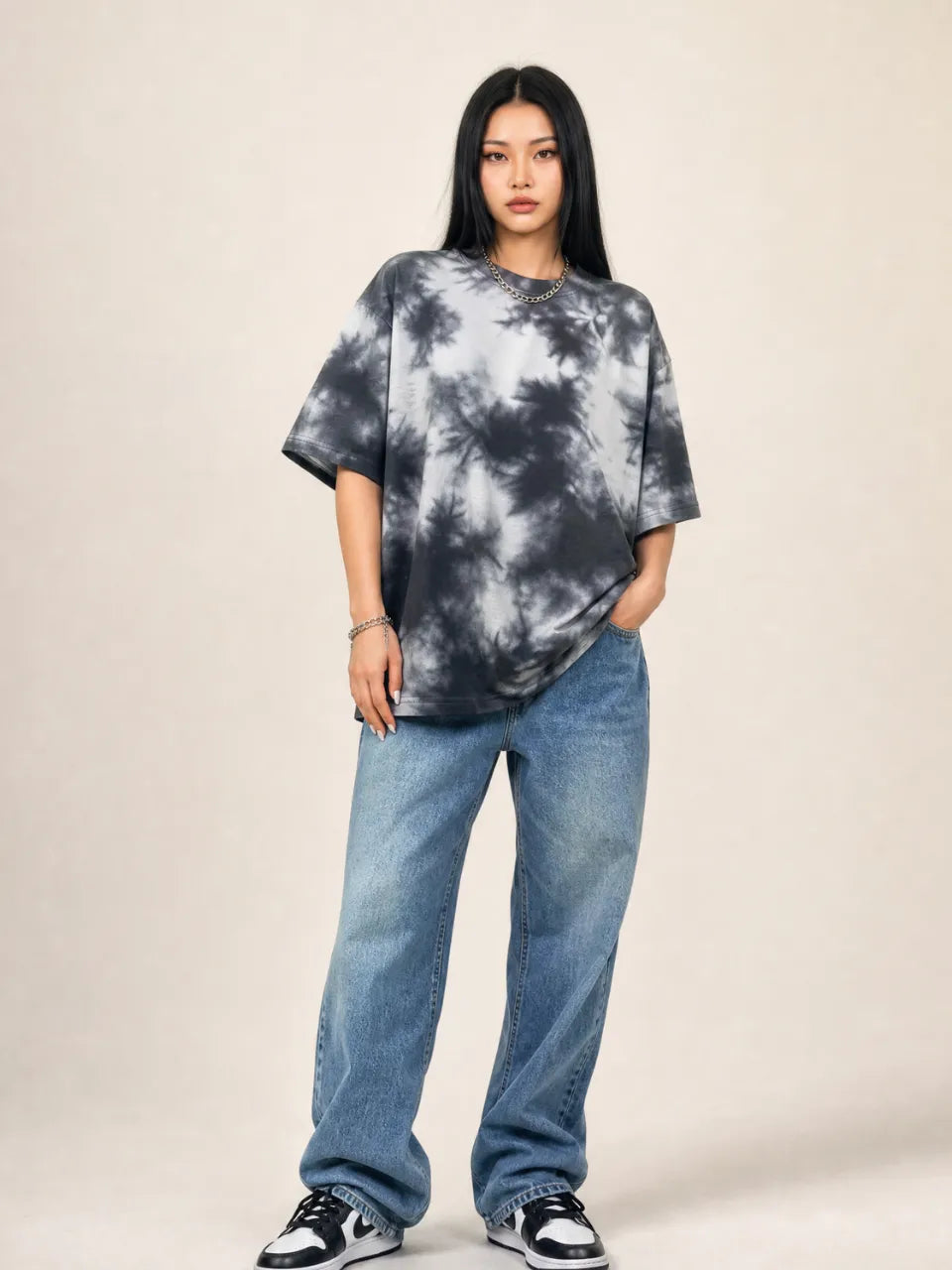
Tie-Dye T-Shirt
Tie dye creates pattern through controlled areas of dye penetration.
Spirals form around a central rotation.
Stripes can come from folded fabric.
Circular bursts appear from bound sections.
Crumpled fabric creates more irregular fields.
The pattern covers a large portion of the shirt, so the rest of the outfit usually has a strong visual relationship with the colors already present.
A blue-and-white tie-dye tee with washed blue jeans keeps several related tones across the outfit.
A dark black-and-grey version works naturally with charcoal cargos and black sneakers.
Oversized cuts give the pattern a larger uninterrupted surface, especially across the back.
How Different T-Shirt Features Combine
A T-shirt rarely belongs to only one style category.
Take a shirt with these features:
Crew neck + drop shoulder + oversized body + elbow-length sleeve + heavyweight cotton + vintage wash + large back graphic.
Every term describes something different.
“Crew neck” describes the collar.
“Drop shoulder” describes seam placement.
“Oversized” describes body volume.
“Elbow length” describes the sleeve.
“Heavyweight” describes fabric density.
“Vintage wash” describes the finish.
“Graphic” describes decoration.
Remove any one of those terms and the remaining description still makes sense. Put them together and they describe one complete garment.
A second shirt could be:
Scoop neck + fitted body + cropped hem + cap sleeves + fine rib fabric.
That creates a completely different silhouette even though both garments still belong to the T-shirt family.
How T-Shirt Fit Changes an Outfit
The shirt-to-trouser relationship has one of the largest effects on overall proportions.
A fitted tee with baggy jeans keeps the torso compact and allows the denim to provide most of the width. The waist becomes clearly visible because the shirt follows the body closely.
An oversized tee with baggy jeans carries volume from shoulder to shoe. A wide sleeve and dropped shoulder create a larger upper block, and the loose denim continues that scale through the legs.
A boxy tee with high-rise wide trousers places the hem closer to the waistband. More trouser length stays visible, giving the legs a longer uninterrupted section.
A longline tee with straight trousers extends the upper block farther downward. The trouser starts visually lower because more of the hip area remains covered.
A baby tee with low-rise jeans leaves open space around the midriff and creates the proportions associated strongly with Y2K outfits.
A cropped fitted tee with high-rise cargos creates a close connection at the waistband and places the cargo-pocket volume farther down the body.
These are physical effects produced by garment length and width.
How Sleeve Length Changes T-Shirt Proportions
Sleeves control how far the shirt extends horizontally and vertically across the arm.
A small cap sleeve leaves most of the arm visible.
A fitted short sleeve adds a compact line around the upper arm.
A wide standard sleeve gives the shoulder more visual weight.
An elbow-length sleeve creates a larger upper-body block.
A long sleeve extends fabric to the wrist and can support graphics down the arm.
The same shirt body can therefore feel very different after the sleeve changes.
Consider a heavyweight boxy body.
Add compact fitted sleeves and the broad torso becomes the dominant feature.
Add wide elbow-length sleeves and the entire upper half expands.
Add long dropped sleeves and the garment begins to feel closer to oversized skate and streetwear silhouettes.
Sleeve opening matters at the same time. A 20 cm flat sleeve opening creates substantially more visible space around the arm than a close 14 cm opening on a similarly sized garment.
How Fabric Weight Changes the Same T-Shirt Cut
A pattern determines the available space. Fabric determines how that space appears once gravity acts on the garment.
Dense jersey can hold a broad chest away from the body.
A softer jersey can fold inward through the same chest area.
Heavy cotton creates clearer sleeve edges.
Light fabric lets the sleeve collapse closer to the arm.
A stiff boxy tee may show a nearly straight side silhouette from chest to hem.
A soft boxy tee can develop vertical folds that make some of that width appear visually narrower.
This explains why sizing measurements alone cannot describe the full silhouette. Two shirts with the same chest width and body length can hang differently because the fabrics have different weight, thickness, stretch, knit density, and finishing.
Common T-Shirt Fabric Structures
The word “cotton” identifies the fiber. It does not fully describe the fabric.
A T-shirt made from smooth single jersey feels different from a waffle knit even when both use cotton.
Single jersey is the familiar knit used across large numbers of everyday T-shirts. The face has a relatively smooth appearance and the reverse shows a different loop structure.
Rib knit has visible vertical ribs and usually more crosswise stretch. Fitted tees and baby tees commonly use it.
Slub jersey includes irregular yarn thickness, producing visible texture.
Waffle knit creates raised cells across the fabric.
Cotton-elastane jersey adds stretch and recovery, making it well suited to fitted shirts.
Polyester performance jersey can provide lightweight construction and moisture management for active use.
Cotton-polyester blends combine properties from both fibers and are common in casual and printed tees.
The knit, fiber, yarn, GSM, finishing, and garment pattern all contribute to the finished feel.
T-Shirt Neck Rib Makes a Visible Difference
The collar deserves more attention because it sits directly beside the face and defines the upper edge of almost every crew-neck tee.
A narrow rib gives the neckline a lighter appearance.
A wider rib creates a stronger ring around the neck.
A firm rib keeps its shape clearly on a heavyweight streetwear shirt.
A softer rib lies closer to the body.
The neck opening diameter matters too. A compact opening sits high around the neck. A larger crew opening exposes more collarbone and begins to approach a scoop shape.
On oversized streetwear tees, a substantial collar often works well because the larger body already carries strong proportions.
On fine fitted tees, a narrower collar can fit the smaller scale of the garment.
T-Shirt Hem Shapes
The lower edge determines how the T-shirt meets the trousers.
- A straight hem creates one horizontal line.
- A curved hem drops farther through the center.
- A split hem opens the side seam.
- A high-low hem places the back lower than the front.
- A raw hem leaves a less structured cut edge, depending on fabric and construction.
- A cropped hem moves the entire lower boundary upward.
Each one reveals a different amount of the garment beneath it.
Straight boxy hems work well when the shirt is designed around clean width.
Curved longline hems create visible layering below shorter jackets.
Side splits allow longer tees to separate around the hips.
Cropped hems put the waistband and upper trouser construction directly into view.
12 Complete Outfits Using Different Types of T Shirts
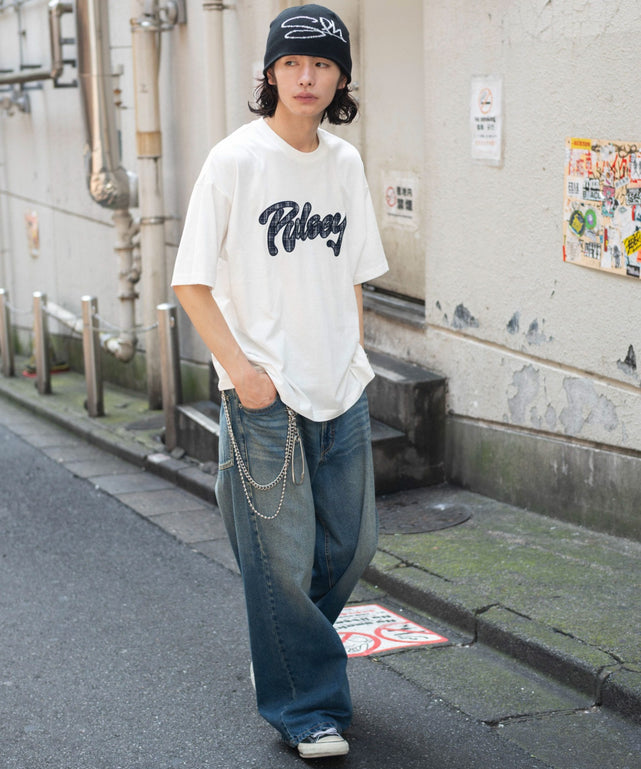
Oversized Graphic Tee With Baggy Jeans
Use a washed oversized graphic T-shirt with dropped shoulders, loose blue denim, and thick-soled sneakers. The broad shirt extends through the upper arm, and the wide jeans continue that scale below the hip. A front or back graphic gains enough surface area to remain visually clear.
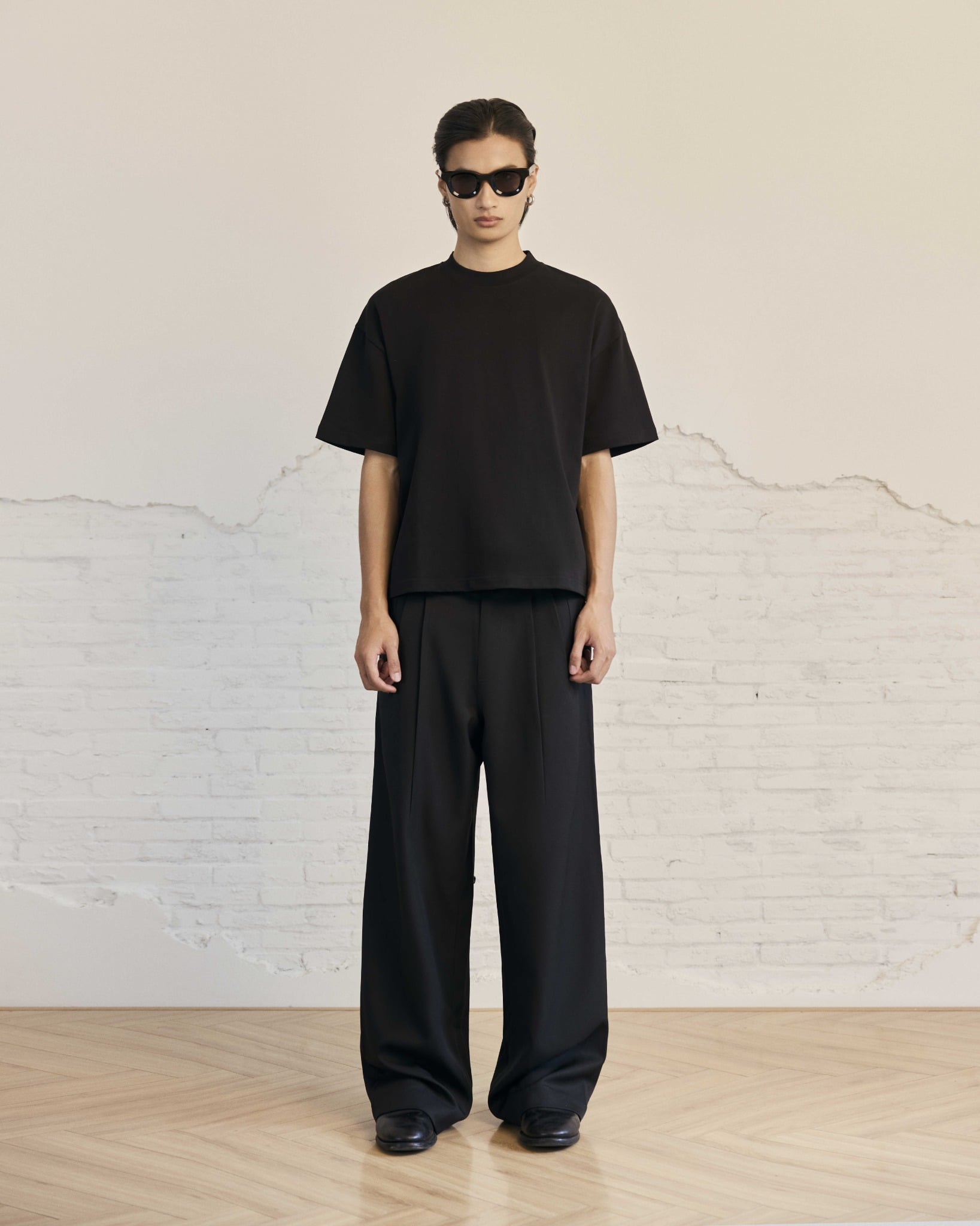
Boxy Heavyweight Tee With Wide Trousers
A short boxy tee in dense cotton works especially well with high-rise wide trousers. The shirt finishes close to the waistband, exposing more of the trouser from hip to shoe. Leather sneakers give the lower edge a cleaner finish.

Baby Tee With Low-Rise Jeans
Pair a fitted baby tee with low-rise loose jeans and slim retro sneakers. The short body leaves visible space around the waist, and the denim begins lower on the hips. A small center graphic suits the compact front panel.

Vintage-Wash Tee With Faded Denim
Choose a charcoal or brown washed tee with faded straight jeans, suede sneakers, and a worn leather belt. Similar softened surfaces connect the pieces through texture and color.
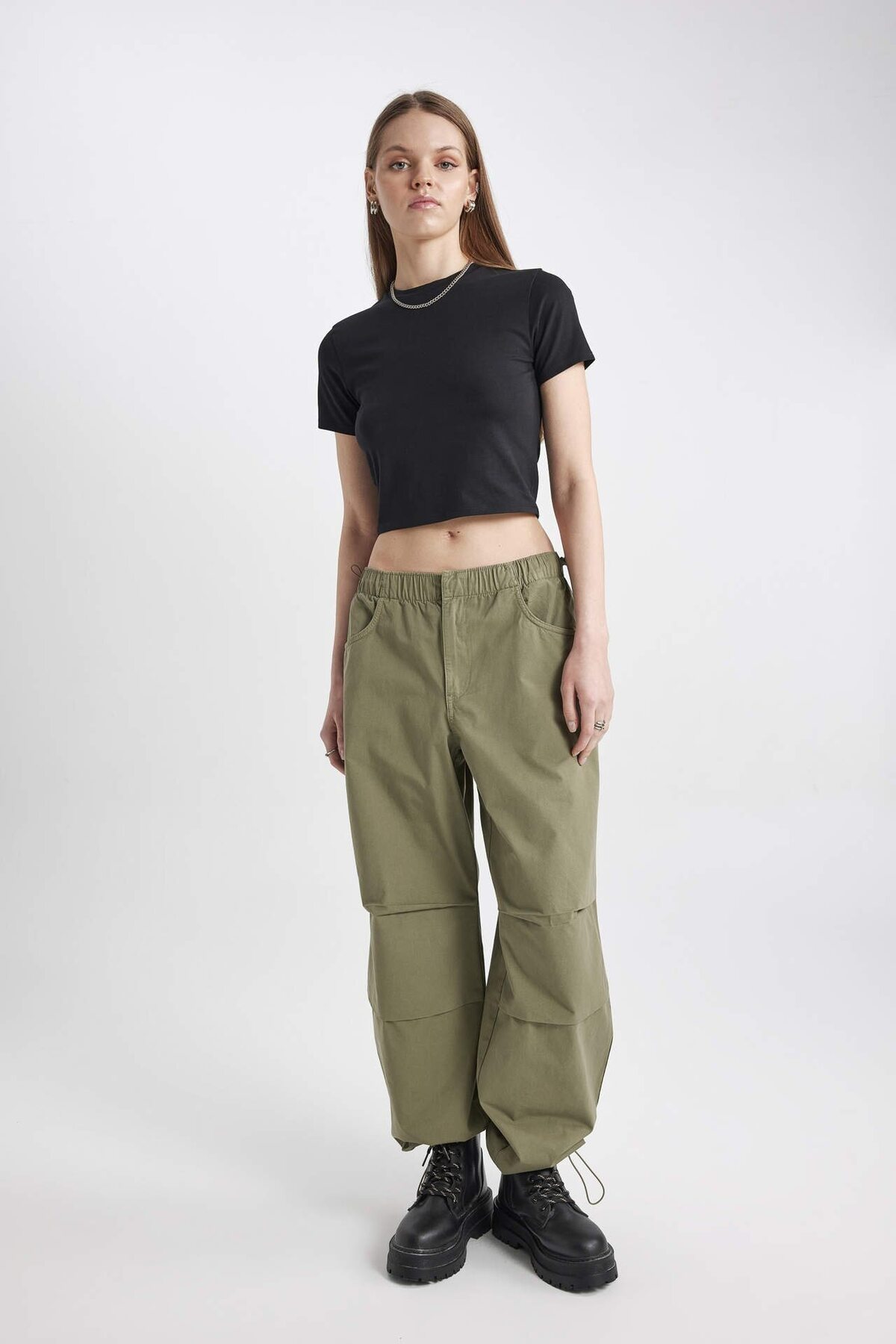
Fitted Tee With Cargo Pants
A fitted short-sleeve tee above wide cargo pants gives the torso a close shape and lets the large trouser pockets occupy more visual space. A compact shoulder and narrow sleeve opening keep the top clean.

Ringer Tee With Flared Jeans
Use a cream ringer tee with dark contrast collar and sleeve bands, blue flared jeans, and retro sneakers. The outlined neckline and sleeves bring a clear 1970s sports reference into the outfit.
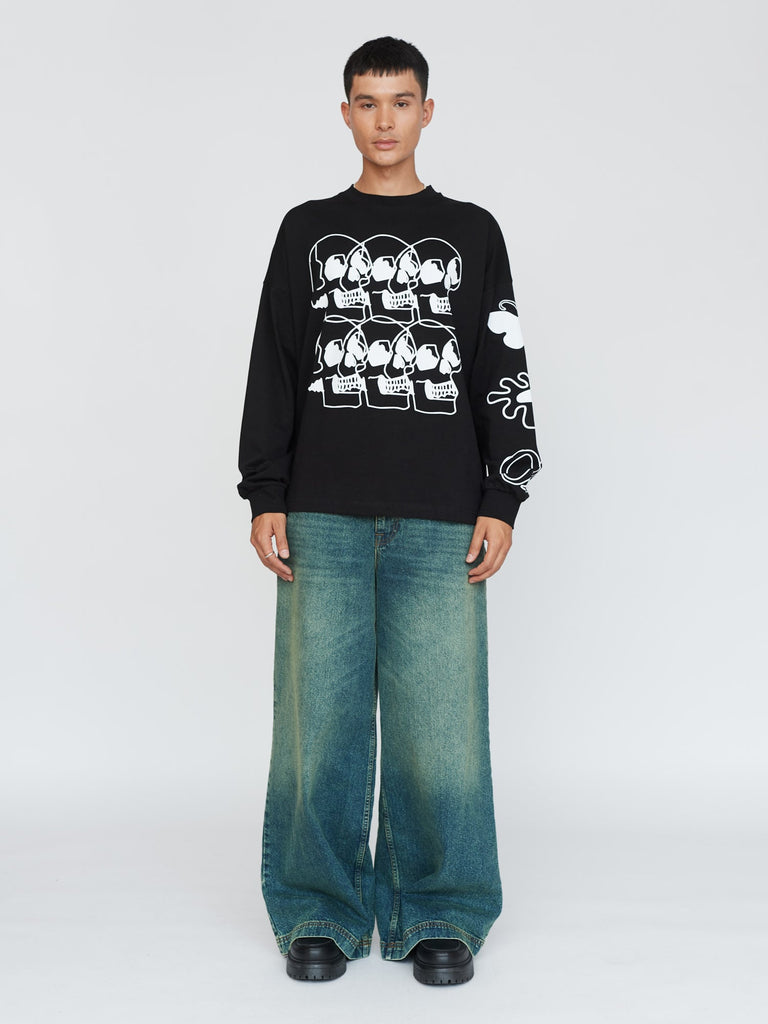
Long-Sleeve Graphic Tee With Loose Denim
A heavyweight long-sleeve graphic shirt, loose faded denim, and skate shoes creates a full streetwear outfit with substantial fabric from shoulder to wrist. Sleeve graphics add detail along the arms when the chest remains relatively simple.

Muscle Tee With Wide Cargos
A washed sleeveless muscle tee paired with large cargos gives the upper body width through the shoulders and body while keeping the arms exposed. Heavy cotton holds the armhole and shoulder shape clearly.
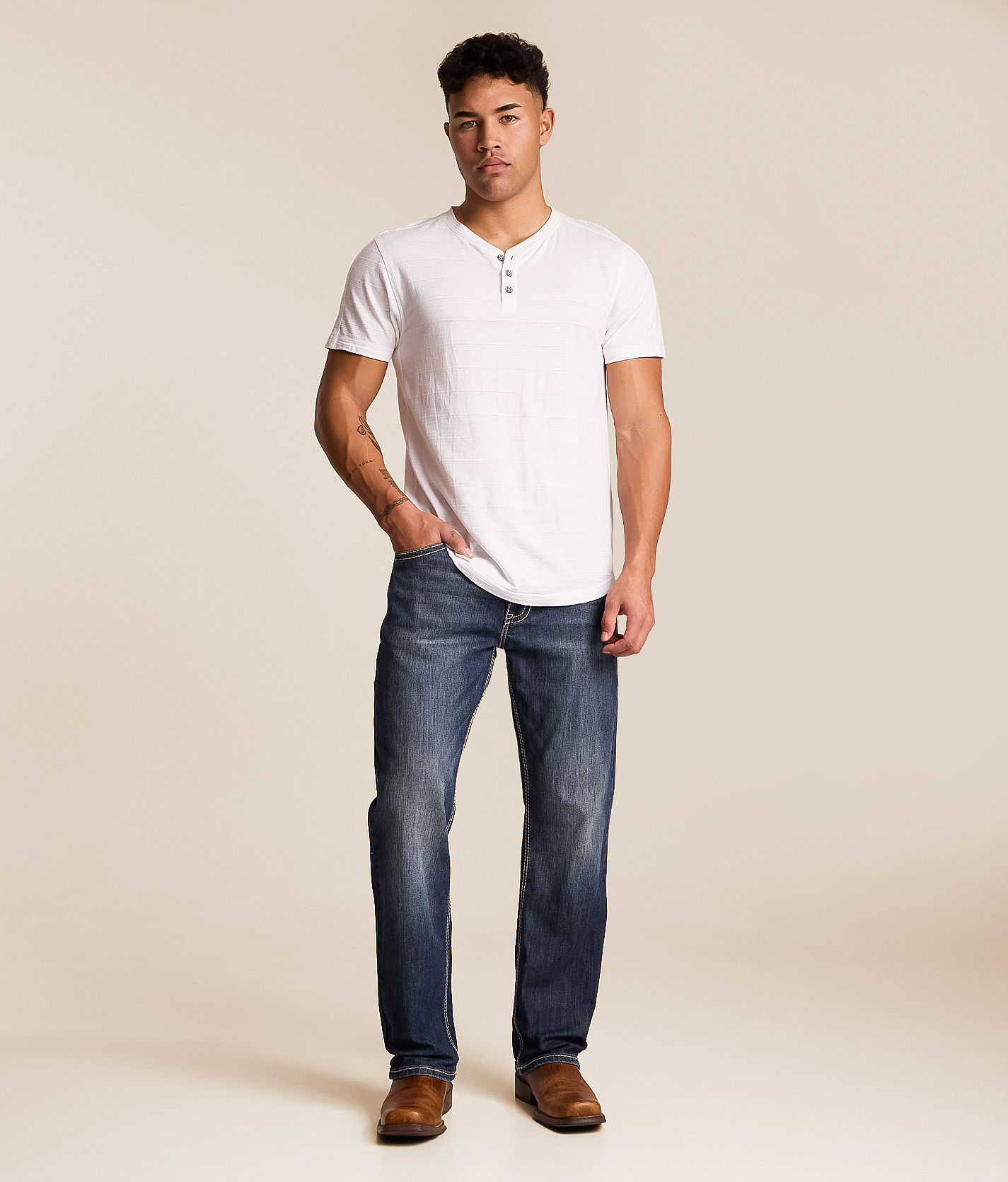
Henley With Straight Jeans
Choose a short-sleeve Henley in textured cotton, straight indigo jeans, and low-profile sneakers. The button placket supplies enough detail for a plain shirt and draws the eye vertically through the center chest.
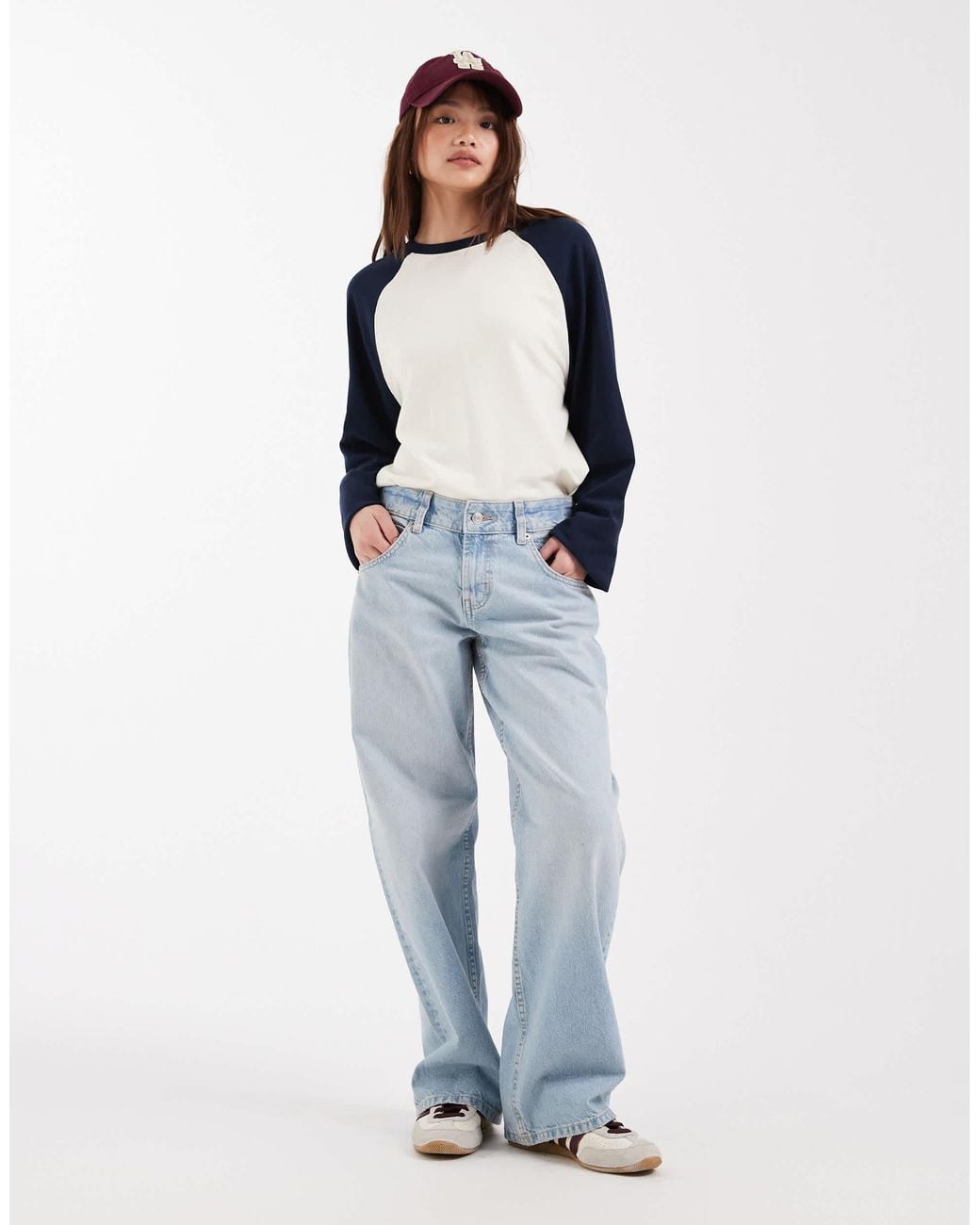
Raglan Tee With Retro Denim
A cream body with dark raglan sleeves works naturally with straight faded jeans and vintage running shoes. The diagonal sleeve seams create a clear sports-derived upper-body shape.
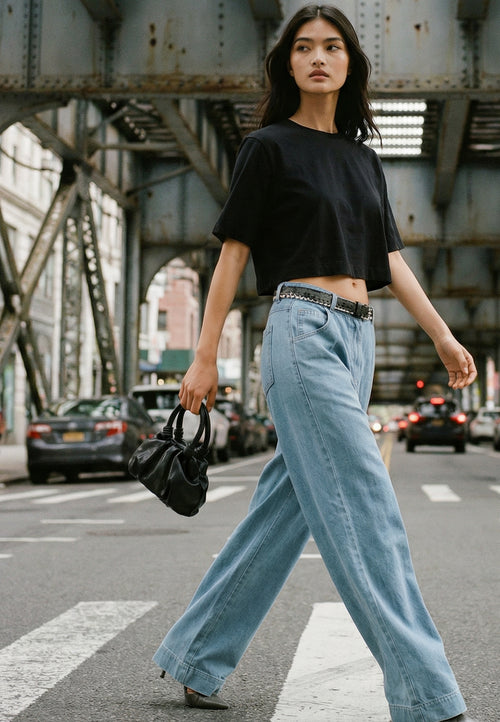
Cropped Boxy Tee With Wide Jeans
Use a short wide tee that finishes around the waistband of high-rise baggy denim. The shirt creates width at the shoulders and chest, then ends early enough to reveal the full rise and upper-leg shape.
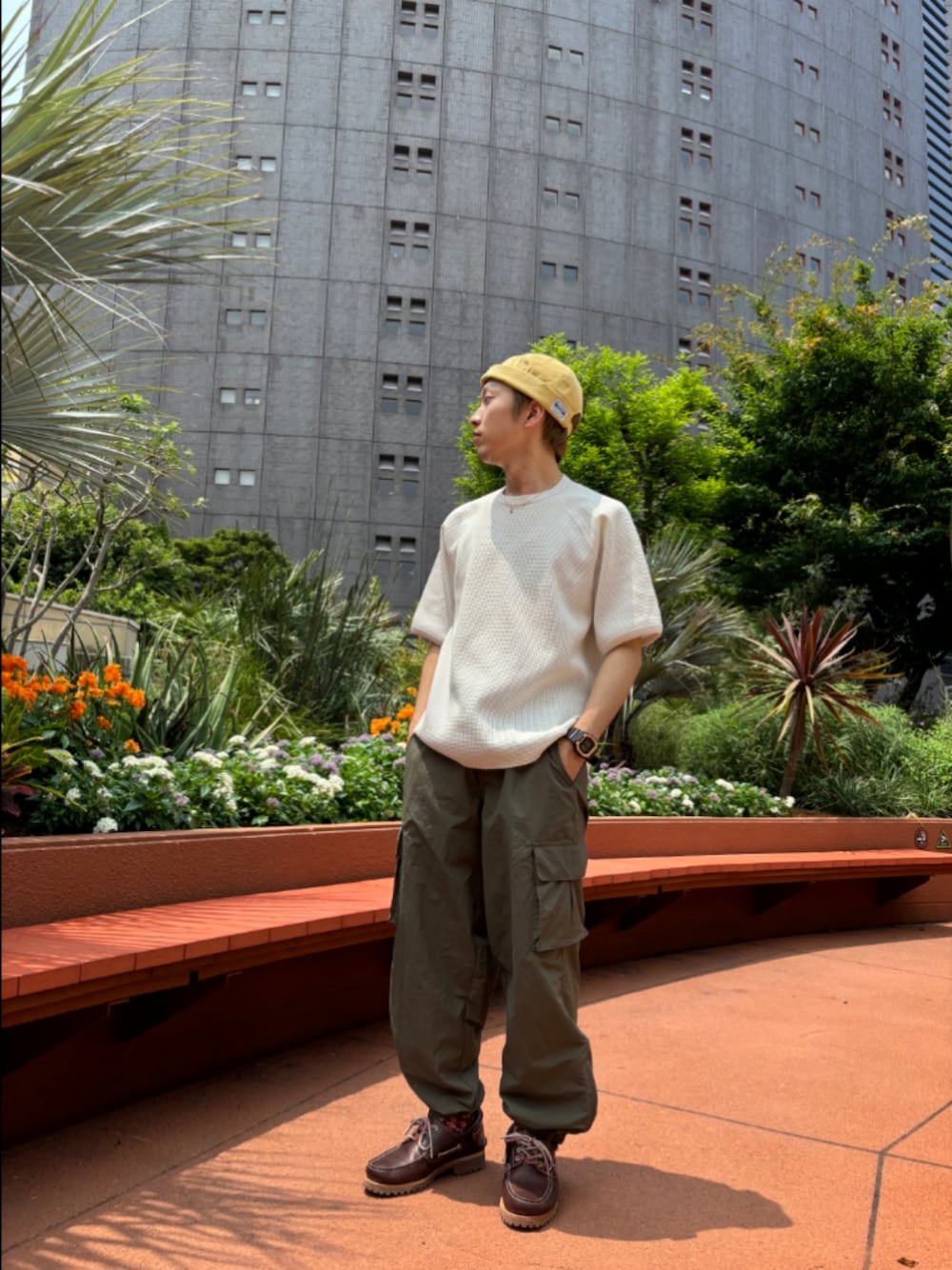
Waffle Tee With Washed Cargos
Pair a textured waffle-knit T-shirt with loose washed cargos and simple sneakers. The fabric grid creates surface depth across a solid-color shirt, allowing the outfit to carry detail through material rather than relying entirely on print.
What Actually Separates One T-Shirt Type From Another
When you look at a T-shirt, start with its physical shape.
Find the neckline.
Locate the shoulder seam.
See where the sleeve ends.
Look at the amount of fabric across the chest.
Check where the hem reaches on the body.
Look at the lower edge.
Then look closely at the fabric surface and decoration.
Those observations can turn a vague product description such as “black T-shirt” into something much more precise:
washed black heavyweight oversized crew-neck T-shirt with drop shoulders, elbow-length sleeves, and a large back graphic.
That description tells you how the shirt is likely to occupy space around the neck, shoulders, arms, torso, and hips before the rest of the outfit is even added.