The strengths of clothing made in China.
The advantage sits in the production base behind the garment: fabric, knitting, components, cutting equipment and suppliers that can work across those stages.
4.0 / 5 MOQ competitiveness 4.0 / 5 flexibility & agility 4.3 / 5 sourcing cost 3,000+ yarn selections in one Dalang showroom
China’s clothing industry includes yarn spinning, fabric production, dyeing, garment assembly and component manufacturing. A clothing brand can source several stages of a product’s development within the country. In the 2026 U.S. Fashion Industry Association benchmarking study, buyers rated China highest among the surveyed sourcing destinations for vertical integration—the availability of textile production within the garment supply chain.
Fabric Supply Extends Through Dyeing and Finishing
Shaoxing shows how fabric trading, textile production and finishing can sit inside the same regional industry.
In Shaoxing, Zhejiang, the textile industry runs from fiber production through weaving, dyeing and finishing to apparel and home textiles. These operations are established within the same manufacturing region, according to the provincial government’s February 2026 industry account. A garment developer looking for cloth can investigate the companies that weave it and the processors responsible for its color and finish.
The distinction matters when the available fabric comes close to a design requirement but still needs development. The base construction, printed design and surface finish involve different production decisions. Access to those suppliers gives the developer a route to investigate each change before committing to a garment sample.

Keqiao’s May 2026 textile exhibition brought these activities together in identifiable sections: fabrics, fashion design, clothing, textile machinery, dyeing and finishing technology, and fiber and yarn materials. Concurrent exhibitions covered printing equipment and garment supply chains. That arrangement allowed buyers to discuss cloth, processing and garment production during the same sourcing visit. The event information was published by the Keqiao district government.
The selection also includes overseas materials offered through the Chinese market. Intertextile Shanghai’s spring 2026 program featured regenerated-cellulose fabrics, wool, acetate, denim, functional textiles and accessories from Chinese and international exhibitors. A manufacturer sourcing in China can therefore compare domestic textile production with imported yarns and fabrics available through those suppliers.
Knitwear Can Be Shaped During Knitting
Sweater production begins with yarn, gauge, stitch structure and shaping—not with a cut piece of finished fabric.
The small shaping marks beside the seams of a fully fashioned sweater come from the knitting process. Its front, back and sleeves are knitted to predetermined shapes, then linked together. Flatbed knitting also allows some pockets and trims to be formed within a panel, reducing the number of separately attached pieces. Woolmark describes these construction methods and the production possibilities attached to them.
Computerized knitting adds control over stitch density, shaping and yarn placement. SHIMA SEIKI’s technical documentation describes equipment that can place different yarns on selected areas and transfer stitches to create different structures. Those controls are relevant to a sweater with shaped shoulders, textured panels or a pattern knitted into the fabric.
Dalang, in Dongguan, has an established supply base for this work. Its local textile network’s showroom held more than 3,000 yarn selections from over 500 source businesses in November 2025, according to a municipal report. The displays included knitted material samples and yarn color cards, allowing visitors to examine the yarns alongside examples of their appearance in fabric.
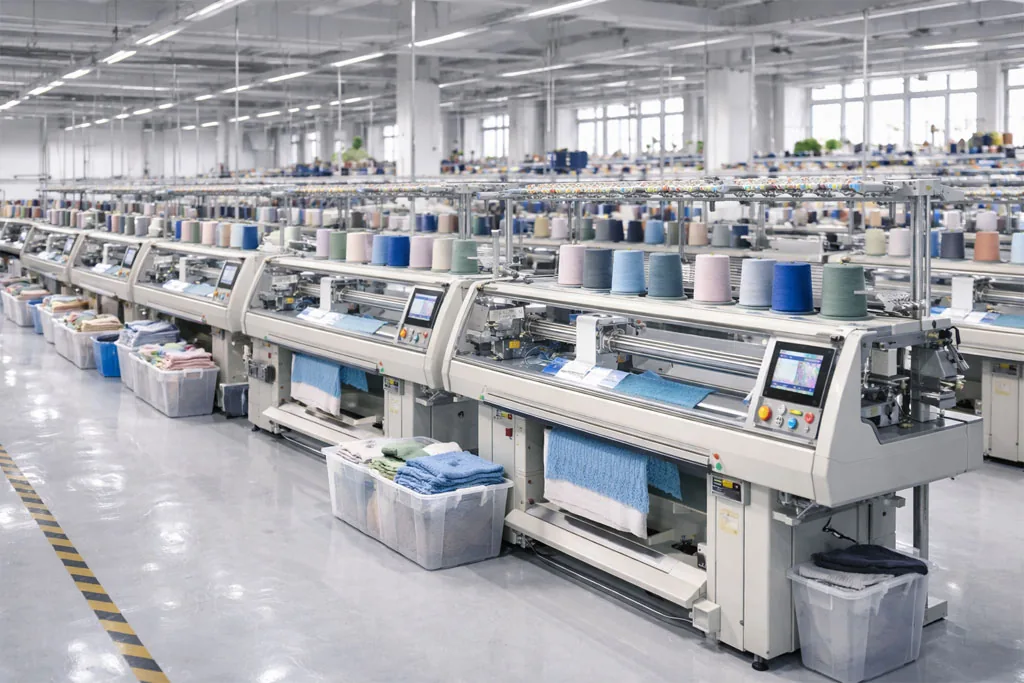
A yarn choice can be checked against the machine and stitch structure that will actually produce the sweater. The developer can review color, surface, stitch definition and panel shape together before the bulk knitting program is fixed.
A buyer interviewed by Dalang’s local broadcaster in 2024 described previously driving between individual suppliers to find yarn. Bringing their materials into one showroom allowed her to compare new products in a single visit. The local-government report records that sourcing experience directly.
The town’s machinery trade also covers whole-garment production. At its June 2026 knitwear exhibition, manufacturers demonstrated computerized flat-knitting and seamless garment equipment. Whole-garment machines can produce the body and sleeves together, with little or no subsequent linking or sewing; the selected equipment determines which constructions a workshop can offer. The event was reported by the Dalang government.
Chinese Mills Develop Fabrics for Specific Uses
The manufacturing base includes mills working on the fabric itself, not only factories cutting cloth that already exists.
Nanshan Fashion in Shandong operates across worsted fabrics and finished clothing. Its published business scope includes textile research, design, production and garment manufacturing. One of its documented developments with Woolmark is OPTIM, a wool fabric technology intended for wind- and water-resistant clothing. Nanshan describes its broader textile operation on its corporate site.
OPTIM begins with Merino wool fibers that are stretched before spinning. The yarn is woven into fabric, then subjected to wet finishing. During that finishing stage, the stretch is released and the yarn contracts, tightening the woven structure. Woolmark attributes the fabric’s wind and water resistance to this dense construction.
- OPTIM Classic — plain weave
- 180 g/m²
- OPTIM Classic — warp rib
- 240 g/m²
- OPTIM Classic — gabardine
- 265 g/m²
The listed applications include suits, jackets, blazers and trousers. Each construction gives a developer a specific fabric to evaluate, with an identified weight and weave. The published specifications appear in Woolmark’s OPTIM technical material.
Development has also extended into different garment surfaces. Woolmark describes an OPTIM Double range with a compact outer face and a brushed inner face, intended for winter jackets and coats. Its Fancy range includes satin, seersucker, stripes and other textured constructions. These variations change the available appearance and structure while retaining the underlying fiber-processing technology.
Cutting Equipment Can Improve Consistency Across an Order
Before sewing can be consistent, the pieces entering the sewing line have to match the approved pattern.
At Ese.Y, a women’s trouser manufacturer in Zhengzhou, the cutting room was part of an effort to accommodate more varied production. Lectra’s published customer study describes the company replacing less consistent cutting with its Vector equipment. The supplier reported that manually cut pieces could vary by several millimeters and that the automated system produced more standardized pieces for sewing.
The reported improvement concerned the material entering the sewing operation. More consistent cut pieces reduced irregularities that operators otherwise had to handle during assembly. Lectra also reported reduced fabric waste and attributed part of the saving to cutting pattern pieces with less space between them. These results belong to the named factory and its equipment supplier’s account.
Ese.Y connected the investment to smaller-batch production and changing demand from its online business. Its management reported that the revised cutting operation made it easier to adjust production as orders changed. The case shows a factory applying automation to product variety as well as output volume.
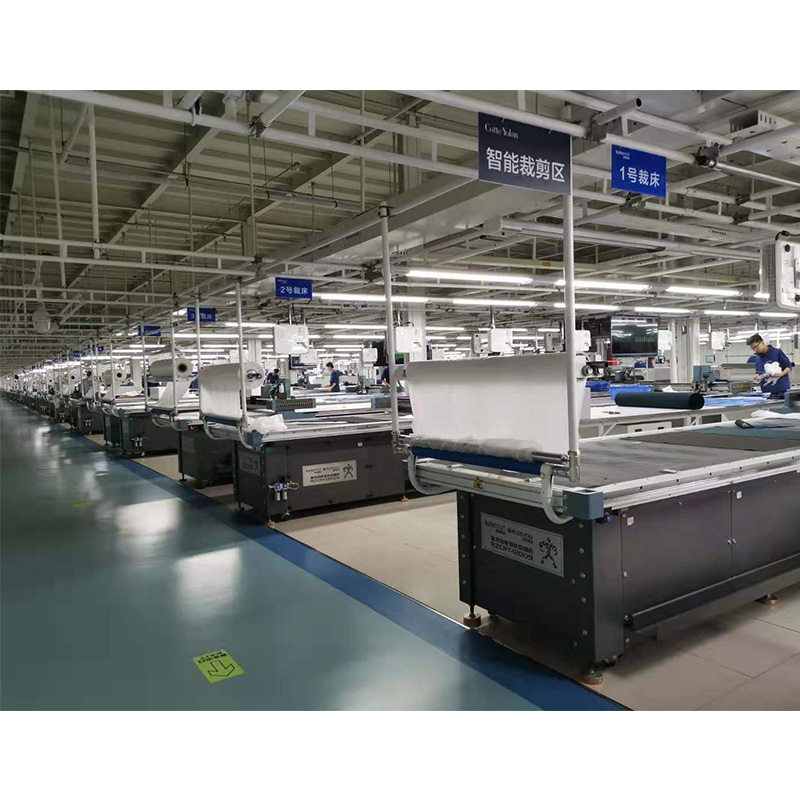
Investment in Chinese production facilities continues beyond that case. Shenzhou International’s 2025 annual report states that its Ningbo garment factory completed refurbishment, added automated equipment and revised its assembly-line layout. The report separately identifies an ongoing technological transformation at the group’s Anhui garment base. These are specified investments at production locations in China.
Buyers Report Competitive Order Minimums and Production Costs
The 2026 USFIA results record how U.S. fashion companies rated China against other sourcing destinations.
USFIA surveyed executives from 30 U.S. fashion companies between April and June 2026. Respondents gave China a score of 4.0 out of 5 for minimum-order competitiveness and 4.0 for flexibility and agility, the highest ratings among the destinations surveyed in both categories. Its sourcing-cost score was 4.3, equal to Bangladesh’s score in the study. The figures come from the 2026 USFIA Benchmarking Study.
The study defined flexibility through the ability to adjust an order’s delivery, volume or product when customers request changes. Its minimum-order score reflects buyers’ experience across suppliers; the report sets no countrywide minimum in garment units. Respondents also identified labor-compliance and trade-policy risks alongside those manufacturing strengths.
Fastenings Can Be Matched to the Fabric
The supply base includes specialist component companies whose products affect the way the finished garment sews and hangs.
YKK’s Shenzhen operation has manufactured and sold zippers since 1998. Its product categories include zippers, plastic components, snaps and buttons, placing an established fastening supplier within China’s clothing manufacturing base. The product categories are listed by YKK Shenzhen.
One product in YKK’s China collection addresses a visible problem in lightweight clothing: puckering beside a sewn zipper. The NATULON Plus coil zipper with puckering-resistant lightweight tape uses a modified tape construction intended to reduce creasing after attachment. YKK describes its chain as lighter and softer than its standard size-three coil zipper and identifies lightweight garments as an intended application in its digital showroom.

- For the size-three version, YKK recommends placing the sewing line 3–7 millimeters from the edge of the zipper elements.
- The product guidance calls for a sewing trial at the garment factory before bulk use.
- YKK notes that the recycled yarn can produce a slightly different shade from standard zipper products, particularly in light colors.
The factory can evaluate the tape, color and stitch placement together on the intended cloth before using that fastening throughout the order.