Types of Blouses: 22 Styles, Fits, Fabrics, and Outfit Ideas
A blouse is a women’s top, usually made from woven fabric and shaped with seams, darts or gathers. It can have a buttoned front, a tied waist or a neckline wide enough to pull over the head. Bow-neck blouses, peplums, peasant tops and puff-sleeve styles are familiar examples, worn with skirts, tailored trousers or jeans.
A cropped satin blouse may also have a cowl neck and a sleeveless cut. Those names identify its length, fabric surface, neckline and sleeve arrangement.
1. Bow-Neck Blouse
The long ties on a bow-neck blouse extend from the neckline. Once knotted, their loops sit below the chin and the ends fall over the chest. The same design is sold as a tie-neck or pussy-bow blouse.
On the ivory silk blouse pictured, the bow continues the fabric of the body. Its folds catch small bands of light around the knot. The soft silk lets the bow ends hang against the chest. Tie width also matters. A broad tie folds over itself as it tightens, leaving a substantial knot at the throat.
An ivory bow above a burgundy pencil skirt puts the lightest fabric close to the face. Tucking the blouse into the skirt leaves the bow ends visible against a smooth front. Burgundy slingbacks carry the skirt color down to the feet.

2. Button-Front Blouse
A white silk blouse tucked into a black midi skirt has the outline of a shirt and the movement of a light woven fabric. The sleeves fall in narrow folds above the cuffs. Black pointed-toe shoes leave the skirt’s calf-length hem and the exposed ankle clearly visible.
The front placket carries the buttons and buttonholes. In LILYSILK’s concealed-placket shirt, a fabric fold covers the mother-of-pearl buttons. The collar, cuff openings and curved shirttail remain part of the familiar shirt construction.
Back-yoke pleats can add room across the shoulder blades. Bust darts and vertical seams shape other button-front blouses closer to the body.
A small slit above each cuff opens the sleeve far enough for the hand to pass through. Buttons fasten the cuff around the wrist.

3. Wrap Blouse
Two front panels cross over the bust and meet at the waist. The overlap forms a V neckline, with a diagonal edge running toward the fastening. A true wrap opens through the front and closes with ties, buttons or another fastening.
The fastening inside the blouse holds the underneath panel in place. An outer tie then secures the overlapping panel at the side or around the waist. The pictured Adira blouse uses an attached waist tie, with lace following the edge of the neckline.
Surplice describes the crossed neckline itself. A sewn-down surplice front keeps that overlap in a fixed position and may use a side zip for dressing. On an adjustable wrap, the tie position and the amount of fabric crossing the bust work together: the panels need enough width to cover the chest at the intended waist fit.

4. Peplum Blouse
A peplum begins where a fitted bodice opens into a flared or gathered lower section. The seam usually follows the waist, and the added fabric spreads over the upper hips. On the plum brocade example, gathers concentrate the volume just below that seam. The floral pattern continues through the flare.
The hem is part of the shape and sits outside the waistband.
A matching skirt carries the brocade below the peplum, creating an uninterrupted field of color through the outfit. With cream straight-leg trousers and plum pumps, the flared edge becomes easier to see against the pale fabric at the hips. Peplum length sets how much of the trouser front remains visible.

5. Cropped Blouse
A cropped blouse can meet a high-rise waistband and cover the waist completely. The hem and trouser rise determine how much skin shows between them.
Cropped names the body length. The white shirt pictured combines that short body with a boxy cut, long cuffed sleeves and a chest pocket. Its straight lower edge sits across the top of the jeans. Extra width through the torso lets the fabric hang away from the waist.
Shoulder-to-hem length gives a more specific indication of where a crop will land. The measurement starts at the high shoulder point beside the neck and runs down to the front hem. An uneven hem also needs its shortest front length recorded.

6. Peasant Blouse
Small gathers around an open neckline release fabric down the chest. The body falls loosely from them, often with similarly full sleeves. This gathered construction is central to the peasant blouse.
The peach blouse pictured is Seamwork’s Dara, a chemise-style pattern with raglan sleeves and a bound, gathered neckline. Its sleeve seams run diagonally toward the neck. The fabric has room through the upper arm, then gathers again at the sleeve end. Tucked into high-rise jeans, that extra body fabric settles above the waistband. The slightly flared denim and black boots continue the loose line below the hips.

7. Smocked Blouse
The rippled surface across a smocked bodice comes from fabric gathered into closely spaced rows. In many contemporary retail designs, elastic shirring creates this texture. The elastic draws the cloth inward and stretches with the body. Machine shirring uses elastic thread in the bobbin. Traditional embroidered smocking secures prepared pleats with decorative stitches. Both appear under the broader smocked-blouse name.
On the floral Remira top, shirring covers the bust and ends above a small peplum. The densely gathered panel fits close to the torso. Below the final row, the fabric opens into a loose hem over the trousers.
Shirring also appears in bands at the cuffs or back waist, drawing in the fabric within each stitched panel.

8. Off-the-Shoulder Blouse
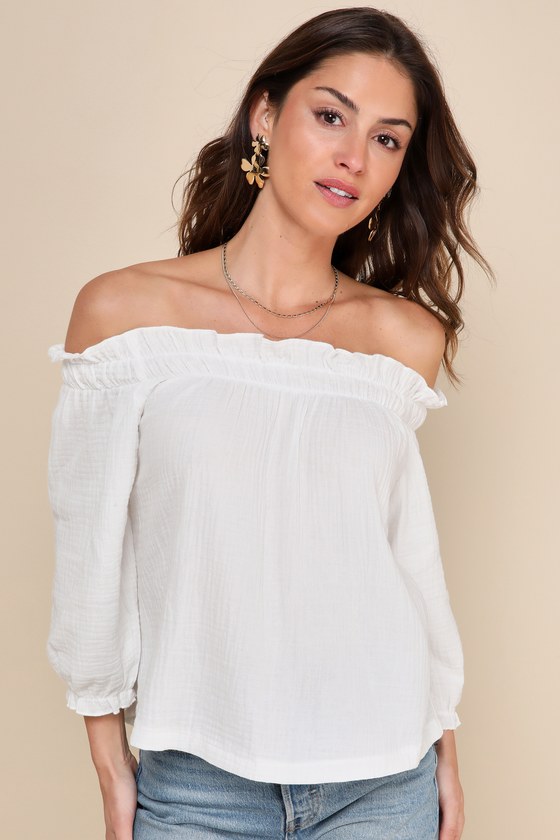
An off-the-shoulder blouse places its upper edge below the shoulder points, exposing the collarbones and tops of the arms. Elastic gathered into a channel can hold a soft woven version around the body. A folded band across the upper chest creates the broader neckline often called Bardot.
In the white cotton example, the opening gathers into a narrow frilled edge. The three-quarter sleeves begin beside the upper arms and finish with elasticated cuffs. Lifting the arms can move that shared neckline upward, so the elastic’s extension is part of the blouse’s fit. Its relaxed body leaves room below the bust for the fabric to fall toward the hem.
9. Halter Blouse
A pale pink halter blouse, matching wide-leg trousers and flat leather sandals make a light summer outfit. Gathers at the front neck release into vertical folds, carrying the pink down the torso. The exposed shoulders leave the gathered neckline clearly outlined.
The halter’s support comes from fabric or a strap that passes around the neck. On the pictured Wren top, a tie closes the neckline. The armholes curve deeply toward it, leaving the shoulder area open. Other halter blouses fasten at the back neck with buttons or a clasp.
Tie length affects where the front neckline sits. Shortening the tie raises it and lifts the armholes with it.

10. One-Shoulder Blouse
A diagonal neckline travels from one shoulder across the upper chest, leaving the other shoulder bare. The cream blouse pictured follows this slope with two soft ruffles. One side rests on the shoulder; the ruffled edge drops over the opposite upper arm. Under those ruffles, the body hangs in a loose, straight cut. A one-shoulder design can also include a single long sleeve, which adds fabric down the covered arm and continues the asymmetry toward the wrist.
The covered shoulder and the upper edge across the chest hold the blouse in position. In fitted woven versions, a side zip gives access through the narrower part of the body. The neckline facing or lining follows the diagonal edge on the inside.

11. Cowl-Neck Blouse
A cowl is a loose fold of fabric that hangs below the neckline.
The black Serena blouse gathers one shoulder into gold hardware. From that point, the satin falls across the chest and into the cowl. Extra width in the front allows it to fold inward under its own weight. Light catches the upper edge of the fold, and a shadow forms inside it. The hardware fixes a small part of the cloth at the shoulder; the rest hangs below that point. The depth of the opening comes from the pattern’s added fullness and the way the material drapes.

12. Square-Neck Blouse
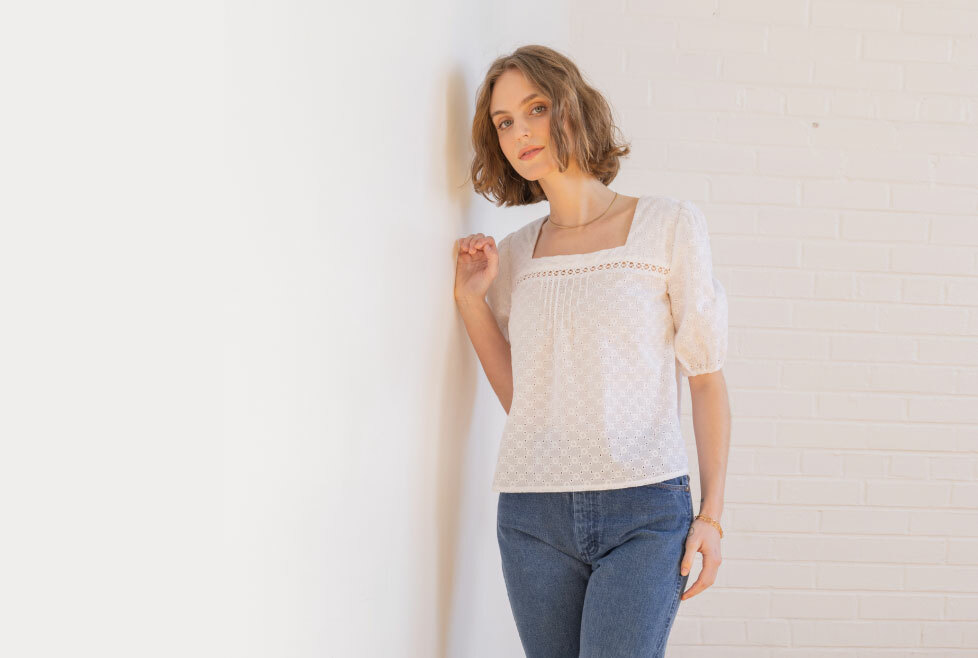
A horizontal front edge meets the sides of the neckline at distinct corners. Width sets how much of the upper chest the square exposes; depth sets how far the bottom edge sits below the collarbones. Wide shoulder sections can carry this shape into a sleeved blouse.
On Seamwork’s Bloom, a square neckline appears at both front and back. Trim follows the yoke seams, making the horizontal line easy to see. The bodice’s pintucks and the gathered sleeves sit below and beside that frame. A facing, binding or lining finishes the neckline on the inside and supports the shape of the corners.
13. Peter Pan Collar Blouse
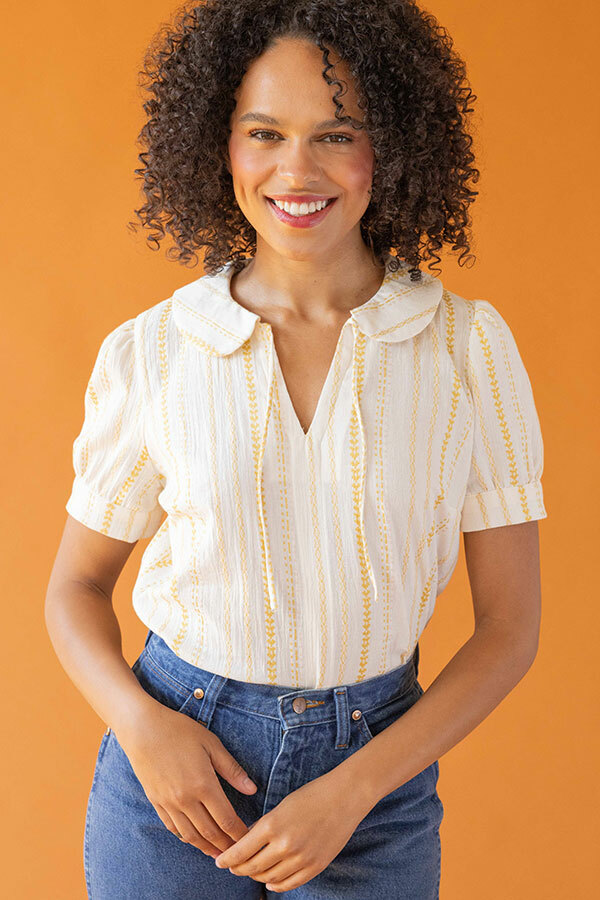
The Romie blouse pulls on over the head. A notch at the front neck opens between two narrow ties.
A rounded collar lies flat on either side of that opening. Its curved ends give it the Peter Pan name. The outer edge continues over the shoulders and around the back neck, covering the join between the neckline and collar. On this version, the narrow ties emerge beneath its front ends.
The pale collar crosses the vertical stripes of the body. Bust darts shape the fabric below it, and bands finish the short gathered sleeves. The collar itself has an upper layer and an undercollar joined around the curved outer edge, with the seam enclosed between them.
14. Puff-Sleeve Blouse
Gathers push a puff sleeve upward at the shoulder and round it out around the upper arm. The sleeve’s lower edge draws back toward the arm through elastic, a band or a cuff.
The ivory blouse pictured puts this volume above the elbow. A raised sleeve cap gives the shoulder a small lift, then the fabric settles into short folds around the elasticated opening. A crisp cotton poplin can support the sleeve’s rounded outline. The amount of fabric gathered into the shoulder seam sets the fullness above the arm.
Its body has a gathered front and a curved, uneven hem. The blouse’s shorter center front leaves the trouser waistband visible between the lower points.

15. Bishop-Sleeve Blouse
On the polka-dot blouse, the spots crowd together immediately above each cuff. A wide sleeve has been gathered into a much narrower wrist opening.
This full lower sleeve, held at the wrist by a fitted cuff, is a bishop sleeve. The example comes from Simplicity S3195. Its fabric expands below the elbow and settles into folds above a deep buttoned cuff. The cuff opens far enough for the hand to pass through. Fastened around the wrist, it supports the extra length as well as the width of the sleeve.

16. Bell-Sleeve Blouse
The lower part of a bell sleeve opens outward around the forearm and wrist. Its hem hangs freely, producing a wide opening around the hand.
Bell sleeves can be cut with a flare running down the sleeve itself. A circular or shaped lower panel creates a separate flounce when joined near the elbow. In the pictured Megan Nielsen Dove blouse, the large lower panels fall into deep folds. Their broad hems move away from the arms as they swing.
Dove’s V neckline and French darts shape the body above a curved hem. A French dart angles upward from the lower side of the bodice toward the bust, taking up fabric through the waist and lower chest.

17. Ruffle Blouse
The light blue blouse pictured has ruffles along the shoulders and across the upper chest. They sit above a panel of vertical pleats, with lace outlining the edges. Because the fabric stays within one color, the raised layers show through their shadows.
The shoulder ruffles extend beyond the armholes and act as short sleeves. White shorts leave the blue hem visible across the hips. White canvas sneakers finish the outfit with the same light color below the knees.
Placement changes how a ruffle sits on the blouse. Sewn around an upright collar, a narrow gathered strip can stand close to the jaw. Along a front seam, it falls down the chest. The edge remains free, so the fabric can turn outward and expose both faces as it moves.

18. Pintuck Blouse
Pintucks are narrow folds stitched close to their edges. Rows of them create raised lines on the fabric. Seamwork’s pintuck tutorial describes stitched widths of 1/16 to 1/8 inch, roughly 1.6 to 3.2 mm.
On this white blouse, the folds run beside the button placket and finish above the lower hem. The cloth opens out beneath their ends, leaving room around the hips. The covered buttons add a second line of small raised shapes down the middle. The tucks take up some of the original fabric width along the upper body; their stitched ends determine where that width is released.

19. Lace and Eyelet Blouse
Flowers and leaves form the surface of the black lace blouse. Open spaces separate the motifs, showing the layer beneath through the torso and sleeves. Its scalloped hem follows the edge of the pattern, and small frills finish the neckline and sleeve openings.
A black camisole makes a solid area through the body, leaving the lace openings along the arms exposed.

The white eyelet blouse uses a fabric with embroidered openings, often called broderie anglaise. Dense stitching surrounds each small cutout and secures its edge. Round floral openings cover the sleeves and body, and scalloped embroidery follows the hem. Along the upper edge of the square neckline, a narrow floral trim continues the open pattern. A separate lining supplies coverage through the bodice.

20. Sheer Blouse
The floral blouse has a lined body and translucent sleeves. At the armholes, the lining ends and skin becomes visible through the printed cloth. The flowers continue across both areas, with the pale lining providing a solid background through the torso. Fabric gathers into the cuffs, where several layers overlap and the print appears denser. The button placket makes another opaque strip down the front.
Sheer describes this transmission of light through the cloth. A separate camisole lets its color become visible beneath an unlined body.

21. Tunic Blouse
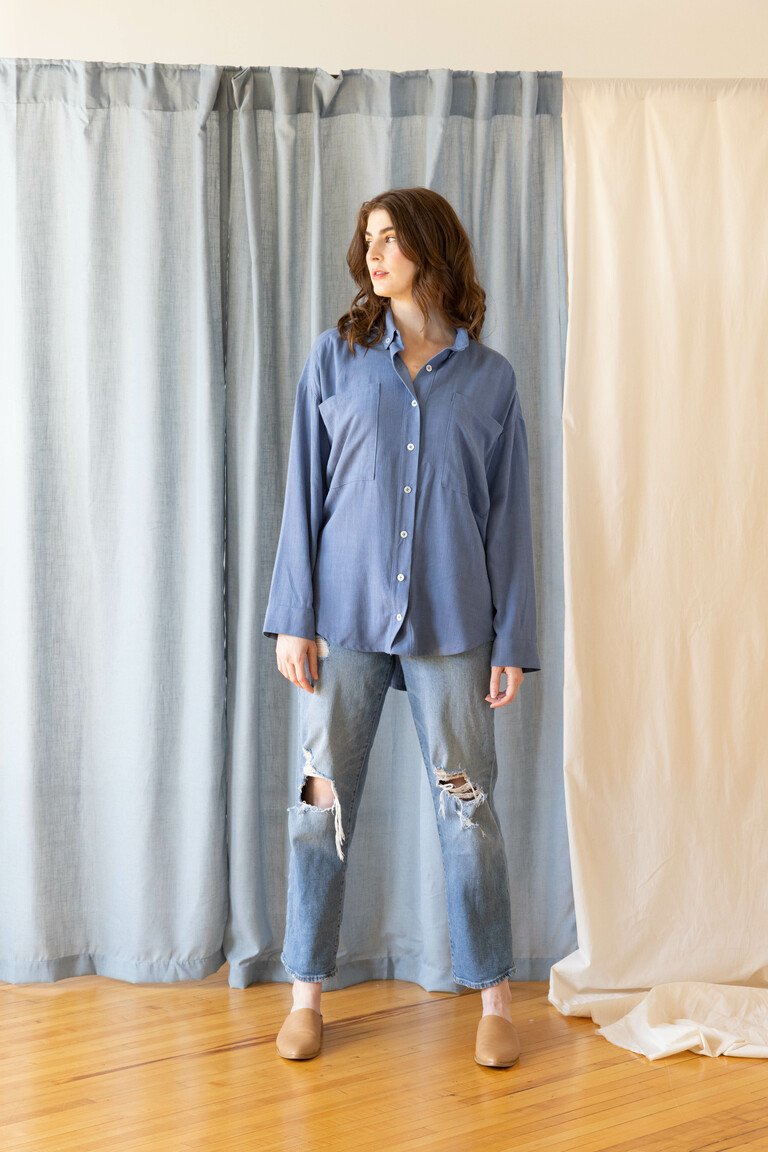
The lower buttons of a tunic blouse sit across the hips, with the hem continuing toward the thighs. The cut needs room around that part of the body as well as the bust. Side openings and curved shirttails let the lower edge separate as the wearer sits or walks.
A tunic-length blouse reaches below the hips, often to the upper or middle thigh. The blue Roan tunic has dropped shoulders and large chest pockets. Its long front covers the trouser waistband and much of the upper thighs. The rising hem at each side exposes more of the jeans around the outer leg.
Tunic blouses also appear with a short front placket and a pullover body. A long side slit opens the lower part of that body below the hip.
22. Sleeveless Blouse and Shell Top
Under an open blazer, a plain shell supplies a continuous area of fabric across the chest. A navy shell with a tan linen suit and brown leather pumps leaves the jacket lapels clearly outlined. A shell is a simple sleeveless blouse, often with a round neckline and a lightly shaped body. Its shoulder sections support the fabric, and the armholes follow the upper chest and back.
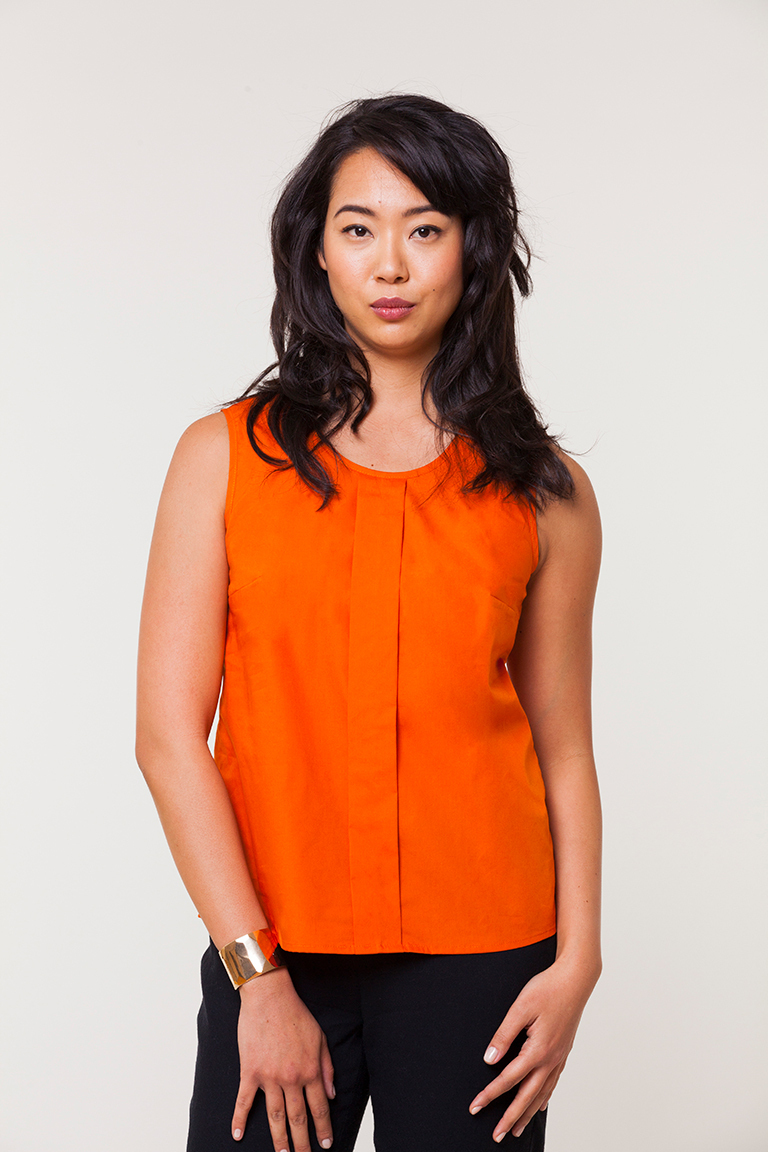
The orange Sorbetto has a wide box pleat down the front. It adds fabric through the center, leaving the body open below the neckline. Bust darts take up fabric at the sides. A narrow binding finishes the armholes, following their curves around the shoulders and underarms.
Blouse Fabrics and Their Drape
A silk satin blouse combines a silk fiber with a satin weave. Long yarn floats on a satin surface give it its smooth appearance and sheen. Fiber content, weave, fabric weight and finishing all contribute to the way a blouse hangs.
| Fabric | What It Adds to a Blouse |
|---|---|
| Cotton poplin | A smooth, closely woven surface that gives collars, puff sleeves and straight hems a crisp outline. |
| Cotton lawn or voile | Fine, lightweight cloth that gathers into small folds at necklines and cuffs. Pale, thin versions can show an underlayer. |
| Linen | Visible yarn texture and a body that suits loose shirts, square necklines and tunic shapes. Wear produces folds around elbows and waistbands. |
| Rayon challis | A soft drape that lets a gathered body settle close to the torso and gives full sleeves a fluid fall. |
| Satin or charmeuse | A smooth face with reflected light along folds, often used for bow ties, cowls and softly draped shirt blouses. |
| Crêpe de chine | A fine, lightly textured surface with a fluid drape, suited to blouses that hang loosely through the body. |
| Organza | A sheer, crisp fabric that supports raised ruffles and rounded sleeves. |
Blouse Fit and Measurements
Body bust circumference and finished blouse circumference describe two different measurements. The space between them is the garment’s ease. In a woven blouse, that extra room allows the chest to expand and the arms to move. The intended cut establishes how much fabric hangs around the torso.
A flat bust measurement runs from side to side across the fastened blouse at the specified level below the armholes. A width of 52 cm corresponds to approximately 104 cm around the garment. The measuring position matters on a blouse with low armholes or shaped bust seams, so the product’s measurement diagram identifies the line being used.
On the body, a button placket sits flat over the bust and the shoulder seams follow the intended shoulder position. Reaching forward uses the room across the back. Sitting shows where a fitted waist seam and a peplum rest. Smocked panels stretch around the body, and their relaxed and extended measurements describe that range.
For a tucked blouse, the fabric below the waistband needs enough length to stay inside it as the arms lift. On a tunic, the front and back hem lengths show how far the blouse will extend down the thighs.