Sublimation vs. DTF Printing for Custom Apparel
You can choose between sublimation and DTF for most custom orders from four facts about the garment: its fiber content, its color, the area the print has to cover and the way it will be worn.
A sublimation press heats disperse dye, the dye type used for polyester, on transfer paper to 190 to 205 °C (375 to 400 °F) and turns it into a gas. The gas enters polyester fibers and sets inside them as the fabric cools. Cotton fibers do not absorb these dyes. A DTF (direct-to-film) printer lays colored ink on plastic film and prints white ink over it. Hot-melt adhesive powder goes on top, and a heat press bonds the print to the garment as a thin, flexible film.

Sublimation vs. DTF by fiber content
Either method gives a full-color print on 100% polyester. Recycled polyester is chemically identical to virgin polyester and absorbs sublimation dye at full strength. Some polyester knits are finished to feel like cotton and are sold under names such as cotton-touch. They take sublimation dye like other polyester and suit an all-over printed tee that should feel soft. The heat press flattens the brushed surface of a polyester fleece hoodie under the print.
Cotton-polyester blends come off the sublimation press paler as the polyester share drops. Dye that lands on the cotton washes out when the garment is laundered. That faded look is the only reason to sublimate a blend. When a blend needs full color, DTF is the method. Garments of 100% cotton have to be printed with DTF.
Sublimation prints on nylon and polyester fabric reached fastness grades of 4 to 5 in a 2021 laboratory study. Fastness grades use a gray scale from 5, no visible change, to 1, severe change. Nylon jackets are often dark or water-repellent, though. Dark ones are printed with DTF. Water-repellent finishes weaken the bond of DTF adhesive. If you order DTF on such jackets, your supplier can peel-test one decorated piece first.
Sublimation vs. DTF by garment color
Sublimation has no white ink, and its colors are translucent enough for the garment color to show through. A blue design on a yellow polyester shirt comes out green. White areas of the artwork stay unprinted and take on the color of the fabric. You can sublimate pale blue, gray, tan and light pink polyester as long as the design is darker than the garment. Dark garments and designs that need white are DTF work. Sublimated garments in dark colors exist only as all-over prints on white polyester, and their white lettering is fabric that the dye never reached.
Some colored polyester fabrics lose color at sublimation temperature. The heated plate of the press leaves a faded rectangle on them. DTF is applied at a lower 150 to 165 °C (300 to 330 °F). Dyes in red and other dark polyester can move into the white layer of a DTF transfer under heat and tint it. Blocker transfers have a dark barrier layer under the white and an adhesive that bonds at a lower temperature. They hold this dye migration back. If your colored polyester has not been tested, your supplier can apply one blocker transfer to a sample garment before the order goes ahead.
Neon colors lie outside the range of standard inks for either method. Some sublimation and DTF printers add fluorescent inks for them. Photographs and soft gradients are sublimated onto white polyester without visible dots. These images show less fine detail in DTF.
Brand colors approved on smooth knit have to be checked again on mesh. Colors sublimated onto open mesh look lighter than on smooth knit. The darker fibers in heather gray polyester show through a sublimated print and dull its colors.
Sublimation vs. DTF by print coverage
DTF transfers are applied one flat area at a time, up to the 40 × 50 cm (16 × 20 in) heated plate of a typical DTF press. Seams and buttons under the film rarely spoil the bond. Prints that wrap around the body are possible only with sublimation.
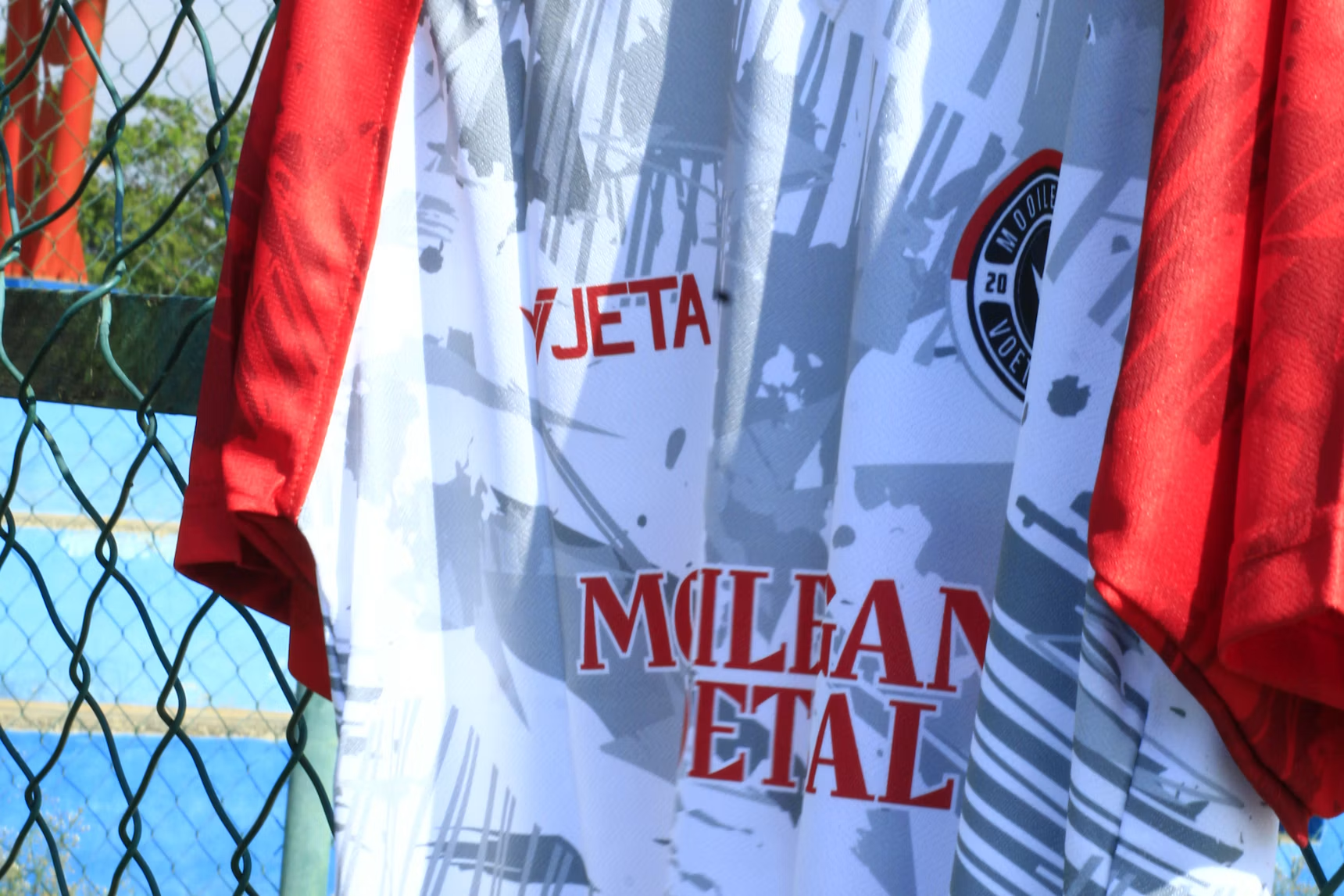
An all-over print can be made on a sewn white polyester garment that is laid on an oversized transfer in the heat press. No cutting or sewing is needed on this finished-garment route. Folds leave small unprinted marks. Garments with straight sleeves and narrow hems have fewer folds. Zippers and thick seams hold the transfer paper away from the fabric and leave gaps in the print.
The other all-over route is cut-and-sew sublimation, in which the design is printed onto fabric on the roll or onto flat pattern pieces before the garment is sewn. The print reaches the seams cleanly. Large blocks of strong color, common on team jerseys, show fold marks plainly and are normally printed this way.
You choose the fabric and the panel layout, and the sizes can go beyond stock ranges to youth cuts and 5XL. Cotton tees can have printed polyester sleeves. All-over sublimation is a good fit for polyester tops and dresses in boutique collections.
An all-over sublimation file has:
- a margin of artwork at least 5 cm (2 in) wide beyond the outline of the largest size
- a resolution of 150 to 200 pixels per inch (ppi) at the final printed size
Artwork for a 70 × 80 cm (27.5 × 31.5 in) front panel at 150 ppi measures 4,125 × 4,725 pixels. Seamless repeat patterns fit all sizes without rework. Single large graphics have to be scaled for the smallest and largest sizes.
Print feel
The printed area of a sublimated garment feels like the rest of the fabric and keeps its stretch and its ability to move sweat away from the skin. Polyester-spandex leggings and swimwear are sublimated for this reason. Large solid DTF prints sit on the shirt like sheets of plastic and keep sweat from evaporating under them. Logos and small chest prints in DTF stretch with the knit. Broad solid DTF areas crack when the knit is stretched further than the film can follow.
If you want a large print on a black performance tee, two routes are open:
- a white polyester shirt that is sublimated black all over except for the design
- a DTF blocker transfer on a stock black performance tee
The sublimated shirt stays as breathable as unprinted fabric. The paler yarns under the dyed face of the knit show as flecks of white on stretched areas. Solid black panels without print can be cut from fabric dyed black. The DTF print sits on the chest as film. Team kits justify the extra production steps of the sublimated shirt. A small merch order is simpler with the DTF tee.
Durability
Sublimated prints have no film to crack, and their colors hold through washing on 100% polyester. Wear on a DTF print appears in the film itself. Published wash counts for DTF come from companies that sell transfers or printers.
If you need proof of durability, you can request a lab report on decorated production garments. Minimum grades in the 2001 edition of ASTM D4154, a voluntary US specification for men's and boys' beachwear and sports shirt fabrics, are based on test methods of the American Association of Textile Chemists and Colorists (AATCC):
- laundering to AATCC 61, grade 4 for color change and 3 for staining of a white test cloth
- light to AATCC 16, grade 4 after 40 fading units of xenon-arc exposure
- perspiration to AATCC 15, grade 4 for color change and 3 for staining
- rubbing of prints to AATCC 116, grade 4 dry and 3 wet
These grades apply only when you and the supplier agree on them before the order. ASTM revised the specification in 2022. The revised edition is the one to name in a purchase agreement.
Personalization
Player names and numbers on a cut-and-sew jersey can be part of the panel artwork. Names printed this way add no weight to the back. The full roster has to be final before production starts. Spare jerseys for players who join later are sewn with blank backs. The names of late players are added to these spares as DTF transfers.
The heat of the transfer press can turn sublimation dye in a jersey back into gas and tint a DTF name. Names for sublimated jerseys are made as blocker transfers. Your supplier can test one name on an offcut of the printed fabric before the set is decorated.
Order size
DTF on stock blanks, the undecorated tees and hoodies in a supplier's catalog, is the simplest route for small orders and restocks. You can have transfers applied to single garments or to unsold stock from an earlier collection. Quotes for DTF depend on print size and the number of print locations. Garment styles are limited to what the catalog offers, and colors and sizes can sell out between orders.
For small orders of light-colored polyester tees, a design can be sublimated onto one area of the ready-made garment. Cut-and-sew sublimation pays off for larger orders of one style and for garments with a custom fit.
Sources
- GRAPHICS PRO, "Why Doesn't Sublimation Work on Cotton?" (2019)
- GRAPHICS PRO, "Sublimating to Colored Polyester Shirts" (2019)
- GRAPHICS PRO, "What Do Apparel Decorators Need to Know About Sublimation Transfers?" (2019)
- ASI Central, "Break Into All-Over Sublimation" (2017)
- Printweek, "DTG vs DTF" (2024)
- Özomay, M., and Z. Özomay, "The Effect of Temperature and Time Variables on Printing Quality in Sublimation Transfer Printing on Nylon and Polyester Fabric," European Journal of Science and Technology, no. 23 (2021)
- ASTM D4154-01, Standard Performance Specification for Men's and Boys' Knitted and Woven Beachwear and Sports Shirt Fabrics