Recycled Polyester Fabric Sources and Uses
Recycled polyester fabric is made from recovered polyethylene terephthalate, usually called PET. The material can begin as a used drinks bottle, polyester production waste, cutting-room scrap or an old textile. Once the PET has been recovered and prepared for fiber production, it can return as fine filament, textured yarn, spun staple fiber, hollow filling fiber or material for nonwovens.
Those forms end up in very different products. Fine filament works in sports jerseys, linings and lightweight fashion fabrics. Staple polyester can be spun for sweatshirts and fleece. Coarser filament appears in bags and footwear textiles. Hollow staple fiber fills quilts, cushions and insulated garments.
Polyester production reached about 82.5 million tonnes in 2025, equal to 59% of global fiber production. About 9.7 million tonnes of that polyester was recycled, putting recycled polyester at roughly 12% of total polyester production. Around 97% of recycled polyester feedstock came from plastic bottles. Textile-to-textile recycled fiber across all fiber categories reached only 0.76% of global fiber production. [1]
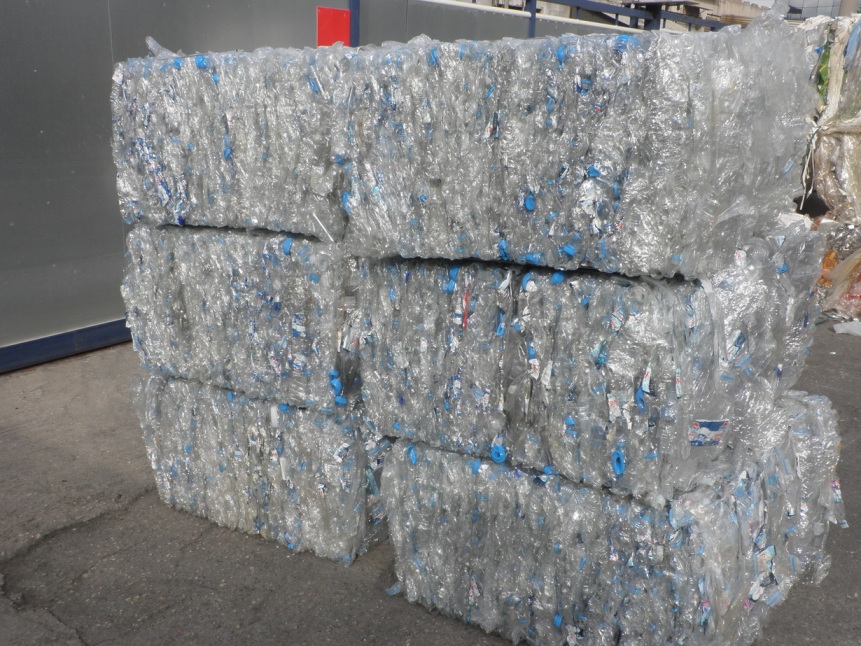
Where Recycled Polyester Comes From
Used PET beverage bottles supply most of today's recycled polyester. Water and soft-drink bottles have already reached an end user before collection, so the recovered PET falls under post-consumer material. Clear bottles are especially useful for textile production because they provide a relatively neutral starting color and can be collected in large volumes. [2]
Polyester waste also appears before clothing reaches a customer. Fiber production can generate rejected material or off-spec yarn. Knitting and weaving mills leave selvage, setup waste and rolls that fail specification. Cutting garment panels produces offcuts between pattern pieces. Qualifying material diverted from these waste streams can become pre-consumer recycled feedstock. Textile Exchange excludes routine rework, regrind or scrap that can simply be returned to the same process that generated it. [3]
Used textiles bring much more variation. A football jersey may have a predominantly polyester knitted body. Leggings commonly contain elastane throughout the fabric. A sweatshirt can use cotton and polyester in the same yarn. A rain shell may combine polyester fabric with polyurethane coating, adhesive, elastic and several trims.
Suitable PET packaging and industrial PET waste can also enter recycling when the material fits the recycler's sorting, cleaning and processing system. The exact source matters when a brand claims textile-to-textile recycling because post-consumer recycled polyester can come from a used bottle without any discarded clothing entering the process.
Why Plastic Bottles Still Supply About 97%
Bottle recycling begins with a fairly recognizable waste stream. Sorting equipment can identify PET containers and separate many of them by color. Labels, adhesive, caps, closure rings, dirt and drink residue still have to be removed, though these contaminants occur repeatedly in high-volume bottle-recycling systems.
Textile waste reaches recyclers with a much wider range of compositions. Cotton, nylon, acrylic, polyester, blends and stretch fabrics can arrive in the same collection. Dye systems vary. Coatings and membranes remain attached to some garments. Elastane can run through thousands of knitted loops, while cotton and polyester may already be mixed inside the yarn.
Color creates another practical restriction. Clear PET bottles give a spinner useful material for yarn that may later become white, cream or pastel. Dark textile waste already contains dyes or pigments from its earlier use, so recovering PET for very pale applications may require additional purification.
The scale difference is visible in the current market: recycled polyester reached about 9.7 million tonnes in 2025, and 97% of the feedstock still came from plastic bottles. [1]
From PET Flakes to Polyester Fiber
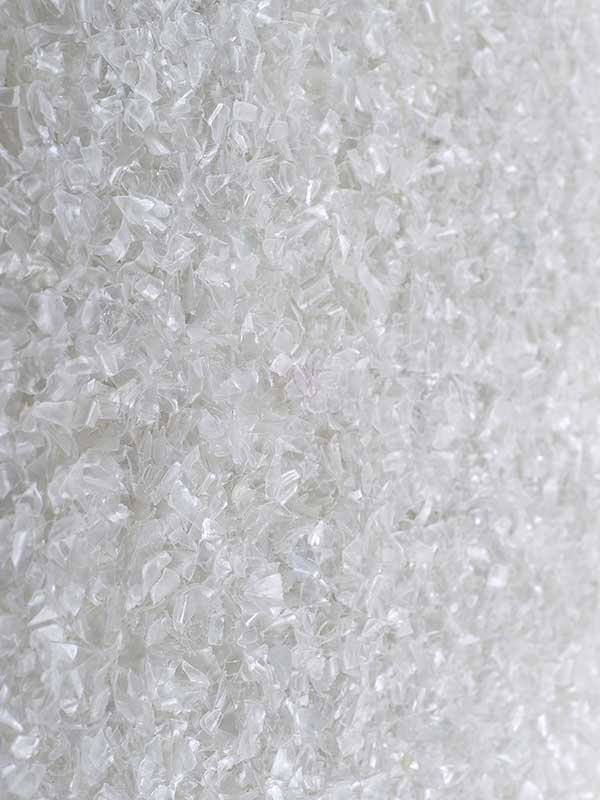
Collected bottles are sorted and reduced to flakes. Washing removes drink residue, adhesive, dirt and other surface contamination. Separation stages remove incompatible plastics from caps, labels and other components as far as the system allows.
PET has to be dried before melt processing. Moisture present at high temperature can promote hydrolytic degradation, shortening polymer chains and changing melt behavior. Drying conditions vary with the material and equipment, so commercial mills set their process around the incoming PET and the fiber they intend to make.

The prepared polymer is melted, filtered and pushed through small openings in a spinneret. Molten strands cool into continuous filaments and are drawn afterward. Drawing changes molecular orientation and fiber dimensions.
A published experiment using recycled PET prepared from white polyester fabric gives a concrete example of the conditions involved. Researchers tested spinning temperatures of 260°C, 270°C and 280°C, a 0.32 mm spinneret opening, throughput of 0.21 g per hole per minute, and take-up speeds of 500, 1,000 and 1,500 m/min. The resulting recycled fibers measured about 224.48 denier at 500 m/min, 58.99 denier at 1,000 m/min and 18.97 denier at 1,500 m/min. [4]
The study used specific equipment and recycled feedstock, so those settings belong to that experiment. They show how strongly spinning speed and processing conditions can change the fiber coming from the same general type of recycled PET.
Why Used Clothing Takes More Work
An 80% polyester and 20% elastane legging arrives with both polymers integrated throughout the knitted fabric. Shredding removes the garment shape and produces smaller material, with the elastane still mixed through the recovered fiber. Waistband elastic, sewing thread, labels and printed decoration add further components.
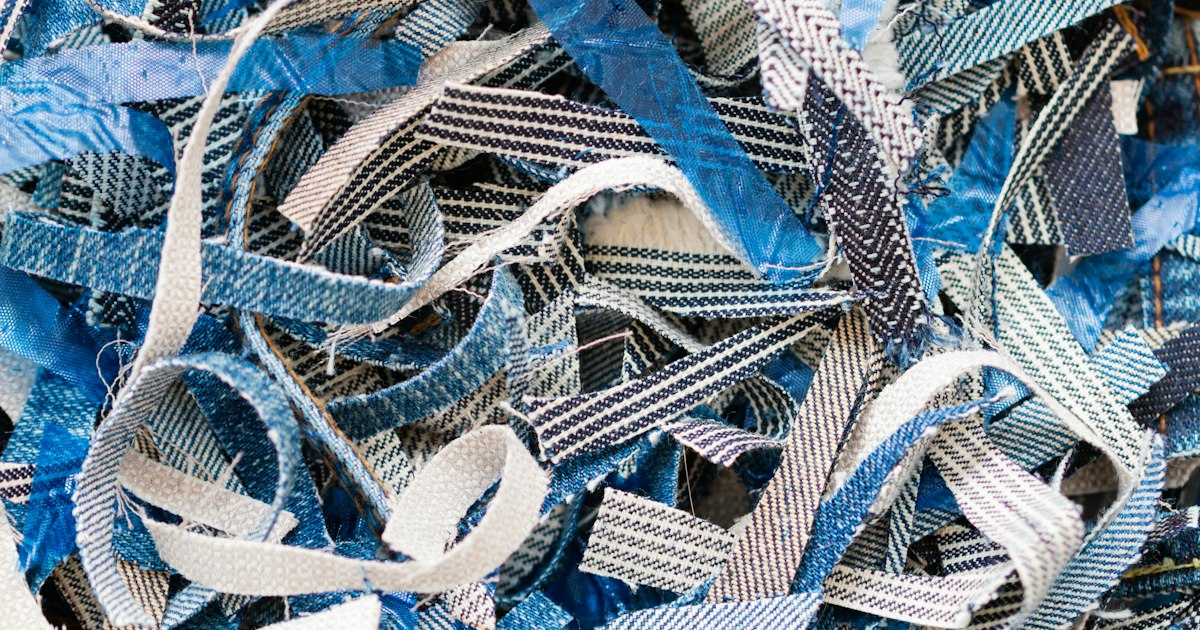
A poly-cotton sweatshirt presents another type of mixture. Cotton and polyester may have been blended before spinning, placing both fibers inside the same yarn. Mechanical opening can tear the fabric back into fibers, and that treatment also shortens them. Short, irregular recovered fibers are more difficult to spin into an even yarn than staple fiber produced to a controlled length.
Outerwear can arrive with polyester face fabric carrying polyurethane coating or a laminated membrane. Adhesive may join several layers. Zippers and hardware can be removed during preparation; materials spread through a coating, laminate or blend remain part of the recycling problem until a suitable separation or recovery process is used.
A collected garment therefore needs more than a polyester care-label entry before it becomes textile-grade recycled feedstock. Composition, color, attached materials and the condition of the polymer affect the recycling route available.
Chemical Recycling Can Recover PET From More Complicated Textile Waste
Glycolysis breaks PET chains into smaller compounds, including bis(2-hydroxyethyl) terephthalate, known as BHET. Purified BHET can return to polyester polymerization, which gives recyclers a way to work with material carrying colorants and additives that are difficult to deal with through simple washing and remelting.
A 2023 Green Chemistry study used waste polyester textiles containing different colors and additives. Decolorization, glycolysis and purification produced BHET yields of up to 89.2% with purity up to 99.7%. The purified material reached a reported whiteness value above 99.9 L* and was used to produce new polyester with properties comparable to polyester made from petroleum-derived BHET. [5]
The yield describes the amount of BHET recovered under that study's process conditions. Purity measures how much of the purified output was BHET. The L* result records how close the recovered material moved toward the light end of the color scale after the original textile color had been removed.
Hydrolysis, methanolysis and selective-solvent systems provide other routes for PET recovery. Commercial operation also depends on sorting, pretreatment, chemical recovery, purification equipment, energy use and the amount of usable material produced from the incoming textile waste.
The Fiber Made From Recycled PET Determines Its Next Use
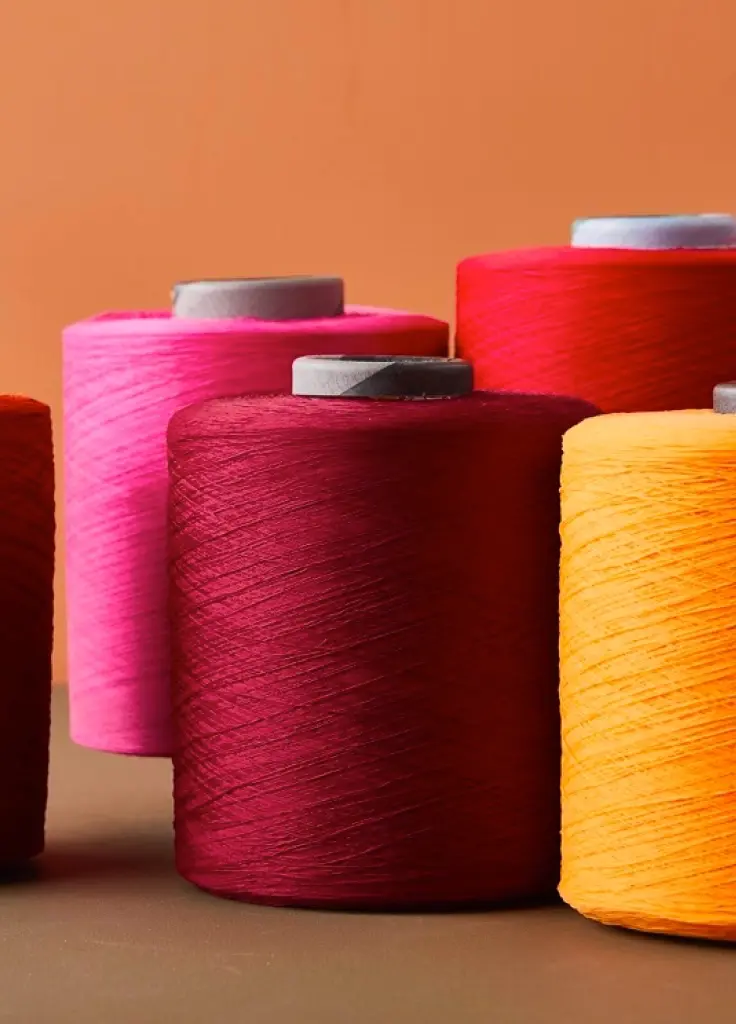
A sports jersey can use continuous polyester filament because the yarn can be made fine, smooth and suitable for dense jersey or more open mesh structures. Texturing introduces crimp and bulk where a different hand is needed. Polyester also works with disperse-dye sublimation, allowing graphics to be transferred into the fiber under heat.
Moisture movement in the jersey depends on the textile itself. Filament geometry, yarn structure, knit density, capillary spaces and finishing affect how liquid spreads and dries. Recycled content identifies the PET source and does not provide a wicking result.
Staple polyester enters another part of apparel production. Continuous material is cut to controlled lengths, then carded and spun into yarn. Sweatshirts, casual knits and polyester-cotton blends can use this route.
Some polyester staple is designed for filling instead of yarn spinning. Hollow cross-sections and crimp help the loose fibers occupy more volume and trap air. Pillows, duvets, cushions and padded garments use this material without turning it into conventional fabric first.
Nonwoven products use another manufacturing route. Fibers are arranged into a web and bonded mechanically, thermally or chemically. Padding, filtration, insulation and acoustic materials can use recovered fibers that would not be suitable for a fine apparel yarn.
Recycled Polyester in Sportswear
Team jerseys are a familiar example because polyester works well with disperse-dye sublimation. Under heat, the dye moves into the polyester fiber, allowing large graphics and complex colors without covering the whole jersey with a thick surface print.
The base fabric still has to be engineered for the garment. Knit structure determines how open the jersey feels. Yarn geometry and texturing affect the surface. Capillary spaces inside the textile influence liquid movement. A recycled-content percentage does not tell a buyer how quickly the fabric will wick or dry.
Stretch activewear adds elastane when high extension and recovery are needed. A legging made from 80% recycled polyester and 20% elastane has a different material structure from a 100% polyester team jersey, even though both may be marketed under the same broad recycled-polyester category.
Fleece Gets Its Character After Knitting
Fleece does not come out of the spinning line with its final soft surface. The mill first produces a suitable knitted fabric. Raising or brushing equipment then works over the surface and pulls fibers outward. The new pile increases loft and changes the hand feel and thermal behavior.

Yarn construction, knit density and brushing conditions all influence the result. Heavy brushing can make a fresh sample feel extremely soft, though surface stability still needs to be checked after laundering. Pilling and loose fibers become more visible once the raised surface has been exposed to repeated friction.
Fiber shedding can also be measured. A 2026 study of new 100% polyester fleece sweatshirts found first-wash releases of 2.82 ± 0.42 g of PET fiber fragments per kg of dry textile without detergent. Washing with powder detergent raised the first-wash result to 5.42 ± 0.58 g/kg. After repeated washing, the measured fragment mass fell sharply and stabilized at an average of about 204.7 mg/kg per cycle after the third wash under the study conditions. [6]
A separate test covering 37 consumer textiles recorded losses ranging from 9.6 to 1,240 mg/kg per wash. That spread shows why surface treatment and fabric construction matter so much when synthetic-fiber shedding is discussed. [7]
Outerwear, Bags and Footwear
Outerwear often uses woven polyester filament. Fine yarn can become lightweight taffeta or ripstop for windbreakers and packable shells. Calendaring changes the surface. Water-repellent treatments affect wetting, and coatings or membranes can be added where the final garment needs greater resistance to water penetration.
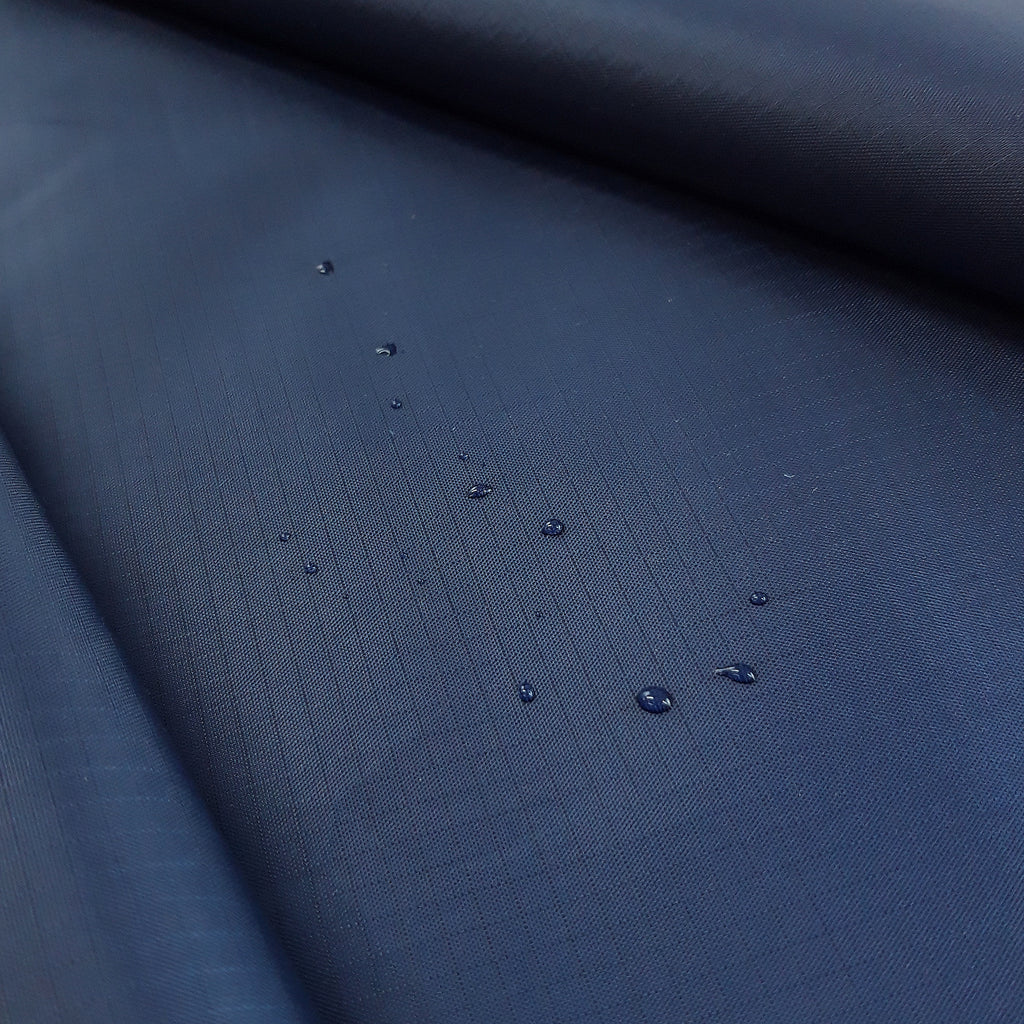
Yarn denier is often used in these specifications. One denier means that 9,000 meters of yarn weighs one gram. A 600D yarn therefore contains more mass per unit length than a 70D yarn.
Denier is not the same measurement as GSM. GSM records the mass of the finished fabric per square meter. Weave density, yarn count, coating and finishing all contribute to the final fabric weight.
Backpacks and luggage usually use heavier woven constructions than lightweight apparel. Development work may focus on abrasion, tear strength, coating adhesion and dimensional stability.
Footwear uses recycled polyester in smaller components such as mesh uppers, tongue fabrics, linings, webbing and laces. Foam, adhesive, reinforcement and outsole material are specified separately.
Recycled Polyester in Fashion Fabrics
Fine recycled polyester filament can also be used in satin, crepe and chiffon-style fabrics.

The smooth face of satin comes from its weave and filament structure. Chiffon-style materials use a much lighter construction. Crepe can gain texture from yarn twist, weave structure and finishing. Recycled PET provides the polymer; textile construction creates the final surface.
Color is especially important in pale fabrics. Mechanically recycled PET can retain some tint from its earlier use. Optical white, cream and light pastel shades therefore require closer control over the incoming material than dark navy or black.
Polyester also responds to heat setting, which makes it useful for pleated garments. Heat-setting can hold a defined pleat through normal wear and laundering when the fabric and finishing process are developed for it.
Filling and Nonwovens Do Not Need Conventional Fabric Production
Some recovered PET leaves fiber production as hollow staple. An internal void reduces the amount of polymer needed for a given fiber volume, while crimp helps the fiber mass hold air and recover after compression. Pillows, cushions, duvets and padded garments use these fibers as filling.
Nonwoven production can use polyester without spinning it into conventional yarn. Fibers are formed into a web and bonded mechanically, thermally or chemically. Padding, insulation, filtration and acoustic materials are among the possible outputs.
Mechanically recovered textile fibers that have become too short or irregular for fine apparel spinning can still have useful bulk, resilience or thermal properties in these applications.
What Testing Shows About Recycled Polyester Fabric Performance
Fiber origin alone cannot predict the finished fabric.
One study examined woven fabrics containing mechanically recycled polyester made from PET bottles. The recycled fiber used in the experiment had lower crystallinity and tensile strength than its virgin-polyester reference. Increasing the recycled-polyester content raised shear rigidity by about 24–44% and bending rigidity by about 9–26% in the tested fabrics. Air permeability and moisture-vapor permeability did not change significantly across the recycled-content levels studied. [8]
The result is specific to the fibers and woven constructions tested. Feedstock condition, polymer processing, yarn type, fabric structure and finishing all affect subsequent performance.
For production, that puts recycled content alongside the usual material checks. A sports fabric still needs the required stretch, recovery, pilling and colorfastness. Fleece needs wash and surface evaluation. Shell fabric may require tear, abrasion and water-performance testing.
RCS and GRS: What the Numbers Mean in 2026
Textile Exchange's Recycled Claim Standard and Global Recycled Standard are used to verify qualifying recycled material and maintain chain of custody through the supply chain.
The RCS is intended for products containing at least 5% recycled material. The GRS is intended for products containing at least 20% recycled material, with 50% recycled content required for eligible consumer-facing GRS product claims. GRS also includes social, environmental and chemical requirements for processing. [9]
Current versions RCS 3.0 and GRS 5.0 were published and became effective on July 1, 2026. They become mandatory on December 31, 2026, together with the revised Reclaimed Material Declaration Form requirements. [10]
Textile Exchange is also moving primary raw-material certification toward the Materials Matter Standard. That standard becomes effective on December 31, 2026. Eligible Tier 4 organizations may begin using it at that point, and it becomes mandatory for eligible Tier 4 audits on December 31, 2027. [11]
For a buyer, the paperwork needs to match the material being purchased. A supplier's general certification does not provide the pilling result, stretch recovery, shade tolerance or tear strength of a particular fabric. Those figures come from the fabric specification and its test reports.
What to Put on a Recycled Polyester Fabric Specification
Writing “100% recycled polyester” gives the factory a fiber-content requirement. Production still needs the construction that creates the actual fabric.
A filament jersey specification can state yarn size, filament type, texturing, knit construction, finished GSM and tolerance, usable width and finishing. Colorfastness, dimensional change and pilling should carry the required test method and acceptance limit. Sportswear can add stretch, recovery, moisture-management or sublimation requirements when they apply to the design.
Fleece needs the base knit, yarn, finished weight and brushing treatment recorded. The approved sample should be checked after laundering because raising changes the surface and can expose pilling or loose-fiber problems that are not obvious from an unused swatch.
For a woven shell, record yarn denier, weave, finished GSM, usable width, coating or membrane construction, strength and abrasion requirements. A water-performance claim needs the test method and target value used for bulk acceptance.
Feedstock information belongs in the same sourcing record. Bottle-derived post-consumer PET, qualifying pre-consumer textile waste and post-consumer textile waste identify different inputs. When a program specifically requires textile-to-textile recycled polyester, the material documents need to identify textile waste as the reclaimed source.
Sources
- Textile Exchange: Materials Market Report 2026
- Textile Exchange: Post-Consumer Material
- Textile Exchange: Pre-Consumer Material
- Polymers: Melt-Spinning Study of Recycled PET From Waste Polyester
- Green Chemistry: Closed-Loop Recycling of Waste Polyester Textiles
- Textiles: PET Fiber Fragment Release From Polyester Fleece During Washing
- Environmental Science and Pollution Research: Fiber Release From 37 Consumer Textiles During Washing
- Resources, Conservation and Recycling: Performance of Fabrics Containing Mechanically Recycled PET Fiber
- Textile Exchange: Standards FAQs for RCS and GRS
- Textile Exchange: Standards and Policy Updates
- Textile Exchange: Recycled Claim Standard, Global Recycled Standard and Materials Matter Transition