FashionMe · Materials
What Is Merino Wool
Merino wool is the fine wool grown by Merino sheep. Its fibers are made mainly from keratin protein, with microscopic cuticle scales covering the surface and a natural crimp running along the fiber.
Fiber diameter is a major reason Merino can be used in T-shirts, underwear and thin base layers. Fine wool bends readily when a fiber end presses against skin, so well-specified Merino can sit directly against the body without the prickly sensation associated with much coarser wool.
The name still covers a wide range of materials. A label reading 100% Merino wool gives the fiber composition, but it does not reveal the micron, diameter distribution, staple length, yarn route, yarn count, fabric weight, knitting density, shrink-resist treatment, pilling performance or dimensional change after washing. Those details are set earlier in the supply chain and remain visible in the finished garment.
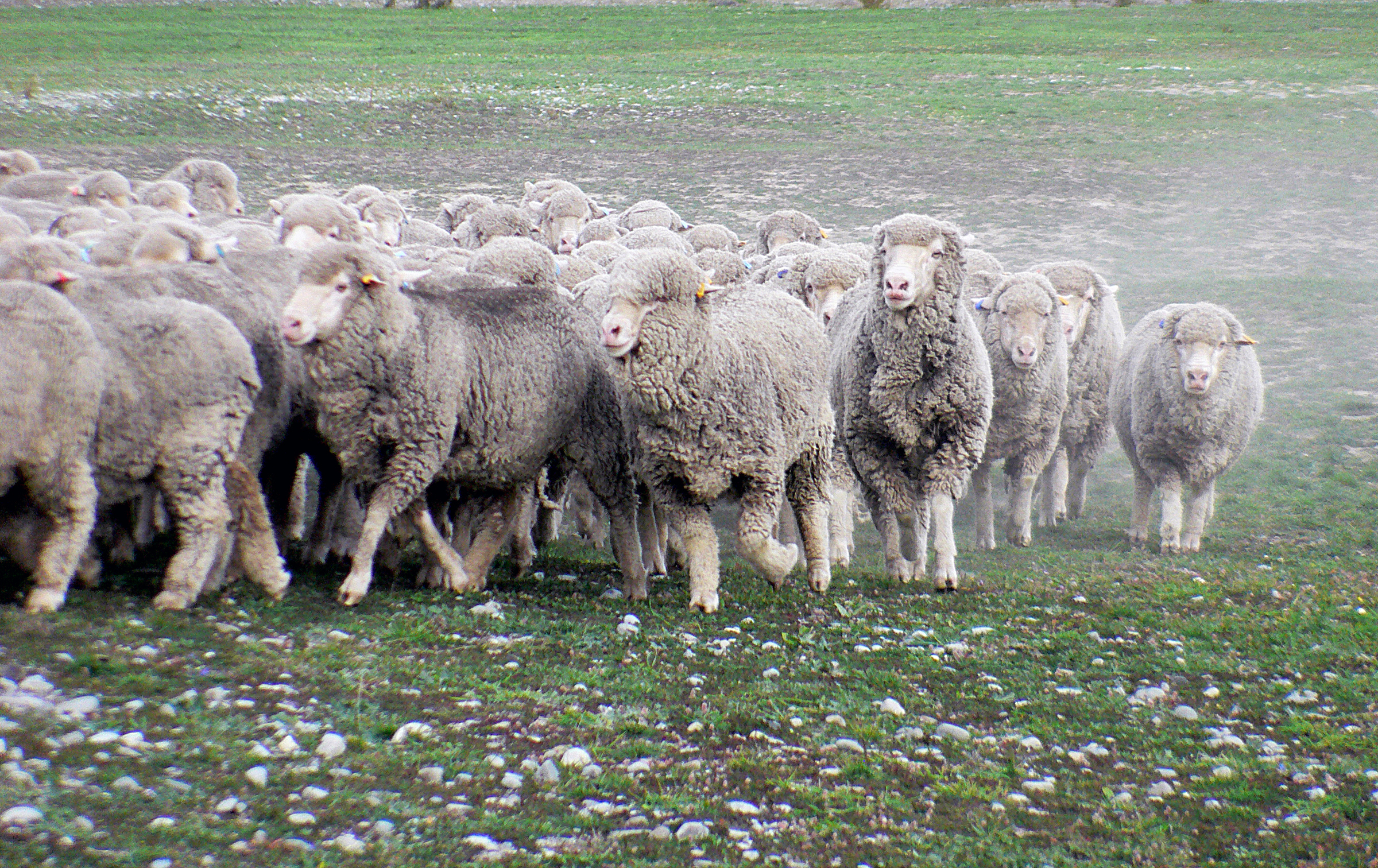
Where Merino Fits Within Wool
Wool is the broad fiber category. Merino identifies wool grown by Merino sheep, a breed selected over generations for fine fleece. Other sheep breeds produce wool with different typical fiber diameters, staple lengths, crimp and intended end uses.
Lambswool describes wool taken from a young sheep, commonly from an early shearing. It does not identify a breed on its own, so lambswool can come from Merino sheep or from another wool-producing breed. A label can therefore describe wool as Merino, lambswool, or both when the material meets both descriptions.
For clothing, the breed name is only the beginning. A fine Merino lot intended for a next-to-skin jersey is selected and processed differently from wool destined for a bulky sweater or dense outerwear fabric.
The Micron Number and Skin Contact
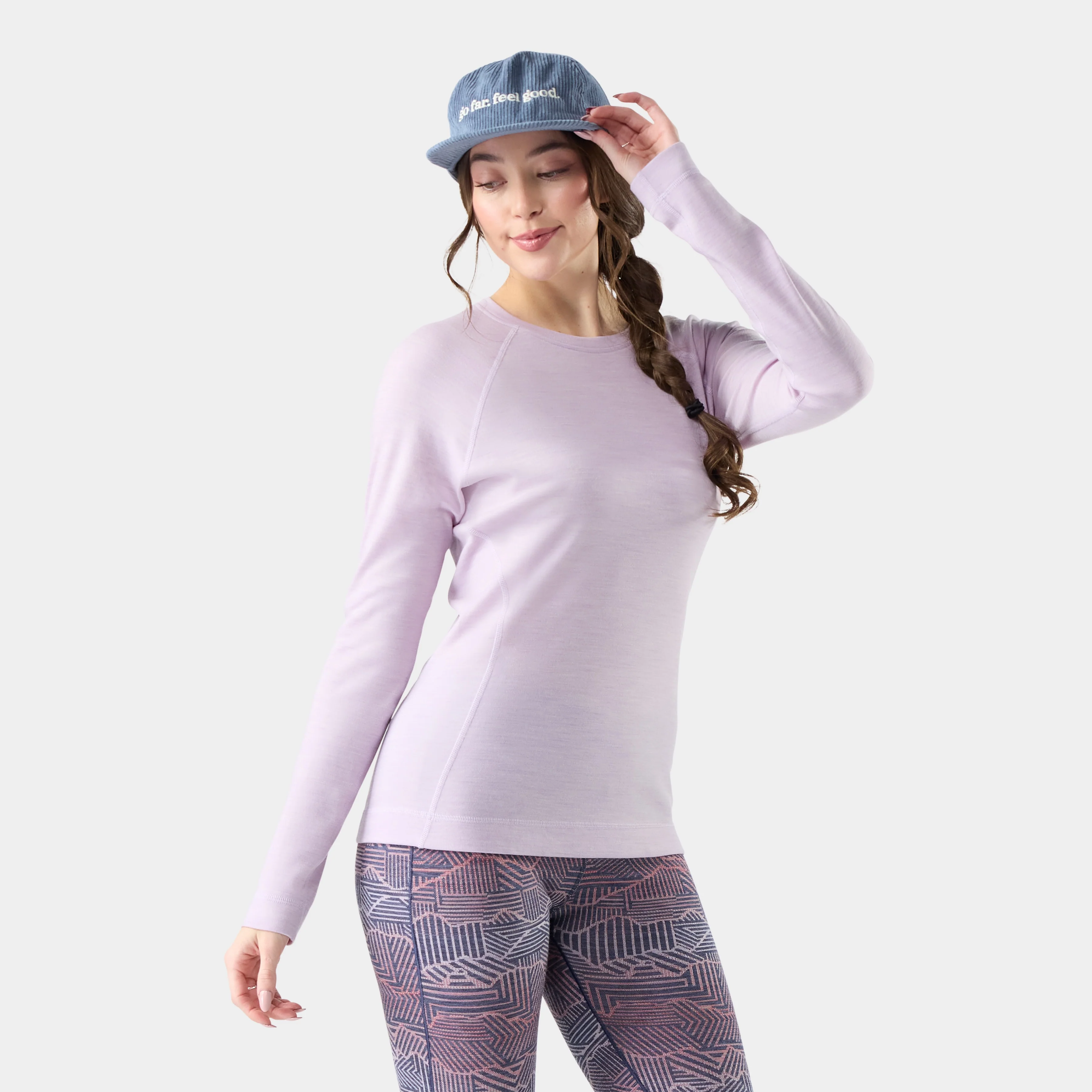
Wool diameter is measured in micrometres, written as µm and usually called microns. One micron equals 0.001 mm.
Very fine Merino used for underwear, base layers and fine knitwear is commonly below about 19.5 µm. Wool around 19.5–22 µm appears widely in sweaters and other apparel, while broader Merino grades can be used where continuous bare-skin contact is less demanding.
The physical effect of diameter has been tested directly. In one skin-contact study involving 24 girls with atopic dermatitis and a previous history of wool irritation, material containing 36 µm fibers caused more intense itching than material containing 20 µm fibers. A later review placed the main mechanical irritation problem around coarse fibers of roughly 30–32 µm and above.
The fiber becomes harder to bend as its diameter increases. A fine fiber can deflect when it presses into skin, which is why an 18 µm Merino jersey can behave very differently on the body from a coarse traditional wool knit.
A Micron Figure Is an Average
A wool lot specified at 18.5 µm does not consist of fibers that all measure exactly 18.5 µm. Natural fleece contains a distribution of diameters, and mills can examine that spread as well as the mean.
A 2024 study of Spanish Merino sheep reported an average fiber diameter of 22.21 µm. Individual mean values in the studied population ranged from 15.2 to 28.5 µm, while the average standard deviation of fiber diameter was 3.89 µm.
The study also recorded an average comfort factor of 95.66%, defined there as the proportion of fibers measuring below 30 µm. A mill working on next-to-skin clothing can therefore learn more from the diameter distribution than from a single headline number.
Fiber Length and Crimp
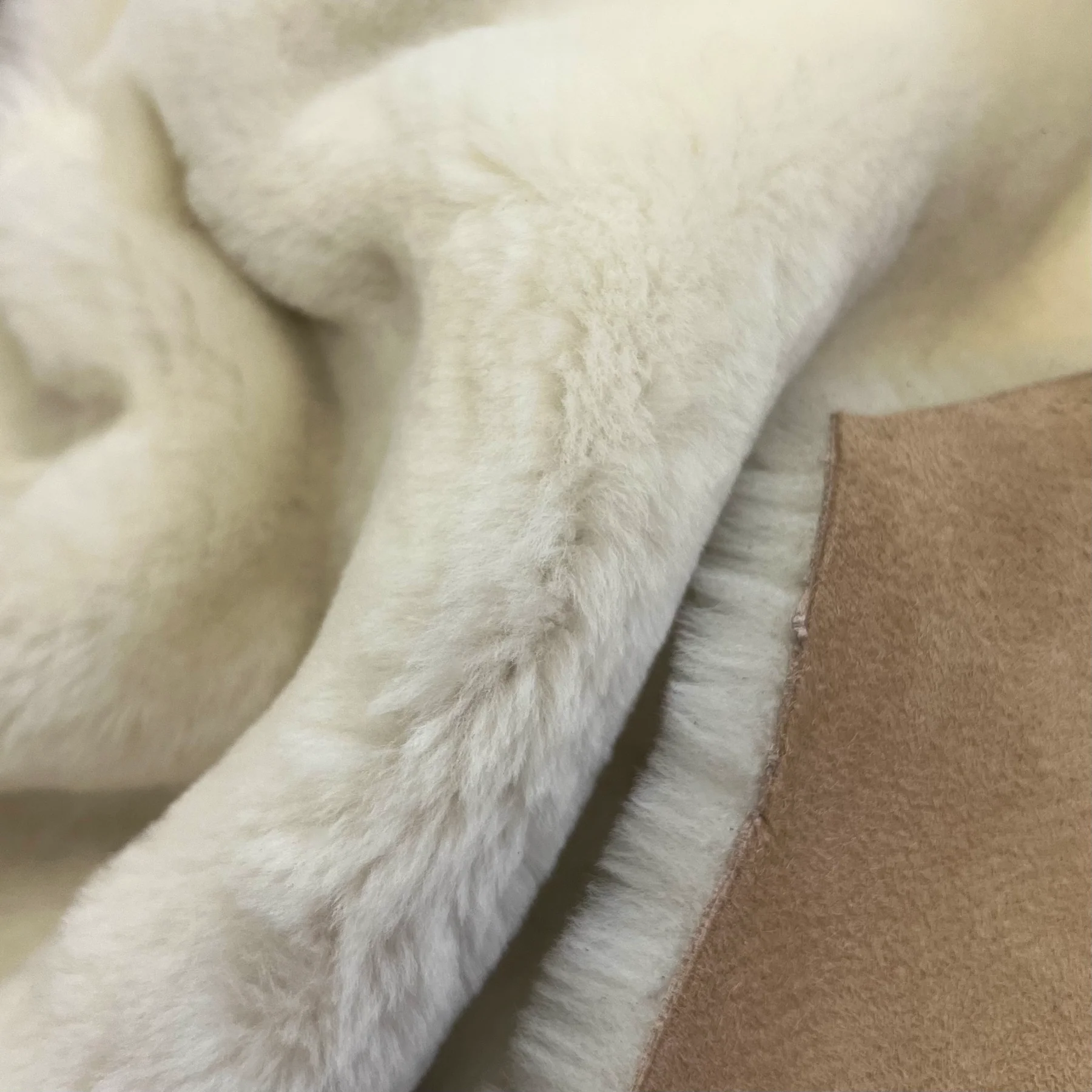
Staple length affects spinning even though consumers rarely see it on a product page. A study of 580 sheep from a commercial fine-wool Merino flock measured an average fiber diameter of 16.9 ± 1.2 µm and an average staple length of 77 ± 10 mm after roughly nine months of growth. Most staples in that flock measured around 65–90 mm.
Longer usable fibers provide more length to hold inside a yarn. When a yarn contains a high proportion of short fiber, more ends can reach its surface and contribute to hairiness, fuzzing and eventually pilling.
The same wool already has a three-dimensional shape before spinning. In the 17–18.5 µm group from that fine-Merino flock, manually assessed crimp averaged about 3.8 crimps per centimetre. A separate materials study recorded around 6.3 crimps/cm in superfine Merino and 5.9 crimps/cm in an ultrafine sample.
Crimp prevents loose fibers from settling into a completely flat mass. Yarn twist, fiber alignment and fabric construction later determine how much of that volume remains visible in the textile.
From Greasy Fleece to Clean Wool
Freshly shorn wool is usually called greasy wool. Along with wool fiber, the fleece contains grease, suint, soil, dust, sand and vegetable contamination. Typical greasy fleece can contain around 35–40% contamination by weight.
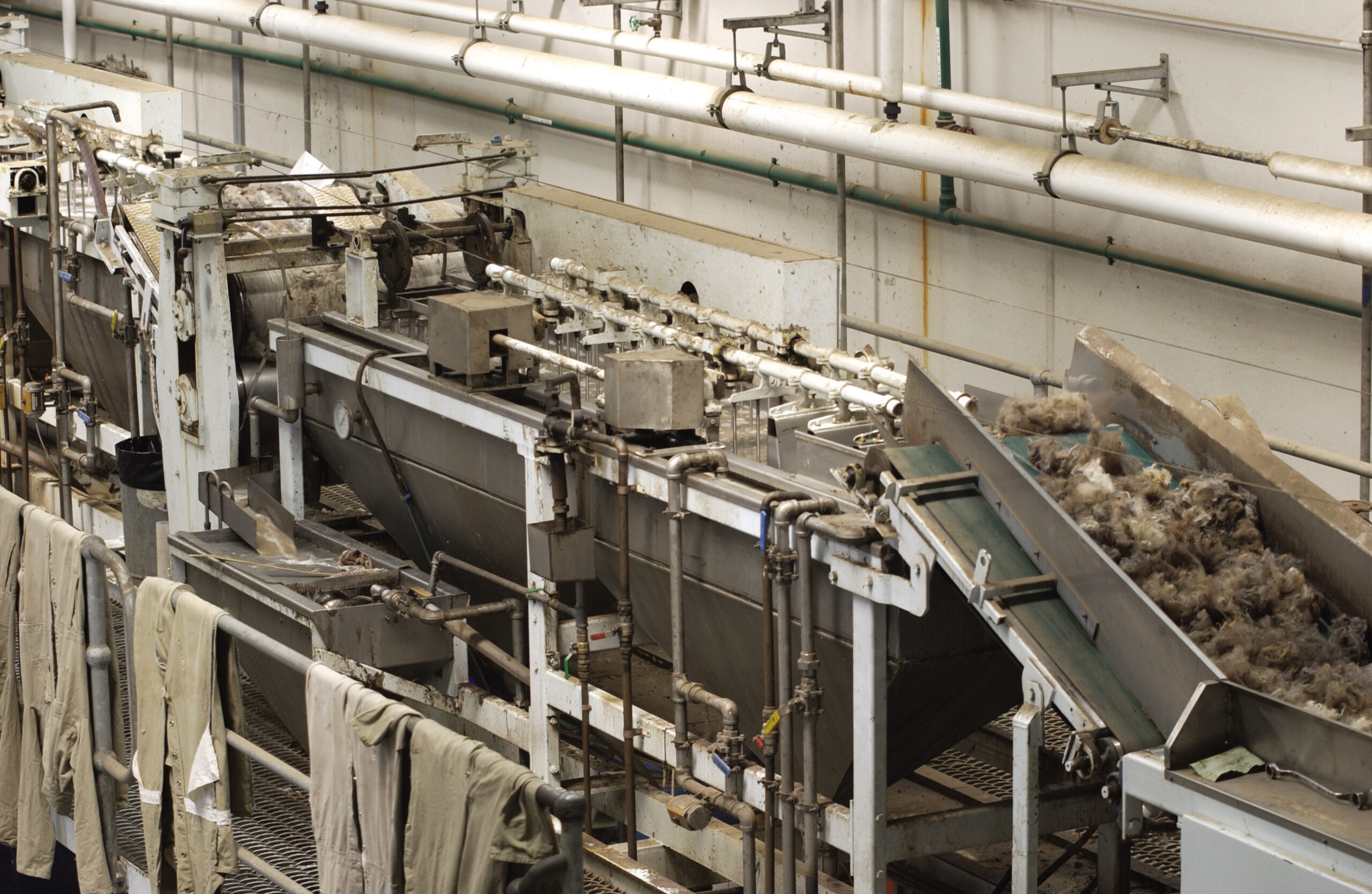
Industrial scouring commonly passes the wool through six to eight bowls. Warm water and detergent are used in the early stages, sometimes with alkali, followed by rinsing and drying. Wool entering later worsted processing may contain only around 0.3–0.5% residual grease by weight.
Some plant material remains trapped after ordinary washing. When vegetable matter is high enough to interfere with woollen processing, carbonising can be used. One industrial route applies approximately 6–7% weight/volume sulfuric acid and heats the wool to roughly 95–120°C. The cellulose becomes brittle enough to crush and remove mechanically before the wool is neutralised.
Most of the original grease has disappeared by the time Merino reaches yarn production, so the soft hand of a finished sweater should not be attributed to a heavy coating of natural lanolin remaining on the fiber.
How Merino Becomes Worsted Yarn
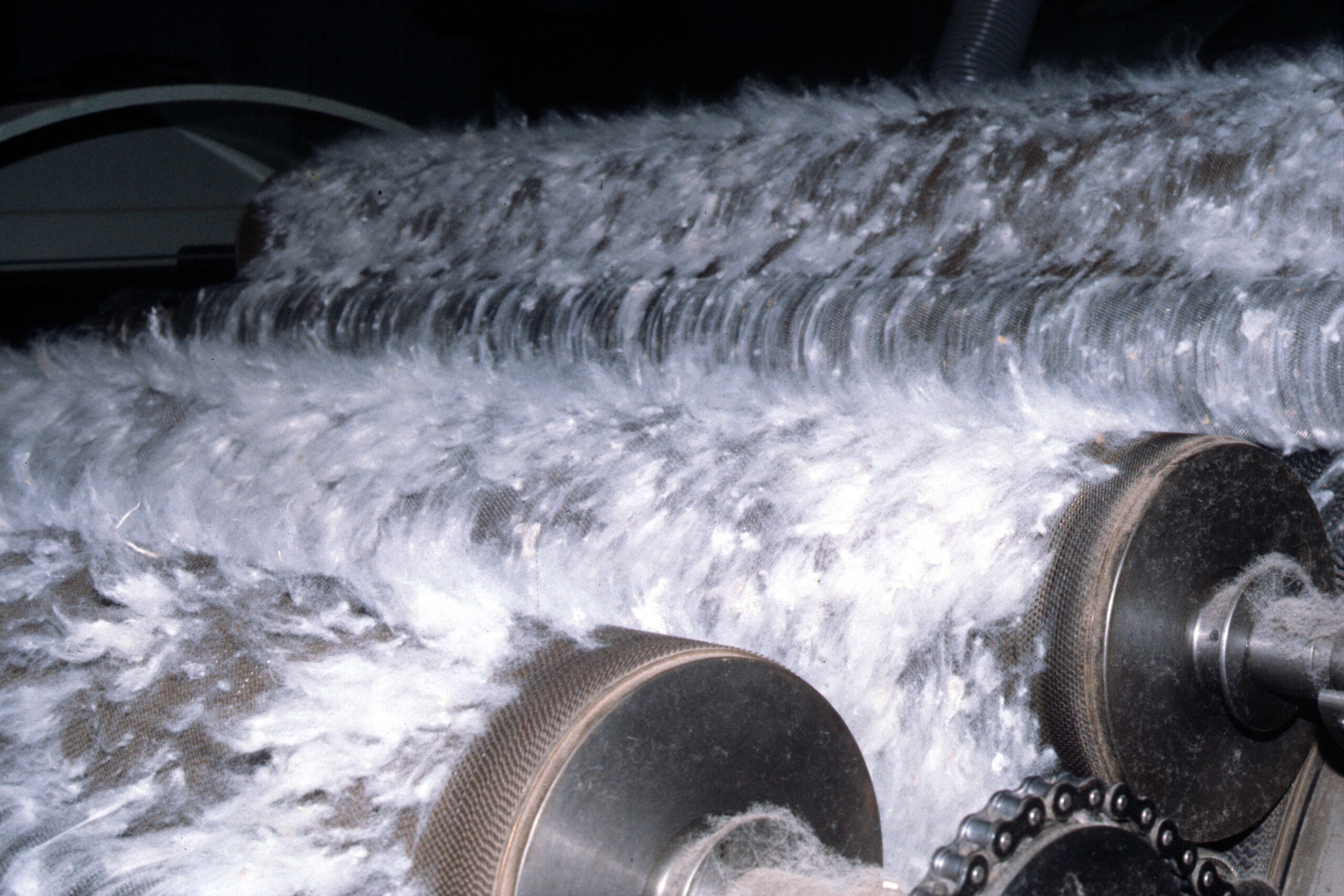
Scoured wool entering a worsted route first goes through carding, which opens tangled fiber masses and forms them into a continuous sliver. Gilling combines and draws those slivers, improving the general alignment of the fibers.
Combing removes short fibers known as noils, along with neps and additional vegetable contamination. The longer material continues as combed sliver and is prepared into wool top.
Drawing gradually makes the top finer before roving and spinning; industrial preparation can reduce its linear size to roughly one-fortieth of an earlier stage. A large proportion of the fibers are then lying in the same general direction inside the yarn.
Fine Merino jersey, lightweight sweaters and tailored wool fabrics can use this compact yarn structure when a cleaner surface is required. Fewer projecting fiber ends make individual knitted stitches easier to see and give woven fabric a flatter face.
What Changes in Woollen-Spun Yarn
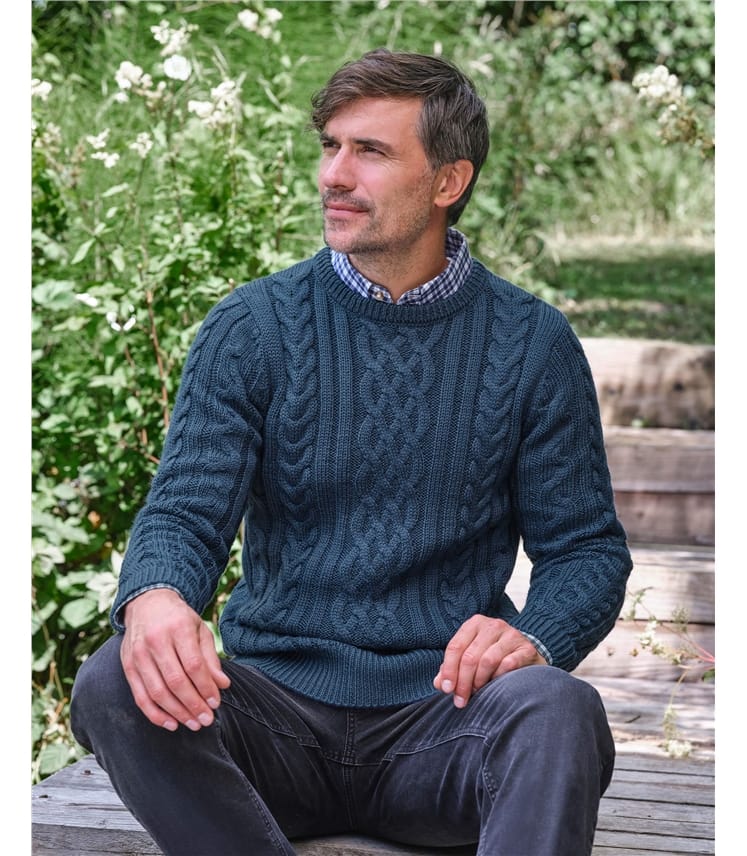
Woollen spinning does not take the fiber through the full combed-top preparation used for worsted yarn. After woollen carding, the web is divided into narrow strands for spinning with more random fiber orientation still present.
The yarn can hold more bulk and show more projecting fiber at its surface, which suits sweaters where loft and a visible wool halo are part of the design. This difference is already present before the yarn reaches the knitting machine.
A dense fine-gauge sweater made from compact worsted yarn can show sharply defined loops. A heavier woollen-spun sweater may look softer at the stitch edges because surface fibers partially obscure the loop structure.
Micron and GSM
A material specification might contain the line:
17.5 µm Merino · 180 GSM single jersey
The 17.5 µm figure is the mean fiber diameter. 180 GSM means that one square metre of the finished fabric weighs 180 grams.
A mill can keep the wool supply at 17.5 µm and produce a lightweight jersey, then use another yarn count, stitch density or loop length to make a much heavier fabric. Ply, knitting construction and finishing also change the amount of material carried in each square metre.
For development work, micron belongs in the fiber specification and GSM belongs in the finished-fabric specification. Neither figure can be calculated reliably from the other.
Measurements From Finished Merino Fabric
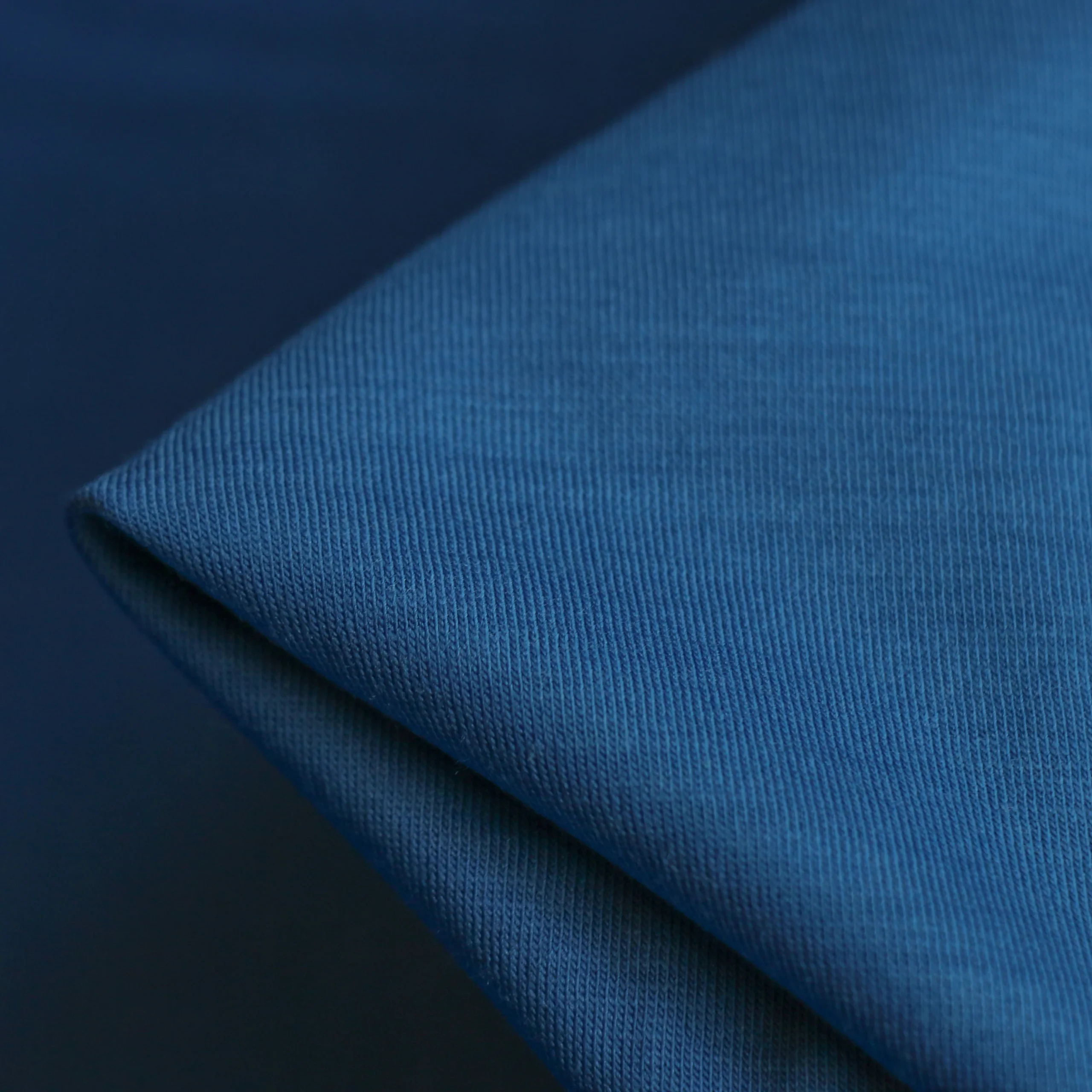
Two commercial 100% Merino fabrics from the same product family were measured at approximately 131 g/m² and 267 g/m². Their laboratory results show how far two fabrics can move apart after the fiber has been turned into yarn and cloth.
| Test | 131 g/m² Merino | 267 g/m² Merino |
|---|---|---|
| Air permeability | 1518 mm/s | 1085 mm/s |
| Thermal resistance, Rct | 0.0225 m²K/W | 0.0451 m²K/W |
| Water-vapour resistance, Ret | 3.04 m²Pa/W | 5.39 m²Pa/W |
| Lengthwise breaking load | 180 N | 270 N |
| Crosswise breaking load | 69 N | 160 N |
| Lengthwise elongation | 48% | 74% |
| Crosswise elongation | 228% | 300% |
| Bursting resistance after five washes | 87.5 kPa | 142 kPa |
The heavier construction contained more material per square metre and recorded a thermal resistance of 0.0451 m²K/W. Its air permeability measured 1085 mm/s. The lightweight fabric recorded 0.0225 m²K/W and 1518 mm/s.
Fiber content alone cannot supply these values because they are properties of the finished textile.
Moisture Inside Wool
Merino is hygroscopic, so water vapor can enter the fiber structure rather than remaining only in the spaces between yarns. Wool can take up moisture equivalent to roughly 35% of its dry weight before it begins to feel wet and cling to skin.
During wear, this gives moisture another place to move when humidity rises inside a base layer. A soaked garment carries considerably more water because liquid is also held between fibers, inside yarns and through the knitted structure.
That added wet mass is relevant when drying sweaters. Suspending a water-heavy knit from a narrow hanger concentrates the load around the shoulders, where the structure can lengthen or develop hanger marks. Flat drying distributes the garment over a much larger supporting area.
Heat Released During Wetting
A 2026 laboratory experiment examined finished wool, cotton, viscose and polyester fabrics at 23°C using isothermal microcalorimetry.
One untreated 100% Merino single jersey weighed 213 GSM and measured 0.69 mm thick. Its construction contained 14 wales per 10 mm and 16 courses per 10 mm, with air permeability measured at 99 cm³/s/cm².
A second 100% Merino single jersey treated with a hydrophilic softener weighed 188 GSM. It was also 0.69 mm thick and recorded 93 cm³/s/cm² air permeability.
The wool samples produced the highest measured heat release during wetting among the materials in that experiment. The test used finished fabrics, so fabric mass, porosity and finishing were already part of the measured samples.
A 30°C Merino Wash Test
A 2026 study produced Merino single-jersey panels on a 5-gauge Brother K950i knitting machine. Reference marks were set 125 mm apart before laundering.
The samples went through a 59-minute domestic wash at 30°C, followed by a 1000 rpm spin and 48 hours of flat drying.
After laundering, the benchmark fabric changed by roughly −2% in the course direction and −7% in the wale direction. Linked seams changed by approximately −5% in the measured directions.
One coursewise benchmark moved from about 125.44 mm to 122.54 mm during the reported measurement sequence. A walewise benchmark moved from approximately 119.49 mm to 115.82 mm.
Those numbers are tied to the specified knit, wash cycle, temperature, spin speed, drying method and direction of measurement.
Shrinkage Needs Test Conditions
A separate commercial 131 g/m² Merino fabric was tested using ISO 6330 procedure 4N at 40 ± 3°C. Its technical data recorded lengthwise dimensional change below approximately −15%, while crosswise movement was around ±3%.
The 267 g/m² construction from the same product family recorded dimensional change below −5% in both stated directions under the listed procedure.
A specification that only says “5% shrinkage” leaves out information needed to interpret the result. Production records normally attach the direction, wash procedure, temperature and drying conditions to the percentage.
Stretch and Recovery
The 2026 Merino single-jersey study also measured extension after laundering. Benchmark fabric reached approximately 75% coursewise elongation and 63% walewise elongation.
Growth-and-recovery testing recorded around 5% coursewise growth, followed by about 1% residual growth. Walewise growth was close to 3%, with approximately 3% remaining in the reported test.
Knitted loops account for a large part of this movement because they can rotate, straighten and open under load. Wool fibers themselves can also extend substantially; controlled fiber testing has recorded breaking elongation around 40–50% across wool samples under laboratory conditions.
How Felting Changes a Sweater

Untreated wool fibers carry microscopic scales on their surfaces. In water, mechanical agitation allows the fibers to move through the textile, and directional friction at those scales encourages gradual migration into neighboring yarns and loops.
As the fibers become more entangled, the knitted structure contracts. A badly felted sweater can come out of laundering shorter and narrower, with a firmer surface and greater apparent thickness because more fiber has been packed into less area.
Severe felting physically rearranges the fiber network. Drying the garment again does not restore the original loop dimensions.
Machine-Washable Merino
Merino intended for easier laundering can receive a shrink-resist treatment before the yarn reaches the finished garment.
One established commercial route is the Hercosett process. A chlorine pretreatment modifies the scale surface, after which a polyamide-epichlorohydrin resin is deposited on the fiber. The modified surface restricts the migration that drives felting during washing.
Superwash is used for wool meeting machine-wash shrink-resistance requirements. Hercosett is one commercial process used to produce that performance; other treatments, including chlorine-free systems, are also available.
The final care instruction is assigned to the finished product because yarn treatment, knitting, seams, trims and finishing are all present when the garment is tested.
Mercerised Merino
Mercerised Merino receives another type of fiber-surface modification. In one commercial process, much of the original scale structure is removed and a thin silicone-polymer layer is grafted onto the wool.
An 18.5 µm starting fiber remains an 18.5 µm fiber when its diameter is measured. The smoother surface changes the way it feels against skin and fingers, with reported perceived softness comparable to using wool roughly 2–3 µm finer.
The treatment can also alter sheen, surface smoothness and drape.
Pilling in Fine Merino
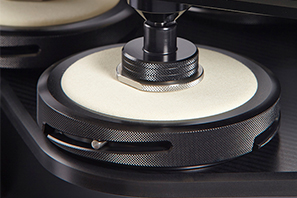
A low micron does not prevent a knitted garment from pilling. Pills develop after loose fibers work out of the yarn and repeated rubbing tangles them together on the fabric surface.
Fiber length affects how many loose ends are available. Yarn twist changes how firmly those fibers are held. Knitting density, finishing and the amount of friction in use also influence what happens at the surface, which is why underarms, elbows and bag-contact areas often show wear first.
In an ISO 12945-2 test, a commercial 100% Merino fabric weighing about 131 g/m² received Grade 3–4 after 2,000 cycles. A heavier 267 g/m² Merino fabric from the same product family received Grade 3 after 2,000 cycles.
Abrasion and Merino Socks
The same commercial fabrics were tested for abrasion under EN ISO 12947-2 at 9 kPa. The 131 g/m² construction reached its first yarn break after more than 11,000 cycles. The 267 g/m² fabric exceeded 40,000 cycles before first yarn break.
A sock heel experiences a concentrated combination of pressure, flexing and friction inside footwear. Fine Merino can supply the wool component of the fabric, while nylon is often added to reinforce high-wear zones and elastane helps the sock recover around the foot and ankle.
Modern sock knitting does not require every yarn to be distributed evenly through the garment. Reinforcement can be concentrated in the heel, toe or footbed while other areas retain a different yarn mix.
Merino and Odor
Claims about Merino odor resistance are more useful when the experiment behind them is known. A 2024 study exposed wool, polyester, nylon, cotton, mercerized cotton and viscose yarn bundles to synthetic sweat containing selected volatile odor compounds.
The headspace was measured after 30 minutes, 3 hours and 24 hours. For diacetyl, wool produced a mean signal of approximately 25,775.9 ncps at 30 minutes, 1,101.4 ncps at 3 hours and 17.5 ncps at 24 hours. Several carboxylic-acid measurements also showed low release from wool during parts of the experiment.
The study used controlled yarn bundles and synthetic sweat. It provides information about how selected odor-related molecules interact with wool without establishing a universal number of days that a Merino shirt can be worn before washing.
What Belongs on a Merino Fabric Specification
“Premium Merino” cannot tell a mill enough to reproduce a material.
For a next-to-skin garment, a working specification can record mean fiber diameter, diameter variation where required, staple or top information, spinning route, yarn count, ply, twist, knitting construction, finished GSM and usable width. Courses and wales can also be controlled where the fabric structure needs them.
Finishing belongs on the same record. A shrink-resist or Superwash treatment changes laundering behavior, while other surface treatments can change hand and appearance.
Dimensional-stability data needs its wash procedure, temperature, drying method and direction of measurement. A pilling result needs the test method, cycle count and grade. Abrasion testing needs the pressure and the endpoint used to define failure. Bursting or tensile strength, colorfastness and agreed manufacturing tolerances can be added according to the garment.
17.5 µm / worsted / 180 GSM single jersey / shrink-resist treated
That line begins to describe material a development team can actually source and test.
Merino in Finished Clothing

A lightweight base layer usually combines fine wool with a smooth knitted construction because much of the garment remains against bare skin. Low fabric weight reduces bulk under another layer, while the final stretch and recovery come from the yarn and loop structure used in the jersey.
Fine-gauge sweaters can use compact worsted yarn when clearly defined stitches and a smoother surface are wanted. Heavier woollen-spun sweaters make use of more bulk and exposed fiber, producing a fuller hand before additional brushing or raising is considered.
Merino is also used in woven trousers, jackets and suiting. Fine worsted yarn gives those fabrics a flatter surface than a lofty woollen knit and allows the cloth to be pressed into tailored shapes.
Socks introduce another requirement because the heel and forefoot repeatedly rub against footwear. Merino is commonly combined with reinforcing fibers in those zones, with elastane added where recovery around the foot or cuff is required.
Heavy outerwear can build mass through thicker yarn, greater fabric density, milling and raised finishes. The resulting coat fabric may share its fiber source with a thin Merino base layer while having a completely different weight, structure and surface.